

That makes two versions of the same job, and there's a written standard for choosing between them. Four questions at the counter turn a recommendation into a measurement.
On this page
What brake pads cost in 2026, before anyone mentions rotors
| Source | Pads only, per axle | Pads and rotors, per axle | What it leaves out |
|---|---|---|---|
| AAA Automotive | $150 to $350 | $250 to $500 | Says a mechanic measures thickness, not what the limit is or where it's marked |
| CARFAX | $150 to $300 | Not given per axle | Mentions resurfacing once, as a way to save money |
| eBay Motors | $150 to $300 | $600 to $1,000 | Says the rotor needs enough material left, never the number |
| Jiffy Lube | No pads-only total | No pads-and-rotors total | Lists rotors at $30 to $75 each and labor at $90 to $200 an hour. Tax and other inclusions are not stated |
| Our cost profiles | No pads-only figure | No pads-and-rotors figure | $132 to $303 is typical across all brake-service scopes. Tax and inclusions are not stated |
The pads-only prices barely disagree, but tax and shop fees may still sit outside them. Rotor replacement cost is where the guides split, and that gap is where your money goes.
Inside any one range, a few ordinary things move your number. AAA notes that a small sedan takes smaller, cheaper pads than a large SUV. eBay Motors says ceramic pads usually cost the most of the three common types, and front brakes cost more than rears because they do most of the stopping. Then there's the shop's labor rate.
Pads only, per axle, and what our own cost profiles show
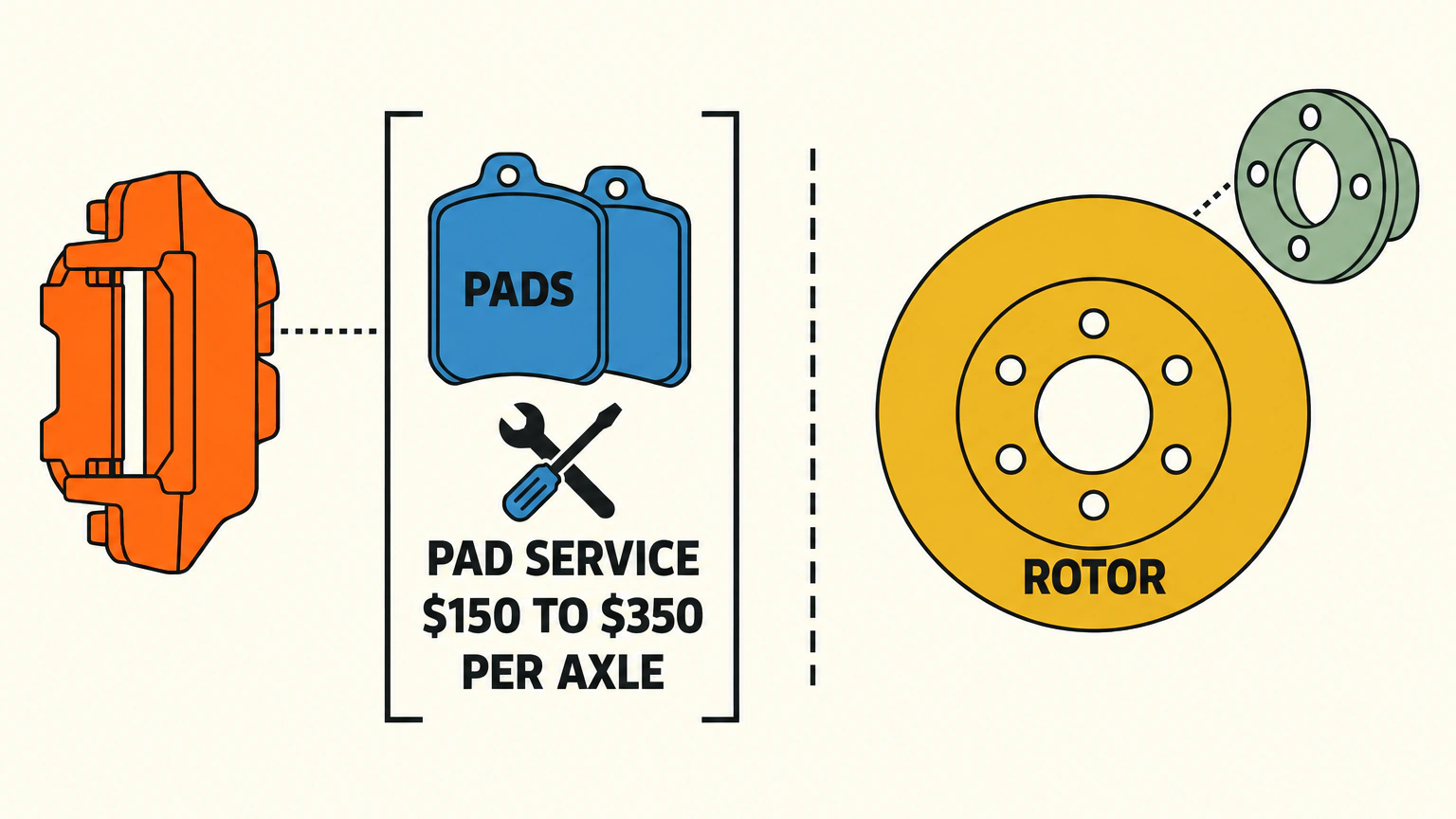
For pads alone, the three guides that price it land in nearly the same spot: $150 at the bottom and $300 to $350 at the top, per axle. Doing the whole car roughly doubles that. AAA puts front and rear together at $300 to $700. CARFAX says $300 to $600 for the vehicle, with the bill split about half parts and half labor.
Our own numbers tell a similar story. Our cost profiles for brake work, 777 of them, put the usual job between $132 and $303. We price that category page to a location, so read that as one snapshot, not a fixed line for the whole country. The range starts a little under the pads-only guides. It tops out just past the point where AAA's pads-and-rotors range begins.
What does that suggest? Our usual brake-service range overlaps the published pads-only bands. CARFAX says rotors usually outlast the pads they work with.
Why one shop says $180 and the next says $600
A gap that size usually comes down to two things, and the bigger one is scope. One shop quoted pads. The other quoted pads and rotors. Nobody said it out loud, so one shop looks cheap and the other looks greedy, when they actually priced different jobs. Before you compare brake job cost between two shops, find the word "rotor" on each estimate.
The second thing is labor. Jiffy Lube puts brake labor at $90 to $200 an hour, and eBay Motors says dealerships tend to charge the highest rates. Plenty of shops don't bill by the clock, either. The FTC explains that some charge a flat rate, based on a published estimate of how long the job should take, while others charge for the time the technician actually spent. If the hourly rate is the part that stings, we've laid out what shops charge per hour and why it swings so much.
AAA says a standard pad job takes about an hour per axle, so even Jiffy Lube's full spread of labor rates moves that job by about $110. Rotors can move it by several hundred.
The question that doubles the bill: do you need rotors too?
This is where the quote gets expensive, and where good shops genuinely disagree. You don't have to settle that argument on gut feel, though. The repair industry wrote down how the call is supposed to be made.
What the industry's own inspection standard says
The Motorist Assurance Program, run by the Automotive Maintenance and Repair Association, publishes the Uniform Inspection and Communication Standards. Shops that join MAP use them to inspect your car and explain what they found. Its brake standard is plain about rotors: "Friction material replacement does not require rotor reconditioning unless other justifications exist."
Friction material means your pads. Reconditioning means machining or sanding the rotor. Translated, new pads on their own are no reason to touch the rotors. The same section adds, "It is not necessary to replace rotors in axle sets."
Now read Jiffy Lube's brake replacement cost page. It warns that new pads on worn rotors can cause vibration, then sums up: "So, plan to purchase new pads and new rotors together."
That's a service recommendation from a chain that does brake work. MAP's line is an inspection standard. Both can be sincere. Only one of them ties the decision to something a technician found on your car.
One more thing about MAP shops. They agree to a pledge that promises written recommendations, a written estimate, and no work without your prior authorization.
The number stamped on your rotor, and who reads it
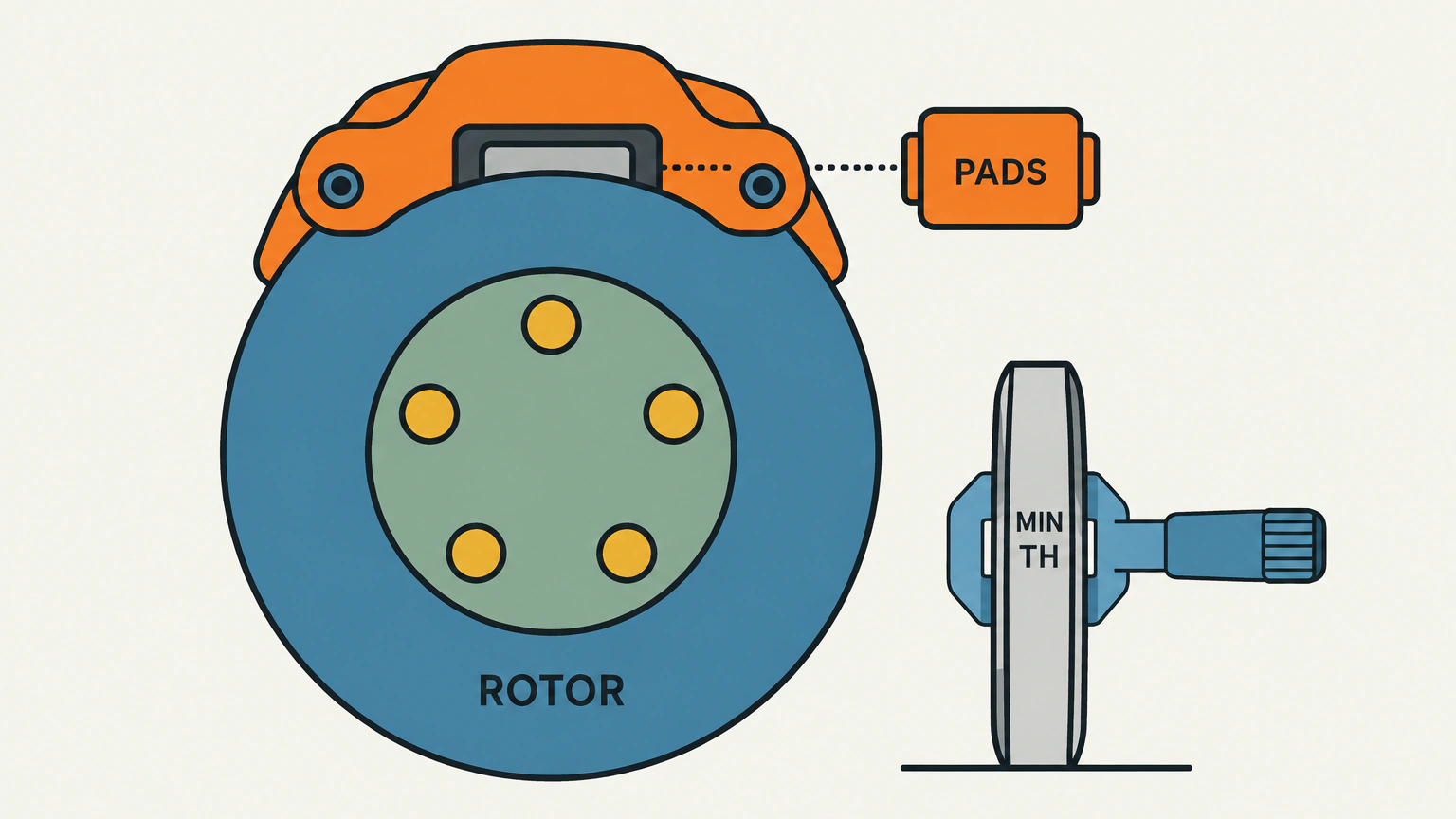
Your rotors almost certainly carry their own limit, usually in millimeters. It's the minimum thickness the rotor is allowed to wear to. The federal criteria that state inspection programs test against lean on exactly that figure, and they say it's found on vehicles built since January 1, 1971. If a rotor is "embossed with a minimum safety thickness dimension," it has to be within spec. If it isn't marked, it has to meet the maker's specification.
Those criteria also call for pulling at least one front and one rear wheel to check. They're a benchmark for state inspections, not a rule aimed at your shop, and whether your state inspects brakes at all is its own call.
Many vehicles have a second number, too. The discard spec is the point where the rotor is finished. The machine-to spec sits above it, and it's the thinnest a rotor can be left after resurfacing. If machining would take a rotor under that line, it has to be replaced.
A technician reads the thickness with a rotor micrometer, in more than one spot, with the wheel off. You won't be doing this in your driveway, and you don't need to. The point is knowing the measurement exists, so you can ask what yours came out at. If your wheels are already coming off at a tire shop for new tires, that's a good moment to ask for the reading.
Required or suggested, and why that one word matters
| What the shop finds | Code | What the standard says to do | What that means for your bill |
|---|---|---|---|
| Measured thickness is under the maker's discard spec | B | Require replacement | Rotors are not optional here. Expect the pads and rotors price. |
| Thickness would fall under the machine-to spec after machining | B | Require replacement | Resurfacing is off the table, so new rotors it is. |
| On a vehicle with an OEM machine-to spec, thickness is under it but over discard and no machining is needed | 1 | Suggest replacement | Your call. Pads only is a legitimate answer. |
| Lateral runout, the wobble, exceeds the maker's spec | B | Require re-indexing, reconditioning or replacement | Something must be done, but replacement is one of three routes. |
| Thickness varies around the rotor, past the maker's spec | B | Require reconditioning or replacement | Two routes again. Ask which one you are quoted. |
| Surface is scored | B | Require reconditioning or replacement | Machining may be enough. Ask which the shop is quoting. |
The codes are the standard's own. B means the part no longer meets a design specification. 1 means the part is close to the end of its useful life.
MAP sorts every finding into one of two words. Required means the part no longer does its job, doesn't meet the maker's design spec, or is missing. Suggested covers a part near the end of its life, something you asked for, the maker's maintenance schedule, or a technician's informed judgment. MAP's consumer page is blunt about it: "Suggested services are always optional."
The in-between case is the one worth memorizing. Some makers publish a machine-to spec. When that number sits above discard, a rotor that's below machine-to but needs no machining only earns a suggestion. Ask which word applies to your rotors and the conversation moves from persuasion to evidence.
The findings that genuinely call for new rotors
Now the fair-minded half. Some findings put the shop squarely in the right, and arguing with them wastes your time.
Thinner than the discard spec
Below the discard number, the rotor is done. No lathe, no negotiation. MAP codes it B, required replacement, and it gives the same verdict to a rotor that would drop under its machine-to spec after the machining it needs.
The reason is heat. Braking turns motion into heat, and the rotor has to soak it up and shed it. A thin rotor has less metal for the job, so it runs hotter, and a rotor that's too thin and too hot can crack. A cracked rotor gets replaced as well, whatever it measures.
Runout and thickness variation, the real story behind a warped rotor
A pulsing brake pedal usually gets blamed on a warped rotor. Wagner Brake, which makes rotors, calls that a common misdiagnosis. Its technical guidance says rotors don't permanently warp, but they can wear unevenly.
Two measurements explain what's actually happening. Lateral runout is wobble, the rotor moving side to side as it turns, and Wagner says most vehicles allow two thousandths of an inch or less. Thickness variation is a rotor that's thicker in some places than others. Runout is usually what causes it: the wobbling rotor rubs the pads on every turn, wearing some spots thin or building others up. As those spots pass through the caliper, the pedal pulses.
That matters for your bill. MAP lets a shop fix excess runout three ways: re-indexing (repositioning the rotor on the hub), reconditioning, or replacement. Thickness variation and scoring allow reconditioning or replacement. So this is the single best place to ask whether new rotors are the only route.
Pro tip: One thing a good brake job includes that almost nobody quotes out loud: cleaning the hub face the rotor bolts against. A speck of rust behind the rotor holds it out of true and produces the same pulsing pedal a worn rotor does, which is why some cars come back pulsing not long after new rotors.
A pedal that sinks to the floor when you hold it down, or a car that pulls to one side when you brake, is past a rotor question. The FTC lists both as reasons to book a diagnosis, and a general repair shop can chase a fault through the whole system.
Brakes are the one system where a wrong call is a safety call. If the shop says stop driving it, stop driving it, and get your second opinion in daylight rather than on the shoulder.
Where honest mechanics disagree, and why that is not a scam
Ask three good technicians about rotors and you can get three answers. One resurfaces them at every brake job. One leaves smooth rotors alone and just fits pads. One replaces them every time and calls a pads-only job a corner cut. Experienced people hold all three positions, and they argue about it in the open.
Some who prefer machining or new rotors still grant that pads alone can be fine when the rotors remain within spec. Their hard line is metal on metal. Once a worn-out pad has cut into the rotor, the rotor needs resurfacing or replacement.
So why has the trade drifted toward replacement? Mostly not greed. Newer rotors are often lighter and thinner, which leaves less metal to machine away before the minimum. eBay Motors says many modern rotors are too thin to resurface, so replacement is increasingly the standard call.
Plenty of shops have also stopped machining rotors, and some no longer own a brake lathe at all. A shop without a lathe can't offer you resurfacing. That's a fact about the shop, not about your rotors.
None of this makes a replace-every-time shop dishonest. It makes the measurement the fair tiebreaker. A shop that replaces rotors as policy should still be able to tell you what yours measured.
What to ask before you authorize the work
Think of this as a two-minute conversation, not a confrontation. Asking "do I need new rotors or just pads?" gets you an opinion. These four get you numbers, and a shop that took the measurement will have them at hand.
Four questions that turn an opinion into a measurement
- What did you measure my rotors at, and what is the discard spec for my car? You're after two thickness numbers, often in millimeters. If there's healthy room between them, thickness alone doesn't force new rotors.
- Is this required or suggested? Please write which one on the estimate. Under MAP's own rules, suggested work is optional, so you can turn it down without arguing.
- If it is runout or thickness variation, can it be re-indexed or machined instead? Re-indexing is a route for runout. Machining can address either problem when the rotor stays within spec. If this shop can't do either, another shop may.
- What is the price with pads only, and what is the price with rotors? Two prices show you exactly what the rotor decision costs.
What belongs on the written estimate
The FTC says a written estimate "should identify the condition to be repaired, the parts needed, and the anticipated labor charge," and it tells you to get a signed copy. The estimate should also say the shop will check with you before going past a set dollar or time limit, and state law may require that.
For a brake job, ask for parts and labor on separate lines, the rotor call written as required or suggested, and both prices whenever a pads-only option is genuinely on the table. A MAP shop has already promised you a written estimate and no work without your okay, so asking costs you nothing. If you approve pads only and the invoice shows rotors anyway, read up on when the final bill comes in higher.
Red flag: Three things that should slow you down at the counter. A rotor recommendation with no measurement or specific condition behind it, because the standard the industry wrote for itself is built on findings. A quote that prices pads and rotors as one item with no pads-only alternative, because you can ask for both prices. And the word "warped" used on its own, since a pulsing pedal is usually runout or thickness variation, and two of the three fixes keep the rotor in service.
Before you say yes, get the second price in writing. If the shop won't put a measurement or specific finding behind its rotor recommendation, take the car to an independent mechanic who will, and know what ASE certification actually means before you pick one. A fair price from a shop that won't show its numbers isn't much of a deal. Start with brake shops near you, and use our Best of awards to narrow the list.
Frequently asked questions
Do I have to replace the rotors every time I replace brake pads?
No. MAP's brake standard says new pads don't call for rotor work unless something else justifies it, such as a rotor under its minimum thickness, too much runout, or scoring. CARFAX adds that rotors usually last 30,000 to 70,000 miles, so owners may only need them at every other pad change. A shop can still recommend rotors. Ask whether that recommendation is required or suggested.
How do I know if my rotors are too thin?
A measurement tells you, not a glance. With the wheel off, a technician measures the rotor with a micrometer and compares it with the minimum thickness marked on the rotor or listed by the maker. Under the discard figure, replacement is required. Grinding, pulsing or deep grooves are good reasons to ask for that measurement, but they aren't the measurement.
Is resurfacing rotors still worth doing?
Sometimes. It works when the rotor will still be thicker than its machine-to spec after machining, and it can fix scoring or thickness variation. CARFAX treats it as a way to save money. The catch is that many newer rotors are too thin to cut, as eBay Motors notes, and some shops no longer own a lathe. If yours qualify, ask for the price both ways.
Why do brake quotes vary so much from shop to shop?
Mostly because the shops are quoting different jobs. One estimate covers pads, another adds rotors, and neither says so plainly. Labor is the other big swing: Jiffy Lube puts brake labor at $90 to $200 an hour, and some shops bill a flat book time instead of the clock. Vehicle size and pad material move the price too. Compare what's included first, then compare dollars.
Can I replace just the front brakes and leave the rear?
Yes, if the rear brakes check out. eBay Motors notes you don't always have to do all four at once, and the fronts do most of the stopping. What you shouldn't split is an axle: MAP requires friction material matched in axle sets, so the pads on both front wheels get replaced together. Rotors are different. MAP doesn't require them in pairs, though a shop may suggest work on the other side.
What is a brake hardware kit, and should I be paying for one?
It's the small parts around the pads and caliper, such as shims, slider pins and the rubber boots that protect those pins. MAP requires new pieces when they're bent, broken, missing, worn or corroded enough to affect braking. Monroe, which makes brake parts, recommends replacing hardware at every service. Paying for a kit is reasonable. Ask whether yours is required or simply the shop's habit.