

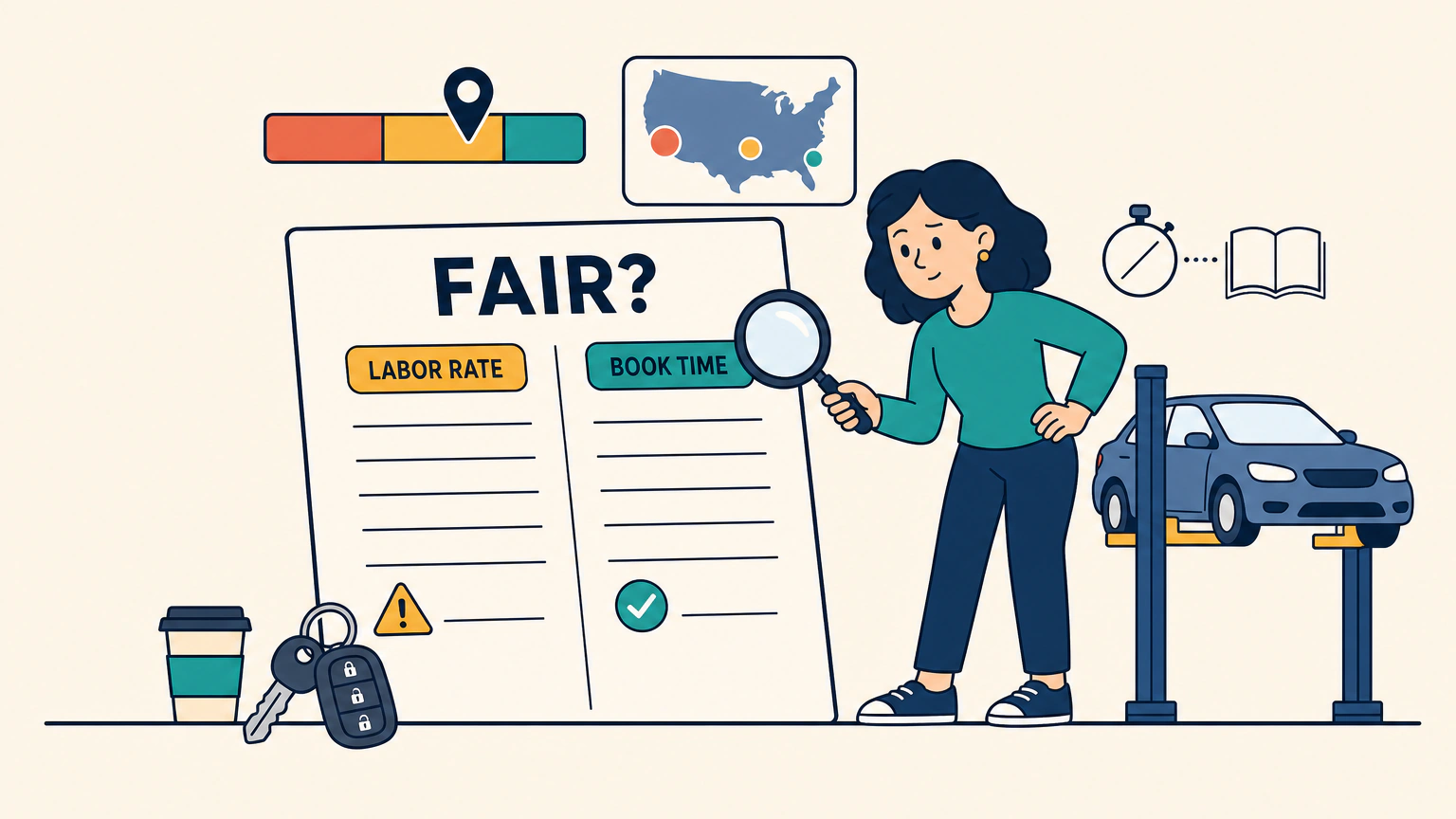
The rate is only half your bill. Most shops don't bill the technician's clock time at all. They quote "book time" from a labor guide, so those hours deserve as hard a look as the rate.
On this page
- What mechanics charge per hour in 2026: the short answer
- Auto repair labor rates by state in 2026
- The hourly rate is only half your bill: how flat-rate billing works
- The other charges that ride along with labor
- How to check your own labor charge in five minutes
- Red flags on a labor line
- What the law says about labor charges and estimates
- Compare shops on more than the hourly number
- Frequently asked questions
What mechanics charge per hour in 2026: the short answer
There is no one national price for an hour of a mechanic's time. Nearby shops quote different rates, so "how much do mechanics charge per hour" only ever has a local answer.
The national average and the band most shops sit in
Tekmetric's labor rate index for 2026 puts the US average at $132 an hour. PartsTech's 2025 survey of US repair shops arrives at almost the same place by a different road: nearly half of the shops it asked price labor at $120 to $159 an hour, a finding AAA repeats in its own explainer.
Two methods, one answer. That makes the band a decent sanity check on a quote, and not much else. Tekmetric's own summary says its lowest and highest state figures are $85 and $197, while its published state table runs from $100 to $161. No single figure settles your estimate.
Independent vs. dealership vs. specialty vs. mobile
Where you take the car moves the number too.
| Shop type | Published or market context (2026) | What the premium pays for | Best fit for |
|---|---|---|---|
| Independent | Varies by market | Local overhead, general tooling, owner-operator flexibility | Most routine repair and maintenance on out-of-warranty vehicles |
| Dealership | Often 25% or more above an independent | Factory training, OEM diagnostic subscriptions, model-specific tooling, warranty and recall work | Warranty work, recalls, model-specific electronic faults, very new vehicles |
| Specialty (European, diesel, EV) | Often higher; varies by market | High-voltage or diesel certification, brand-specific tooling and software | Vehicles a general shop declines or has to sublet |
| Mobile mechanic | Trackara reports $50–$150, averaging about $85 | No bay overhead, limited to jobs safely done in a driveway | Batteries, starters, alternators, brakes, diagnostics at home or at work |
Factory tools and service data can be worth the dealer premium on a model-specific electronic fault. For the rest, price the job at independent mechanic shops too. Mobile mechanics skip some building overhead, though prices and driveway limits vary.
One thing that is not the labor rate: the mechanic's pay
The rate on your estimate is not the mechanic's wage. The Bureau of Labor Statistics put median pay for automotive service technicians at $49,670 a year in May 2024, roughly $23.88 an hour full-time. The rest pays for rent, lifts, scan tools and their subscriptions, insurance, training, and whatever profit is left. That's the honest answer to why mechanic labor is expensive.
Auto repair labor rates by state in 2026
A state figure can't tell you what your shop should charge. It can tell you whether your estimate is in the neighborhood.
Average shop labor rate, all 50 states
These are the values Tekmetric lists in its 2026 index. Each one is a published state benchmark. None of them is a quote for your repair.
| State | Tekmetric-listed labor rate ($/hr) | Difference vs. $132 national average |
|---|---|---|
| Alabama | $124 | -$8 |
| Alaska | $161 | +$29 |
| Arizona | $145 | +$13 |
| Arkansas | $116 | -$16 |
| California | $156 | +$24 |
| Colorado | $151 | +$19 |
| Connecticut | $141 | +$9 |
| Delaware | $141 | +$9 |
| Florida | $138 | +$6 |
| Georgia | $137 | +$5 |
| Hawaii | $142 | +$10 |
| Idaho | $136 | +$4 |
| Illinois | $135 | +$3 |
| Indiana | $123 | -$9 |
| Iowa | $123 | -$9 |
| Kansas | $120 | -$12 |
| Kentucky | $126 | -$6 |
| Louisiana | $132 | $0 |
| Maine | $110 | -$22 |
| Maryland | $141 | +$9 |
| Massachusetts | $133 | +$1 |
| Michigan | $130 | -$2 |
| Minnesota | $137 | +$5 |
| Mississippi | $125 | -$7 |
| Missouri | $120 | -$12 |
| Montana | $135 | +$3 |
| Nebraska | $127 | -$5 |
| Nevada | $152 | +$20 |
| New Hampshire | $128 | -$4 |
| New Jersey | $140 | +$8 |
| New Mexico | $141 | +$9 |
| New York | $125 | -$7 |
| North Carolina | $123 | -$9 |
| North Dakota | $135 | +$3 |
| Ohio | $125 | -$7 |
| Oklahoma | $129 | -$3 |
| Oregon | $150 | +$18 |
| Pennsylvania | $115 | -$17 |
| Rhode Island | $134 | +$2 |
| South Carolina | $130 | -$2 |
| South Dakota | $120 | -$12 |
| Tennessee | $127 | -$5 |
| Texas | $141 | +$9 |
| Utah | $135 | +$3 |
| Vermont | $110 | -$22 |
| Virginia | $136 | +$4 |
| Washington | $152 | +$20 |
| West Virginia | $100 | -$32 |
| Wisconsin | $125 | -$7 |
| Wyoming | $134 | +$2 |
The District of Columbia isn't in the dataset at all. And Tekmetric's summary still puts its lowest and highest state figures at $85 and $197, numbers its own table contradicts. We'd go with the table.
Why your city can be $30 an hour off your state's number
One figure has to cover every local market in the state. A quote above it may be telling you what it costs to run a shop on that block, not that anyone is padding your bill.
Pro tip: Your state's figure is a starting point, not your local number. Listings for auto repair shops in your city carry an average per-hour rate and a price range, plus the count of cost profiles behind them, which is another local reference point beside the national ones. Read that count first. A handful of profiles is a hint, not a measurement.
A warning about the state "repair cost" tables you'll see elsewhere
Search this question and you'll hit state tables where every figure lands between about $211 and $282. Those are not hourly rates. AAA's own 2026 state page runs a column headed "Average Cost of Labor" from $211.26 in Michigan to $281.53 in Connecticut, built on CarMD's 2021 vehicle-health data. That is the labor on one repair, not one hour of a technician's time.
Easy way to scare yourself over nothing. Check what a column measures before you hold it against your estimate.
The hourly rate is only half your bill: how flat-rate billing works
The rate is one number on the estimate. The hours printed next to it decide everything else about the labor charge.
Book time, in one paragraph
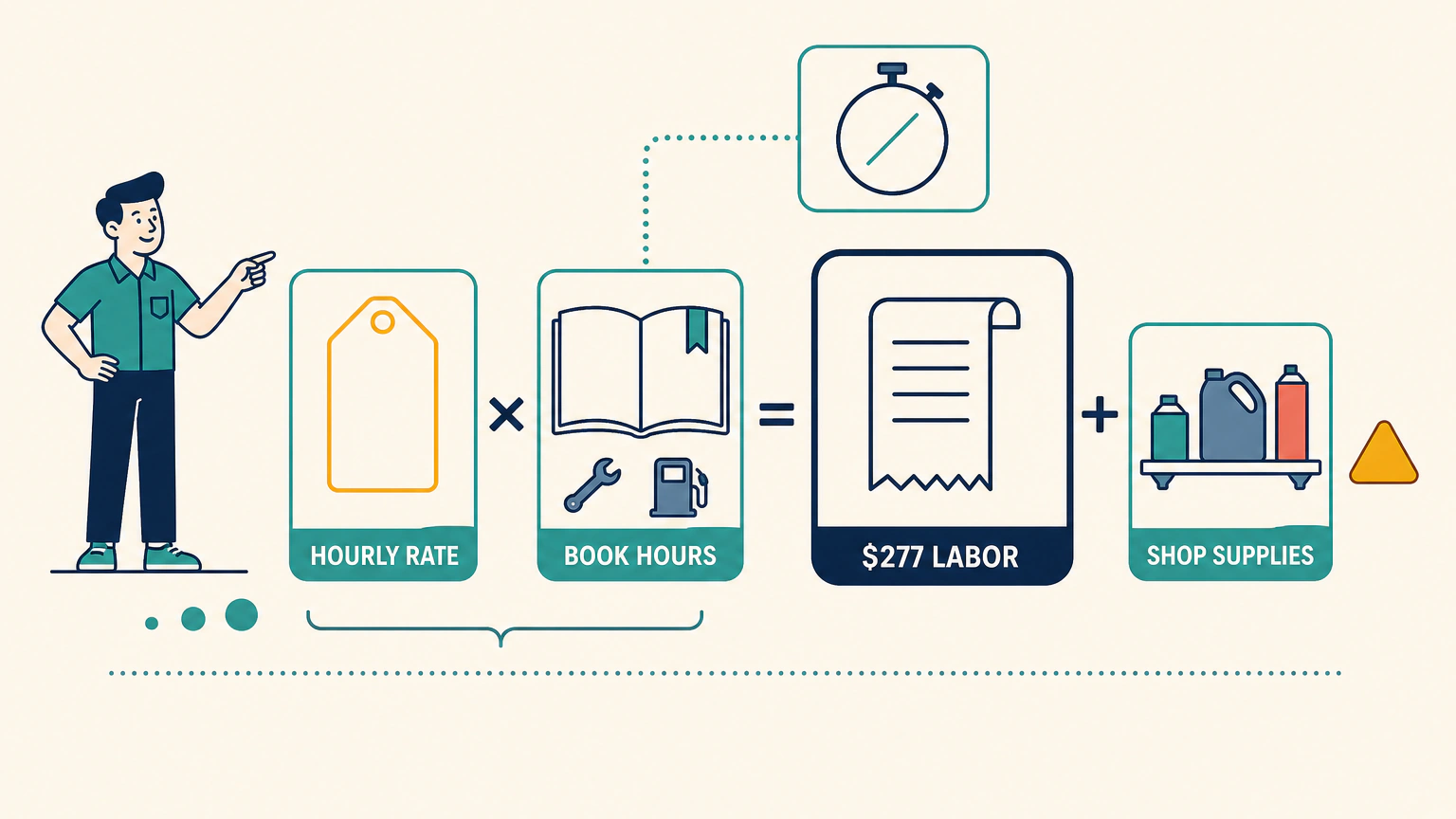
Most shops quote flat-rate guide hours rather than the technician's actual time, though some do bill the clock. Mitchell 1, ALLDATA, MOTOR and Chilton each publish a standard number of hours for a given repair on a given vehicle, and the shop multiplies that by its rate.
Say the guide calls it 2.0 hours. You pay 2.0 hours. The technician who finishes in 90 minutes saves you nothing, and the one who fights rusted bolts for three hours costs you nothing.
AAA calls flat rate "a system that allows shops to give fair and consistent auto repair estimates while paying their technicians based on ability," and the defense holds: you get a price before anyone touches the car. The catch is that customer-pay guide times can differ sharply from what a manufacturer pays its own dealers for warranty or recall work.
Why two honest shops quote different hours for the same job
Minnesota senators got a look at this. An exhibit filed with a committee laid the hours dealerships bill customers beside the hours the automaker pays those same dealerships for the identical job.
| Repair operation | Customer-pay hours (ALLDATA / MOTOR guide) | Manufacturer warranty hours | Difference |
|---|---|---|---|
| Front coil springs replacement | 4.6 (ALLDATA) | 1.1 | 76% |
| Steering shaft repair | 2.1 (ALLDATA) | 0.8 | 62% |
| Cylinder head replacement | 21.5 | 10.5 | 51% |
| Fuel pump replacement | 2.1 (ALLDATA) | 1.1 | 48% |
| Piston replacement | 41.5 (MOTOR) | 30.9 | 25% |
| Timing chain replacement | 7.3 (ALLDATA) | 5.4 (recall time 3.7) | 49% vs. the recall time |
Source: Minnesota Senate committee exhibit for SF827, "Repair Time Comparison," March 23, 2023, described in the document as "a sampling from dozens of examples collected from Minnesota dealerships representing various brands." Manufacturer warranty times are what the automaker pays its own dealers for the same operation.
None of that is proof of fraud. The exhibit sets customer-pay guide times against manufacturer warranty and recall times, and says nothing about how often that gap shows up.
What it does show is that "the book time" is not one fixed number. So ask which guide produced yours, and ask before you sign.
Labor overlap, the discount most people never ask for
When two jobs on your car share the same teardown, the guides may carry a combination time or an overlap deduction instead of stacking both at full price. Ask the shop whether yours accounts for it. On a multi-line ticket from brake repair shops, that beats an argument about the rate.
The other charges that ride along with labor
Fees under the labor line can be perfectly legitimate. What they cost, and whether anyone has to warn you first, depends on the shop and the state. Florida picked a side: supply and waste-removal charges have to appear on the estimate.
| Charge | Typical amount | Standard practice? | What to ask |
|---|---|---|---|
| Diagnostic fee | Varies; many shops charge for diagnostic time | Common | "Is this credited toward the repair if I authorize the work?" |
| Shop supply fee | Varies by shop and estimate | Varies | "Is this capped, and can it be itemized?" |
| Hazardous waste / environmental disposal | Varies | Varies | "What is being disposed of on this job?" |
| Sublet | Varies | Varies | "Which shop is doing this part of the work, and are they certified for it?" |
| Storage | Varies | Notice rules depend on jurisdiction | "When does storage start and what is the daily rate?" |
Ask about these while the car is still on the ground, not when the invoice prints.
How to check your own labor charge in five minutes
The five-minute check
- Find the hourly labor rate on the estimate. If it isn't printed, ask. Nothing else you check means much without it.
- Set it against your state's published figure. A gap isn't proof of overcharging. It's your cue to ask what that rate covers.
- Find the labor hours. You want them attached to each repair line, not one lump sum for the visit.
- Ask which labor guide the hours came from, Mitchell 1, ALLDATA, MOTOR or Chilton, and ask to see the entry for your exact year, make, model and engine.
- If there's more than one job on the ticket, ask whether the overlapping labor came off.
- Look for a separate diagnostic fee, and ask whether it's credited if you go ahead with the repair.
- Add up labor, parts and fees yourself and see whether the total matches. Then find out whether your state makes the shop come back to you before it passes that number.
- Get all of it in writing, signed, before you hand over the keys.
Labor Charge Check
Enter the numbers from your estimate to compare its rate with a published state benchmark and calculate the labor-side total.
How a labor charge is built
Hourly rate
$132/hr
Tekmetric's national table value
Book hours
2.1 hrs
From the labor guide, not the clock
Labor
About $277
Hourly rate x book hours
Shop supplies
Only if listed
Whatever percentage your estimate prints
Your labor charge = the hourly rate x the hours on your estimate, plus any shop supply fee your estimate actually lists.
Selects the value in Tekmetric's published state table.
If it isn't printed on the estimate, ask the shop - it's the first number you need for this check.
Add up the hours across the repair lines. Most shops quote flat-rate guide hours, although some charge for actual time.
Enter the percentage printed on your estimate; enter 0 if none is listed or if the fee is a flat dollar amount.
Your labor charge: $325.50
Above the state benchmark
$14/hr above the Texas table value
Enter the labor hours from your estimate to see the full charge.
Your shop's $155/hr is $14 above Tekmetric's $141 Texas table value. Nearly half of the 752 shops in PartsTech's national survey priced labor at $120-$159/hr; that national band is context, not a Texas range.
A rate above the table value is not on its own evidence of overcharging.
Tekmetric table value for Texas: $141/hr; PartsTech national survey band: $120-$159/hr
- Labor (2.1 hrs x $155/hr)
- $325.50
- Shop supply fee (0%)
- $0.00
- Your labor-side total
- $325.50
- Same hours at the state table value
- $296.10
- National survey band for these hours
- $252.00 - $333.90
State table values: Tekmetric auto repair labor rate index, updated June 30, 2026, backed by data from more than 10,000 shops. Tekmetric's summary sentence gives different $85/$197 endpoints from its $100-$161 table. National survey context: 2025 PartsTech survey of 752 US shops; nearly half priced labor at $120-$159/hr. These are benchmarks, not a quote for your vehicle.
It's a benchmark, not a quote. The calculator knows your state's published figure and nothing at all about your car or your shop.
What to say at the counter
- "What's your hourly labor rate, and is it printed on the estimate?"
- "Which labor guide did these hours come from, and what does it show for my year and engine?"
- "There are three jobs on here. Has the overlapping labor been discounted?"
- "Is the diagnostic fee credited toward the repair if I go ahead with the work today?"
Red flags on a labor line
Red flags: Every one of these is something a shop does. A high rate, on its own, is not one of them.
- One lump labor figure, no hours, nothing broken out by repair.
- The shop won't say what its hourly rate is, or won't name the labor guide it bills from.
- Hours well above guide time that nobody can explain. Rust, seized hardware and an old car are real answers. "That's just what we charge" is not.
- Three jobs on one estimate, no overlap discount, no reason given.
- A diagnostic fee that grows after the fact, or that nobody mentioned before the car went up on the lift.
- Pressure to authorize out loud, right now, with nothing in writing.
- An invoice above the estimate you authorized, and no phone call.
- You asked for your replaced parts in advance and the shop won't hand them over. In several states, California and New York among them, those parts are your right.
What the law says about labor charges and estimates
We're not your lawyer, and repair law is state law that shifts. Check the current rule with your own state's agency before you lean on any of this in a fight.
The federal floor
Whether you get a written estimate by right, and whether the mechanic needs a license, comes down to your state and sometimes your city. The FTC's advice is to ask for a written estimate that "should identify the condition to be repaired, the parts needed, and the anticipated labor charge." State law may also require the shop to call you for approval before the work passes a set amount.
State rules that actually bite
- California. Business and Professions Code § 9884.9 makes the shop put an estimated price for labor and parts in writing, then says it flatly: "No work shall be done and no charges shall accrue before authorization to proceed is obtained from the customer." Going past that estimate takes your consent, spoken or written, and the shop has to log it.
- New York. Ask for it and 15 NYCRR § 82.5 requires a written estimate listing "the labor charge for each repair together with the costs of each labor charge," plus every part and its cost. It also has to tell you that you can ask for your replaced parts.
- Florida. Once a repair is expected to run more than $150, your written-estimate rights kick in. The shop then needs your approval to exceed the estimate by more than $10 or 10%, whichever is greater, and that allowance stops at $50.
- Washington. RCW 46.71.031 puts a rights sign on the wall covering written estimates above $100, and under RCW 46.71.025 a shop "may not charge the customer more than one hundred ten percent, exclusive of retail sales tax, of the total shown on the written price estimate" without fresh authorization.
Four states, four different answers. Look yours up before you argue with anybody.
If you think you were overcharged
Start with paper. The estimate, the invoice, dates, names, photos, and the replaced parts if you asked in time. Then put your question to the shop in writing, and make it the specific one: which guide supplied the book time?
If that goes nowhere, escalate. New York's DMV takes repair-shop complaints within 90 days or 3,000 miles, whichever lands first. California's Bureau of Automotive Repair handles complaints against registered repair dealers. Everywhere else, start with your attorney general's consumer division. Small claims court is still there if it comes to it.
Compare shops on more than the hourly number
Do the arithmetic on the job, not the rate. A $110 an hour shop billing 3.0 hours costs you $330. A $150 an hour shop billing 1.8 hours costs you $270 for the identical job. The cheaper rate loses.
Four things separate a good shop from a cheap one. Current ASE certification, though it's a voluntary industry credential rather than a government license, and the FTC is careful to say "certification alone is no guarantee of good or honest work." A written parts-and-labor warranty. Real experience with your make on this repair. Recent reviews that name the same service. All four matter most on high-hour work, which is why nobody shops transmission repair specialists the way they shop an oil change.
A fair rate at a shop nobody vetted is no bargain. Start with the Best of Preferred Mechanic awards and the listings for auto repair shops in your city. Then walk in asking for the rate, the hours and the guide.
Frequently asked questions
Why is mechanic labor so expensive?
Because the rate isn't a wage. Shops bill about $132 an hour on average, while BLS puts median technician pay near $23.88 an hour. The gap pays for the building, lifts, scan tools and their software subscriptions, insurance, training and profit. Diagnostic equipment alone can take a substantial investment to buy and keep current.
Is $150 an hour too much for a mechanic?
Usually not. Nearly half the US shops PartsTech surveyed priced labor at $120 to $159 an hour, so $150 sits inside that national band. Local rates and billed hours both move, so judge the total price of the job rather than the rate alone.
What is "book time" in auto repair?
It's the standard number of hours a labor guide assigns to one repair on one vehicle. Mitchell 1, ALLDATA, MOTOR and Chilton all publish them. Most shops bill that figure rather than actual time, so a faster technician doesn't lower your bill and a slower one doesn't raise it.
Do mechanics charge for a diagnosis?
Many do. A shop may quote a basic diagnostic charge covering a set list of procedures and a maximum amount of time. Whether that money comes off the repair varies, so ask before the car goes on the lift and get the answer written on the estimate.
Can a mechanic charge more than the estimate?
Generally not without your say-so, though the exact rule is your state's. California wants your consent, spoken or written, before charges exceed the estimate. Florida requires approval once the overage tops $10 or 10%, whichever is greater, and caps that allowance at $50. Washington needs fresh authorization past 110% of the written estimate.
Do dealerships charge more per hour than independent shops?
Yes. AAA says dealer mechanics often cost 25% or more than independent mechanics, and points to factory-trained technicians, specialized diagnostic equipment and higher overhead. Whether that premium is worth paying depends on the repair.
What is a shop supply fee, and do I have to pay it?
It's the catch-all for rags, cleaners, fasteners, lubricants and other consumables too small to bill one at a time. How much it runs, and who has to disclose it, varies by shop and state. Ask whether it's itemized and whether it's capped.
What should I do if I think I was overcharged for labor?
Ask the shop, in writing, for the book time and the guide it came from. That puts the answer on paper. If it doesn't settle things, collect the estimate, invoice, dates, names and photos, then file with your state agency: New York's DMV, California's Bureau of Automotive Repair, or your attorney general.