

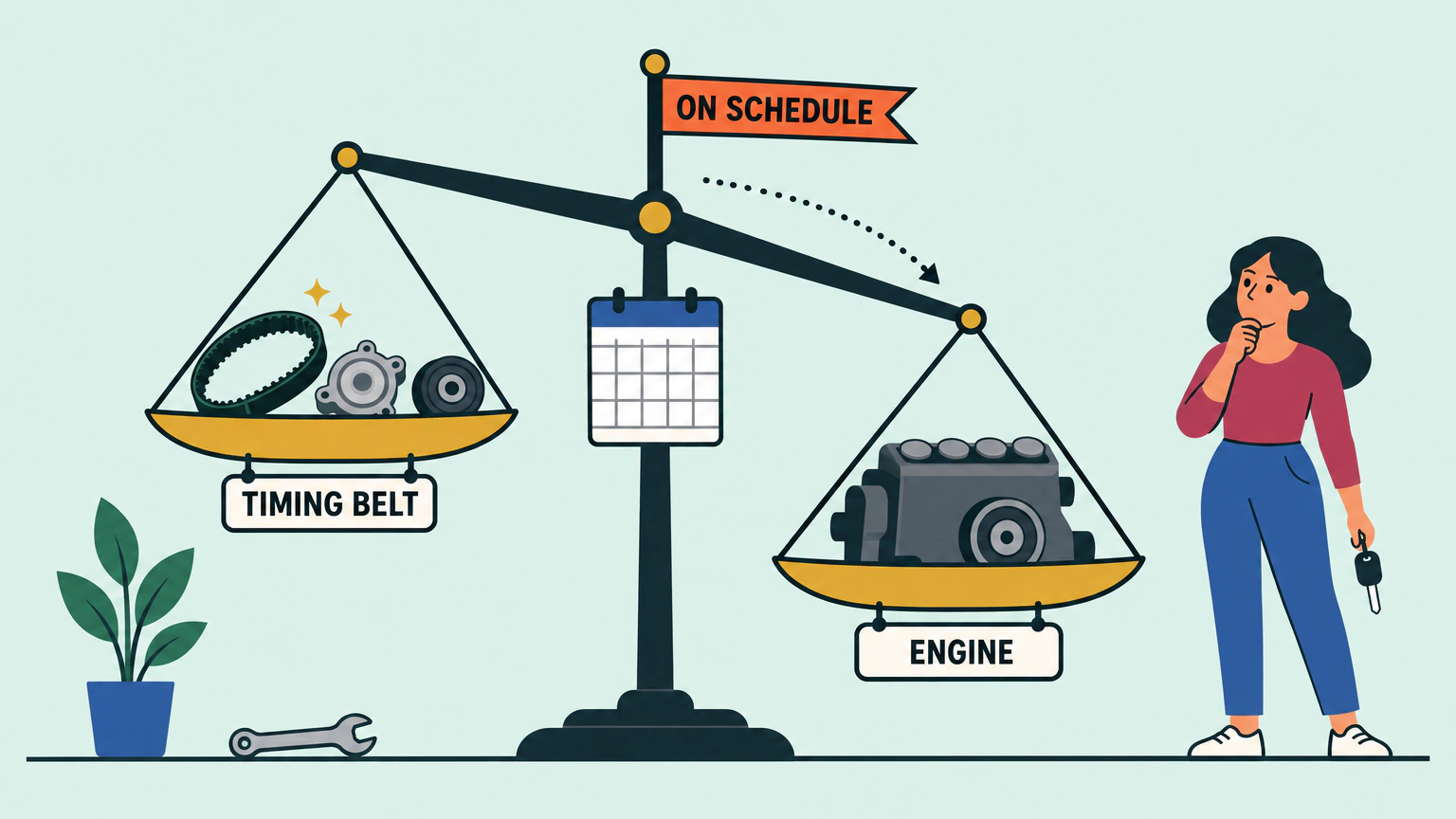
RepairPal puts a typical timing belt replacement at $918 to $1,338, and a Honda Pilot's at $1,127 to $1,519. If the belt on your engine also drives the water pump, adding the pump on the same visit usually costs far less than paying for the teardown twice. And the one line you shouldn't talk a shop down on is the belt interval printed in your own maintenance schedule.
Three voices have a say in that quote: the carmaker, the belt maker and the shop. They don't say the same thing.
On this page
What a timing belt replacement costs in 2026
Line up the published price guides and the spread is hard to trust: $367 at the bottom, $1,555 at the top of RepairPal's Honda Ridgeline estimate. Nobody's lying. Each guide prices a different job, and only some of them say which one. RepairPal's number is the belt by itself. Its Pilot page says pulleys, tensioners and the water pump "are not included in the estimate above." AutoZone prices a parts kit plus labor. Kelley Blue Book gives a range and stops there.
| Price guide | What it prices | Range | What the range counts |
|---|---|---|---|
| RepairPal national estimate | Timing belt replacement, all vehicles | $918 to $1,338 | Labor $603 to $885 plus parts $315 to $453, before tax and fees |
| RepairPal, Honda Pilot | The same job on the 3.5-liter V6 | $1,127 to $1,519 | Labor $417 to $611 plus parts $711 to $908 |
| RepairPal, Honda Odyssey | The same job on the 3.5-liter V6 minivan | $1,076 to $1,522 | Labor $402 to $590 plus parts $674 to $932 |
| AutoZone | Belt kit plus shop labor | $400 to $1,000 | Kit $100 to $350 plus 3 to 5 hours of labor |
| Kelley Blue Book | Timing belt replacement | $367 to $585 | No breakdown or scope given |
Why most of the bill is labor
The belt itself is a toothed rubber loop that keeps the engine's valves in step with its pistons, and it's cheap. Getting to it isn't. It lives behind a cover at the front of the engine, and on some cars, RepairPal says, the motor mounts, cooling fans, radiator and other accessories have to come off first.
That's why labor is about two-thirds of RepairPal's national figure, at $603 to $885. AutoZone does the same math from the parts counter: a kit for $100 to $350, then three to five hours of a mechanic's time. So your timing belt cost swings with the shop's hourly rate more than with the part, and what shop labor costs where you live is a guide of its own.
What a Honda V6 quote looks like
RepairPal's current estimates for Honda's 3.5-liter V6 models put the Pilot at $1,127 to $1,519 and the Odyssey at $1,076 to $1,522. The Ridgeline runs $1,180 to $1,555. On the Pilot the split flips: parts run $711 to $908 against $417 to $611 in labor.
Now the trap. A dealer rarely quotes "a timing belt." It quotes the code, and on an Odyssey, Honda's code 4 covers three things: new spark plugs, the timing belt with a water pump inspection, and a valve clearance check. An independent shop's belt-only price looks cheaper because it's a smaller job. Line the two up item by item before you call either one high.
One more check before you pay anyone. In 2019 Honda recalled certain 2018 and 2019 Pilot and Acura MDX models, plus 2019 Odyssey, Ridgeline, TLX and RLX models. NHTSA's summary gives the reason: "The timing belt teeth may separate from the belt." Dealers replaced affected belts free, so run your VIN through NHTSA's recall search first.
What your carmaker's schedule actually asks for
One document settles most of the argument at the counter. The carmaker wrote a maintenance schedule for your exact engine, and your warranty leans on it. That schedule decides when the belt is due and what comes with it. A blog's round number doesn't, and neither does a shop's wall chart. Honda and Subaru put theirs in writing. So does the company that makes the belts, and the three don't match.
| Whose document | Engines it covers | When the belt is due | What it says about the water pump |
|---|---|---|---|
| Honda Odyssey owner's manual (2017, 2022, 2024, 2025) | 3.5-liter V6 | When the Maintenance Minder shows code 4, or every 60,000 miles if you regularly drive in heat over 110°F or cold under -20°F | "Replace timing belt and inspect water pump" |
| Honda Pilot owner's manual (2024) | 3.5-liter V6 | Code 4, or every 60,000 miles in that heat or cold, or if you tow a trailer | "Replace timing belt and inspect water pump" |
| Honda CR-V owner's manual (2024) | Four-cylinder | No timing belt line: code 4 means new spark plugs and a valve clearance check | Not listed |
| Subaru warranty and maintenance booklets (2010, 2011) | Belt-driven 2.5-liter engines; the 3.0, the 3.6 and the 2011 Forester non-turbo use chains | Inspect at 30,000, 60,000 and 90,000 miles; replace at 105,000 miles or 105 months, whichever comes first | Not listed; its chain engines need no periodic inspection or replacement |
| Gates timing belt replacement guide (2010), from a belt and kit maker | Every belt engine it lists | The carmaker's interval or 72 months, whichever comes first; Honda's V6 listed at 105,000 miles normal, 60,000 severe | "Timing belt driven water pumps should always be replaced" |
We can't see your engine. For your exact car, the schedule in your owner's manual outranks any general figure here, ours included.
Honda's V6: replace the belt, inspect the pump
Honda doesn't print a mileage for this job on a normally driven car. The Maintenance Minder works from how the engine has been run and puts service codes on the dash when work is due, and code 4 is the one with the timing belt in it. Honda's Odyssey manuals for 2017, 2022, 2024 and 2025 and its 2024 Pilot manual, all for the 3.5-liter V6, print the same line: "Replace timing belt and inspect water pump."
Read it twice: replace the belt, inspect the pump. Honda's own schedule doesn't ask for a new one.
The one hard number is in a footnote. Honda says to replace the belt every 60,000 miles "If you drive regularly in very high temperatures (over 110°F, 43°C), in very low temperatures (under -20°F, -29°C)." The 2024 Pilot's footnote adds "or towing a trailer." If that isn't you, believe the dash over anybody's mileage rule of thumb.
Acura models were swept into Honda's 2019 timing belt recall too. We haven't read Acura's manuals, so look for that line in your own Minder table.
Subaru: 105,000 miles or 105 months, whichever comes first
Subaru does print the number, and it prints two. In its 2010 and 2011 warranty and maintenance booklets, the camshaft drive belt (Subaru's name for the timing belt) gets inspected at 30,000, 60,000 and 90,000 miles. It gets replaced at 105,000 miles or 105 months, whichever comes first. That's eight years and nine months, and the clock runs even when the car sits.
The line covers the belt-driven 2.5-liter engines of those years. It skips the 3.0 and the 3.6, and the 2011 Forester's non-turbo 2.5, because those use chains. Subaru's note on the chains is blunt: periodic inspection and replacement "are not required."
Look for a water pump in that schedule and you won't find one.
Why the belt maker's numbers are stricter
Gates makes timing belts and sells them in kits with tensioners, idlers and water pumps. Its Timing Belt Replacement Interval Guide is a real catalog and a useful one, and it's also a 2010 edition from a company with parts to sell. The cover says to change the belt at the recommended interval "Or Every 72 Months, Which Ever Comes First." Inside: "Generally belts should be replaced at around 60,000 miles or less." And on pumps: "Timing belt driven water pumps should always be replaced when the timing belt is replaced."
Set that beside the carmakers. Subaru allows 105 months, not 72. Honda asks for a pump inspection, not a pump. Gates' own listing for Honda's 2008 to 2010 3.5-liter V6 says 105,000 miles for normal driving and 60,000 for severe.
Gates is open about the motive: it offers "questions to ask customers that will help sell belts and protect the customer from expensive repairs." Both halves are true. Our verdict: the carmaker's interval is the requirement. Anything stricter is a judgment call, and you're entitled to ask why. Start with shops that follow the factory schedule.
Should the water pump come out too?
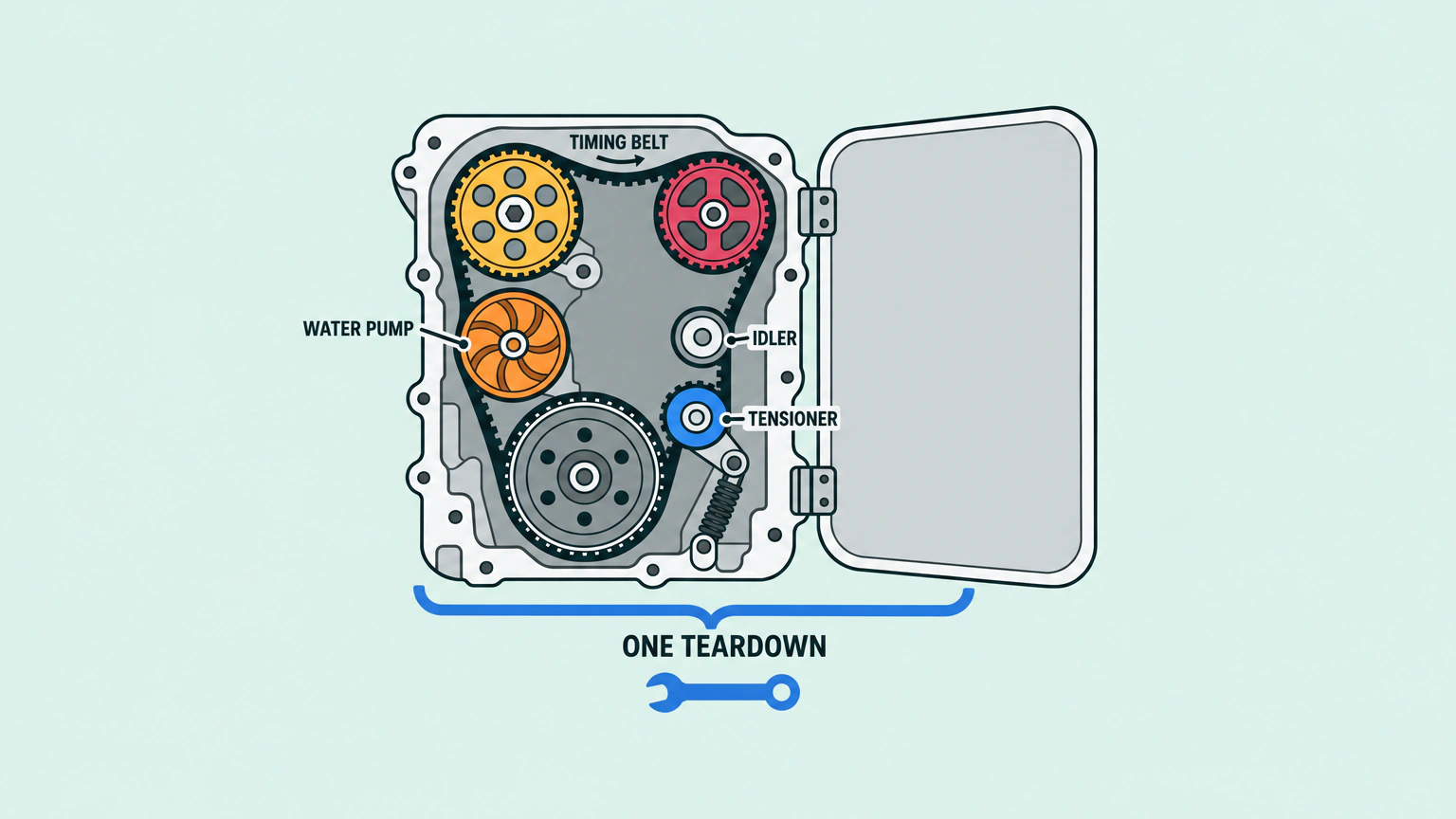
On an engine whose water pump (the part that pushes coolant through the engine) is driven by the timing belt, usually yes. The reason is money, not fear.
Put two RepairPal numbers side by side. A timing belt replacement runs $918 to $1,338, and a water pump replacement as its own job runs $891 to $1,135. That pump figure averages every kind of car, so it isn't the price of a pump buried behind a timing cover. Still, the shape is clear: a pump job can cost about what the whole belt job did. Done during the belt job, AutoZone says, the pump adds "less than 1 hour" of labor.
Why the pump rides on the timing belt
On many engines the pump sits behind the same cover as the timing belt and is spun by it. One belt loops around the crankshaft and camshaft sprockets, a tensioner (the wheel that keeps the belt tight), an idler (a plain guide wheel) and the pump. Reach one and you've reached them all.
Honda's recall history shows how closely they're tied. In 2002 it recalled 17,551 V6 vehicles from the 2002 and 2003 model years (Accord, Odyssey, Pilot, and Acura's CL, MDX and TL) over "a timing belt tensioner pulley on the water pump" that sat out of line. Where a dealer found a bad pump, it replaced the pump and the belt together.
A pump or pulley bearing that fails later can take a nearly new belt with it, and then you pay for the same teardown again.
When it's fine to leave the pump alone
Skip the pump if yours isn't on the timing belt. On other engines it runs off the accessory belt, the one you can see with the hood up, so there's no shared labor and no reason to bundle. Ask the shop which kind yours is. Leave it alone too when the pump is nearly new and you have the invoice to prove it. A second one is waste.
The reverse case comes up too. Say the pump starts leaking and the belt isn't due for years. Replacing the pump alone is a normal repair. But if the belt is close to its interval, do both. The parts are coming off anyway, and a leaking pump may have soaked the belt in coolant.
What a complete timing belt quote should list
A quote that says "timing belt service" beside a dollar figure tells you almost nothing about your real timing belt replacement cost. The FTC says a written estimate "should identify the condition to be repaired, the parts needed, and the anticipated labor charge." On this job the parts list matters most, because two quotes that look alike can describe different jobs.
Read these off the estimate before you sign it.
- The timing belt itself, with the brand: a factory part or which aftermarket kit.
- The tensioner and every idler pulley the belt runs over.
- The water pump, if your engine's pump is driven by the timing belt, or a written note that it was inspected.
- Coolant, and whether your schedule's own coolant item is due anyway (Honda lists it separately, as code 5).
- Camshaft and crankshaft seals, replaced if they're leaking and priced as their own line if recommended anyway.
- The accessory drive belt, which often comes off to reach the timing cover, so a worn one costs only the part.
- Labor as hours and a rate, not just a total.
- The parts and labor warranty in writing, and your old belt and pump handed back.
Comparing a dealer quote with an independent one
Before you compare prices, make the two quotes describe the same job. That means the same parts list, the same answer on brand (factory or a named aftermarket kit) and the same warranty, in writing.
Then ask each shop two things: when did you last do a timing belt on this engine, and what parts will you use? A botched belt job can wreck an engine, so a shop's experience with your engine matters more than the sign out front.
The credential that fits this job is the A1 engine repair certification, and you can compare two mechanics near you in our listings. Priced a kit online? Read up on bringing your own timing belt kit before you offer it.
Red flag: Three quote lines to question before you sign
- A timing chain replacement sold as maintenance, with no code, noise or measurement behind it. Subaru's own booklet says its chain engines need no periodic inspection or replacement, so ask what was found.
- A timing belt on a car whose schedule has no timing belt line. Honda's 2024 CR-V is one example: its code 4 means spark plugs and a valve check. Ask the shop to show you the line.
- A belt interval shorter than your carmaker's, presented as required. The FTC notes that some shops write their own schedules, so ask the shop to explain why it differs from your manual.
What happens if the belt goes past its interval
The engine stalls. That's how NHTSA's summaries of both Honda recalls describe a failed belt, and what happens next depends on the engine.
Gates explains the difference. In a free-running engine the valves and pistons have room to miss each other, so a broken belt just stops the car. In an interference engine they don't, and once timing is lost a piston hits a valve. "Damage can occur to valves, pistons, or heads, and in some cases, completely ruin the engine." Gates' 2010 guide marks Honda's 3.5-liter V6 and Subaru's 2.5-liter engines as interference designs in the model years it lists.
AutoZone puts the bill for a snapped belt at $3,000 to $5,000, against $400 to $1,000 for doing the job on time. If you're already there, start with engine repair shops near you.
Why a belt that looks fine can still snap
AutoZone points out that most timing covers have inspection plugs, small ports that show a short stretch of belt. Cracks there are a clear reason to act now. A clean-looking patch proves much less. You're seeing a sliver of one side.
So use a visual check one way only. It can move the job sooner. It can't move it later.
Low miles on an older car, or no records at all
Miles aren't the only clock. Subaru writes months into its schedule, 105 of them, and Gates says 72. Honda's Minder pages print no year limit for the belt at all. So on an older car with low miles, follow the carmaker's time limit where it prints one, and where it doesn't, weigh the belt's age honestly. We'd rather replace an old belt early than tow the car.
No records is its own case. If nobody can show the belt was changed, treat it as due. Gates' question list flags exactly this: buy a car used and you "won't know if the belt has been replaced." Still shopping? Get the belt question answered during a pre-purchase inspection.
Timing chain quotes are a different job
Some engines use a metal chain where others use a belt, and a chain quote plays by different rules. RepairPal prices a timing chain replacement at $2,120 to $2,764, more than twice its belt job at either end of the range. A number that size deserves a reason.
Subaru's booklet says its chain engines need no periodic inspection or replacement. Kelley Blue Book says chains "can actually last the lifetime of your car." So a chain quote should rest on something a mechanic found: a stored code (RepairPal ties P0008, P0009 and P0016 to timing work), a diagnosed rattle, or measured wear. Ask which one it is. Then run the VIN for recalls and carmaker coverage before you agree to a timing chain repair cost like that.
Timing belt questions we hear most
How much does it cost to replace a timing belt and water pump?
RepairPal's national estimate for the belt job is $918 to $1,338. On an engine whose pump is driven by the timing belt, adding the pump costs the part plus under an hour of labor, by AutoZone's estimate. That's far less than RepairPal's $891 to $1,135 for a water pump job done separately, a figure averaged across all vehicles. Ask for both as separate lines on one quote.
Should I replace the water pump when I replace the timing belt?
Usually yes, if the timing belt drives your pump. The labor to reach it is already paid for. Honda's schedule asks only for an inspection. Gates, which sells pumps, says always. So it's a judgment call with good money logic behind it. If your pump runs off the accessory belt, no. There's no shared labor to save.
Is timing belt replacement covered under warranty?
Not when it's scheduled. That's maintenance, and you pay for it. A belt that fails early from a defect is different. Subaru's 2010 and 2011 powertrain warranty, 5 years or 60,000 miles, lists "Timing belts or gears and cover" and "Water pump." Honda's 2019 recall replaced affected belts free. And the scheduled job doesn't have to happen at the dealer: an independent shop can do this without touching your warranty.
How long does a timing belt last?
As long as your carmaker's schedule says, and no longer. Subaru's 2010 and 2011 booklets say 105,000 miles or 105 months, whichever comes first. A Honda V6 waits for the Maintenance Minder's code 4, or 60,000 miles for owners who regularly drive in extreme heat or cold. Gates, the belt maker, sets its own outer limit at 72 months.
What happens if a timing belt breaks while you're driving?
The engine stops. NHTSA's Honda recall summaries call it a stall. On an interference engine the pistons and valves can collide, and AutoZone puts that repair at $3,000 to $5,000. Steer to a safe spot, stop, and have the car towed. Don't try to restart it.
How much does a timing chain replacement cost?
RepairPal's national estimate is $2,120 to $2,764, and most of it is labor, at $1,334 to $1,957. A chain has no scheduled interval on the chain engines in Subaru's booklet. So the quote should come with a reason: a stored code, a diagnosed noise or a measurement. If nobody can name one, get a second opinion before you say yes.
How can I tell if my car has a timing belt or a timing chain?
Open the maintenance schedule and look for a timing belt replacement line. Honda's 2024 CR-V schedule, for example, lists spark plugs and a valve clearance check under code 4 but no belt. If the schedule leaves you unsure, a dealer's service desk can identify the engine's timing drive from your VIN.
Find the timing belt line in your own schedule and book the job for when it says, not sooner because of a wall chart and not later because the belt looked fine. Take the checklist, get two quotes that describe the same job, and choose from engine repair shops near you.