

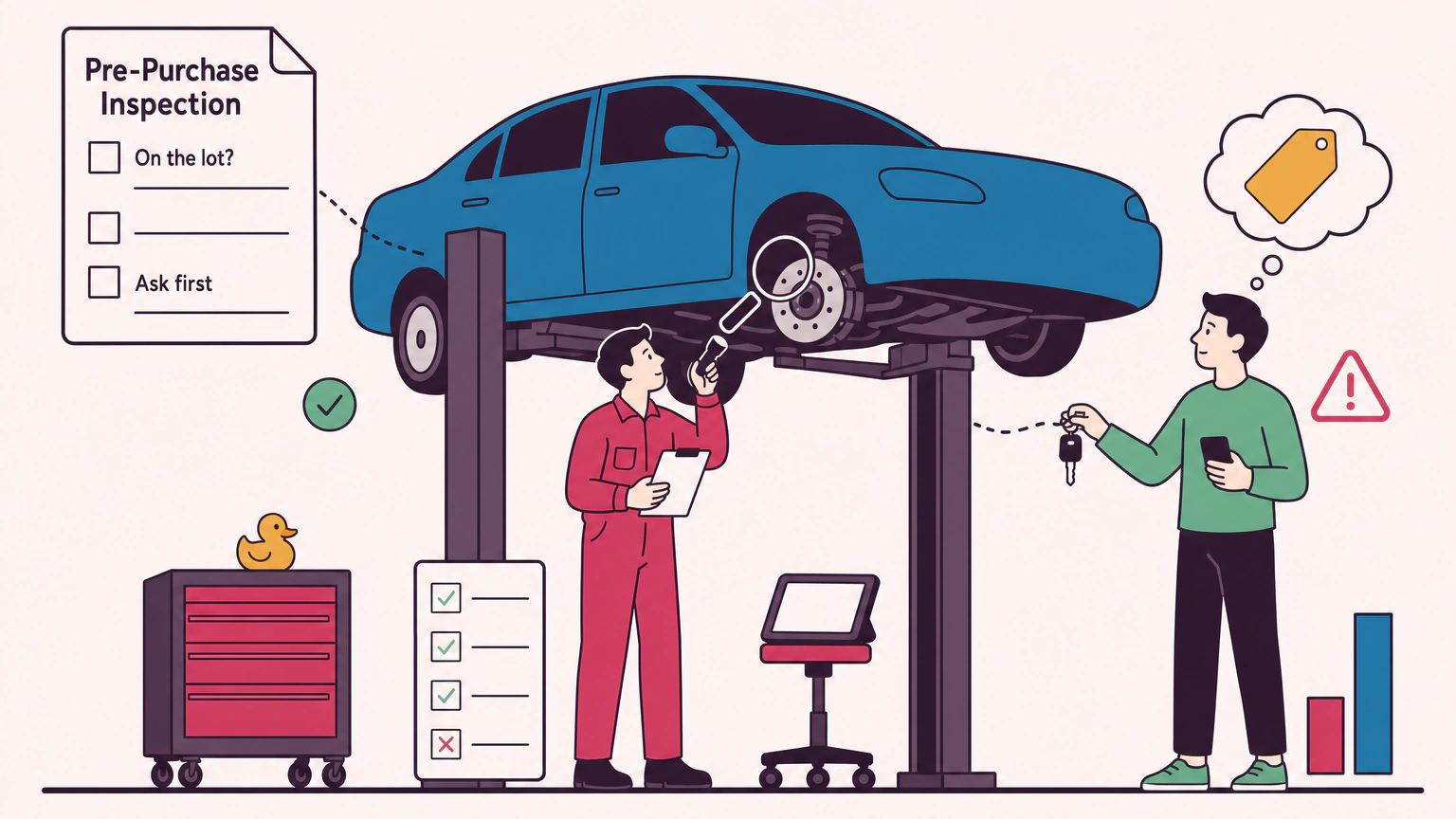
And if the car is sitting on a dealer lot, the Buyers Guide displayed on or in it already tells you to ask: "ASK THE DEALER IF YOUR MECHANIC CAN INSPECT THE VEHICLE ON OR OFF THE LOT." That's the federal government's own instruction, printed on the form the dealer has to show you.
On this page
- What a pre-purchase inspection costs in 2026
- What you are actually buying
- Where to get one, and who must never do it
- Getting access to the car, the part nobody explains
- How long it takes, and how to schedule it
- Reading the report and turning it into money
- When the math says skip it
- Where to find a shop that does pre-purchase inspections
- Frequently asked questions
What a pre-purchase inspection costs in 2026
The spread is wide because the job isn't one job. A mobile inspector working in a parking lot and a marque specialist with the factory software are selling two different things.
The national range, and the three numbers behind it
Three sources price this work, and none of them lands in the same place. RepairPal's estimator lists it at $183 to $322, all labor, excluding taxes and location. ConsumerAffairs reports $150 to $250, around $200 on average, with on-site visits costing more and a luxury car at $250 or more. A 2026 automotive-retail writer's guide puts mainstream work at $150 to $300.
They disagree because they aren't counting the same thing: one is a labor-only estimate, one a consumer guide, one an automotive-retail writer's estimate. None of them is a quote for your car. Your local labor rate and your car's platform move the number, and the only price that means anything is the one a shop gives you on the phone.
Price by where you take it
What you're buying is an hour or two of a shop's posted rate plus two pieces of equipment: a lift, and a scan tool that speaks your car's language. So the price follows the local hourly rate more than the car. Check what shops in your state charge per hour, then the going rates at auto repair shops in your city.
| Where you take it | Typical 2026 cost | Comes to the car? | Lift and scan tool? | Best for | Watch out for |
|---|---|---|---|---|---|
| Independent repair shop | $150-$300* | No | Lift yes, factory software sometimes | Mainstream cars | Does it do these routinely? |
| National service chain | No venue figure published; the $150-$250 national range (ConsumerAffairs) | No | Lift yes, scan depth varies | Ask about scheduling | A walk-around, not a diagnosis |
| Franchised dealer of that make | One to two hours of its posted labor rate | No | Yes, plus the factory tool | Brand electronics, recalls | Never the dealer selling it |
| Marque or specialty shop | $300-$600 on European models* | No | Yes, with platform software | German, exotic, EV, diesel | Ask about lead time |
| Mobile inspection service | $200-$400 plus travel* | Yes | Portable scan tool; lift access varies | A car that cannot leave | Confirm underbody access |
| The seller's own shop, do not use | Paid by the seller. That is the problem. | n/a | n/a | Nothing | The seller pays the inspector |
Starred cells are directional, from a 2026 automotive-retail writer's guide with no published methodology. RepairPal's national estimate is $183-$322 in labor, updated June 18, 2026.
What pushes the price up
European platforms, mostly. The software and tooling cost the shop real money, and that lands on your invoice. EVs and plug-in hybrids may add a traction-battery health check. Classics climb further still: the same automotive-retail guide puts them at $500 to $1,000, directional. Mobile service adds travel, and so do the extras: paint-depth gauging, a compression test, photographs from the lift.
Put the number in proportion
Cox Automotive reported in July 2026 that average used-vehicle listing prices have climbed back toward $27,000. A $200 inspection is roughly 0.7 percent of that. Spend it.
The inverse holds too, and nobody in the inspection business likes saying it out loud. On a $4,000 car, $200 is 5 percent.
What you are actually buying
A careful walk-around and a real inspection are not the same product, and the difference isn't the mechanic's eyesight. It's equipment.
The road test, the lift and the scan tool
The road test has to include highway speed, because vibration, shift quality and pull can emerge under load. The car has to go up on a lift, because a car on the ground hides its suspension, underbody, exhaust and leaks. And the scan has to read all available modules, so stored transmission, airbag and camera faults can be put on the record.
Miss any one of those three and you paid for a walk-around.
The federal defect list nobody quotes
Your checklist doesn't have to be anybody's opinion. Turn the FTC Buyers Guide over, the form displayed on or in the car in front of you, and the federal government has already written one: the major defects that may occur in used vehicles, listed by system.
- Frame and body: cracks, corrective welds, rusted through; dog tracks, a bent or twisted frame
- Engine: oil leakage beyond normal seepage; cracked block or head; belts missing or inoperable; knocks or misses from camshaft, lifters, push rods; abnormal exhaust discharge
- Transmission and drive shaft: improper fluid level or leakage beyond normal seepage; visibly cracked or damaged case; abnormal noise or vibration; improper shifting in any gear; clutch slip or chatter
- Differential: improper fluid level or leakage beyond normal seepage; visibly cracked or damaged housing; abnormal noise or vibration
- Cooling system: leakage including the radiator; water pump not working properly
- Electrical system: battery leakage; alternator, generator, battery or starter not working properly
- Fuel system: visible leakage
- Inoperable accessories: gauges or warning devices; air conditioner; heater and defroster
- Brake system: failure warning light broken; pedal not firm under pressure; not enough pedal reserve; does not stop in a straight line; damaged hoses; drum or rotor too thin; lining or pad thickness less than 1/32 inch; power unit not operating or leaking; damaged structural or mechanical parts
- Air bags
- Steering system: too much free play at the wheel; free play in the linkage more than 1/4 inch; steering gear binds or jams; front wheels aligned improperly; power unit belts cracked or slipping; improper power unit fluid level
- Suspension system: damaged ball joint seals; bent or damaged structural parts; disconnected stabilizer bar; broken spring; loose shock mounting; damaged or missing rubber bushings; damaged or missing radius rod; shock absorber leaking or functioning improperly
- Tires: tread depth less than 2/32 inch; mismatched sizes; visible damage
- Wheels: visible cracks, damage or repairs; loose or missing mounting bolts
- Exhaust system: leakage
- Catalytic converter

What a pre-purchase inspection cannot see
Now the honest part. A fault that isn't happening on the day won't show up. Anything needing teardown is out of scope, because a standard PPI does not include disassembly. Season-dependent performance may be harder to assess out of season. Module history the tool can't read stays invisible.
And the big one: the report describes one day. It's a snapshot, not a warranty.
Four different inspections, constantly confused
Four documents get called an inspection. Only one of them is working for you.
| What it is | Who pays | What it proves | What it misses | Source |
|---|---|---|---|---|
| Pre-purchase inspection | You | This car's condition today, judged by someone with no stake in the sale | Intermittent faults, teardown work | FTC |
| Vehicle history report | Usually you | Title status, reported accidents, reported flood damage, odometer records | "A vehicle history report is not a substitute for an independent vehicle inspection." It "may list accidents and flood damage, but typically it will not list mechanical problems." | FTC |
| State safety or emissions inspection | Varies by state and transaction | That the car met your state's legal minimum that day | "A mechanical inspection is different from a safety inspection" | FTC |
| Dealer "certified pre-owned" inspection | The dealer, priced in | That it passed the seller's checklist to the seller's standard | "A mechanical inspection is a good idea even if the car has been 'certified' and inspected by the dealer, and is being sold with a warranty or service contract." | FTC |
Where to get one, and who must never do it
Five kinds of business do this job properly. A sixth will happily offer, and it must never touch it.
The five kinds of inspector
Independent repair shop. The default, and the right call on most mainstream cars. Factory software is hit and miss, so ask about your platform.
National service chain. How deep the inspection goes varies by store. Ask what's on the checklist.
Franchised dealer of that make. Strong on brand electronics and recall lookups. Never the one selling you the car.
Marque or specialty shop. Worth the premium on German, exotic, EV and diesel platforms. Ask about lead time.
Mobile inspection service. The answer when the car can't come to you. Lift access varies, so settle that on the phone. Start with shops that handle vehicle inspections in your city.
The conflict-of-interest rule
The FTC's word for the inspector you want is independent, and that word is carrying the whole idea. Not the seller's shop. Not a shop the seller recommends. Not the service department of the dealership selling you the car. Choose independent mechanic shops with no tie to either side of the deal.
How to vet the shop in five minutes
Four questions, on the phone, before you book anything. Does the shop do these routinely, or would yours be a favor squeezed in between jobs? Will it check that the technician is certified for the systems on this car? Do the findings come in writing? And what's the flat fee, plus what falls outside it?
What to ask for when you book
Read these off your phone. Say all eight and the report comes back usable at the negotiating table.
- "This is a pre-purchase inspection on a car I don't own yet. Do you do those?"
- "What's the flat fee, and what's not included in it?"
- "Will it go on a lift?"
- "Will you scan every module, not just the engine?" (note that a full module scan is not the same as a diagnosis)
- "Will you road-test it, including highway speed?"
- "Is the technician certified for the systems on this car?"
- "Will I get a written report with the make, model and VIN, and a repair cost estimate for each finding?"
- "What day can you do it, and how long will you need the car?"
Take this before you go: the eight questions, the federal defect list, and somewhere to write down the VIN, seller, shop, date, fee and your three buckets.
Getting access to the car, the part nobody explains
You don't own this car yet, and that's the whole problem. Somebody has to hand over the keys before anyone can tell you what you're buying, and how you get there depends entirely on who's selling.
Who is selling the car?
- A private seller - Ask to meet at your shop: "I'd like my mechanic to look at it." - Refused? Offer a mobile inspector who comes to the car. - Refused again? Walk away.
- A franchised dealer - Read the Buyers Guide displayed on or in the car first. - Ask to take the car to your own shop. - Refused on insurance grounds? Ask for a mobile inspector at the lot, or ask the dealer to bring the car to a facility you choose. - Refused outright? Another dealer.
- A no-haggle superstore or online retailer - Ask for a mobile inspector at the lot. - Offered a return period instead? Book the inspection for day one of that window.
Buying from a private seller
Ask early, before you talk price at all: "If we agree on a number, I'll have my mechanic look at it first." Meet at the shop rather than borrowing the car, which settles the insurance question and the trust question in one move. And if you've already left a deposit, get in writing what happens to that money if the inspection finds something.
Buying from a franchised dealer, read the window form
Any dealer who sells or offers more than five used vehicles in a 12-month period has to display a Buyers Guide before showing you the car. That's federal law: the FTC's Used Car Rule. It applies in every state except Maine and Wisconsin, which run their own equivalent forms, and it covers DC, Puerto Rico, Guam, the US Virgin Islands and American Samoa.
Read it before you say anything about price. It tells you whether the car is as-is or warranted, and it carries this:
"ASK THE DEALER IF YOUR MECHANIC CAN INSPECT THE VEHICLE ON OR OFF THE LOT. OBTAIN A VEHICLE HISTORY REPORT AND CHECK FOR OPEN SAFETY RECALLS."
Whatever is printed there becomes part of your sales contract, so a promise on the form is easier to enforce than a spoken one. The same form points you to safercar.gov to check for open recalls.
No-haggle superstores and online-only retailers
This one we can't answer for you, and neither can a forum thread. Some large used-car retailers offer a return window, and policies differ by retailer and by store. If you're searching whether CarMax or Carvana allows a pre-purchase inspection, take the answer from that retailer's current published terms or from the store itself.
Ask for a mobile inspector at the lot either way, which answers the insurance objection without the car going anywhere. And if you're offered a return period instead, book the inspection for the first day of that window. Not the last.
If the seller says no, the three-step escalation
The FTC's own guidance is a ladder, and you climb it in order. One: if the dealer will not let the car off the lot, find a mobile inspection service that will come to the dealer. Two: if that is not an option, ask the dealer to bring the car for inspection at a facility you choose. Three: if a dealer will not allow an independent inspection at all, consider going to another dealer.
Red flag: no inspection allowed. A refusal is information, and it's the only free information in this whole transaction. RepairPal puts it harder than the FTC does: if a seller will not allow a pre-purchase inspection, "there's a good chance they're hiding a serious issue. Consider this as a big red flag and walk away."
How long it takes, and how to schedule it
Budget one to two hours of shop time. That's what the fee buys, plus a short wait for the written report.
The running order is simple. Call two shops for a flat fee, book the slot, tell the seller the date, meet the car there, and read the report before anybody talks price. A shop that cannot see the car for a week is the wrong shop for a car under offer.
Reading the report and turning it into money
A report comes back as a list of findings. Turning it into a lower price starts with sorting.
Sort every finding into three buckets
Safety-now: urgent brake, tire, steering or suspension defects. Will-need-soon: a weeping seal, a tired battery, service due inside 5,000 miles. Cosmetic: curb rash, a trim clip, a stone chip.
Sort the report yourself if it does not sort itself. Those three buckets are three completely different conversations.
Get the numbers in writing
The FTC is specific about this one. Ask the mechanic for a written report with a cost estimate for all necessary repairs, and be sure it includes the make, model and VIN. Then, if you buy the car after seeing the results, use those estimated repair costs to negotiate the price.
Pro tip: make the report do the negotiating. Ask for the estimate itemized by finding, not as one lump sum. Then hand over the safety-now bucket as a price adjustment, not a complaint. A seller argues with an opinion. A seller negotiates against a number.
Three findings worth walking away from
Frame damage or corrective welds. The federal list names frame cracks, corrective welds, and a bent or twisted frame among its major defects. If you go ahead anyway, price the work with auto body repair shops that do structural repair, not with the seller's estimate.
Evidence of flood exposure. Silt in the seat rails. Corrosion on the connectors under the carpet. A musty smell that keeps coming back. Water damage surfaces as electrical faults for years.
A driveline fault priced above a meaningful share of the asking price. An engine or transmission repair quoted at a third of what you're paying isn't a negotiating position. It's a different car.
When the math says skip it
We'd book the inspection on almost anything. Almost.
On a very cheap car, say $3,000 to $4,000, a $200 inspection is at least 5 percent of the purchase. Put the money into a repair budget instead, and have a mechanic look at brakes, tires and leaks. On a car you can already see is wrong, don't spend a dollar. Walk.
And on a car the seller will not let anybody touch, be clear about what you're doing. You're not skipping the inspection. You're skipping the car.
Where to find a shop that does pre-purchase inspections
Three things decide it. Does the shop do these routinely? Does it have a lift and scan coverage for your platform? Will it put every finding in writing with a cost estimate against it?
Start with shops that handle vehicle inspections in your city, then call two of them and work through the eight questions. Our own shortlist comes out of an AI-based rating methodology: machine reading of reviews across hundreds of thousands of public sources, scored on 150 proprietary data points, which is also what produces the Best of Preferred Mechanic awards. Those are our own claims rather than audited figures, so treat the result as a starting point and still make the calls yourself.
Take the checklist. Come back with a report that has numbers on it.
Frequently asked questions
How much does a pre-purchase inspection cost?
Figure $150 to $300 at an independent shop for a mainstream car. RepairPal's national estimator puts a pre-purchase car inspection at $183 to $322 in labor, before taxes and fees. A mobile visit or a marque specialist runs higher. One thing not to do: don't substitute the seller's own shop for an independent inspection.
Is a pre-purchase inspection worth it?
On a car near the $27,000 national average listing price, a $200 inspection is under one percent of the purchase. That's an easy yes. It stops being an automatic yes on cheap cars, where the same fee is 5 percent of the price and the money may do more good in a repair budget.
Where can I get a pre-purchase inspection?
Any independent repair shop, national service chain, franchised dealer of that make, marque specialist, or a mobile inspector who drives out to the car. Pick one with a lift and the right scan tool for your platform. Never the seller's own shop, and never a shop the seller recommends.
How long does a pre-purchase inspection take?
Budget one to two hours of shop time, which is what the fee buys, plus a short wait for the written report. Book it the moment you've agreed on a number, because a shop that cannot see the car for a week is the wrong shop for a car under offer.
Can I get a pre-purchase inspection at a dealership?
It depends, and the federal window form tells you to ask. The line printed on it is to ask the dealer whether your mechanic can inspect the vehicle on or off the lot. If insurance rules keep the car on site, ask for a mobile inspector at the lot, or for the car to be brought to a facility you choose.
Do I need a pre-purchase inspection on a certified pre-owned car?
The FTC says a mechanical inspection is a good idea even if the car has been "certified" and inspected by the dealer and comes with a warranty. Certification is the seller's inspection, run to the seller's standard. Yours is independent, and it's the one you can negotiate with.
Who pays for a pre-purchase inspection?
You do, and that's the point. The FTC says plainly that you will have to pay the inspection fee, and an inspector paid by the buyer works for the buyer. A seller who insists on covering it, or who offers his own shop's report instead, has just told you something worth hearing.
Can I do a pre-purchase inspection myself?
You can do a useful pre-screen, and you should: fluids, tire tread, panel gaps, warning lights, a test drive that reaches highway speed. It costs nothing and it filters out the obvious wrecks. A thorough inspection generally needs lift access, a scan tool and an experienced technician.