

On this page
- The short answer: ASE certifies people, not shops
- What the letters actually stand for
- One seal, more than 50 certifications — which one covers your repair
- The blue seal on the door: what an ASE Blue Seal shop is
- Certified, licensed, accredited, approved — a credential decoder
- How to verify an ASE certification before you hand over the keys
- What ASE certification does not tell you
- How Preferred Mechanic weighs credentials in its shop ratings
- Frequently asked questions
The short answer: ASE certifies people, not shops
ASE certification is a voluntary, test-based credential earned by individual technicians. Shops don't hold it. The National Institute for Automotive Service Excellence tests people, one specialty at a time: A5 is brakes, A7 is air conditioning, A8 is engine performance. Each certification normally expires after five years, unless the technician recertifies or, for A1 through A9, earns an extension through the ASE Renewal App. About 160,000 of the roughly 805,600 automotive technicians in the US hold one.
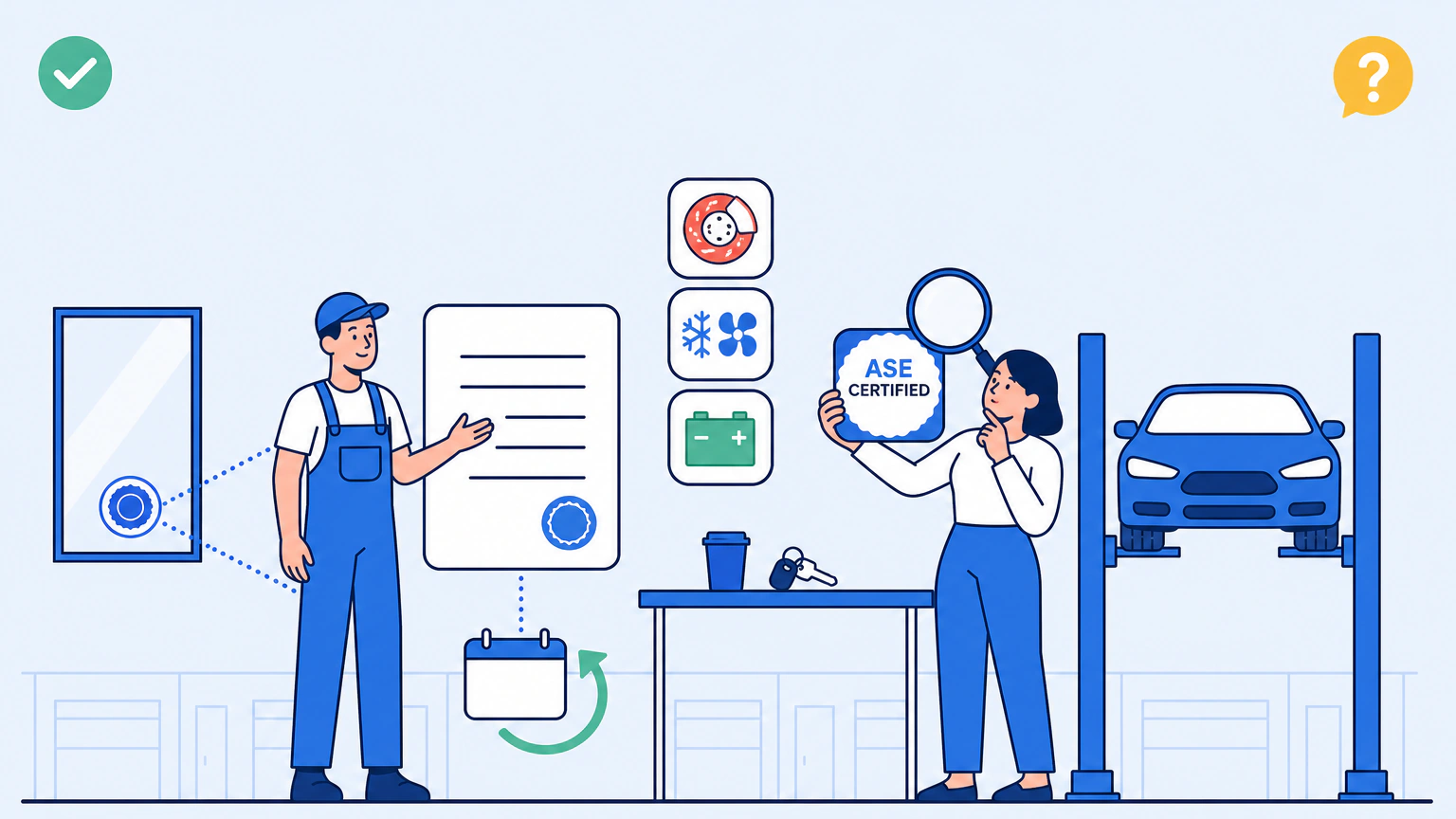
So the question to ask at the counter isn't "are you ASE certified?" It's which certification the technician doing your job holds, and whether it's still current. A seal on the window means somebody in that building passed a test. It doesn't tell you the hands on your car did.
What the letters actually stand for
The letters stand for the National Institute for Automotive Service Excellence, a non-profit the automotive industry set up in 1972. It calls itself "an independent third party that upholds and promotes high standards of service and repair." It tests technicians. It repairs nothing.
Why a voluntary credential exists at all
Nobody needs a federal license to open your hood and charge you for what happens next. There isn't one. The Automotive Service Association counts 35 states with some form of repair-dealer registration or mechanic licensing statute, which leaves a lot of the map running on trust alone.
Drivers can feel it. AAA's driver survey found that 63% of US drivers don't trust repair shops in general, and that 75 million motorists have no shop they trust. That is the hole a voluntary credential fills.
What a technician does to earn one certification
An ASE certified mechanic has done two things, not one. First the test, written by a national panel of working technicians, automakers, parts manufacturers and educators. Then the hours: one, two or three years of hands-on experience, part of which formal training can replace.
Order is flexible. A technician can take the test first, but ASE sends back a score report and no certificate until the experience is approved.
These are not quiz-night tests. A5 Brakes has 45 scored questions. A6 and A8 have 50.
Why the five-year clock matters more than the certificate on the wall
Every ASE certification is valid for five years, and then it lapses. To hold one, a technician retakes a recertification test. The A-series versions, A1R through A9R, run about half the length of the originals. A1 through A9 have a second route: an extension through the ASE Renewal App, which serves up one question per certification every 30 days.
So a framed certificate proves somebody passed a test. It doesn't prove they passed it lately. Ask for the expiration date, which ASE prints right on it.
One seal, more than 50 certifications — which one covers your repair
The expensive mistake here is treating "ASE certified" as one thing. It isn't. ASE publishes over 50 tests across the automobile, truck, bus, collision, parts and support series, and the technician certified in A5 Brakes may hold nothing at all that covers your air conditioning.
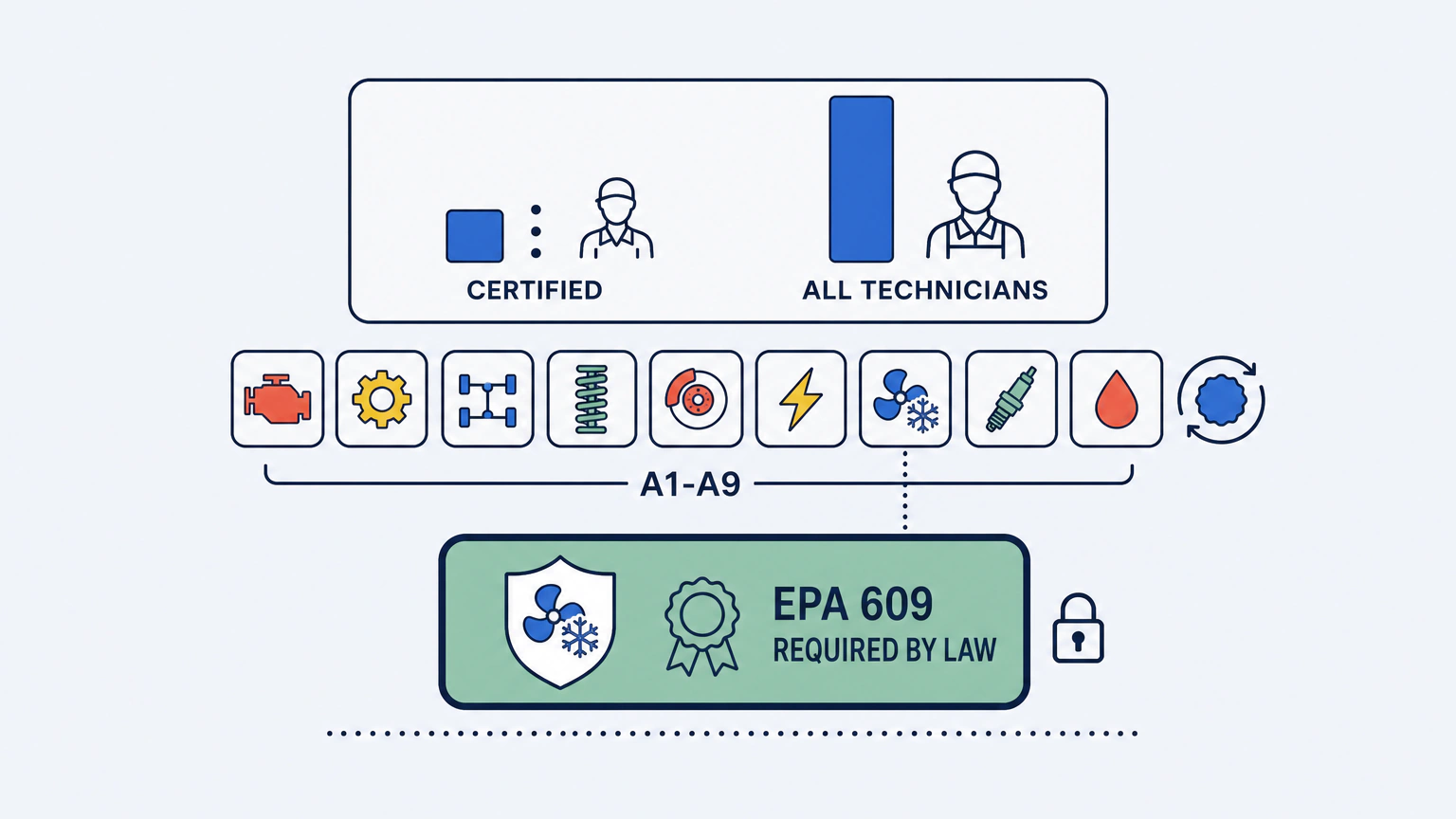
The A-series (A1–A9): the nine everyday automobile tests
Nine tests cover most of what a car does wrong. Match your symptom to a code, then ask for that code by name.
| ASE test | Official title | Scored questions | The job you'd book it for |
|---|---|---|---|
| A1 | Engine Repair | 45 | Oil leaks, knocking, head gasket, timing belt |
| A2 | Automatic Transmission/Transaxle | 45 | Slipping, harsh shifts, transmission service |
| A3 | Manual Drive Train & Axles | 40 | Clutch, manual gearbox, CV joints, differentials |
| A4 | Suspension & Steering | 40 | Alignment, shocks and struts, steering wander |
| A5 | Brakes | 45 | Pads, rotors, calipers, squealing or grinding |
| A6 | Electrical/Electronic Systems | 50 | No-start, alternator, parasitic drain, wiring faults |
| A7 | Heating & Air Conditioning | 50 | A/C blowing warm, heater problems, refrigerant work |
| A8 | Engine Performance | 50 | Check engine light, misfire, rough idle, emissions failure |
| A9 | Light Vehicle Diesel Engines | 50 | Diesel pickups and light-duty diesel vehicles |
| G1 | Auto Maintenance and Light Repair | — | Oil changes, rotations, filters, routine service |
| L1 | Advanced Engine Performance Specialist | — | Driveability faults the base tech couldn't solve |
| L3 | Light Duty Hybrid/Electric Vehicle Specialist | — | Hybrid and EV high-voltage systems |
| L4 | Advanced Driver Assistance Systems (ADAS) Specialist | — | Camera and radar calibration after glass or collision work |
| B6 | Damage Analysis & Estimating | — | Collision estimates and insurance damage appraisal |
| C1 | Automobile Service Consultant | — | The service writer at the counter, not the repair |
Titles and counts come from ASE's Automobile & Light Truck test series; only the A-series counts are shown. A1-A9 and G1 are also offered in Spanish.
ASE Master Automobile Technician: what it does and doesn't prove
Hold A1 through A8 at once and you're recognized as an ASE-Certified Master Automobile Technician. ASE says plainly that A9, Light Vehicle Diesel Engines, is not required for it.
Read that as broad coverage of automobile and light-truck service areas. Don't read it as proof of A9 diesel, L3 hybrid/EV or L4 driver-assistance expertise, because it isn't.
Master is a live status, not a trophy: it lapses the moment any one of the eight expires.
The advanced L-series: engine performance, diesel, hybrid/EV and ADAS
Four advanced certifications sit above the base tests: L1 Advanced Engine Performance Specialist, L2 Electronic Diesel Engine Diagnosis Specialist, L3 Light Duty Hybrid/Electric Vehicle Specialist, and L4 Advanced Driver Assistance Systems (ADAS) Specialist. L1, L2 and L3 have prerequisite tests. L4 doesn't.
L4 is the one to raise after a windshield replacement, collision repair, alignment or suspension work on a car with cameras or radar, because those systems may need recalibration depending on the vehicle and repair. Then find out which collision centers calibrate in-house.
For hybrids and EVs, L3 is the diagnostic credential and ASE's xEV Levels 1 and 2 are the electrical-safety ones ($38.99 and $49.99 in 2026, valid five years). Auto electrical specialists are one place to ask about them.
G1, C1 and B6 — the people you actually talk to
Three more certifications cover the routine-service and customer-facing roles. G1 Auto Maintenance and Light Repair belongs to the technician doing your oil change and tire rotation. C1 Automobile Service Consultant belongs to the service writer quoting you at the counter. B6 Damage Analysis & Estimating belongs to collision estimators.
Which means the person who wrote your estimate and the person turning the wrenches may hold different credentials.
Or none.
ASE Credential Matcher
Pick the job and the vehicle. See which certification the technician should hold - and which one is required by law.
Not sure? Choose "I'm still deciding" for the general shop check.
Changes which certifications apply.
3 credentials to ask about
- A7 ASE certification (voluntary)
Heating & Air Conditioning
The automobile test that covers A/C and heating work.
50 scored questions
Pairs with EPA 609. Paid air-conditioning work also needs the federal certification.
Valid 5 years. Ask for the expiration date.
- EPA 609 REQUIRED BY FEDERAL LAW
Motor Vehicle Air Conditioning
"Any person who repairs or services a motor vehicle air conditioning system for consideration (payment or bartering) must be properly trained and certified under section 609 of the Clean Air Act by an EPA-approved program."
Issued by an EPA-approved program, not by ASE.
- MASTER ASE status (A1-A8)
ASE-Certified Master Automobile Technician
Awarded for holding current A1 through A8 certifications. A9 is not required; Master status alone does not prove A9 diesel, L3 hybrid/EV or L4 ADAS expertise.
Master status lasts only while A1 through A8 are all current.
One seal, more than 50 certifications
- More than 50 separate ASE certifications sit behind the one blue seal.
- The nine A-series tests, A1 through A9, each cover a defined service area: A5 Brakes says nothing about A7 air conditioning.
- About 160,000 of roughly 805,600 US technicians hold any ASE certification, or about one in five.
- EPA Section 609 certification is required by federal law for paid motor-vehicle air-conditioning service. It is the only automotive credential the law demands.
Certification counts from ase.com; technician employment from the US Bureau of Labor Statistics, 2024.
Certification titles, series and renewal terms from ase.com, verified August 2026. Air-conditioning requirement from the US EPA under section 609 of the Clean Air Act. ASE certifies technicians, not businesses - ask to see the credential and its expiration date.
Ready to shortlist a shop? Browse auto repair shops in your area ->
The blue seal on the door: what an ASE Blue Seal shop is
ASE's recognition for a whole repair business is strict. At an ASE Blue Seal of Excellence Recognized Business, at least 75% of the technicians performing diagnosis and repairs must be ASE Certified, every area of service has to be covered by at least one ASE Certified technician, and shops with service consultants or estimators need somebody holding C1 or B6.
You'll find ASE blue seal shops through ASE's locator at ase.com/repair-centers. Set your expectations before you go looking, though. ASE counts nearly 1,500 nationwide, which makes the seal a relatively uncommon distinction rather than a baseline. Finding one is a strong signal. Not finding one is not a strike against the shop.
Certified, licensed, accredited, approved — a credential decoder
Four words get used on shop windows as if they were the same word. They aren't. One is a test, one is a business permit, one is a paid membership, and one is the only credential federal law actually requires.
| What it's called | Person or business? | Who issues it | Required by law? | What it actually proves | How you check it |
|---|---|---|---|---|---|
| ASE certification (A, B, C, G, L, T series) | Person | ASE | No | One specialty test, plus 1-3 years of experience | The certificate, and its date |
| ASE-Certified Master Automobile Technician | Person | ASE | No | Holds A1 through A8; A9 not required | Ask which are current |
| ASE xEV Safety Certification (Levels 1, 2) | Person | ASE | No | High-voltage safety training | Ask before high-voltage work |
| ASE Blue Seal of Excellence Recognized Business | Business | ASE | No | 75%+ of repair techs certified | ASE's Blue Seal locator |
| EPA Section 609 (vehicle A/C) | Person | EPA-approved programs | Yes, federal law | Trained to service A/C for pay | Ask the technician |
| State repair dealer registration | Business | Your state agency | Where a state has one | The business is registered | Your state agency |
| Manufacturer or factory training | Person | The automaker | No | Brand-specific training only | Ask which brand |
| AAA Approved Auto Repair | Business | AAA | No | Met AAA's inspection standards | AAA's repair locator |
| BBB Accredited Business | Business | Better Business Bureau | No | Paid membership and conduct standards | BBB's directory |
The one credential that federal law actually requires
The EPA doesn't hedge: "Any person who repairs or services a motor vehicle air conditioning system for consideration (payment or bartering) must be properly trained and certified under section 609 of the Clean Air Act by an EPA-approved program."
That's not a courtesy, and it has nothing to do with ASE. It's the one credential you're entitled to expect from anyone servicing your A/C for money, so ask on the phone when you call A/C repair shops.
State registration is a business permit, not a skills test
Take California. It registers the shop: its Business and Professions Code section 9884.6 makes it "unlawful for any person to be an automotive repair dealer unless that person has registered" with the Bureau of Automotive Repair.
Registration like that gives the state somewhere to send complaints and something to suspend. Useful. It also says nothing about whether anyone in the building can diagnose your misfire.
We're not lawyers, and repair law is a state-by-state business. If the law is your real question, your state's consumer-protection or repair-licensing agency is the place to take it.
AAA Approved, factory trained, BBB accredited
AAA Approved Auto Repair covers over 7,000 facilities in the US and Canada, and the standards behind the sign have teeth. Shops have to staff ASE-certified or factory-trained technicians, honor a 24-month/24,000-mile warranty, and keep the final bill within 10% of the written estimate unless you authorized more. AAA inspects them every year, and in a dispute the shop accepts AAA's decision. AAA's 2026 announcement says its separate Best in Repair award requires a customer-satisfaction score of 95% or higher.
Factory training is real, and often deep, but it's brand-specific. The automaker issues it, not an independent body.
BBB accreditation is a paid membership. You apply, you pay dues, you agree to standards of conduct. It says nothing about whether anyone in that building can fix your car.
How to verify an ASE certification before you hand over the keys
What you can check yourself — and what you can't
Start with the honest limit, because it saves you an evening. There is no public, consumer-searchable registry of individual ASE-certified technicians. myASE is the technician's own account, and ASE's locator finds Blue Seal businesses, not people.
Looking up how to check if a mechanic is ASE certified online gets you ASE's Blue Seal business locator and, if the technician gives you an ASE ID, a certification-status request. After that it's a counter conversation, which is what ASE tells drivers to have anyway: "Ask to see their ASE credentials."
The 60-second credential check at the counter
None of this is rude. A shop that's proud of its people enjoys the question, and a shop that bristles at it has told you something too.
- Ask who will actually work on the car. Not the shop. A name.
- Ask which ASE certification covers this job, by code.
- Ask to see the credential. A certified technician has a certificate.
- Read the expiration date. Certifications lapse after five years.
- If the job is air conditioning, ask about EPA Section 609. That one is federal law.
- If the car has cameras or radar and the work touches glass, alignment or bodywork, ask about L4 and who does the calibration.
- If it's a hybrid or an EV, ask about L3 or ASE xEV certification before anyone opens a high-voltage system.
- Look the shop up on ASE's Blue Seal locator. A yes is a strong signal, a no is not a strike.
- Get the answers written onto the estimate, next to the labor rate and hours. Spoken answers evaporate.
Red flags when the seal doesn't hold up
Red flag: Any one of these is a reason to slow down.
- The seal is on the window, but nobody on shift can name a certified technician.
- A certificate's expiration date has passed and the answer is "we're renewing it."
- The shop calls itself ASE certified. Shops can't be. They can be Blue Seal recognized.
- Somebody is about to recharge your A/C and can't confirm EPA Section 609 certification.
- You ask which certification covers your repair and get irritation instead of an answer.
- The credential sounds invented: "factory certified," with no automaker named.
What ASE certification does not tell you
Certification is a floor, not a ceiling. It says nothing about the labor rate, the parts markup, the diagnostic fee, how the shop behaves when a repair goes wrong, or whether anyone there will recommend work your car doesn't need. That last one is the common fear, and drivers are not imagining it: in AAA's survey, 76% of the drivers who distrust shops named unnecessary recommendations. A technician can be genuinely excellent and the invoice still wrong. Competence and billing are two different questions, and the seal only answers one of them.
So check what a fair labor rate looks like in your state against your estimate before you sign anything.
Pro tip: Read your warranty or vehicle service contract before you authorize work. Terms about which facility may do the job, and about getting approval first, vary from contract to contract, and they can decide whether a claim gets paid.
How Preferred Mechanic weighs credentials in its shop ratings
Fair warning about our own side of this. Preferred Mechanic says its rating methodology draws on 150 proprietary data points per business, with review analysis across the sources it monitors, plus the annual Best of Preferred Mechanic awards. Those are our own claims rather than audited numbers, and credentials are one input into them, not a badge that settles the question.
Which is why the last step belongs to you. Shortlist two or three auto repair shops in your area, then take the counter questions to every one of them.
Frequently asked questions
Do mechanics have to be ASE certified?
No. ASE certification is voluntary, and there's no federal license to be a mechanic in the US at all. State licensing and repair-business registration rules vary, so your state may have something or nothing. The one exception is air conditioning: EPA Section 609 certification is federally required for anyone servicing a vehicle A/C for pay.
Are all mechanics ASE certified?
Far from it. ASE puts the number of ASE Certified technicians at about 160,000, against roughly 805,600 automotive service technicians and mechanics employed in the US in 2024 according to federal labor statistics. That's close to one in five.
You'll also see about 220,000 in ASE's press materials. That's a wider count, covering all certified professionals rather than technicians alone.
What does ASE Master Certified mean?
It means the technician is certified in tests A1 through A8 and is recognized as an ASE-Certified Master Automobile Technician. A9, Light Vehicle Diesel Engines, isn't required for the title. So Master shows broad automobile and light-truck coverage, but it doesn't by itself prove A9 diesel, L3 hybrid/EV or L4 ADAS expertise.
How can I check if a mechanic is ASE certified online?
Mostly you can't, and that isn't your search skills. There's no public registry of individual technicians, and myASE is the technician's own account rather than a consumer lookup. ASE says you can request a certification-status letter if you have the technician's ASE ID; its Blue Seal locator separately searches recognized businesses. Otherwise, ASE's own advice is to ask to see credentials.
How long does ASE certification last?
Five years. After that a technician must pass a recertification test. For A1 through A9 there's an alternative: extensions earned through the ASE Renewal App, which offers one question per certification every 30 days. The A-series recertification tests, A1R through A9R, run about half the length of the originals. Expiration dates appear on the certificate.
What is an ASE Blue Seal shop?
It's recognition for the business, not a certification for a technician. At least 75% of the technicians performing diagnosis and repairs must be ASE Certified, every service area needs at least one certified technician covering it, and shops with service consultants or estimators need somebody holding C1 or B6.
ASE's locator says there are nearly 1,500 nationwide, so treat one as a bonus, not a minimum.
Does ASE certification actually matter?
As a floor, yes. The credential is independent, it's test-based, it's tied to a defined specialty, and it expires, which is more than most shop-window signals can say. What it won't tell you is whether the price is fair, whether the work is necessary, or how the shop behaves when a repair goes wrong. Ask about those separately.