

On this page
- Flashing, steady or off: what the light is telling you
- What Service ESC and Service StabiliTrak mean
- Look at what else is lit before you do anything
- What usually turns it on, most likely first
- What the fix usually costs
- Can you drive with the traction control light on?
- Before you pay for a repair
- Frequently asked questions
Flashing, steady or off: what the light is telling you
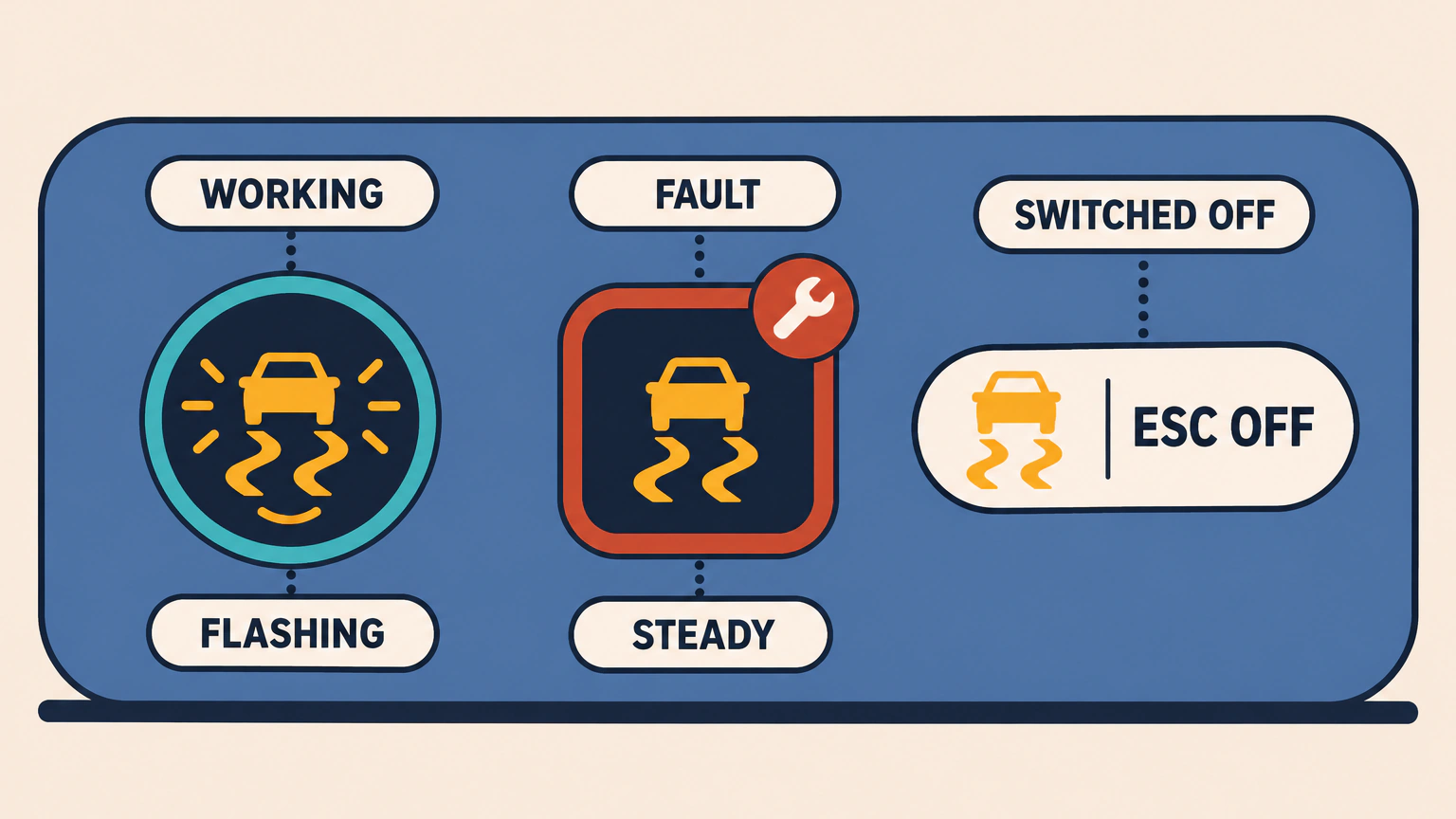
The light just came on and you're wondering whether to pull over. The first useful thing you can do costs nothing. Watch what the light does. The federal safety standard keeps the meanings of amber traction and stability warnings much the same from car to car. Flashing, steady and OFF each mean something different, and each one calls for a different move.
Flashing means the system is catching a slip
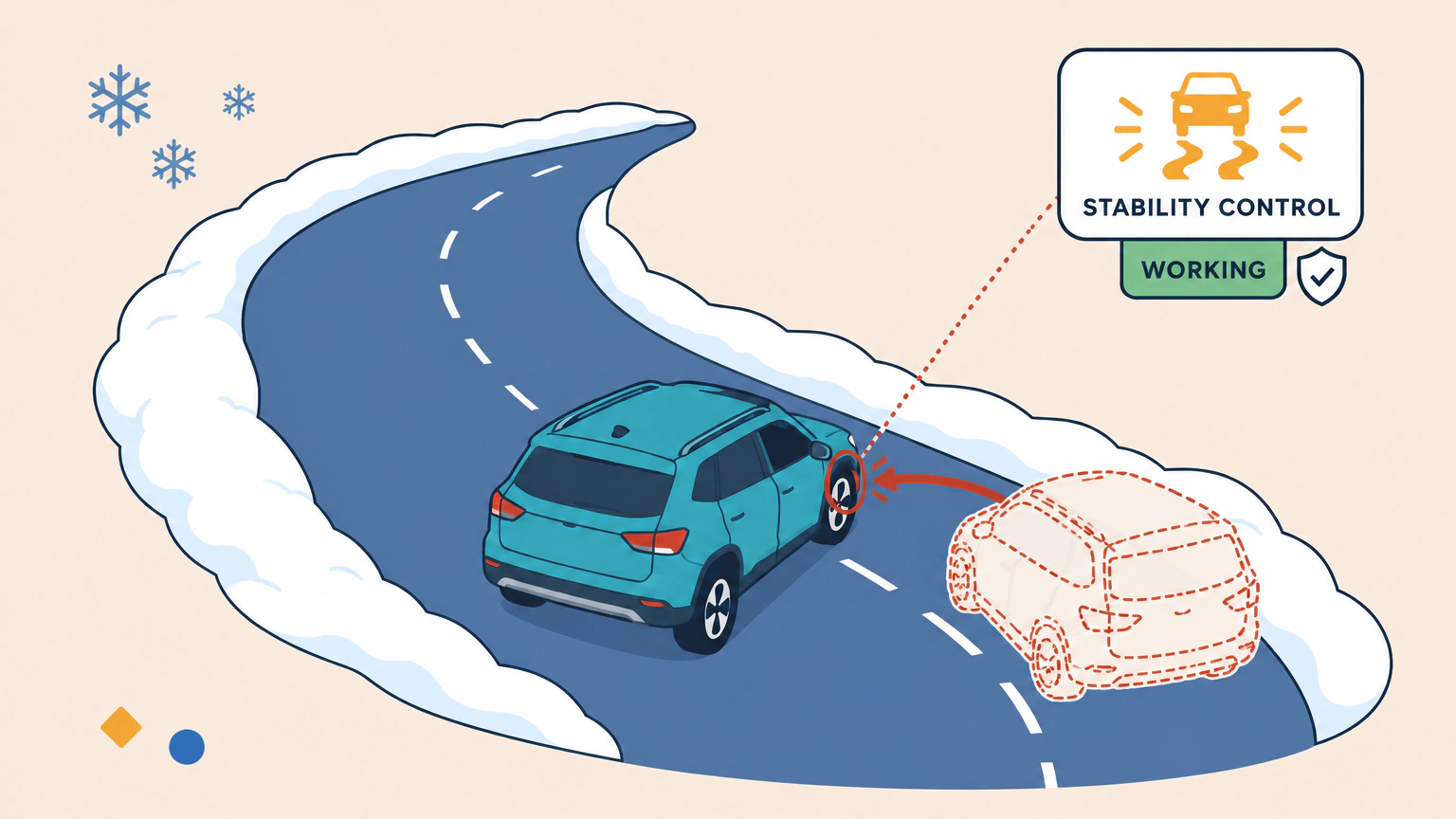
The federal standard lets carmakers flash the light "to indicate ESC operation" (ESC is electronic stability control) and to show traction control at work. When NHTSA surveyed 28 cars with stability control before writing the rule, every one that used a symbol flashed it. Their owner's manuals said the flash meant the system was "active" or "working." GM's owner's manual for the 2025 Equinox puts it plainly: the light "flashes when the TCS and/or the StabiliTrak/ESC system is actively working."
A wheel spun or the car started to slide, and the car braked that wheel or cut power. On snow, rain or gravel, that's normal. Ease off the gas, and take the flash as news that the road is slicker than it looks. Frequent flashing on dry pavement during gentle driving needs a tire check and scan.
Steady means it found a fault
The light normally comes on for a moment when you start the engine. That's the required bulb check on newer cars, not a fault. After that, a light that stays on is the malfunction warning, and the federal standard says it must stay lit "for as long as the malfunction(s) exists." GM's manual says a steady light means traction control, and potentially stability control, "are not fully operational and may not assist in maintaining control."
There's a wrinkle. On some cars the steady light also covers systems that stability control leans on. Mazda's manual says a light that stays on can mean a problem with traction control, stability control or brake assist. That's why the other lights on the dash matter.
Don't assume the car drives, steers or stops normally. Check other lights and how the car feels.
An OFF light means somebody switched it off
A separate light, or the words ESC OFF, TRAC OFF, VSC OFF or DSC OFF, means somebody put the system into its off mode with a button, a touchscreen menu or a drive mode. The federal standard requires the car to go back to full stability control "at the initiation of each new ignition cycle," meaning every time you start it. There are two narrow exceptions, both four-wheel-drive settings: low range, and a locked mode built for snow, sand or dirt.
Mazda puts it more plainly. Leave the system off when you shut the engine down, and it "automatically activates when the ignition is switched ON." So an OFF light on a fresh start, with nobody touching the button, is a fault worth mentioning to the shop. Mazda tells owners to have that checked.
What Service ESC and Service StabiliTrak mean
A message like Service ESC (short for service electronic stability control) reports the same kind of fault as a steady warning. GM's manual says that if either system "fails to turn on or to activate, a message displays in the Driver Information Center." The light then "comes on and stays on to indicate that the system is inactive and is not assisting the driver in maintaining control." Service StabiliTrak is GM's own name for that message, and a GM service bulletin uses those exact words. Whatever your dash calls it, Service ESC, Service Traction Control or Service StabiliTrak, the message means the system needs service and may not assist you.
If braking feels normal and no red brake warning is on, try GM's restart check. Stop, turn the engine off, wait 15 seconds, restart and drive. If the message comes back, book a scan.
Once a fault is actually fixed, the federal standard says the light must go out "at the next ignition cycle." So the repair itself is what clears it, not a separate reset of the light.
Carmakers use different names for the same system, so here's what yours may be calling it.
What your car calls it
| Who | What they call the system | What you may see on the dash |
|---|---|---|
| Federal safety standard (FMVSS No. 126) | Electronic stability control (ESC) | An ESC malfunction light, and a light or the words "ESC Off" when it's switched off |
| GM (Chevrolet, GMC, Buick, Cadillac) | StabiliTrak, working with the Traction Control System (TCS) | One traction and stability light, a Traction Off light, an ESC Off light, and messages such as "Service StabiliTrak" |
| Toyota | VSC and TRAC | A slip indicator, plus TRAC OFF and VSC OFF indicators |
| Mazda | Dynamic Stability Control (DSC) and TCS | A TCS/DSC indicator and a DSC OFF indicator |
| Subaru | Vehicle Dynamics Control (VDC) | A VDC light, and a VDC OFF light or the stability icon with a slash |
Look at what else is lit before you do anything
The other lights on your dash narrow the search faster than any forum thread. One of them also changes what you should do in the next five minutes. Here's how to read the combinations you're most likely to see.
What else is lit, and what it means
| What's lit | What it usually means | What to do |
|---|---|---|
| The traction or stability light, steady, nothing else | The system found a fault and may not assist you. No brake warning is on. | Restart the way your manual says. If it comes back, book a scan that reads the ABS module. |
| That light plus the ABS light | Both systems report a fault. A wheel speed sensor is one possible shared cause. | Leave extra room to stop. If braking feels different, stop driving. Otherwise, get an ABS scan soon. |
| That light plus the check engine light | On some cars, an engine fault can turn on both lights. | Read the engine code first. Fixing it may clear both lights. |
| That light plus the red brake warning light | There may be a problem with the regular brakes. | Pull off the road and stop carefully. If the red light stays on, have the car towed. |
| Only an OFF light (ESC OFF, TRAC OFF, VSC OFF or DSC OFF) | The system was switched off with a button, a menu or a drive mode. | Switch it back on. It also comes back by itself at the next start, except in some four-wheel-drive modes. |
A red brake warning means pull over and stop carefully. With any other combination, slow down and follow your manual. If the car feels different, stop driving. If the tire pressure light came on as well, that's a separate system with its own rules, so deal with it on its own.
What usually turns it on, most likely first
Most of these faults trace back to a handful of parts. The single most useful question is what was done to the car in the last few weeks, because an alignment, a battery, new tires or brake work can each set this light off.
A wheel speed sensor, or the wire running to it
RepairPal calls the wheel speed sensor "the most basic component in the ABS system, and the most likely to fail." Traction control, stability control and the anti-lock brakes (ABS) all read the same sensors, one at each wheel. RepairPal notes they're "shared with your ABS system," which is why the ABS light can come on too.
Those sensors and wires sit at the wheels. The wire flexes as the suspension moves, and one routed badly after a brake or suspension job can get snagged and pulled apart. So if the light showed up soon after a recent brake job, call that shop first. A wheel speed sensor is among the cheaper common fixes.
A steering angle sensor nobody reset after an alignment or a battery change
Stability control has to know where you're pointing the car. The federal standard's own definition of the system requires "a means to monitor driver steering inputs." That's the steering angle sensor, behind the steering wheel. Hunter Engineering, which makes alignment equipment, says about 45 percent of vehicles on the road in North America need that sensor reset after a wheel alignment, as the carmaker instructs. Repairer Driven News, a body-shop trade outlet, adds that the same recalibration can follow "something as simple as disconnecting a battery." Skip it, and Hunter says the result can be a dashboard warning light, a steering wheel that rocks side to side, or a car that drifts or pulls.
Not every car needs the reset, and the procedure differs by model, so ask rather than assume. The shop that did your alignment is the first call. If it can't do the reset, find an alignment shop that can.
Pro tip: Booking an alignment? Ask two things first: does this car need a steering angle sensor reset afterward, and is that reset included in the price?
Tires that don't match, or the spare
The system compares how fast each wheel turns. A tire of a different size turns at a different speed, and to the computer that looks like a slip. Mazda's manual spells out what its system needs: "tires of the correct size specified for your Mazda on all four wheels," the same maker, brand and tread pattern on all four, and no mixing of worn tires. It adds that chains or a temporary spare change the tire diameter, so the system may not work correctly. GM's manual says traction control and ABS may engage with the compact spare on "until the spare tire is recognized by the vehicle."
So if the light arrived with one new tire, or with the spare, you've got an obvious first suspect. Check for worn or mismatched tires, and have a tire shop confirm all four match.
An engine problem, or a bad brake light switch
Two causes aren't wheel parts at all. The first is the engine. Stability control works partly by cutting engine power, and the federal definition of the system includes "a means to modify engine torque." On some cars an engine fault turns the stability light on right beside the check engine light. Subaru says a stability light that "turns on simultaneously with the Check Engine light" could signal a malfunction. When both are lit, read the engine code first.
The second is the brake light switch, the part that tells the car you've pressed the pedal. Kia's 2013 recall of a faulty switch, which grew to about 980,000 vehicles, listed the stability control warning light among its symptoms. Swapping that switch because a forum said so, before anyone scans the car, is a good way to buy the part twice.
What the fix usually costs
The price depends on which part the scan points to. RepairPal's figures run from about a hundred dollars for a brake light switch to more than a thousand for an ABS module. The same job also moves a lot from car to car. RepairPal's wheel speed sensor range runs $184 to $264 on a Ford F-150 and $396 to $520 on a Toyota Corolla.
What the usual fixes cost
| Repair | RepairPal national average, parts and labor | When it's the likely fix |
|---|---|---|
| Wheel speed sensor | $234 to $310 | The ABS light is on too, or the scan names one wheel |
| Wheel hub assembly | $512 to $652 | The sensor is built into the hub and can't be replaced alone |
| Brake light switch | $109 to $146 | The scan points to the brake switch circuit |
| ABS control module | $1,181 to $1,278 | The scan names the module itself, after the sensors check out |
Averages before tax, from RepairPal's national estimates. Your car and your area move them.
The diagnosis comes before any of these. The scan has to talk to the ABS module, not just the engine computer. RepairPal says the technician "will communicate with the ABS control module via computer" and watch live data. We cover what a proper diagnostic scan costs separately. Before you approve a hub or a module, ask whether the sensor on your car can be replaced by itself. RepairPal notes that on some models it can't, and that's how a sensor job turns into a hub job for steering and suspension shops.
Can you drive with the traction control light on?
With a steady light, check the car before you keep driving
If the car feels normal and no red brake warning is on, drive gently to a shop. Traction or stability control may not help in a skid. GM's manual says the systems "may not assist in maintaining control" and tells drivers to "adjust driving accordingly." That help is worth a lot. IIHS research finds stability control cuts the risk of a fatal single-vehicle crash by about half, and of a fatal single-vehicle rollover by roughly three quarters.
On newer cars, the fault can take other features down with it. GM's 2025 Equinox manual says automatic emergency braking can show as unavailable when there's a StabiliTrak/ESC problem, and adaptive cruise control won't engage with the system off. So drive gently, leave extra room, and book the scan before bad weather, not after. A light is a symptom, and the scan on your own car decides what gets replaced.
Red flag: Red brake light too? Pull off the road and stop carefully. GM's own manual says that if the red light is still on once you've stopped, have the car towed, because the regular brakes may not be working properly.
In snow, leave it on unless you're stuck
GM's advice for slippery roads is blunt: "Turn on Traction Control." Mazda agrees that leaving it on "will provide the best traction."
The exception is getting unstuck. In fresh snow the system cuts power to stop the wheels spinning, and Mazda warns that pressing the gas then "will not increase engine power and freeing the vehicle may be difficult." GM says the same. Switch it off to rock the car out, then switch it back on. Forget, and it comes back at the next start anyway.
Some cars re-arm it on the move, too. GM's 2025 Equinox turns stability control back on by itself above 35 mph, but that's one model's behavior, not a rule. Tire chains are the other exception. NHTSA named them as a fair reason to switch the system off when it wrote the rule, and Mazda warns its system may not work correctly with chains on.
Before you pay for a repair
Six checks, most of them free, can narrow the cause or make sure the quote you get is for the right part.
- Note whether the light flashed or stayed on, and which other lights came on with it.
- If braking feels normal and no red brake warning is on, stop, turn the engine off, wait 15 seconds, restart and drive a short way.
- Check that all four tires match in size, brand and tread, and that the compact spare isn't on.
- Think back a few weeks: an alignment, a battery, new tires or brake work? Call that shop first.
- Ask for a scan that reads the ABS module, and ask for the code in writing.
- Look up open recalls for your VIN before paying for a module or a switch. NHTSA's search at nhtsa.gov/recalls takes the VIN (it's on the lower left of the windshield) or your license plate, and recall repairs are free at the dealer.
If the scan points at a sensor, a hub or the ABS module, take it to a brake shop that does ABS work. If the light followed an alignment, go back to an alignment shop. If the code names a module or wiring, an auto electrical specialist is the right call.
Frequently asked questions
Should traction control be on or off in snow?
On. GM's winter advice is to turn traction control on for slippery roads. Switch it off only to rock the car out of deep snow, then switch it back on once you're moving. Forget, and the federal standard has you covered: the car must return to full stability control at the next start, except in a few four-wheel-drive modes.
Why does my traction control light come on when I turn or hit a bump?
A quick flash means the system is responding to wheel slip, and a hard turn can trigger that response. GM's manual says the light flashes while the system is working. If the light stays on after a bump, get it scanned instead of guessing at a loose wire.
How do I reset the traction control light?
You can't reset a real fault away. Only try GM's restart routine if braking feels normal and no red brake warning is on. Stop, turn the engine off for 15 seconds, restart and drive to see whether the warning returns. The federal standard requires the light to go out at the next start once the fault is actually fixed. So a light that keeps coming back needs a scan and a repair, not a reset.
Can new tires or a spare make the traction control light come on?
Yes. The system compares wheel speeds, so a tire of a different size can look like a slip. Mazda's manual asks for the same size, brand and tread pattern on all four wheels, and warns that a temporary spare or chains change the tire diameter. GM says its traction control and ABS may engage with the compact spare installed until the car recognizes it.
Is the traction control light the same as the ABS light?
No. They're separate lights, but the two systems share the same wheel speed sensors, so one fault can light both. GM's manual draws the line that matters. With only the ABS light on, you still have regular brakes, just no anti-lock. With the ABS light and the red brake light on together, there's a problem with the regular brakes, and that's the one to stop for.
What do TC, TCS and ESC mean on a car?
TC and TCS mean traction control (system), which limits wheel spin when you accelerate. ESC is electronic stability control, the term the federal safety standard uses, and it brakes individual wheels to stop a skid as it starts. Carmakers add their own names: StabiliTrak at GM, VSC and TRAC at Toyota, DSC at Mazda and VDC at Subaru.