

On this page
Before you pay for a sensor, look at what the light is doing
First real frost of the fall, you back down the driveway, and a little amber horseshoe lights up the dash. Maybe a shop has already looked at it and said the word "sensor." That one lamp does two different jobs, and federal rules make the two jobs look different on your dashboard. Telling them apart costs you a tire gauge and five minutes.
| What you see | What it usually means | What to do first |
|---|---|---|
| The light comes on and stays on | At least one tire is low. Federal rules require the warning within 20 minutes of a tire falling 25 percent below your door placard pressure | Check all four tires with a gauge and fill them cold to the placard pressure |
| It came on during a cold snap and went out after a drive | Cold air lowered the pressure, about 1 psi for every 10°F, and the tires warmed back up as you drove | Top up to the placard pressure in the morning, before you drive anywhere |
| It blinks for about a minute when you start the car, then stays on | The system has found a fault and may not warn you about a low tire | Check pressures by gauge, then get the system scanned before anyone quotes a sensor |
Why the first cold morning turns it on
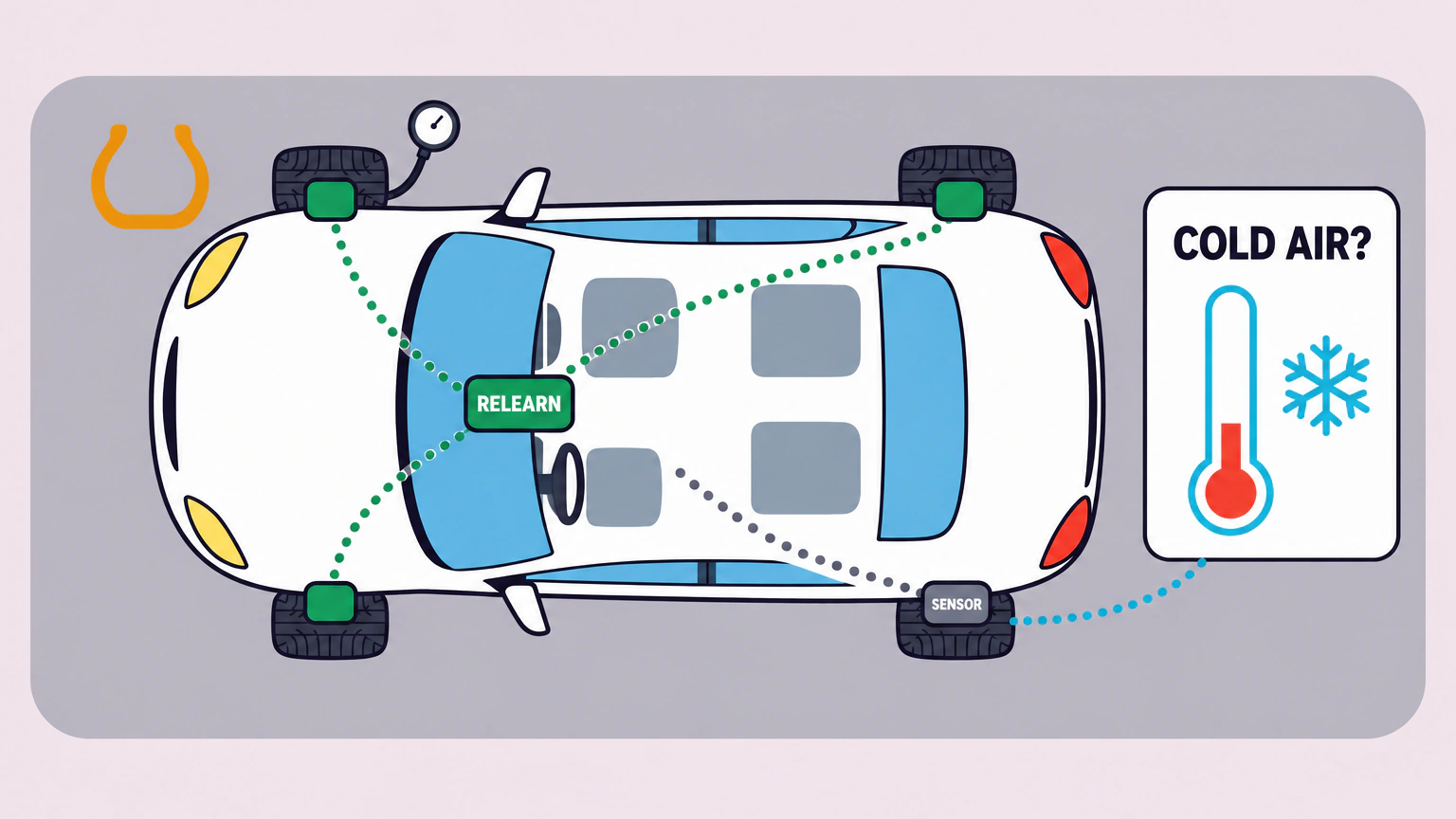
Air shrinks when it gets cold. General Tire puts the rule of thumb at about 1 psi for every 10 degrees Fahrenheit, so a tire you filled on a mild September afternoon can be a few pounds down by the first frosty morning. Federal rules say the system has to warn you no later than the point where a tire sits 25 percent below the pressure the carmaker recommends. Your car may warn you sooner. A tire that was already a little soft crosses that line overnight, lights the lamp, then warms up on the drive to work and climbs back over it.
Check all four cold, before you drive anywhere, and fill them to the number on the placard inside the driver's door frame.
If the light returns a few days after a proper fill, check the pressure again. A tire that's still low has a leak, and that's a flat tire repair, not a sensor. Worth knowing whether that tire can be patched before anyone sells you a new one.
A light that blinks first is a different problem
Watch the first ninety seconds. If your car uses one lamp for both jobs, federal rules say it has to flash for at least 60 seconds and no longer than 90 when the system finds a fault, then stay on solid. Some cars skip the flashing and use a separate lamp marked "TPMS." Either way, the Tire Industry Association puts it plainly: the system has a malfunction, so it isn't watching your tires.
Midas says a dead sensor battery is a common cause. It isn't the only one. A good shop reads every wheel with a handheld tool before it touches a thing, because the fault sometimes sits in the receiver rather than in a wheel. Four new sensors won't fix that one. Ask for a scan that names the sensor, and know what a diagnostic scan should cost first. If a tire looks low, or the light came on at highway speed, pull over somewhere safe and check it before you drive on. No price question outranks that one.
What a TPMS sensor replacement costs
The spread is wide, and it isn't random. Done inside a tire service, one sensor can be a few dozen dollars. Done at a dealer as its own visit, you're into three figures. These are published estimates and quoted examples, not a survey of shops in your zip code.
| Source | What it prices | Price | Worth knowing |
|---|---|---|---|
| RepairPal estimate | A TPMS sensor replacement at a shop | $245 to $305 before taxes and fees; parts $168 to $193, labor $77 to $113 | Doesn't adjust for where you live |
| J.D. Power | Replacement, per tire | $50 to $200, usually $100 to $150 | A dealer or a specialized sensor can push it higher |
| Car Talk | One tire's sensor replaced | $50 to $350; the sensor alone $40 to $200 | A tire retailer, a shop or a dealer can all do the job |
| Car Talk, calls to dealers | A dealer replacing one sensor | $125 to $200; a Subaru Forester sensor $171, about $210 with remount and balance; a Ford F-150 sensor $182, just over $200 mounted and balanced | Two dealers, quoted by phone |
| Car Talk, a Massachusetts mobile tire shop | One sensor, two ways | $40 installed and programmed when the tire is already off; add $50 labor per tire for a sensor-only visit | One shop's pricing, and the clearest case for timing the job |
What's inside the price
Four things hide inside a sensor quote. A good service writer names all four without being asked.
The part. RepairPal puts parts at $168 to $193 of its estimate, while Car Talk prices the sensor itself at $40 to $200. Ask whether the quote uses an original-equipment or aftermarket sensor.
The tire work. The sensor lives inside the wheel, so the tire has to come off, go back on, and be rebalanced. That's why Car Talk's dealer quotes jump once "remount and balance" gets added.
The service kit, for an aluminum clamp-in sensor. Cap, valve core, nut and grommet. Schrader says those sealing parts get replaced whenever the tire comes off the wheel, even when the sensor stays.
The relearn. A new sensor has to introduce itself to the car. RepairPal describes it as driving a short distance or relearning the sensors by hand.
Ask which of the four your number covers. A price for the part alone isn't a price for the job.
Why the dealer's number runs so much higher
Car Talk phoned two dealers and got $125 to $200 per sensor. A Subaru dealer quoted $171 for a Forester's sensor and about $210 once the wheel was remounted and balanced. A Ford dealer quoted $182 for an F-150 sensor and just over $200 mounted and balanced. Then it called a mobile tire shop in Norwood, Massachusetts, which charges $40 per sensor including installation and programming, as long as the tire is already off.
Car Talk's own verdict: "the dealer will cost you the most for the same result."
Two things drive that gap. One is the part, a dealer's $171 or $182 against $40 fitted. The other is the visit, a standalone remount and balance against a few extra minutes inside tire work that's already happening. Nobody here is the villain. A dealer may quote the carmaker's part, and plenty of drivers want exactly that. Just know which one you're buying, because tire shops near you quote the same repair on a different basis.
The cheapest way to get it done
There are three honest ways to pay less, and not one of them involves leaving the system switched off.
Wait for the tire to come off anyway
Remember that $50 the Massachusetts shop adds per tire for a sensor-only visit. You're paying it because the tire still has to be broken down, refitted and rebalanced for a part the size of a key fob. Do the sensor while the tire is already off and that charge disappears.
So if your tires are close to done, the math changes. Midas says most sensor batteries last five to ten years, and that swapping older sensors in with new tires is often convenient. Work out how to tell if you really need new tires first, then price the sensors as a line on that visit at a tire store. This only works if the car is safe to drive in the meantime. With the warning system down, you are the warning system, so check all four with a gauge every couple of weeks.
Ask which aftermarket sensors the shop can fit
Aftermarket sensors come in three broad types. Direct-fit sensors carry one vehicle protocol. Programmable sensors come blank, while preprogrammed ones arrive with a list of protocols. The installer Car Talk interviewed described one programming route: his tool can clone the code from a good sensor, or pull information from the OBD port and write new code to the car.
That's the trick, and the trap. Buy a blank sensor online, hand it to a shop without the tool, and you'll be told it "can't be reset." Sometimes the sensor is wrong for the car. A blank sensor still needs the programming step. Car Talk's advice is to phone ahead, because special tools are used to program the sensor. So ask before you click buy: do you program aftermarket sensors for my car, and do you want blank ones or preprogrammed?
Ask the shop that last had your wheels off
If new tires went on recently, stop shopping for a quote and call that shop. RepairPal's own recommendation is to contact the repair center where the tires were last installed and use the warranty if there is one.
There's a good reason the timing matters. FMVSS 138, the federal standard, requires an owner's-manual line telling drivers that a malfunction can come from "the installation of replacement or alternate tires or wheels on the vehicle that prevent the TPMS from functioning properly," and to check the warning after any tire or wheel change. Sensors can be damaged during a tire change, and some systems take several days to report a fault. Light off going in, light on coming out, same shop. Start there.
Pro tip: Keep the plain plastic caps on your sensor valve stems. Schrader, which makes original-equipment sensors, warns that a brass cap on an aluminum stem can corrode until it sticks, and forcing it off can damage the stem. That's a cheap cap turning into a sensor bill.
Replace one sensor or all four?
Car Talk's rule of thumb is the useful one. If your sensors are under about ten years old and one quits, replace that one. If the car is older than ten years, the others are probably close behind, and that can mean four sensors, or five when the spare carries one too. Midas's five-to-ten-year battery life says the same thing from the other direction.
On an original set in a car past its tenth birthday, we'd do them all in one visit. You pay for the tire work either way, and paying it four separate times over two years is the expensive way to save money. On a car still in its first decade, one sensor is a fair answer, and a shop recommending four should say what the other three did to earn it. "They're all the same age" is a reason. "While we're in there" is not.
Will a lit TPMS light fail your state inspection?
"That light will fail your inspection" is the sentence that sells sensors. So we read the rulebooks in eleven states.
| State | What the rules say about the TPMS light | Where it's written |
|---|---|---|
| Massachusetts | Not an inspection item. The inspection program told stations "Vehicles cannot be failed if a TPMS Lamp is illuminated." | Massachusetts Vehicle Check, Inspection Update, Fall 2013; 540 CMR 4.04 |
| New York | TPMS isn't an inspection item. Inspectors check tire pressure, but that check is "an advisory only, do not reject the vehicle." | 15 NYCRR 79.21(c) |
| Pennsylvania | TPMS doesn't appear in the inspection rules. | PennDOT Publication 45, Vehicle Equipment and Inspection Regulations |
| Virginia | TPMS doesn't appear in the passenger vehicle inspection rules. | 19VAC30-70, Part III |
| Vermont | Not a reason to reject. The station must advise you and "recommend repair" if the light is on and the system may be malfunctioning. | Vermont Periodic Inspection Manual, VN-113 |
| West Virginia | Not a reason to reject if adjusting the pressure doesn't clear it and the tires pass. The inspector must tell you it should be repaired and note it on your receipt. | West Virginia State Police Official Motor Vehicle Inspection Manual |
| Rhode Island | TPMS isn't named. The ABS and airbag lights are, and the general rule for defective parts reaches only items "identified in this manual." | 280-RICR-30-15-3 |
| North Carolina | TPMS isn't on the list of nine inspected items. Tires are. | N.C. Gen. Stat. § 20-183.3(a) |
| Maryland | TPMS doesn't appear in the passenger car inspection standards. | COMAR 11.14.02 |
| New Jersey | No safety inspection for most passenger vehicles since August 1, 2010, emissions only. | NJ Motor Vehicle Commission Advisory 2010-003 |
| Texas | No safety inspection for non-commercial vehicles since January 1, 2025. | Texas Department of Motor Vehicles notice, December 17, 2024 (House Bill 3297) |
These are the written rules for passenger cars. Tires themselves are an inspection item in every state here that runs a safety inspection, so a worn or damaged tire can still cost you the sticker.
Not one of the eleven lists the light as a reason to fail. Massachusetts put that in writing to its stations. Vermont and West Virginia go further. Both tell the inspector to advise you and recommend the repair instead of rejecting the car. Rhode Island names the ABS and airbag lamps as rejection items and never mentions this one. New Jersey and Texas don't safety-inspect ordinary passenger cars at all. Some guides online still list states where the light fails you. In the manuals we read, it doesn't.
Your state might not be one of the eleven. Search its inspection manual for "TPMS," or ask an inspection station to show you the line before you pay. And keep it in proportion. In every one of these states that still inspects, the tire itself is on the list. The lamp isn't what costs you a sticker. A cut or bald tire is.
What a shop isn't allowed to do about the light
Almost nobody tells drivers about the federal law on this. Under 49 U.S.C. § 30122, a repair business may not knowingly make inoperative any part of a safety device your car was built with to meet a federal standard. Your tire pressure monitoring system is one of those devices.
In plain terms: a shop can't switch the system off to make the lamp go dark, and it can't hand back a car with a system it knowingly killed during a tire job. The law aims at businesses rather than at you, and it makes an exception for testing during a repair. It also turns on that word "knowingly." A sensor broken by accident during a tire change isn't a federal case, it's a warranty conversation, and the shop that did the work is the one to have it with. FMVSS 138 pushes the same way, by requiring the owner's manual to tell you to check the warning after any tire or wheel change.
Questions to ask before you say yes
This is a two-minute phone call, and it's the cheapest two minutes in the job. You want to know one thing: did anyone read this car, or did someone read the dashboard?
- Which sensor isn't reporting, and did you read it with a scan tool?
- Is this price for one sensor or the whole job, and does it include remounting, balancing, the service kit and the relearn?
- Is it an original-equipment, direct-fit, preprogrammed or programmable aftermarket sensor, and what setup does it need for my car?
- If you're recommending more than one sensor, why do the others need replacing today?
- Is any of this still under warranty from the shop that last put tires on my car?
Red flag: Three things worth slowing down for. A sensor quote with no scan result behind it. Being told the light will fail your inspection in a state whose rules say otherwise. And an offer to make the warning go away instead of fixing what set it off, because federal law bars a repair business from knowingly disabling a safety system your car was built with.
Get the scan result and an itemized price in writing before you approve anything. That's what keeps you out of the argument that starts when the bill comes in higher than the quote. And if a shop won't tell you which sensor failed, call one that will.
Frequently asked questions
Can I drive with the TPMS light on?
Briefly, and carefully. FMVSS 138 requires your owner's manual to tell you that when the low pressure lamp comes on, you should stop and check your tires as soon as possible. Midas puts the limit well: it's only safe if you're certain your tires are holding proper pressure. If the fault is in the system itself, nothing is going to warn you about the next slow leak.
Why is my tire pressure light on when my tires look fine?
Because a tire can be badly underinflated and still look normal. The Tire Industry Association says underinflation is visually difficult to detect and recommends checking monthly with an accurate gauge. Two other explanations: Car Talk notes some cars monitor a full-size spare, and Midas says some systems need a reset after you add air or rotate the tires.
Do TPMS sensors need to be programmed?
It depends on the sensor. A blank programmable sensor needs its vehicle protocol loaded, while a direct-fit or preprogrammed sensor does not. The car still needs a relearn so it recognizes the replacement sensor. Programming and relearning are different steps, so ask whether the shop can handle both for your car.
Do I need new TPMS sensors when I buy new tires?
No. Midas says you don't need to replace sensors when buying new tires, though it's often convenient if they're more than a few years old, since the tire is coming off anyway. For Schrader aluminum clamp-in sensors, the sealing parts, the cap, valve core, nut and grommet, are renewed whenever the tire comes off the wheel.
Can you replace just the battery in a TPMS sensor?
Almost never. Midas says most TPMS sensors don't have removable batteries, so the whole sensor usually gets replaced once the battery is drained. In those sensors, the battery is sealed inside the unit, which is why a dead one turns into a part price rather than a five-dollar cell. If a shop offers to swap the battery, ask which sensor it has that allows it.
How long do TPMS sensors last?
Midas puts most sensor batteries at five to ten years. Car Talk frames the same fact as an ownership milestone: keep a car past roughly ten years and you should expect to replace one or more. Your original sensors are all the same age, which is why that matters when you're deciding how many to do.
Does every car have a sensor inside each wheel?
Most cars, but not all. The Tire Industry Association says direct systems use a sensor inside each tire, and that a few indirect systems work through the wheel speed sensors instead, so there's no wheel sensor to buy or program. Your owner's manual will tell you which one you have, and it's the first thing to check before you price anything.