

On this page
- Start here: the three things a shop checks
- Tread, shoulder, sidewall: where a repair is allowed
- Why the tire has to come off the wheel
- Plug, patch, or both: what a proper repair is
- What a repair costs, and what saying no costs you instead
- Seven reasons a shop turns a tire down
- Can the same tire be patched twice?
- Run flats, sealant cans, and roadside plug kits
- What to do right now if you have a nail in your tire
- Frequently asked questions
Start here: the three things a shop checks
A technician checks the location, the hole size and the tire's condition. Where did the object go in? How wide is the hole? What does the inside of the tire look like once it's off the wheel?
The first two answers come from one document, the U.S. Tire Manufacturers Association's puncture repair wall chart, which hangs in a lot of American tire shops. The third belongs to whoever built your tire, because the chart hands that decision straight over: "Not all tires can be repaired. Specific repair limits should be based on recommendations or repair policy of the tire manufacturer and/or type of tire service."
That's why two shops can give you different answers about one nail. You can spot damage near the edge yourself. The hole's full width and path, and any hidden damage, need an off-wheel inspection.
Tread, shoulder, sidewall: where a repair is allowed
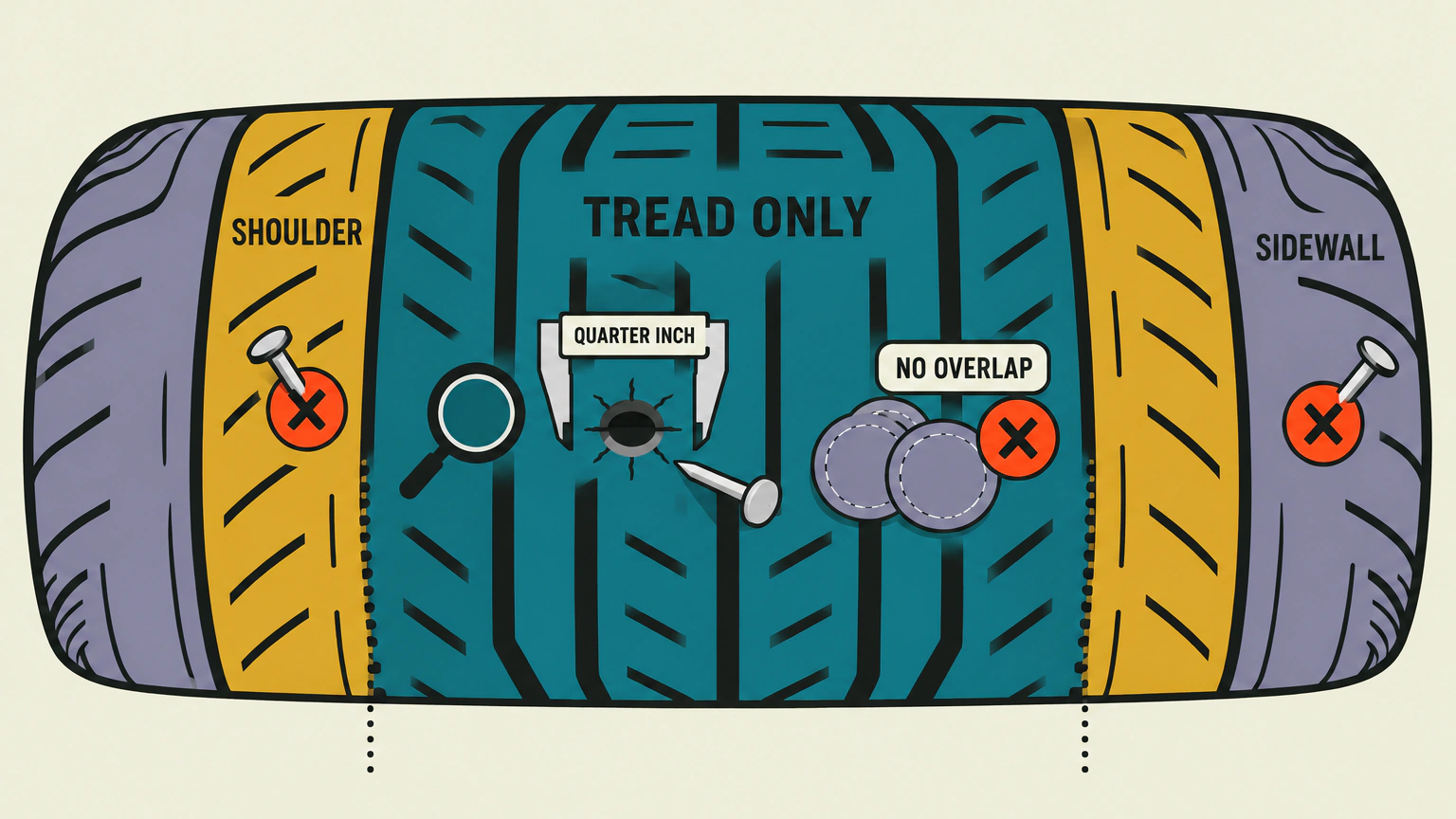
The face of a tire isn't one surface. It's three. Only the middle one can be repaired. The chart is brief about it: "Repairs are limited to the tread area as shown in the graphic."
Why the shoulder is off limits even though it looks like tread
The shoulder carries tread blocks and grooves, so it looks like fair game. It isn't. That's the belt edge area. The shoulder and sidewall flex as you drive, and a patch isn't designed for that movement. Les Schwab gives exactly that as its reason for refusing damage closer than half an inch to the sidewall.
The chart draws the line in capitals: "DO NOT make repairs where the injury damage extends into the shoulder/belt edge area." Sidewalls are out for the same reason, only more so. "It looks like tread to me" is what drivers say right before a shop says no. The shop is right.
The angled nail that starts in the tread and ends somewhere else
Here's the case the big pages skip. A nail can go in dead center and still travel sideways under the belt on its way through. From above, the head sits in perfect tread. Underneath, the shank has rubbed toward the shoulder, and from outside you see nothing at all.
The chart rules that tire out on exactly that basis: repairs are banned "where the injury extends at an angle into the shoulder area," and if there's any question about it, the tire gets scrapped. Goodyear's bulletin tells the technician to pull the object out "noting the angle of penetration," then probe the channel with a blunt awl to learn where it really went. Past 25 degrees, the repair itself has to change.
A shop can reject visible damage from outside. It can't clear a tire for repair without looking inside.
How to spot damage near the edge
The tread curves away toward the sidewall at each shoulder. Damage there is out of bounds. That bend is a warning sign, not a way to clear a hole near the belt edge.
While you're down there, find out how many leaks you actually have. Mix dish soap and water in a spray bottle, wet the whole tread, then do both sides of the wheel and finish at the valve stem with the cap off. Wherever it bubbles, air is getting out. A leaking valve can also explain the pressure loss.
A picture and a rule get you most of the way. The only person who can clear a tire is someone who's taken it off the wheel and looked inside.
Why the tire has to come off the wheel
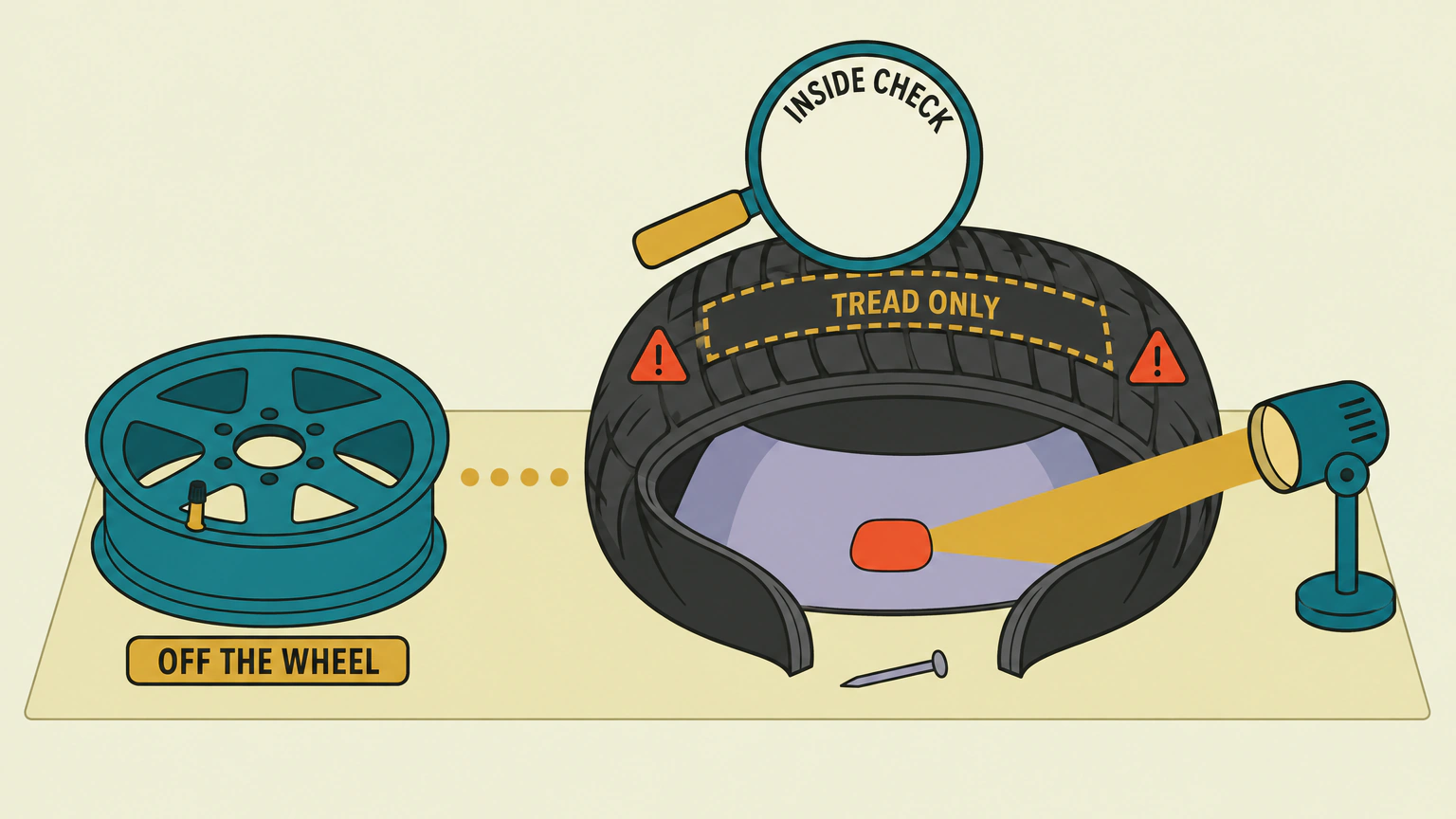
Drivers push back on this step harder than any other. It reads like padding on the bill. The chart leaves no daylight: "NEVER perform a tire repair without removing the tire from the rim/wheel assembly for internal inspection." EricTheCarGuy's ten minute tire repair walkthrough shows you the whole thing, from spreading the beads to stitching the unit down.
What the technician is looking for in there
The sequence is fixed. Spread the beads, mark the injury with a tire crayon, pull the object while noting the angle it came in at, then probe the channel with a blunt awl to learn how deep it runs and which way. The channel gets reamed so no damaged rubber is left behind, and the plies around it get checked for splits.
Then comes the part you're really paying for. The technician reads the whole inner liner, not just the puncture, looking for the chafing that says this tire has been run soft.
The damage you can miss from outside
A tire driven even a short distance while badly underinflated can be finished as a structure with nothing showing outside. Underinflation and overloading fatigue the cords, the steel ones especially. They break one after another until the sidewall ruptures all at once, which the trade calls a zipper failure, and it lets go with enough force to hurt whoever is standing there.
The wall chart makes the point with a photograph of a wrecked casing and one line underneath: "The damage was not visible from the outside." That's the honest answer to why a tire that looks fine gets condemned, and it's why a shop asks how far you drove on it.
Red flag: Aerosol sealants and factory mobility kits provide temporary mobility, not a repair. Follow the tire maker's instructions and go promptly to a shop. An outside plug is an improper repair. Under the chart's rule, a tire that already carries one must be scrapped.
Plug, patch, or both: what a proper repair is
The industry recognizes two acceptable methods. Neither is a plug on its own. One is a two piece stem and patch. The other is a one piece combination unit, a rubber stem with the patch already attached. Everything else fails the chart's flat verdict: "A repair using a plug only or a patch only is NOT ACCEPTABLE."
Why a plug alone and a patch alone both fail
The two parts do two different jobs. The stem fills the injury channel from the inside out, so water can't sit against the steel belts and rust them. The patch seals the inner liner, the airtight skin inside the tire, so the air stays where it belongs. Skip the patch and the tire keeps seeping. Skip the fill and water gets into the open injury channel and eats the belts, which is Les Schwab's own reason for insisting on both.
The angle matters here too. Past 25 degrees, the chart recommends the two piece version.
What a finished repair should look like when you get the keys back
Four things should be true when the car comes back. The tire came off the wheel. The repair sits inside the tread band, not near the edge. The wheel got rebalanced, which is routine work at tire service and balancing shops and the step most drivers don't expect. And the tire holds pressure overnight.
If it's still losing air at the repair, don't let anyone top it up and send you away. The chart says that tire comes off the wheel again for a full reinspection and rework.
Pro tip: Ask to see the tire off the wheel, inside face up, before you agree to a repair. If the shop found damage inside, ask it to show you. A visible sidewall puncture or worn-out tread can rule a tire out before it comes off the wheel.
What a repair costs, and what saying no costs you instead
A flat repair price buys the whole job: the tire off the wheel, an internal inspection, a combination plug and patch, then remount and rebalance. It's cheap because it's quick, not because it's slight. Free repairs are real too. Les Schwab includes them with tires bought there, and AAA says road hazard coverage can cover the bill.
Across our own cost profiles for this category we see $16 to $31, with $21 the average. Hold any quote from flat tire repair shops near you against that. Our category pages price to your location, so that range is one snapshot across shops rather than a fixed line for the country.
| Option | Published US price guide | What it includes | The catch |
|---|---|---|---|
| Flat repair, our cost profiles | $16 to $31, with a $21 average across our own cost profiles | Ask whether inspection, plug and patch, remounting and rebalancing are included | The price depends on the job and the tire passing inspection |
| Flat repair, AAA's published range | $25 to $75 | The same job, including rebalancing the wheel afterward | AAA's national figure, not a quote for your market |
| Free repair where you bought the tires | No charge | Les Schwab repairs covered flats free and replaces the tire free if it cannot be fixed | Applies to tires bought from that retailer, not to any tire you bring in |
| Do it yourself plug kit | $50 to $100 for a full kit, per AAA | Reamer, plugs, pliers, a compressor and a gauge | An outside plug is an improper repair. The chart says a tire carrying one must be scrapped |
| One replacement tire | $150 to $400 or more, per AAA | A replacement tire. Ask whether mounting and balancing are included | An all wheel drive car may need matching tires at all four corners |
The math that decides repair or replace
Set our $21 average against the cheapest new tire in AAA's range, $150, and the repair costs about a seventh of the replacement. That's why we'd make somebody prove a tire is unfixable before you buy one.
Replacement carries a cost the quote hides. Put one new tire beside a half worn one and the tread depths no longer match. An all wheel drive car may need matching tire diameters at all four corners, so check its maker's replacement rules. One case runs the other way: a tire already close to the wear bars. Repairing it won't restore the tread you've already lost.
Seven reasons a shop turns a tire down
Most of the time the no you hear is a safety standard, not a sales pitch. Every one of these traces to the wall chart or to a manufacturer's own policy.
- The puncture is wider than a quarter inch. The ceiling is 1/4 inch, or 6 mm, measured across the injury. Bigger than that and the chart rules it out.
- The object went into the shoulder or the sidewall. Those areas flex, so a repair works loose. No shop working to the chart will touch one.
- It entered the tread at an angle and came out under the shoulder. This shows up only once the tire is off the wheel.
- There's already a repair where the new one has to sit. Repair units cannot overlap. Les Schwab says the same: new damage overlapping an old repair means the tire gets replaced.
- Somebody plugged it from the outside. The chart bans outside in and on the wheel repairs, and bans repairing a tire that carries an improper one. That tire is scrap.
- The tread is gone. Nothing is repairable on a tire worn to its treadwear indicators or worn down to two thirty seconds of an inch anywhere on the tread, however clean the puncture is.
- It has damage from being driven flat or badly underinflated. The inside can be chewed up and the cords weakened, even when the outside looks fine.
Any one of these disqualifiers is enough to rule out a repair. If that leaves you buying a tire, start with tire shops near you and get a second price.
Can the same tire be patched twice?
Often, yes. But there's no universal number that covers every tire. The wall chart's rule reads: "For all tires, repair units cannot overlap. The number of repairs should be limited first by the tire manufacturer's recommendations and repair policy and then by application and the individual tire's condition."
Your tire brand sets the first limit. A shop also checks the tire's condition and follows its own repair policy. Look up your brand's policy first.
Speed rated tires, and the one repair limit
Goodyear does put a number on it. Its current repair bulletin says "for H and above speed rated tires, Goodyear allows only one properly performed puncture repair for the speed rating of the tire to be maintained." Just one. After a second repair, Goodyear no longer stands behind the rating.
Your own rating is a letter in the service description, printed near the size on the sidewall: Q, S, T, U, H, V, W, Y or ZR. H and anything past it puts you in that bracket on a Goodyear.
You'll read elsewhere that a properly installed combination patch restores a tire's full speed rating. The chart doesn't say that. It says the manufacturer "must be contacted for its individual repair policy and whether the speed rating is retained after repair."
Run flats, sealant cans, and roadside plug kits
The two things in your trunk are mobility, not repair. An aerosol can or a factory mobility kit gets you off the side of the road and to a shop, and the chart says so in as many words. There's a consequence people miss: a tire dosed with sealant may already have been run underinflated, so it has to be inspected for that damage before anyone repairs it. Tires built with sealant from the factory need specialized technique, and the tire maker gets asked first.
Run flat tires are the manufacturer's call
The internet's flat answer is that a punctured run flat means a new tire, full stop. Neither the chart nor Goodyear puts it that way. The chart is careful: "Some run-flat technology tires cannot be repaired. Consult tire manufacturer for their repair policy." Goodyear answers it the other way for its own tires, stating that its run flats "may also be repaired in the same manner specified in the wall chart."
Two answers, both current. With a punctured run flat, then, the useful move is to find your brand's published repair policy and bring it to the counter, rather than argue once you get there.
What to do right now if you have a nail in your tire
In order, from the driveway to the counter.
- Leave the nail where it is. Pulling it can turn a slow leak into a flat.
- Check the pressure. The target is on the driver's door placard or in your owner's manual. If the tire is damaged or has been driven flat, use the spare or call for help instead of inflating it yourself.
- Look for the leak while you're safely parked. Soapy water over the tread, both sides of the wheel, and the valve stem can help you find it.
- Look at where the object actually sits. Middle of the tread is good news. Out where the tread starts curving away isn't.
- If it's out toward the edge, or the tire won't hold air, don't drive it. Fit the spare, or call roadside assistance in your city. With no usable spare, know what a tow runs before you phone anyone.
- Ask what rules the tire out. Have the shop show you visible damage, or damage found during its off-wheel inspection, before you agree to a new tire.
When you're ready to book, compare flat tire repair shops near you and take the nail in with you.
Frequently asked questions
Can a tire be patched if the nail is in the sidewall?
No. Industry procedure limits every repair to the tread area, and the sidewall is excluded because it flexes with every rotation. A patch bonded there works loose and fails, sometimes at speed. No price and no technique changes that. A sidewall puncture means a new tire, and an offer to fix one is a reason to leave.
Can the same tire be patched twice?
Often, yes. Two conditions have to hold. The new repair can't overlap an old one, and your tire manufacturer's policy has to allow a second repair. There's no industry number for every tire, so a limit of two or three needs your tire maker's policy behind it. Goodyear allows just one on its H rated and faster tires if the speed rating is to stand.
Is it safe to drive with a nail in my tire if it is not leaking?
Don't use a steady pressure reading as proof it's safe to drive. Leave the nail in place and arrange an inspection promptly. The tire has to come off the wheel before a repair can be approved.
How much should a shop charge to patch a tire?
Across our own cost profiles for this category we see $16 to $31, with $21 the average. AAA puts a professional repair at $25 to $75, which includes rebalancing the wheel afterward. If you bought the tires from the shop doing the repair, or you carry its road hazard coverage, it's often free. Anything far above $75 deserves an itemized explanation.
My shop plugged the tire without taking it off the wheel. Is that a real repair?
No. The industry is unusually direct about it: no shop should repair a tire from the outside, or while it's still on the wheel. Nobody inspected the inside of your tire, so nobody knows what the nail did in there. The chart says a tire with an existing improper repair must be scrapped. That includes a plug installed without taking the tire off the wheel.
Does a tire repair void the speed rating?
Not automatically, but don't assume it survives either. The wall chart tells shops to contact the tire manufacturer to learn whether the rating is retained after a repair. Goodyear publishes its own answer: one properly performed repair on an H rated or faster tire, and the rating stands. Check your own brand's policy.