

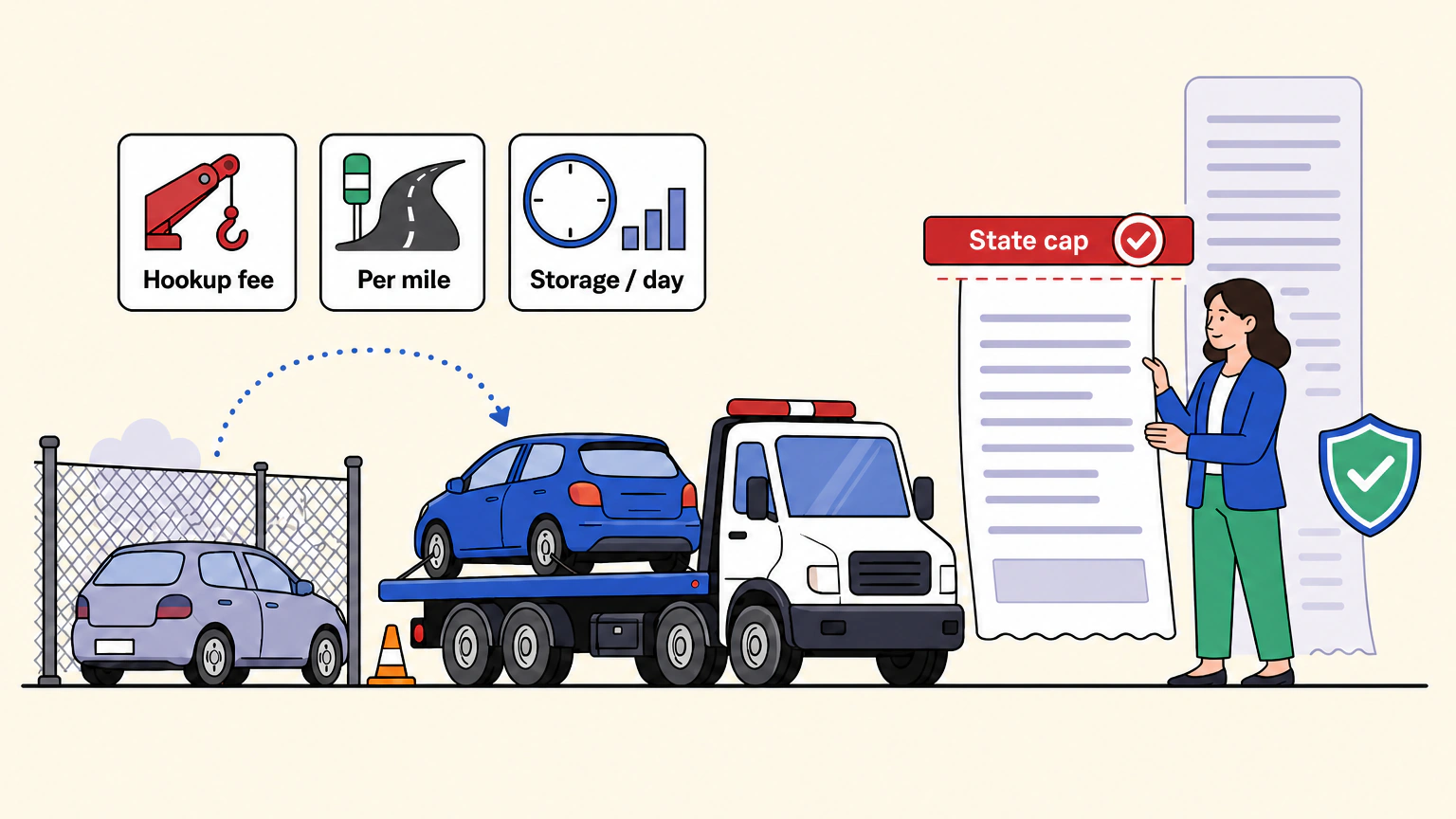
That $4.45 isn't a market average. It's the midpoint of two figures regulators actually set: Colorado's August 2026 maximum of $4.63, fuel surcharge included, and Miami-Dade County's $4.27. Which bill you're holding matters more than any national average, because a regulated tow may carry a published ceiling you can look up and hold the operator to.
On this page
- Two tows, two completely different prices
- What a tow you called actually costs in 2026
- What a tow you didn't authorize costs: your state's published ceiling
- Storage is the bill. The tow is just the deposit.
- Red flags: seven things that should stop you cold
- If you think you were overcharged: a four-step path
- The three things that keep you out of a tow yard in the first place
- Frequently asked questions
Two tows, two completely different prices
Search "average tow cost" and you get the price of a tow somebody chose to order. That's one of the two bills. For the other, the number that matters sits in a nonconsensual-tow schedule, not in a market average.
The tow you called: a price you can get on the phone
You picked the company, so use the one moment of leverage you get and ask for the number before the truck rolls. Regulated rate schedules generally cover nonconsensual tows rather than owner-requested ones. Call two towing companies in your city and ask each for a hookup fee and a per-mile rate. That leverage ends the moment your wheels leave the pavement.
The tow you didn't call: a price set by a regulator
A car pulled off private property at the property owner's request, or hauled away on a police order, is a nonconsensual tow. Learn that phrase. It's the term the regulators use, and typing it into a search box turns up a rate schedule instead of an ad.
You don't get to pick the company here, and there's nothing to negotiate. Many states and localities regulate the charge anyway, and several publish a ceiling.
Why the storage clock changes everything
The bill on a tow you ordered may stop when your car reaches the shop. The other bill keeps a clock running. Storage may accrue in whatever billing periods local law sets, and that clock is what separates an expensive night from a genuine problem.
What a tow you called actually costs in 2026
The hookup fee: what it buys and when it's charged
A quoted hookup fee usually covers getting the truck to you and getting your car onto it: dispatch, securing, lifting. It sits apart from the distance charge, which is why a one-mile tow looks so brutal per mile. The cost publishers put it at roughly $75 to $125 in 2026.
Per mile: what regulators say versus what the internet says
Two regulators, working independently, landed within fifty cents of each other.
Table A. What a mile actually costs
| Source of the figure | Who set it | Per-mile rate | What it covers |
|---|---|---|---|
| Colorado PUC, 4 CCR 723-6 Rule 6511(b)(III) | State regulator, cost study | $3.80 base plus a monthly diesel surcharge ($0.83 in August 2026, so $4.63) | Private-property impound |
| Miami-Dade County Consumer Protection | County regulator | $4.27, Class A, after 5 miles | Police-directed tow |
| Live tow-cost publishers | Market survey, unsourced | $2.50 to $7.00, "average $4.75" | A tow you call |
Colorado's $3.80 is only a base. The monthly surcharge pushed its private-property-impound maximum between $4.05 and $4.91 from September 2025 through August 2026, so the ceiling moves while the schedule sits still. Useful as a comparison. Not a market cap on a tow you ordered yourself.
Flatbed, winch-outs and the surcharges that move the number
Open your owner's manual before you argue about equipment. Many all-wheel-drive and electric-vehicle manuals require all four wheels off the ground, which usually means a flatbed, though some permit a wheel lift with dollies instead. Your vehicle's own towing instructions are the ones that count.
A winch-out, dragging your car out of a ditch or off a shoulder, may show up as labor. Seattle doesn't allow that on a private-property impound: winching, dolly service, hookup and standby time all sit inside the hourly rate, and billing them separately is forbidden. The cost publishers put after-hours and weekend surcharges at 20 to 50 percent. On a tow you ordered, the quote you agreed to is what controls.
What your roadside plan actually covers
Covered mileage is the term to read closely, and the time to read it is now, not while the truck idles. Go past the plan's limit and the extra distance may land on you at the provider's excess-mile rate. Your policy says which.
Table B. Roadside plan towing limits
| Plan | Miles per tow | Past the limit | Fine print |
|---|---|---|---|
| AAA Classic | About 5 | Per-mile overage | Some clubs, 7 |
| AAA Plus | Up to 100 | Per-mile overage | 4 calls a year |
| AAA Premier | 200 on one call a year | Reverts to 100 | Once a year |
| GEICO roadside | 15 in most states | You pay per mile | Nearest facility only |
| Progressive roadside | 15, or nearest shop | Extra mileage is yours | Pay to go farther |
| State Farm roadside | Nearest qualified facility | Mileage is yours | Varies by state |
| USAA roadside | Nearest repair shop, or a chosen shop within the distance listed in the policy | Check the policy | Eligibility and distance vary |
| Manufacturer plan | Varies; often a franchised dealer | Varies by brand and model | Coverage term varies |
| No coverage | Zero | Full quoted rate | No plan benefit applies |
AAA clubs vary, and so do insurer policies from one state to the next, so confirm yours on your declarations page or membership terms. If your covered miles won't reach your own mechanic, compare longer-tow plans from roadside assistance providers.
Four things to ask before you say yes on the phone
Say these out loud, in this order.
- "What's your hookup fee, and what's your per-mile rate after that?" One combined total hides which half is padded.
- "Is that rate different after hours or on a weekend, and is right now 'after hours' for you?"
- "Are winching, dolly service or a flatbed extra, or included?"
- "Can you take it to my shop at this address, or only to the nearest one?" Pick from the auto repair shops near you before you dial, not while the driver waits.
What a tow you didn't authorize costs: your state's published ceiling
The eight jurisdictions we verified against the primary source
Every maximum here came off the regulator's own page, schedule or statute. Eight, not fifty, because a wrong number costs you real money standing at a tow-yard counter.
Table C. Published maximum rates for a tow you didn't authorize
| Jurisdiction | Who sets it | Max tow, passenger car | Storage | Other capped charges | Verified against |
|---|---|---|---|---|---|
| Colorado | PUC, 4 CCR 723-6 Rule 6511 | $250.91, under 10,000 lb | $48.19 / 24 hrs or part | Mileage $4.63/mi in August 2026 ($3.80 base plus $0.83 surcharge), up to 12 or 16.5 billable miles by location; notification $75.00 if completed; after-hours release $106.06; drop $97.70, $0 residential | puc.colorado.gov, 2026-03-15 |
| Texas | TDLR, 16 TAC 86.455 | $272, private-property tow, 10,000 lb or less, unless a locality sets less | $22.85 / day or part, 25 ft or less | Drop $135; notification up to $50 if sent; impoundment up to $22.85 only for documented qualifying services | tdlr.texas.gov |
| Virginia | Va. Code 46.2-1233.1 | $210 hookup and initial tow unless a locality sets different limits | First 24 hrs free, then locality-set | $30 for 7pm to 8am, weekends, holidays, maximum two, unless local limits differ | law.lis.virginia.gov |
| Massachusetts | DPU, 220 CMR 272.00 | $132 | $35 / 24 hrs | Extra labor if needed; the DPU does not regulate tows you request | mass.gov |
| Miami-Dade County, FL | County schedule, Fla. Stat. 125.0103 | $145 private-property Class A; $158.07 police | Private: $27.60 / day outdoor, $33.90 indoor; none under 6 hrs | Drop $72.50; $4.27/mi on police tows past 5 miles; private admin $38.20 after the first 24 hours or police admin $42.97, plus capped actual costs | miamidade.gov, 2025-10-01 |
| Seattle, WA | Municipal Code 6.214.220 | Private-property impound: $306.88 first hour, $54.75 per added 15 min | $42.98 / 12 hrs or part | After-hours release $100; city impound $15; winching, dolly and hookup are inside the hourly rate | seattle.gov, 2026-04-20 |
| California | Cal. Veh. Code 22658 | No fixed dollar cap, rate-linked: excessive above the greater of the applicable local-law-enforcement rate or CHP-approved rate | One day only if released within 24 hrs, then per calendar day | Gate fee at most half the hourly tow rate, none in business hours; yard within 10 miles unless law enforcement gave prior written approval; 4x civil liability plus a misdemeanor for knowing excessive charges | leginfo.legislature.ca.gov |
| New Jersey | N.J.S.A. 56:13-14 | No fixed dollar cap, reasonableness: presumptively excessive above 25% over the company's own consensual fee or 50% over other local firms | Same standard | A law-enforcement-authorized fee set by municipal ordinance, resolution or contract has a rebuttable presumption of reasonableness | njconsumeraffairs.gov |
Everywhere else the rules vary, and they're often written by a county or a city rather than a state, so run the five-minute lookup and find your own number. Never carry a figure from one jurisdiction into another. What's legal in one state is just a number in the next.
Please note: This is consumer information, not legal advice, and towing rates change often because states, counties and cities all get a say. Check the current figure with the agency named beside it before you rely on it.
Four different ways a state sets the ceiling
1. A hard dollar cap. A published schedule with an actual number on it. Colorado, Texas, Virginia, Massachusetts, Miami-Dade and Seattle.
2. A rate-linked cap. California publishes no single figure. A private-property charge there is excessive once it beats the greater of two numbers: the applicable local-law-enforcement rate, or the CHP-approved rate. Ask the agency for both.
3. A reasonableness standard. New Jersey doesn't set a price, it sets a comparison. A fee is presumptively unreasonable once it runs 25 percent over the company's own consensual price, or 50 percent over what other local firms charge.
4. Delegated to counties and cities. Florida makes its counties set maximum nonconsensual-tow rates, lets municipalities set their own, and falls back to the Florida Highway Patrol maximum where no local maximum applies. Miami-Dade publishes its own.
Jurisdictions where the rules are moving right now
Four more places worth watching, because the figure you find in any of them today may not be the figure next year.
Table D. Recent and pending changes
| Jurisdiction | What changed | Status |
|---|---|---|
| Connecticut | DMV private-property form K-11 (Rev. 1-2026): $130.63 under 10,000 lb including two loaded miles, then $6.65/mile to a 13-mile cap, $50 drop | Current rate verified, effective 2026-01-01. CT Mirror reports $136.51 in 2027 and $142.65 in 2028 |
| Utah | UDOT's 2026 Consumer Bill of Rights: $211 tow, $42/day outdoor storage, $44 admin, $105.50 drop, $75 after-hours | Verified, effective 2026-01-01 |
| Pennsylvania | No fixed statewide tow cap in this section, only a "reasonable expense" standard; storage defaults to $25/day under 75 Pa.C.S. 3353(c) absent a municipal rate | Verified against the current official legislature page on 2026-08-09 |
| North Carolina | House Bill 199 (2025) would create a towing commission, permits, a statewide vehicle database, itemized billing and required payment methods | Proposed, not enacted; last action was re-referral to House Finance on 2025-06-03 |
If your state isn't on this list, here's how to find your own number in five minutes
- Did you order the tow? If yes, regulated schedules generally don't apply to you, so start with the quote you were given. If no, keep going.
- Police order, or property owner? Same jurisdiction, separate schedules. Miami-Dade's two base rates differ by $13.07.
- Search these exactly: "[your state] maximum nonconsensual towing rates" and "[your county] maximum tow rates". The agency is usually a public utilities commission, the way Colorado does it, a licensing department like Texas, or a county consumer office as in Florida.
- Nothing at state level? Drop to the county, then the city. Seattle publishes a municipal private-property schedule of its own.
- Still nothing? Call your attorney general's consumer-protection division and ask two things: which towing or general consumer-protection rule applies, and which agency takes the complaint.
What's the most they can charge you?
Enter your situation. We'll show the published ceiling where your car is, and how fast the storage clock is running.
A tow you ordered is market-priced and not covered by these schedules.
Colorado only lets them bill you for the first 12 miles.
This is a full-day projection. Colorado and Texas may charge for part of a 24-hour period, Seattle for part of a 12-hour increment, and other rules differ; compare the invoice timestamps.
No published schedule is loaded for your state, so enter the daily storage rate from your invoice.
Enter the total the operator is asking for today, so you know what you are comparing.
These controls need JavaScript. The worked Colorado example beside them is complete without it.
Loaded-schedule projection for the full days enteredmarket estimate
Enter the miles and days from your paperwork.
Loaded-schedule projection for the full days entered: $432.52.Gross market comparison before plan benefits.
- Tow chargeColorado PUC maximum for a private-property impound.
- $250.91
- Mileage$4.63 a mile in August 2026: the $3.80 base plus the $0.83 fuel surcharge. Colorado bills up to 12 miles within 10 miles of I-25, or 16.5 farther away.
- $37.04
- Storage (3 periods)$48.19 per 24-hour period or any portion.
- $144.57
Possible extras — not included
- Notification fee $75.00, only if the title search and the required mailings were completed.
- After-hours release $106.06, only if you collect the car outside business hours.
Conditional fees, partial periods and the current monthly fuel surcharge have to match your invoice.
Each further 24-hour period or part adds up to $48.19.
At this rate the projection first passes $1,000 after 15 storage periods.
Colorado PUC, 4 CCR 723-6 Rule 6511 — base rates effective March 15, 2026; fuel surcharge August 2026
General information, not legal advice. Towing rates change — verify with the agency named above before you rely on this.
Storage is the bill. The tow is just the deposit.
How the storage clock actually runs
There's no such thing as a storage day. There are only the billing periods your jurisdiction defines, and they change from one jurisdiction to the next. Colorado and Texas let a carrier charge for a 24-hour period or any part of one, so an hour turns into a day. Seattle bills each 12-hour increment or part, so a day turns into two. Other jurisdictions count calendar days and add free windows of their own.
Those free windows are the good news. Florida bars any fee under six hours. Virginia bars any charge for the first 24 hours. California limits you to a single day if you collect within 24 hours. Colorado adds one more limit: storage can't accrue past the first 24 hours until the carrier completes statutory owner notification.
The day your bill passes your car's value
Take an 8-mile Colorado private-property impound. Before a minute of storage, you're at $362.95: $250.91 for the tow, $37.04 in mileage at the August 2026 maximum with the fuel surcharge in it, and $75.00 for notification if the carrier completed it.
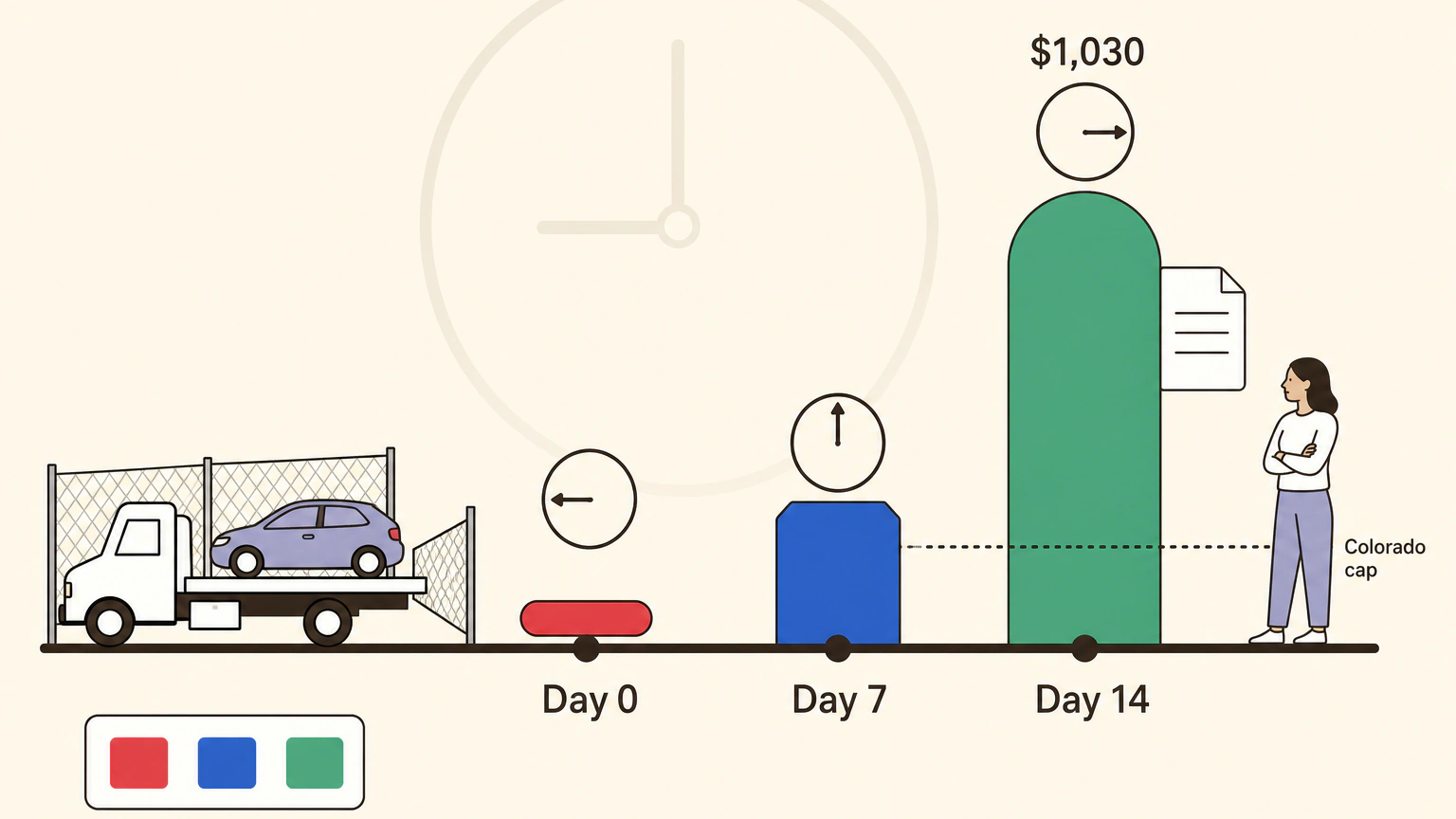
- Before storage: $362.95
- After 1 storage period: $411.14
- After 3 storage periods: $507.52
- After 7 storage periods: $700.28
- After 14 storage periods: $1,037.61
Each step is one more $48.19 storage period. Keep going long enough and state law may eventually permit a lien sale after the required notice and waiting periods. If the car goes from the yard to a garage, check what a shop should charge per hour first.
Getting your belongings out without paying first
Your kid's car seat is not collateral. In the states we checked, anyway. California attaches no lien to personal property and requires free release to the registered owner during business hours, even if you can't pay the tow.
Colorado requires free return of a vehicle's contents at residential impounds. Florida requires it within an hour after you present the right documents.
Payment methods they must accept
California requires a storage facility to take cash or a valid bank credit card. Refusing is a misdemeanor there, with a fine up to $2,500. Florida requires at least two of three: cash or its equivalent, a card, or a mobile payment service. If a yard turns down a method the applicable rule says it has to accept, treat that as your first red flag.
Red flags: seven things that should stop you cold
Red flag: One of these is enough. Call the rate-setting agency before you pay, not after.
- Cash only, or a refusal to take a card. In California, that alone is grounds for four times the charges.
- No itemized invoice, or one line reading "towing services."
- A separate charge for winching, hookup or dolly service the base rate already includes.
- Storage days billed before the required owner notification was completed.
- An after-hours or gate fee during normal weekday business hours.
- A refusal to release personal property until the bill is paid.
- A yard far outside your area. California generally requires it within 10 miles of the pickup, unless law enforcement gave prior written approval.
If you think you were overcharged: a four-step path
Step 1: Get the itemized invoice, in writing, before you pay
Ask before you hand over a dollar. Colorado requires a carrier to provide an itemized bill on request, showing each charge and the rate behind it. Florida requires an itemized invoice of the actual towing and storage fees, with any additional services or fees broken out as separate, explained line items. Repair work is a separate fight under separate rules, so check your state's rules on repair estimates and authorization on its own.
Step 2: Put it next to the published schedule
Set the invoice beside the schedule and check three things. Charges the schedule already folds into the base rate. Storage periods that run against a required notice or free window. After-hours fees stamped inside the yard's own stated business hours. Circle every line you can't match.
Step 3: Pay under protest, then complain to the agency that sets the rate
The clock is the reason to move fast. Storage may keep accruing while you argue, so call the rate-setting agency early and ask about payment, hearings, bonds and dispute options. Don't assume paying first preserves every remedy. If you do pay under protest, write those words on your own copy of the invoice.
Then call the right desk. The PUC in Colorado, TDLR in Texas, the DPU in Massachusetts, a county consumer-protection office in Florida, the DMV in Connecticut, and your attorney general anywhere else.
Step 4: Know what the penalty actually is
Knowing the number gives you something to say. California makes an operator who charges an excessive fee civilly liable for four times the amount charged, plus a misdemeanor fine up to $2,500. In Colorado the violation is a deceptive trade practice under the Colorado Consumer Protection Act, which carries civil penalties.
The three things that keep you out of a tow yard in the first place
Know what your plan covers before the breakdown. Look up your covered mileage today, then write the roadside number on your insurance card.
Pick your tow company and shop now. Choose from the towing companies in your city while you're calm, not at 11pm on a shoulder with the hazards going.
Check two common causes of avoidable call-outs. AAA's Automotive Research Center puts battery-strength losses at about 35 percent at 32°F and 60 percent at 0°F. A battery that starts fine in October may not turn over in January. Book car battery service before the first cold snap, and check the spare.
We score shops and towing companies across 150 data points and 6 million opinions, and publish the result as the Best of Preferred Mechanic awards. Those are our own figures, not an outside audit. Pick your truck and your shop today, while the choice is still yours.
Frequently asked questions
How much does a tow cost per mile?
Call it four to five dollars a mile if you go by the regulators. Colorado's PUC sets a $3.80 base plus a monthly diesel surcharge, which put the August 2026 maximum at $4.63. Miami-Dade County sets $4.27 per mile on police-directed Class A tows past five miles. Commercial cost pages quote a wider band, $2.50 to $7.00.
How much does it cost to get your car out of impound?
Tow plus billable storage plus any qualifying notification or after-hours release charge, and storage is the part that keeps moving. Under Colorado's August 2026 maximums, an 8-mile private-property impound sitting three storage periods with notification completed comes to $507.52: $250.91 tow, $37.04 mileage including the fuel surcharge, $75.00 notification and $144.57 storage. Your schedule may run differently.
Can a towing company charge whatever they want?
Not in the eight jurisdictions we checked, though the mechanism changes from one to the next. Six publish a hard dollar cap. California links the ceiling to applicable law-enforcement rates. New Jersey uses a reasonableness standard against comparison prices. Florida pushes rate-setting down to counties and cities. Outside those eight, look up your own.
How long can a tow yard keep my car?
Longer than you'd like, and the answer sits in your state's law rather than the yard's policy. Possession, liens, required notice and any eventual sale are all set by statute, and the timetable varies. Get the notice they owe you and call the responsible agency now.
Can a tow company charge me for days they were closed?
That depends on the local storage rule, which is an unsatisfying answer and also the true one. Some schedules run on a 24-hour or calendar-day period regardless of whether anyone is at the gate. Virginia lets localities regulate storage and may let them bar charges for closed days. California caps a legitimate gate fee at half the hourly tow rate and bars it during normal business hours.
Can they keep my belongings until I pay?
In the three states whose rules we checked, no, at least in the circumstances those rules cover. California attaches no lien to personal property in the vehicle and requires free release to the registered owner during business hours, even if you can't pay. Colorado makes release free at residential impounds, and Florida requires it within an hour after you present the required documents.
What happens if I can't afford to get my car out of impound?
Ask about a partial-payment route before you assume the car is gone. Colorado lets an owner or authorized operator pull a vehicle out of a residential private-property impound by paying 15 percent of what's owed, capped at $60, signing the required form and settling the balance no sooner than 90 days later. Everywhere else, call the responsible agency today about payment and lien-sale procedures.
Does insurance cover towing, and how far?
For a mechanical breakdown, you usually need roadside-assistance coverage on the policy. Towing after a crash may instead ride along with the auto claim. AAA club limits vary. GEICO and Progressive publish 15-mile or nearest-qualified-facility rules in many situations, State Farm uses the nearest repair facility, and USAA points members to the distance written into their own policy. Ask who pays for the extra distance.