Overview: Tire Service
Tires need attention between the day you buy them and the day they go in the scrap pile. That is the work in this category: rotation, balancing, pressure checks, valve stems and sensors, and getting a set on and off the car properly.
Rotation moves each tire to a position that wears it differently, which is why it belongs on a schedule instead of waiting until somebody notices. Balancing is separate work. A shake that shows up at highway speed and fades as you slow down is almost always a wheel out of balance or a weight that fell off. A shake you feel only through the brake pedal is not a tire problem at all.
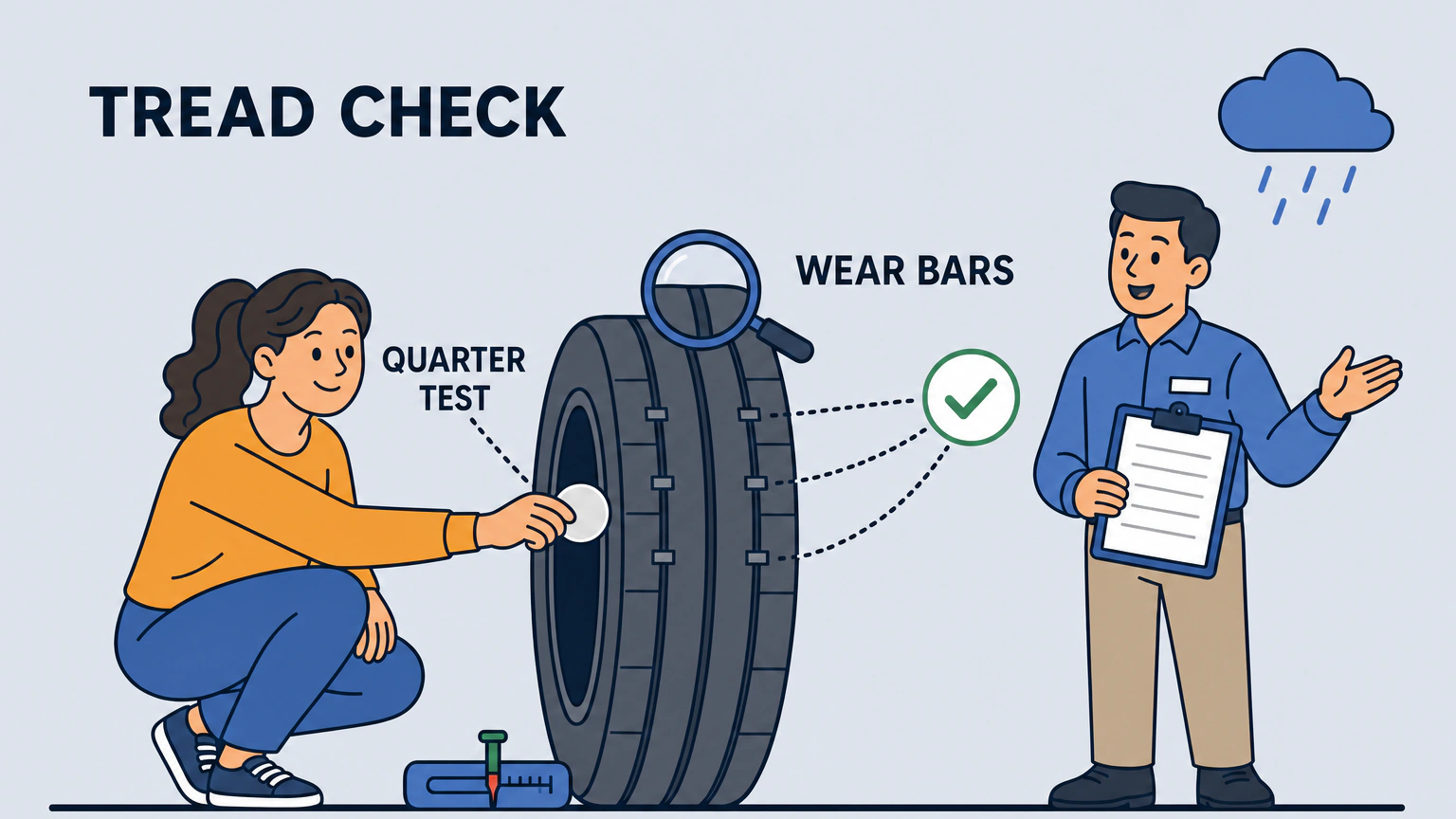
Wear patterns tell you things. Both edges worn with a good middle means the tires ran soft. A worn strip down the center means they ran hard. One inside edge scrubbed bare is a geometry problem, and new rubber without a fix just buys you the same wear again. Scalloped, wavy tread usually points at tired shocks.
Work through the state and city lists below to reach the shops near you. Most of this is short, drop-in work, so convenience counts for more than usual, and a shop that keeps a record of what was rotated and when is worth going back to.
Cost of tire services
Labor and service for existing passenger-car and light-SUV tires; tire purchase and wheel alignment are separate.
| Service or charge | Planning estimate | What it covers |
|---|---|---|
| Mount and standard balance | $25–$50per tire | Mount and balance one ordinary passenger-car tire supplied for installation, on a compatible wheel.Ask whether the quoted installation includes disposal, valve or TPMS service and any fee for tires bought elsewhere.Scope detailsIncluded in this estimate: Standard mounting; Standard balancing Separate unless quoted otherwise: Tire purchase; Disposal; TPMS sensor or kit; Specialty run-flat or oversized surcharge |
| Tire rotation | $25–$35per four-wheel rotation | Rotate the existing four wheels and tires on an ordinary passenger car, without dismounting the tires.Rotation may be included with another service or tire purchase. Ask whether your tire sizes and tread pattern allow the proposed rotation.Scope detailsIncluded in this estimate: Rotation; Inflation check Separate unless quoted otherwise: Balancing; Alignment |
| Standard tire rebalance | $12–$30per wheel | Rebalance one existing ordinary tire-and-wheel assembly using standard balancing equipment.Ask whether a four-wheel quote is a package and whether it includes diagnosing vibration from other causes.Scope detailsIncluded in this estimate: Standard balance; Weights Separate unless quoted otherwise: Road-force diagnosis; Wheel repair |
| Road-force balance | $30–$60per wheel | Road-force measurement and balancing of one ordinary tire-and-wheel assembly.Ask whether the price includes rotating the tire on the rim to improve the result, and whether damaged tires or wheels need separate work.Scope detailsIncluded in this estimate: Road-force measurement; Balancing Separate unless quoted otherwise: Replacement tires or wheels; Separately billed match-mounting |
| Seasonal wheel-set swap | $60–$85per set of four wheels | Swap four complete seasonal tire-and-wheel assemblies that are already mounted on a second set of wheels.Ask whether balancing, tire-pressure relearning or wheel storage is additional. Dismounting seasonal tires from the same wheels is a different service.Scope detailsIncluded in this estimate: Removal and installation of four premounted assemblies Separate unless quoted otherwise: Moving tires between wheels; Storage; New TPMS sensors; Balancing unless stated |
| TPMS sensor replacement | $75–$100per installed sensor | Replace one compatible tire-pressure sensor, including fitting and standard programming or relearn.Confirm sensor compatibility, programming and whether the price is a standalone service or only applies with new tires.Scope detailsIncluded in this estimate: One compatible TPMS sensor; Installation; Standard programming or relearn Separate unless quoted otherwise: Multiple sensors; Additional control-module faults |
What affects the price
- Low-profile, run-flat, oversized, or specialty assemblies may need different service pricing.
- A seasonal wheel-set swap is different from remounting tires on the same wheels.
- Existing purchase packages may include rotations, rebalances, or repairs.
Questions to ask before booking
- Which of these services are already included with my tire purchase?
- Is the charge per wheel or for all four, including required valve or sensor work?
- Does this complaint need standard balance, road-force testing, or another diagnosis?
Before you book
Balancing corrects a tire-and-wheel assembly; alignment adjusts wheel angles. One is not a substitute for the other.
U.S. planning estimates in USD. Taxes and fees may be extra; confirm the work and written total. Actual quotes can fall outside these ranges.
Frequently asked questions
How often should tires be rotated?
The habit most people keep is every other oil change, and the manual is the real answer because it varies by car. Front-drive cars wear the front tires faster, so rotation is what keeps a set wearing evenly enough to replace together. Directional tires can only move front to back on the same side. Staggered setups, with wider tires on the rear, often cannot be rotated at all.
Why does the car shake at highway speed?
Usually balance. A wheel weight falls off, or a tire picks up mud or a flat spot, and the shake arrives in a narrow speed band and eases off above and below it. Rebalancing all four is cheap and quick. If balancing does not settle it, the next suspects are a bent wheel, a tire with a separated belt, or a worn suspension part letting the wheel move around.
What is a TPMS relearn and do I need one?
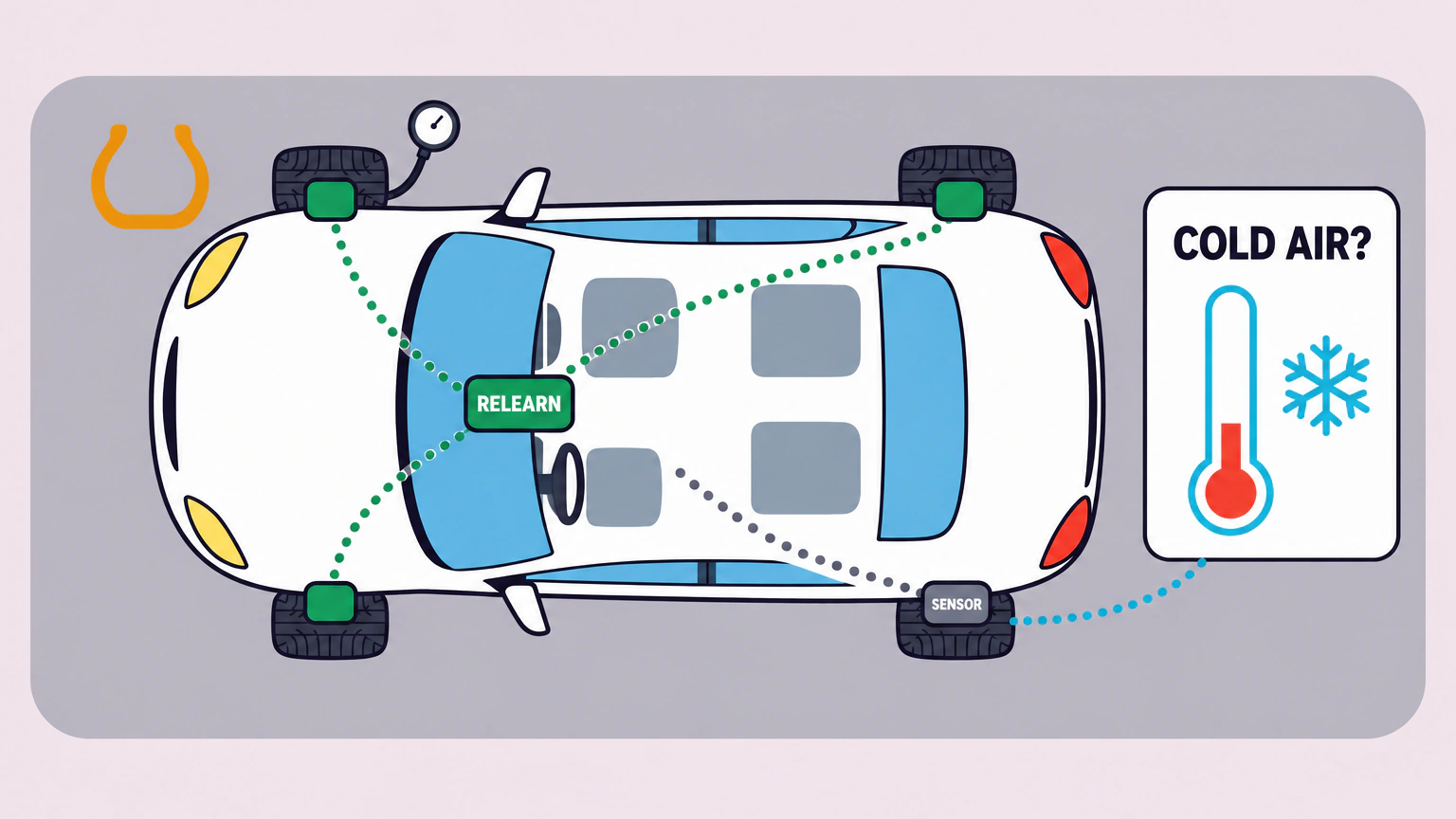
It is the step that tells the car which sensor is at which corner. Some cars work it out on their own after a few miles of driving. Others need a tool held against each wheel in a set order, which is why a rotation at a shop with no tool leaves the display pointing at the wrong tire. Sensors also have sealed batteries that eventually die, and the whole sensor gets replaced when that happens.
What do uneven wear patterns mean?
Read them like a report. Both shoulders worn with a healthy middle means the tires were run underinflated. A bald strip down the center means overinflated. One inside or outside edge scrubbed down is alignment, usually camber or toe. Feathered edges you can feel by running a hand across the tread is toe. Cupped, wavy wear is a worn shock or strut letting the tire bounce.
Do valve stems get replaced with new tires?
Rubber stems should be, every time, because they perish with age and heat and they are the cheapest part of the job. If the wheels carry pressure sensors, the equivalent is a service kit: a new valve core, grommet and nut, fitted whenever the tire comes off. Skipping it is how a slow leak appears a month after new tires went on.