

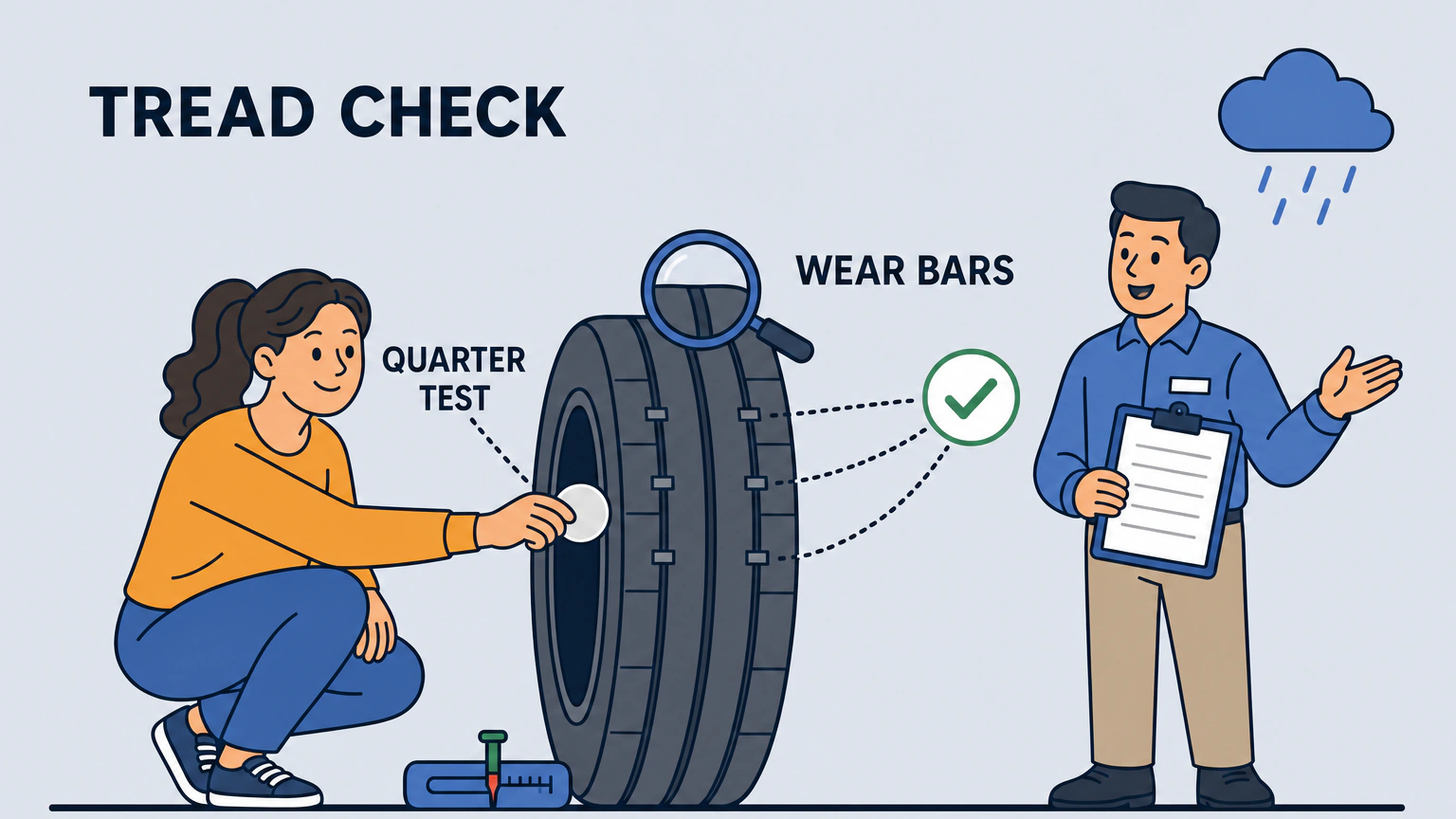
That is how to tell if you need new tires without taking anyone's word for it. This check is how you confirm a recommendation before you agree to the bill instead of after.
On this page
- The two-minute check, before anyone quotes you a price
- What the numbers mean, from new to worn out
- 2/32 inch is a common legal floor, not a safety threshold
- What your state actually requires
- Tread depth is only one of four reasons to replace a tire
- Do you have to replace all four?
- What the next step costs
- Telling a fair recommendation from an upsell
- Frequently asked questions
The two-minute check, before anyone quotes you a price
Take one coin to each tire. Check at least three places around the circumference and more than one groove, because tires rarely wear evenly. For a conservative condition check, act on the lowest reading you find. A legal inspection may use the particular grooves and locations specified by the applicable rule.
The quarter test, the one AAA actually recommends
Turn a quarter upside down and slide it into a groove, Washington's head first. If the tread covers part of his head, you have more than 4/32 inch left. If the whole head shows, you are at or near 4/32 inch.
AAA's director of automotive engineering, Greg Brannon, puts it plainly: "Slip an upside-down quarter between your tire grooves and look at Washington's head, if you can see all of it, it's time to start shopping for new tires."
The penny test, what it proves and what it doesn't
Same move, smaller coin. Part of Lincoln's head covered means you are above 2/32 inch. His whole head visible means you are at or below it.
The penny detects one thing: whether you have reached 2/32 inch, a common legal threshold. It cannot tell you whether you are at 4/32 inch, the depth where wet braking has already degraded measurably. That is why AAA reaches for the quarter.
Tread wear indicator bars, the check that needs no coin
Look into a groove and you'll see short raised bars of rubber crossing it. Those are tread wear indicators, molded in at 2/32 inch. When the tread around them wears flush with them, the tire is at the floor.
The federal guideline for state inspection systems uses the same feature. 49 CFR 570.9(a)(1) says to "inspect for indicators in any two adjacent major grooves at three locations spaced approximately equally around the outside of the tire."
Where to measure, and why one reading isn't enough
Measure in the grooves showing the most wear, never on a tie bar, a hump or a wear indicator bar. Those sit higher than the groove floor and flatter the reading, and New York's inspection manual says so outright.
States disagree about where to measure, which is what decides borderline tires. Minnesota reads the groove nearest the center, Washington any two major grooves, Iowa any two or more adjacent grooves excluding tie bars, and New York the two adjacent major grooves showing the most wear. All use more than one groove or location. For a conservative condition check, do the same and use the lowest number; for a legal question, follow the rule's exact method.
What the numbers mean, from new to worn out
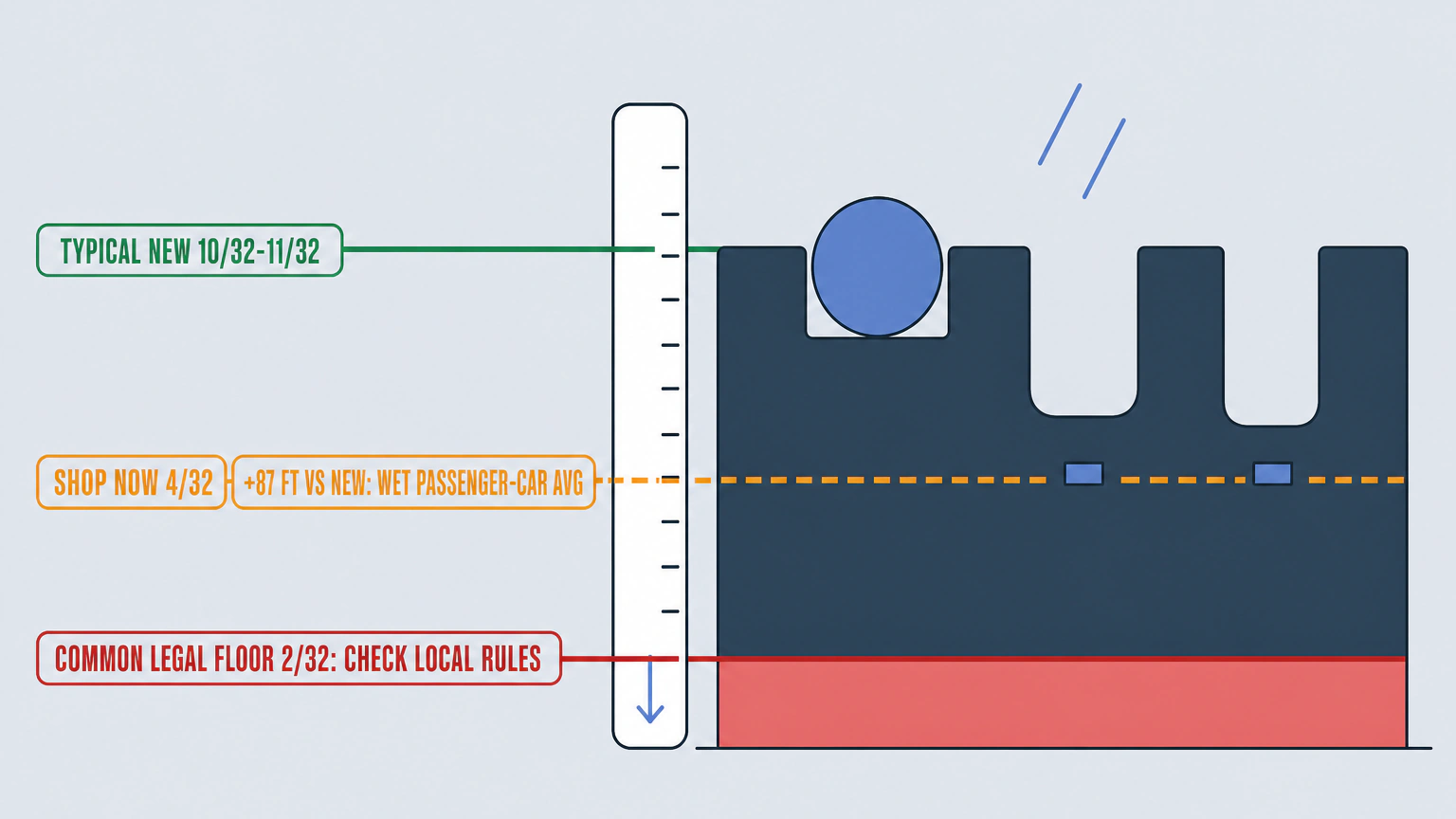
Tread is sold in thirty-seconds of an inch, so 4/32 is an eighth of an inch and 2/32 a sixteenth. Tire manufacturers publish new-tire depths of roughly 10/32 to 11/32 inch for typical passenger tires, and many truck, SUV and winter tires start deeper. So "half worn" has no shared meaning: half of 11/32 is about 5/32, already below AAA's shopping trigger. Take these numbers to a used-car lot too, alongside a pre-purchase inspection, since tread is one of the few things you can measure yourself before buying.
| Tread depth | Coin check | What it means | What to do |
|---|---|---|---|
| 10/32"-11/32" | New | Typical depth on a new passenger tire; some truck, SUV and winter tires start deeper | Nothing |
| 6/32" | Quarter covers Washington's head easily | Roughly half worn on a typical tire | Start checking monthly |
| 4/32" | Top of Washington's head just visible | AAA measured 87 feet of extra wet stopping distance at this depth versus new | Start shopping |
| 2/32" | Lincoln's whole head visible; wear bars flush with tread | Threshold in the federal guideline for state inspection systems; also used by the verified Minnesota, Washington, Iowa, Pennsylvania and New York rules below | Replace now |
| Below 2/32" | Wear bars level or worn | Below the federal state-inspection guideline and the numeric state minimums verified in this article | Replace before driving in rain |
2/32 inch is a common legal floor, not a safety threshold
The number everyone quotes appears in 49 CFR 570.9(a), part of NHTSA's Vehicle In Use Inspection Standards for motor vehicles rated at 10,000 pounds gross vehicle weight or less, except motorcycles and trailers: "The tread on each tire shall be not less than two thirty-seconds of an inch deep." The criterion dates from 1973 and was last amended in 1974.
Read what that is. Part 570 supplies criteria for state inspection systems, and § 570.3 expressly says the part does not itself impose requirements on any person. A state may adopt such a criterion as a pass-or-fail rule, but Part 570 is not a national passenger-car tread law or a manufacturer's replacement recommendation, and nothing in it claims a tire at 2/32 inch performs acceptably in rain.
AAA's testing says otherwise. In 2018 AAA, with the Automobile Club of Southern California's Automotive Research Center, compared new all-season tires against tires worn to 4/32 inch at highway speed on wet pavement. The worn tires needed an average of 87 additional feet to stop for a passenger car and 86 feet for a light truck, about a 43 percent increase, with a 33 percent reduction in handling ability for the car and 28 percent for the light truck.
AAA is blunt about the convention itself, writing that industry guidelines and state rules frequently recommend waiting until tread depth reaches 2/32 inch and that doing so "jeopardizes a driver's safety." Its own position is to replace at 4/32 inch.
4/32 inch is a shopping trigger, 2/32 inch is a replace-now trigger.
What 87 feet looks like from the driver's seat
Megan McKernan of the Automotive Research Center translates that gap into speed: "If tested side-by-side at 60 mph, vehicles with worn tires would still be traveling at an alarming 40 mph when reaching the same distance it takes for vehicles with new tires to make a complete stop."
Forty miles an hour is not a near miss. AAA published that figure beside its count of nearly 800,000 crashes on wet roads each year.
Snow and slush need more tread than rain does
Snow and slush have to pack into a groove and be thrown clear, so a tread that still copes with rain can stop biting in winter well before an ordinary tread minimum. Treat 4/32 inch as a wet-pavement trigger, not a universal winter rule. Colorado provides a current counterexample: when its Passenger Vehicle Traction Law is active, motorists need qualifying tires with at least 3/16 inch of tread or chains or another approved traction device. Check the current rule for the road and conditions where you drive.
What your state actually requires
There is no single national tire-tread law for passenger cars. The federal figure is a guideline for state inspection systems that a state may adopt in its vehicle code or inspection rules. The table covers only the cited provisions checked for this article; New York was checked through Cornell LII's regulation mirror rather than a state-hosted page. Treat a missing state as unverified rather than unregulated, and do not read “no number in the cited text” as a statewide legal conclusion.
| Jurisdiction | Minimum tread depth | How it is measured | Where the rule lives |
|---|---|---|---|
| Federal guideline for state inspection systems, motor vehicles 10,000 lb GVWR or less (except motorcycles and trailers) | 2/32" criterion; Part 570 imposes no requirement by itself | Tread depth indicators in any two adjacent major grooves, at three locations spaced around the tire | 49 CFR 570.2-.3, 570.9(a) (NHTSA Vehicle In Use Inspection Standards) |
| Federal, buses, trucks, truck tractors | 4/32" front wheels; 2/32" all other wheels | At any point on a major tread groove, not on tie bars, humps or fillets | 49 CFR 393.75(b)-(c) (FMCSA) |
| Minnesota | 2/32" (written as 2/32 (1/16) of an inch) | In the tread groove nearest the center of the tire, at three locations around the circumference | Minn. Stat. § 169.723(3), statute |
| Washington | 2/32" | In any two major tread grooves, at three locations around the circumference | RCW 46.37.425(4), statute |
| Iowa | 1/16" (equal to 2/32") | In any two or more adjacent tread grooves, excluding tie bars | Iowa Code § 321.440(1)(c), statute |
| Pennsylvania | 2/32"; 4/32" on front tires of vehicles over 10,000 lb GW | Two adjacent treads, at any point | 67 Pa. Code § 175.80(e)(1), safety inspection rule |
| New York | 2/32"; 4/32" on front tires of vehicles with MGW of 10,000 lb or more, and truck tractors | Two adjacent major grooves showing the most wear; center of tire for tread designs running across the tire | 15 NYCRR 79.21, inspection rule |
| Arizona | No numeric minimum found in the cited provision | - | A.R.S. § 28-958 addresses tire equipment but states no minimum tread depth; this is not a statewide no-rule finding |
| South Carolina | No numeric minimum found in the cited chapter | - | S.C. Code Title 56, Chapter 5 contains no tread-depth figure in the text checked; § 56-5-4410 still prohibits operation in an unsafe condition |
California is not listed. We could not reach its statutory text by any documented route, and we won't print a legal figure we haven't read at its source.
Maryland and Missouri are not listed with a number. Md. Transp. § 22-405(c) directs the Administrator to adopt tire-inspection rules but states no depth, and Mo. Rev. Stat. § 307.170 states no tread depth. Missouri's current ordinary-vehicle inspection rule, 11 CSR 50-2.240, was also checked and gives no numeric minimum. A current Maryland numeric inspection threshold was not verified in this fact-check, so no Maryland number is printed here.
Last verified: August 2026. The cited statute or regulation text was checked for each printed legal figure; New York was checked through Cornell LII's regulation mirror rather than a state-hosted source. Jurisdictions whose controlling text could not be verified were left without a number rather than estimated. Traffic and inspection rules change, so if a number matters for a legal question, confirm it against your state's current code or inspection manual.
States that put the number in the statute
Minnesota, Washington and Iowa write the minimum into the motor-vehicle code rather than a periodic-inspection rule. All three land on the same depth and each describes a different way of measuring it, which is what decides a borderline tire. Iowa expresses it as one-sixteenth of an inch, the same thing as 2/32.
States where the number lives in the inspection rule
Pennsylvania and New York put tread depth in their periodic safety inspection rules instead. Pennsylvania rejects a vehicle when "a tire has two adjacent treads with less than 2/32-inch tread remaining at any point." New York rejects at less than 2/32 inch of major tread design at the two worst adjacent gauge readings.
Both demand more from heavier vehicles: 4/32 inch on the front tires of vehicles over 10,000 pounds gross weight in Pennsylvania, and in New York for vehicles with a maximum gross weight of 10,000 pounds or more, plus truck tractors.
States where the cited text supplies no number
The cited Arizona tire provision, A.R.S. § 28-958, covers solid-rubber tires, protuberances and studs but states no tread depth. The South Carolina motor-vehicle chapter checked for this article contains no tread-depth figure; it does contain a general prohibition on operating a vehicle in an unsafe condition at § 56-5-4410.
Those bounded findings do not establish that no other applicable Arizona or South Carolina rule supplies a number. They mean only that the cited text does not provide one, so verify current state and local requirements before relying on the table.
Commercial vehicles and the separate federal tread rule
Commercial vehicles fall under 49 CFR 393.75. Any tire on the front wheels of a bus, truck or truck tractor must have at least 4/32 inch of tread measured at any point on a major groove, while 2/32 inch is allowed on all other wheels.
These provisions have different scopes. Section 393.75 is a federal operating rule for the covered commercial vehicles, while Part 570 supplies criteria for state inspection systems and says it imposes no requirement by itself. Comparing their numbers does not create a federal passenger-car minimum or explain why the commercial rule uses 4/32 inch on front tires.
How to find your own state's rule in five minutes
Search your state's official code site for "tire" within the motor-vehicle title and read the section on unsafe tires or tire equipment. If no depth figure is there, check the state police or DMV inspection manual, because that is usually where the number moved. States running a periodic inspection publish their reject criteria, and for drivers there those criteria are the operative rule. Read the section itself, not a summary, and note the date the page says it is current to.
Tread depth is only one of four reasons to replace a tire
Legal tread isn't the same as a healthy tire. Three other triggers retire one on their own.
Age, how to read the DOT date code
Every tire sold in the US carries a Tire Identification Number molded into the sidewall, starting with the letters DOT. Under the current 49 CFR 574.5(a)(3), the final group of four digits is the date code: the first two give the week of manufacture, using "01" for the first full calendar week of the year, and the last two give the year. A tire reading 3223 was built in the 32nd week of 2023.
On replacing by age, the honest answer is narrower than the internet's. The U.S. Tire Manufacturers Association says service and storage conditions vary so widely that a tire's serviceable life cannot be predicted from calendar age alone. Most drivers cover enough miles that the tread wears out before age becomes the issue. Its exceptions are full-size spares and ultra-low-mileage vehicles, such as classic cars, seasonal cars and cars used only for short local trips. For those it advises following the tire manufacturer's own service-life guidance, while noting that such a recommendation is not a guarantee of minimum serviceable life.
Damage the tread can't tell you about
Bulges, knots or separations, cuts or cracks deep enough to expose the body cords, and any exposed ply or cord are replacement conditions no matter how much tread is left.
These are not a shop's opinion. Minnesota, Washington and Iowa each list them in the same statute that sets the depth, Iowa's covering "tread or sidewall cracks, cuts or snags deep enough to expose the body cord," and the federal inspection standard rejects a tire for chunking, bumps, knots or bulges and for exposed cord or belting material.
Uneven wear is a symptom, not a tire problem
If one shoulder is worn and the other is not, if the tread is scalloped or cupped, or if one tire is far ahead of the other three, the tires are reporting a problem elsewhere: alignment, inflation, or a worn steering or suspension part. New tires without a fix buy the same bill again a year early.
Shoulder wear and pull usually point to wheel alignment shops. Cupping and patchy scalloping more often point past alignment to worn dampers or bushings, work for steering and suspension specialists. Get the cause named before you approve tires.
When a puncture can be repaired instead
A flat is not automatically a new tire. Industry repair procedure from the U.S. Tire Manufacturers Association allows a repair only when the damage is in the tread area and the puncture injury is no larger than 1/4 inch (6 mm) across. The tire must come off the wheel so the inside can be inspected, repairs cannot overlap an earlier repair, and a proper repair fills the hole with a rubber stem and seals the inner liner with a patch. A plug alone is not acceptable.
A sidewall or shoulder puncture is outside the repairable tread area. A tire driven while flat must be removed and internally inspected before anyone decides it is repairable; hidden damage can make replacement necessary. When a repair does meet the criteria, a flat tire repair averages $21, typically $16 to $31, across 905 quoted jobs in PreferredMechanic's own data.
Do you have to replace all four?
The answer turns on your drivetrain and on how far apart the remaining tires are, not on shop preference. The U.S. Tire Manufacturers Association recommends replacing all four together for best performance and is specific about the alternative: replace two and the new pair goes on the rear axle, because deeper tread grips better in the wet and keeps the back of the car from stepping out. Replace one and it pairs with the deepest-tread tire, both on the rear.
All-wheel drive is where "all four" can become a mechanical question rather than a sales preference. A tread or tire-diameter difference can affect the drivetrain, and the owner's manual may restrict how much difference is allowed. Ask two things: is this vehicle all-wheel drive, and what does the tread difference measure. Your owner's manual settles it.
What the next step costs
Across PreferredMechanic's own aggregate of quoted jobs, tire service shops show a national average of $61, typically $51 to $81, from 905 cost profiles. A wheel alignment averages $124, typically $62 to $155, from 707 cost profiles. A flat repair averages $21, typically $16 to $31, from 905 cost profiles. Those are what users were quoted for the service, not the price of the tires, which depends on size and model.
A tire visit bills for more than rubber. Expect mounting and balancing per tire, a disposal fee per old tire, new valve stems or a TPMS service kit if the car has pressure sensors, and an alignment only where a wear pattern or steering complaint calls for one. Get the out-the-door total in writing with those lines separate before work starts, and know what happens if the final bill comes in above the estimate. When you are ready to buy, compare tire shops near you on the itemized number, not the headline one.
Telling a fair recommendation from an upsell
These questions aren't an accusation. They turn "your tires are shot" into something you can check at the counter.
Eight questions to ask before you agree to new tires
- "What did you measure, in 32nds, on each tire?" A real answer is four numbers, not "they're low."
- "Which groove did you measure, and did you check more than one spot?" For a conservative condition check, act on the lowest reading; a legal inspection follows the rule's specified method.
- "Can you show me the wear bars?" They are visible without tools, so this costs nobody anything.
- "Is the wear even across the tread?" Uneven wear means something else needs fixing first.
- "What's the DOT date code on these tires?" Age is a separate replacement reason from depth.
- "Do I need all four, and why?" Drivetrain or tread mismatch are reasons. "We recommend it" is not.
- "Does this quote include mounting, balancing, valve stems or TPMS kits, and disposal?" Get the out-the-door number itemized.
- "Do I need an alignment with this, and what did you see that says so?" A wear pattern or a steering complaint, not a policy.
Red flags, and the move that answers each
You're told the tires are unsafe but shown no measurement. Ask for the reading in 32nds, or check it yourself with a quarter before you agree.
You're told all four must go because of a single flat. Ask whether the vehicle is all-wheel drive, what the tread difference measures and what the owner's manual allows. On some vehicles, replacing two is correct.
The out-the-door price appears only after the old tires are off the car. Ask for the itemized total, including mounting, balancing and disposal, before any work starts.
If the answers are specific and the numbers hold up, you have a shop worth keeping. If they're vague, get a second opinion, and look at how to check a technician's credentials when you decide where to take the car next.
Frequently asked questions
Is 4/32 inch of tread still safe to drive on?
Do not assume 4/32 inch is legal in every condition. For example, when Colorado's Passenger Vehicle Traction Law is active, qualifying tires need at least 3/16 inch of tread unless the vehicle uses chains or another approved traction device. Separately, AAA's wet testing found a passenger car on tires worn to 4/32 needed an average of 87 additional feet to stop versus new tires, about a 43 percent increase. Treat 4/32 inch as the point to start shopping, leave more following distance in rain, and check the rule that applies where you drive.
What is the legal minimum tire tread depth in the US?
There is no single national tread-depth rule for passenger cars. Section 570.9 gives a 2/32-inch criterion in a federal guideline for state inspection systems, but § 570.3 says Part 570 imposes no requirement by itself. The verified Minnesota, Washington, Iowa, Pennsylvania and New York provisions use 2/32 inch, while other rules or conditions can differ. Check the current law where you drive.
Does the penny test actually work?
It reliably detects one thing: whether you have reached 2/32 inch. If Lincoln's whole head is visible, you are at or below the threshold in the federal guideline for state inspection systems and in several state rules verified here. It cannot tell you whether you are at 4/32 inch, the depth where wet braking has already degraded measurably, so use an upside-down quarter for that reading.
Do I have to replace all four tires at once?
On an all-wheel-drive vehicle, check the owner's manual: tire-diameter or tread differences can affect the drivetrain, and the vehicle maker may require all four tires to stay within a specified range. On front- or rear-wheel drive, replacing two can be correct, and the U.S. Tire Manufacturers Association says the new pair goes on the rear axle. Ask which situation applies to your car.
How do I tell how old my tires are?
Read the last four digits of the DOT code molded into the sidewall. Under 49 CFR 574.5 the first two digits are the week of manufacture and the last two the year, so "3223" means the 32nd week of 2023. The code appears in full on one sidewall, so check both sides.
Can my car fail a state inspection because of tire tread?
In states that run a periodic safety inspection, yes. Pennsylvania and New York both list tread depth among their reject criteria, and both apply a stricter 4/32 inch rule to the front tires of heavier vehicles. Periodic-inspection programs differ by state, so the consequence is not universal.
How many miles should a set of tires last?
There is no single answer worth quoting. Mileage depends on the tire's own tread-wear rating, the vehicle, alignment, inflation and how it is driven. Measure depth rather than counting miles, and read the DOT date code as well, because tires can age out as well as wear out, particularly a spare.