

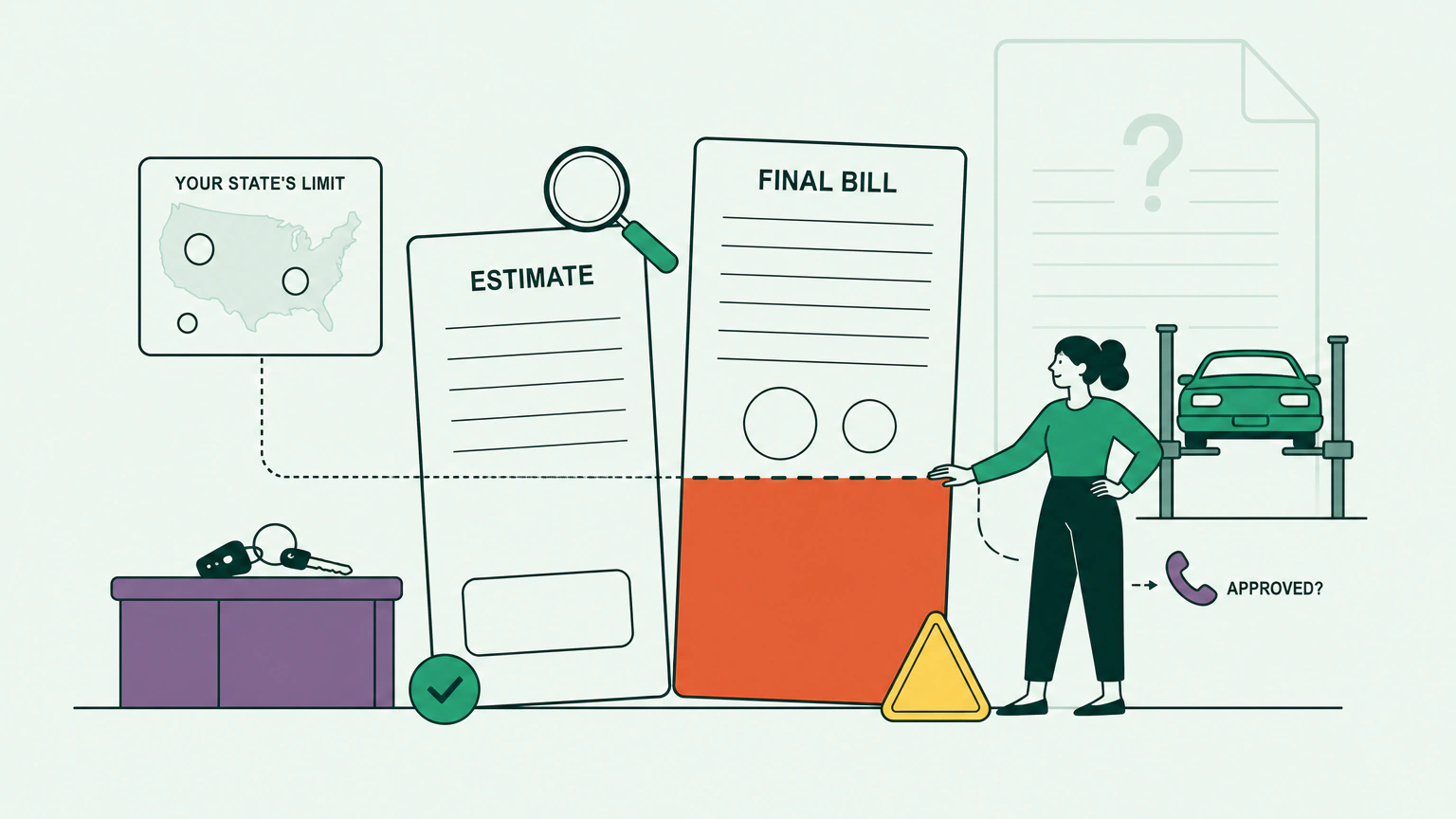
Not every overage is a shakedown. Bolts snap. A caliper seizes. Some overages are real discoveries, found after the car was already in the air, and a good shop is not trying to rob you. The question is narrower than that: whether the shop could bill for them without picking up the phone first.
On this page
- The short answer, and the one thing it depends on
- The "10% rule" is really five different rules
- Your state's estimate rules at a glance
- Check your own bill in four steps
- What counts as authorization, and what doesn't
- Can the shop keep your car until you pay?
- What to do when the bill is over the line
- How to stop it happening on the next repair
- Frequently asked questions
The short answer, and the one thing it depends on
Almost all of it comes down to paper. Most of the numbers that protect you measure from a written estimate, so that's the document your state's limit attaches to. An oral quote can be harder to prove. The argument becomes your word against the shop's.
Estimate, quote, and "not to exceed" are three different pieces of paper
An estimate is a good-faith projection of cost, which is a polite way of saying an informed guess by someone who has seen the car. A quote is usually understood as something firmer, a price the shop is committing to. A not-to-exceed authorization is the one you write yourself: a dollar ceiling above which the shop has to stop and call you. New Jersey lets a shop use a not-to-exceed figure as one of several estimate options.
Pro tip: write your own ceiling. At drop-off, write "Do not exceed $_ without calling me at _" on the repair order, sign it, and photograph your copy before you hand over the keys. Florida's and Massachusetts's forms both leave a blank for that number. Filling it in is the cheapest evidence you'll ever create of the ceiling you agreed to.
When a shop must give you a written estimate
You aren't automatically owed one, and the triggers vary more than the overage rules do. Virginia's starts at work over $25, on request. Maryland's and Ohio's start over $50, Illinois's and Washington's over $100, Florida's over $150. California generally requires an estimate before work begins, and Oregon before repair work starts. New York gives you one on request. So does Minnesota, for covered repairs totaling more than $100. Then two carve-outs quietly swallow a lot of this: the after-hours drop-off, and the waiver you sign at the counter.
The "10% rule" is really five different rules
Search this question and nearly every page hands you the same number: 10%. It is a real rule, but only in five states. Washington, Minnesota, Maryland, Ohio and Virginia use it. California, New York and New Jersey give no cushion, Massachusetts allows $10, and Florida, Michigan and Oregon run dollar-capped formulas that often leave far less room than a flat tenth would.
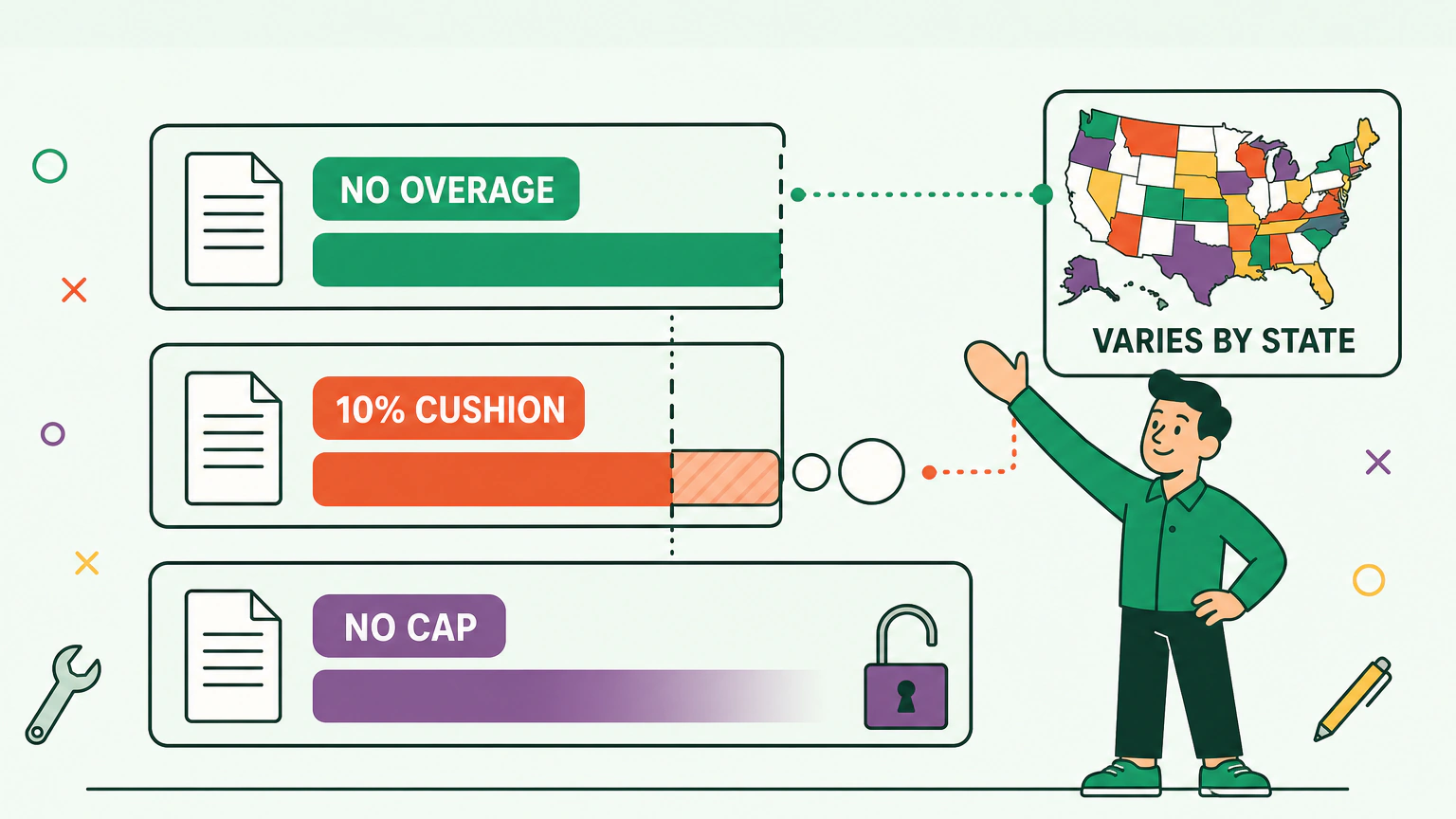
Zero or near-zero tolerance: California, New York, New Jersey, Massachusetts' $10 rule
Three states draw the line at the estimate itself. California's Business and Professions Code § 9884.9 forbids charging "in excess of the estimated price" unless the shop gets your consent after it learns the estimate is short and before the work is done. New York's DMV says the same thing in fewer words: no charge above the estimated price without your permission. New Jersey requires that later consent too, above the estimated price, including above a not-to-exceed figure when the shop used that estimate option. No cushion in any of the three. Not a dollar.
Massachusetts runs on several authorization routes under 940 CMR 5.05, one of which is a signed waiver carrying a dollar cap. Once the price would run more than $10 past what you authorized, or past the posted price, the shop has to obtain additional authorization. That $10 is the only overage figure in the regulation. The "10% or $100" repeated for Massachusetts all over the internet isn't in there. We read it.
The flat 10% cushion: Washington, Minnesota, Maryland, Ohio, Virginia
Washington and Minnesota write the limit as 110% of the written estimate, which is the same rule said backwards. Washington calculates it before sales tax, and it covers face-to-face jobs over $100. Minnesota's applies to repairs with a total price over $100, and the shop has to hand you a revised written estimate as soon as it knows. Maryland sets 10%. Ohio requires authorization once the added work amounts to 10% or more, tax excluded. Virginia sets 10% and then doubles it: 20% for a vehicle at least 25 model years old.
Greater-of with a ceiling: Florida
Florida allows the greater of $10 or 10%, then caps the whole thing at $50 (Fla. Stat. § 559.909). Watch what that does on a real repair. On a $2,000 estimate, 10% would be $200, so the ceiling takes over and the shop's room is $50. On a big repair, the cap is what's protecting you, not the percentage.
Lesser-of: Michigan and Oregon
Michigan's Motor Vehicle Service and Repair Act (Mich. Comp. Laws § 257.1332) allows 10% or $50, whichever is less. On that same $2,000 estimate, that's $50, not $200. Older Department of State handouts still print $10, so if a shop waves a printout at you, check the figure against the statute it claims to be quoting.
Oregon works the same way: 10% or $200, whichever is less, above $200. Here's where the intuition inverts. The bigger the job, the smaller the share a shop can add without calling you.
No repair statute at all: Texas and states like it
Texas has no auto-repair-specific act. What you have is your contract plus the Deceptive Trade Practices Act, which bars false statements about a repair but sets no estimate threshold. The DTPA also makes you give 60 days' written notice before you sue. A written estimate is an important piece of evidence there, so get one even though nothing is making the shop offer it.
Illinois has a separate Automotive Collision Repair Act for repairs at collision centers, with similar estimate and authorization limits.
Your state's estimate rules at a glance
Find your state, then find the overage column, because that's the number your whole argument sits on. One thing before you do: we're explaining general consumer-protection rules here, not advising you on your own bill, and if real money is riding on it, your state attorney general's consumer protection division or a lawyer licensed in your state is worth the call.
| State | Written estimate required when | Overage allowed without approval | Approval form | Complain to |
|---|---|---|---|---|
| California | Before work begins, generally | $0, none | Oral or written; oral must be logged | Bureau of Automotive Repair |
| New York | On request | $0, none | Phone approvals logged on the invoice | DMV Consumer & Facilities Services Complaint Unit |
| New Jersey | One of several permitted estimate options | $0, none | Oral or written consent | Division of Consumer Affairs |
| Massachusetts | Multiple authorization paths, including a signed dollar-cap waiver | $10; additional authorization above that | Oral or written | Attorney General's Office |
| Illinois | Repairs over $100 | 10% (itemized), $0 (single price) | Oral or written | Attorney General's Office |
| Washington | Face-to-face, over $100 | 10%, excluding sales tax | Oral or written | Attorney General's Office |
| Minnesota | On request, for repairs totaling over $100 | 10% (110% of estimate) | Revised estimate, then re-authorization | Attorney General's Office |
| Maryland | On request, work over $50 | 10% | Consent | Attorney General's Consumer Protection Division |
| Ohio | Face-to-face, cost over $50 | Under 10%, excluding tax | Oral or written | Attorney General's Office |
| Virginia | On request, work over $25 | 10% (20% if 25+ model years old) | Written or oral | Attorney General's Office |
| Florida | Repairs over $150 | $10 or 10%, whichever is greater, capped at $50 | Oral or written | Dept. of Agriculture and Consumer Services |
| Michigan | $50 or more, or on request below $50, unless waived | 10% or $50, whichever is less | Approval after re-contact | Secretary of State |
| Oregon | Before repair work begins | 10% or $200, whichever is less, when the separate-authorization rule applies | Owner authorization | Dept. of Justice consumer hotline |
| Texas | Not required by statute | No statutory limit; contract and the DTPA apply | Your written authorization | Attorney General's Office |
Not listed? Your state may not have a repair-specific act. A general deceptive-practices law may apply, and your state attorney general's consumer page is the place to confirm.
How much of this bill is above the line?
Your state decides how far past a written estimate a shop can go before it has to call you. Enter both totals to see where your bill lands.
Use the totals before sales tax. Washington and Ohio set their limits on the pre-tax figure.
Enter the totals from your paperwork
$120.00 of this bill is above Washington's limit.
Washington lets a shop bill up to $660.00 — the estimate plus 10%, before sales tax — without your approval. Yours came to $780.00.
- Written estimate
- $600.00
- Your state's allowance
- $60.00
- Most the shop could bill without asking
- $660.00
- Your bill
- $780.00
RCW 46.71.025
Ask the shop to show you the authorization for the lines that weren't on your estimate — the date, the time, the name of the person who called you, and the added cost you were told. If it can't produce that, the amount above the line is generally an unauthorized charge.
Compare auto repair shops in your areaGeneral information, not legal advice. Thresholds verified against the statutes cited above; confirm current text with your state attorney general before relying on a figure.
If your state isn't there, a general deceptive-practices law may still cover you. Search your attorney general's site for "auto repair" and see whether a repair act reaches you.
Check your own bill in four steps
- Put the written estimate and the final invoice side by side and compare pre-tax totals. Washington's rule and Ohio's are calculated before sales tax.
- Circle every line on the invoice that is not on the estimate. That is the overage; the rest isn't in dispute.
- Find your state's line and do the subtraction. Where the listed rule applies, anything above it needed your prior approval.
- Ask to see the authorization for those lines: the date, the time, the name of whoever called you, and the cost you were told.
Worked example: a $600 estimate, a $780 bill, three different answers. All three run on pre-tax numbers. In Washington, the shop could bill $660 before it needed your OK, so $120 sits above the line. In Michigan, the cushion is the lesser of $50 and 10%, which puts $130 above the line. In California there's no cushion at all, so the whole $180 needed your consent.
What counts as authorization, and what doesn't
Most disputes turn on whether the shop can prove you said yes to a number. Not to the work. To a number.
Oral approval is legal in most states, but it has to be logged
California makes the shop log the date, the time, the name of the person authorizing the work and the number called, plus the added parts, labor and total cost. New York puts the date, time and name on the invoice. Illinois and Massachusetts keep their own logs. So ask to see the record. If the shop can't produce it, that gap is your argument, and it's a strong one.
"I said go ahead" is not the same as "I approved $840"
Where state law requires the added cost to be stated, consent has to attach to a number. A vague go-ahead about a noise may not authorize a particular dollar amount. If the call you remember was about a symptom, say exactly that. You authorized someone to find out what the noise was. That isn't the same as authorizing $840 of parts and labor.
The waiver you may have signed without reading
Massachusetts prints its waiver right in the regulation: clear type, signed separately from every other signature on the order, and always naming a dollar cap. Florida's form gives you three checkboxes, one of which reads "I DO NOT REQUEST A WRITTEN ESTIMATE AS LONG AS THE REPAIR COSTS DO NOT EXCEED $___." Ohio's makes you initial a choice: a written estimate, an oral one, or none. Go dig out your copy of the repair order. Whatever you initialed on it can be important evidence.
Teardown, diagnosis and the second estimate
Here is the case where an estimate moves for an honest reason. You authorize diagnosis first and repair second, and nobody can write the repair number until the unit is apart. Florida sets a notification duty for that sequence. Minnesota requires an immediately revised written estimate. Oregon requires the estimate to state the reassembly time if you decline.
Overages can happen here, which is why some transmission repair specialists quote a teardown fee and a repair range separately.
Can the shop keep your car until you pay?
This is where the leverage actually sits. State lien law may let a shop hold the vehicle for authorized charges, and the details vary, so you can be dead right about the repair law and still be standing in the lobby without your car.
A lien doesn't always stretch over unauthorized work, though. Washington permits retention when the amount due does not exceed 110% of the authorized estimate. Florida makes it unlawful to refuse to return a vehicle over charges you never approved.
Storage fees may begin after the car is ready, depending on state law and what your repair agreement says. Massachusetts makes shops disclose storage terms up front. Paying the undisputed portion and putting the rest under protest may be an option, though what it buys you varies by state.
What to do when the bill is over the line
Work up the ladder in order. Each rung is cheap, and none of them closes off the next.
At the counter: four sentences that move the conversation
- "Can I see the written estimate and the invoice side by side?"
- "Which of these line items were not on the estimate?"
- "Can you show me the authorization for those lines, with the date, time and who called me?"
- "I'd like the manager to review the difference with me."
Pay, pay under protest, or don't pay
Refuse to pay and you may lose access to the car and start collecting storage charges. Pay in full and you may complicate your own position. Paying under protest can be the middle route: pay the undisputed portion, pay the disputed amount separately, and write "paid under protest, $___ disputed" on your copy of the invoice. Then email the shop that same sentence before the day is out. A sentence you can date beats a memory.
Your credit card is a second lever
A card dispute may be open to you when a shop billed more than you authorized, and it can run alongside an agency complaint rather than instead of one. Use it after the shop has said no, not before you've asked.
File the complaint, and where it actually goes
California's Bureau of Automotive Repair mediates complaints directly. New York routes form VS-35 to the DMV Consumer & Facilities Services Complaint Unit. In other states, go to the complaint agency listed for your state, or to your state attorney general's consumer protection division.
What to bring to a complaint or small claims filing:
- The written estimate, signed and dated
- The final invoice, itemized by parts and labor
- The repair order, including any waiver box you initialed
- Your note of any call: date, time, who you spoke to, the number quoted
- Texts, emails and voicemails from the shop
- A second shop's written opinion, if you got one
- Photos of any posted rate and rights signage
Small claims, and the states where the damages triple
In Washington, an auto repair violation is also a Consumer Protection Act violation. A court may, in its discretion, increase damages up to three times, subject to a $25,000 cap on the increased award. Ohio's Consumer Sales Practices Act can allow treble damages for specified violations and attorney's fees in listed circumstances. Texas justice courts handle claims up to $20,000. None of that is a lottery ticket. It is worth knowing before you write the letter.
How to stop it happening on the next repair
Red flag: five things that should stop the conversation.
- The shop won't put the estimate in writing where you're entitled to one.
- You're asked to sign a blank authorization, or a waiver with no dollar figure in it.
- The extra work was "found" and completed in the same phone call, with no cost stated.
- The shop can't produce a date, a time and a name for the approval it says you gave.
- You can't have the car back until you pay for work you never approved, which Florida law prohibits.
Three habits can help prevent this, and none of them costs anything. Get the written estimate every time, including in the states where no statute makes the shop offer one. Write your not-to-exceed number and your phone number on the repair order before you hand over the keys. And pick the shop before the emergency, not during it.
That last habit is the one you can do today. Compare auto repair shops in your area before you need one, look at an independent mechanic shop if you are leaving a dealership, and check the technician's credentials before you book. The Best of Preferred Mechanic awards use the same review data. And if the bill clears every legal hurdle and still feels high, the next question is whether the labor rate itself was fair.
Frequently asked questions
Is a car repair estimate legally binding?
Generally not, in the sense of a fixed price you can hold the shop to. An estimate is a good-faith projection of what the job should cost. That doesn't leave the shop free to bill whatever it likes, though. State law or your repair agreement may limit the overage or require new authorization, and many of the numerical state limits measure from the estimate itself.
Can a mechanic charge more than the quote?
A quote is usually understood as firmer than an estimate: the price the shop said it would do the job for. Whether it binds the shop depends on state law and on the agreement you signed. Either way, a written price is evidence of what you authorized, which is the question most of these arguments turn on.
Does a mechanic have to give you an estimate?
That depends on your state and the size of the job. California generally requires one before work begins, and Oregon before repair work. New York gives you one on request, as does Minnesota for repairs totaling over $100. Maryland and Ohio use over-$50 triggers, Virginia over $25, Illinois and Washington over $100, Florida over $150. Texas has no auto-repair-specific estimate statute.
Do auto repair shops charge for estimates?
They can, where state law and your own authorization allow it. Diagnosis is real labor and somebody pays for it. The rules are mostly about disclosure: Maryland requires disclosure before a charged estimate is prepared, New York caps the estimate's labor charge at the shop's usual hourly rate, and Massachusetts requires diagnostic charges to be disclosed before authorization.
Can a mechanic keep my car if I refuse to pay?
Possibly, for charges you authorized. State lien law may let a shop hold the car until an authorized bill is paid, and the details vary. Unauthorized charges are a different matter. Florida makes it unlawful to withhold a vehicle over charges you did not authorize, and Washington permits retention when the amount due does not exceed 110% of the authorized estimate.
How do I dispute a car repair bill?
Work up the ladder, in order. Ask the manager to compare the estimate and the invoice line by line. If you need the car back that day, pay the undisputed part and the rest under protest. Then dispute the unauthorized amount with your card issuer, file with your state agency, and treat small claims as the last rung rather than the first.
What happens if a mechanic fixes the wrong thing?
That is a workmanship question rather than an estimate question, and it runs on different rules. Massachusetts, for one, requires a shop to promptly correct work not performed in a good and workmanlike manner, at no charge. Start by asking for the diagnostic findings in writing, because the paper decides this one too.
Do I have to pay the diagnostic fee if I decline the repair?
Often yes, if the fee was disclosed and authorized before the work started. State law may require that disclosure or that authorization up front. Oregon goes a step further and requires the estimate to state the reassembly time if you decline.
Find your state's line, do the subtraction where that rule applies to your repair, and ask to see the authorization for everything above it. Then use the ratings to pick a shop you never have to do this with again.