

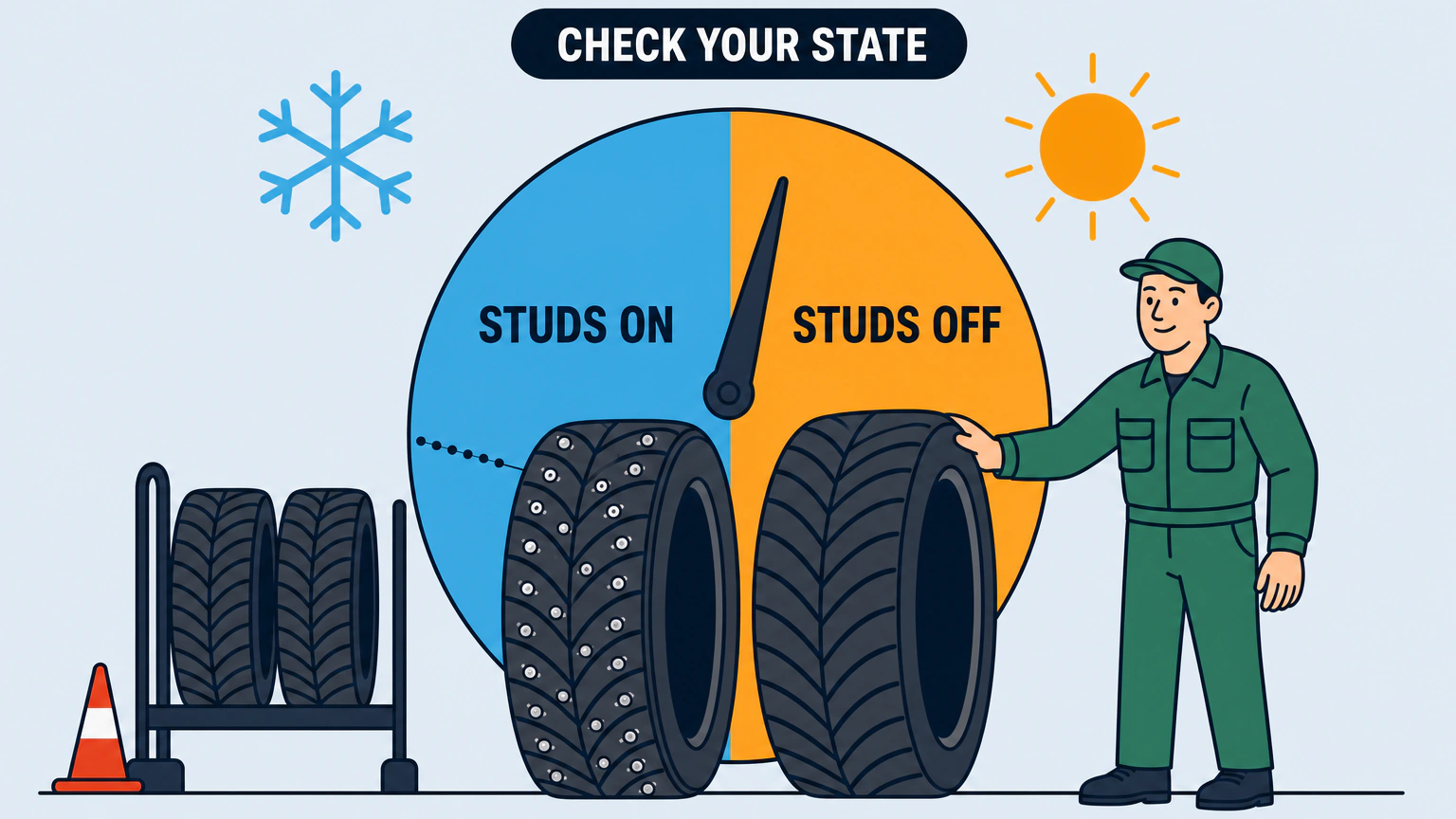
Among the twelve states we read, studs are legal for a season in nine, banned with exceptions in Minnesota, and governed without a calendar in Texas and Wyoming. The earliest you can mount them is October 1 and the latest you can leave them on is May 31. North Dakota and Virginia share one window, and Oregon and Washington share another. The rest don't line up. The date that matters is your state's, not the one a neighbor quoted you over the fence.
On this page
The rule is a calendar, not the weather
Nine of our twelve states set a season, and those two dates don't care what the sky is doing. A warm April doesn't shorten your window. A late storm doesn't extend it either, unless a named state official says so out loud, and only four of the twelve statutes hand anyone that power.
So it's a lookup, not a judgment call. You need two dates and the sentence they came from.
What a stud is, and why states count the damage
A stud is a small pin, usually tungsten carbide, set into the tread so it stands a fraction of an inch proud of the rubber. On ice it bites. On bare pavement it grinds, and the grinding is the whole reason the calendar exists.
Washington State DOT puts the bill in public. Studded tires cause "between $20 million to $29 million in damage to Washington's state-owned roads each winter, in addition to damaging city and county roads," says its Maintenance Operations Branch Manager, James Morin. That's WSDOT's figure for WSDOT's roads. Oregon's transportation department makes the same case more quietly: studs leave holes and ruts, ruts hold ice, and repaving comes around sooner.
Three ways a state writes the rule
Read a dozen of these and the shapes repeat.
The common one is a calendar window. Studs are fine between two dates and unlawful outside them, and nine of our twelve work that way, from Arizona to New York.
The second is an outright ban with narrow exceptions underneath it. Minnesota is this set's example, and those exceptions repay a careful read.
The third is a state with no calendar, and it splits in two. Texas sets no season and instead bars any non-rubber protuberance that injures the highway, a judgment test rather than a date. Wyoming sets no season either, and regulates the tire itself.
Work out which shape you're in and an unlisted state stops being a dead end.
What the statute says in twelve states
Nothing federal sets a studded tire season for passenger cars. Every rule here is a state vehicle equipment statute, which is why the answer changes under you at the state line.
These twelve are the states whose code sections we opened. The rest aren't here for a plain reason: we won't print a legal date we haven't read at the source. The five-minute method further down gets the same answer for any of them.
We read these twelve statutes ourselves and we still wouldn't bet a ticket on a date off any website, this one included. If you're inside a week of your boundary day, pull up your state's own code or call the state patrol's non-emergency line.
| State | Studs allowed? | Legal window | What the statute says, and where it lives |
|---|---|---|---|
| Arizona | Yes, seasonal | Oct 1 to May 1 | Tungsten carbide or similar; metal touching the road capped at 3% of the tire's contact area. A.R.S. § 28-958(B)(3) |
| California | Yes, seasonal | Nov 1 to Apr 30 | Metal studs capped at 3% of contact area; retractable studs allowed year round if retracted May 1 to Oct 31; emergency vehicles unrestricted. Veh. Code § 27454(e), (f) |
| Maine | Yes, seasonal | Statute bans studs May 1 to Oct 1 | Retractable studs may stay on year round if not engaged in the banned months; the Commissioner of Transportation may extend the period or issue a permit for $3 to $15; fire vehicles and school buses exempt. 29-A M.R.S. § 1919 |
| Minnesota | No, with exceptions | None outside the exceptions | Studs banned outright. A vehicle registered where studs are legal may run them while "occasionally within the state," meaning not more than 30 days in any consecutive six months, and never if your regular workplace or school is in Minnesota. Rural mail carriers may hold a permit for Nov 1 to Apr 15. Minn. Stat. § 169.72 subd. 1(c), 4, 5 |
| Montana | Yes, seasonal | Oct 1 to May 31 | Studs must not protrude more than 1/16 inch; retractable studs allowed year round but not engaged outside the season on ice-free and snow-free roads; school buses Aug 15 to Jun 15. Mont. Code Ann. § 61-9-406(3), (4) |
| New York | Yes, seasonal | Oct 16 to Apr 30 | Written as a ban: studs are prohibited May 1 to Oct 15 inclusive. Stud diameter capped at 3/8 inch, protrusion at 3/32 inch, contact area at 0.75%. School buses and state or municipal vehicles exempt. Veh. & Traf. Law § 375(35-a) |
| North Dakota | Yes, seasonal | Oct 15 to Apr 15 | Studs must not project more than 1/16 inch beyond the tread; school buses may run them at any time of year. N.D.C.C. § 39-21-40(3) |
| Oregon | Yes, seasonal | Nov 1 to Mar 31 | The statutory exemption runs "between November 1 of any year and April 1 of the following year"; ODOT publishes the season as Nov. 1 through March 31, with a fine outside it of nearly $200. Studs must project 0.04 to 0.06 inch and wear at the same rate as the tread; ODOT may shorten or lengthen the period in a designated area; retractable studs separately exempt. Or. Rev. Stat. § 815.165(7), (12) |
| Texas | Only if they don't injure the highway | No season set | No calendar rule at all. A non-rubber protuberance is barred unless it "does not injure the highway" or is a tire chain used for a skid risk. Tex. Transp. Code § 547.612(c) |
| Virginia | Yes, seasonal | Oct 15 to Apr 15 | Vehicles at or under 10,000 lb gross weight only; studs capped at 1/16 inch projection when compressed and 3% of the traction surface; law enforcement, fire, EMS and VDOT vehicles exempt. Va. Code § 46.2-1044 |
| Washington | Yes, seasonal | Nov 1 to Mar 31 | Written as a ban: unlawful between April 1 and November 1. Retractable studs allowed year round if they retract below the wear bar and are engaged only in season. School buses and fire vehicles Nov 1 to Mar 31. RCW 46.37.420(2), (4) |
| Wyoming | Yes, year round | No season set | No calendar limit, but the studded tire itself must be approved by the superintendent, and selling an unapproved one is prohibited. Wyo. Stat. §§ 31-5-956(c)(iii), 31-5-934(a) |
Thirty-eight states and DC are missing. We only print a date we've read in the state's own code, and the code sites for several of the states people ask about most, Michigan, Ohio, Pennsylvania, Colorado and Wisconsin, wouldn't open while we were writing. The next section shows you how to pull your own state's rule.
An eight-month season and a five-month one
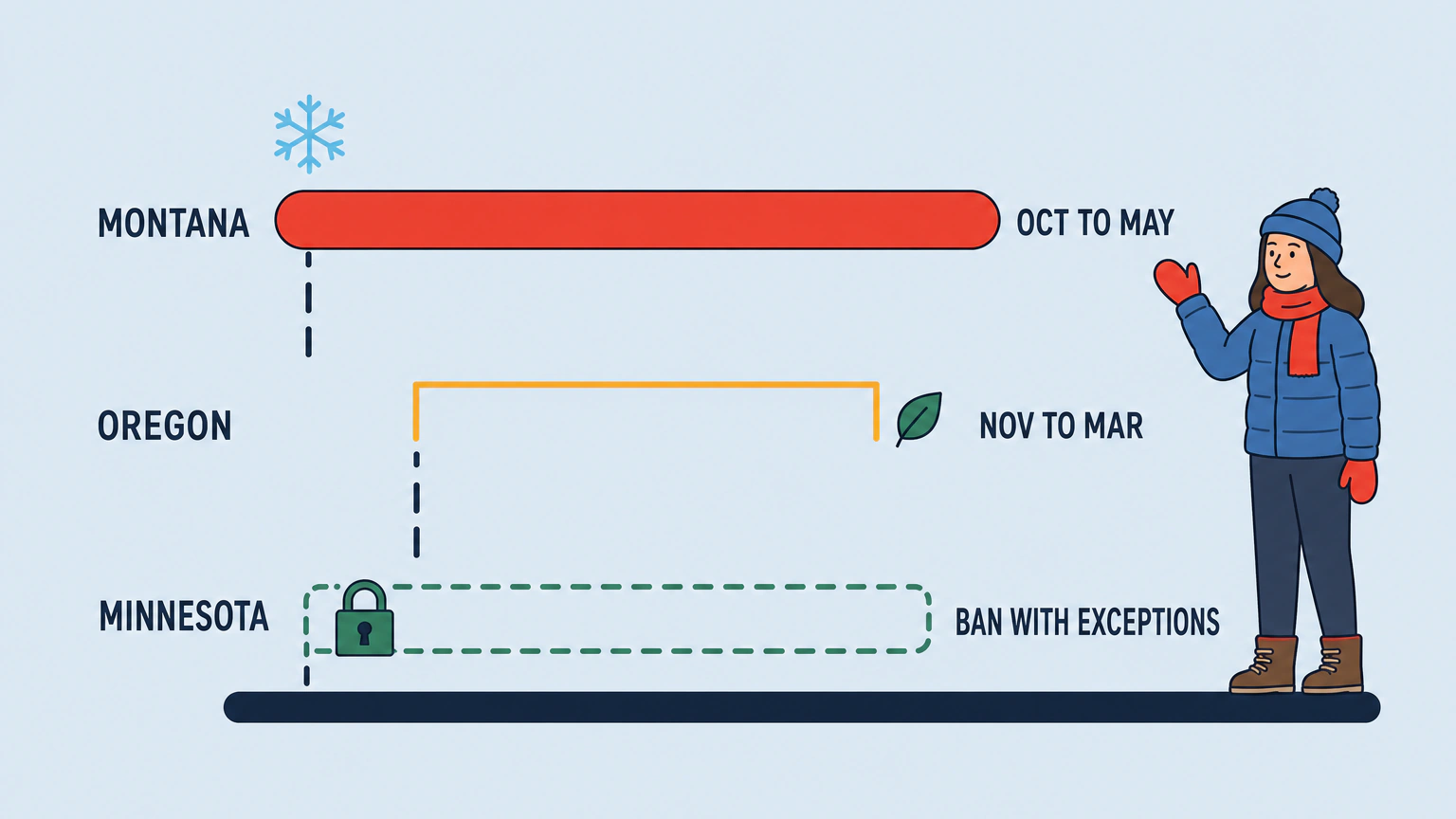
Montana gives you October 1 to May 31. Eight months, and the statute says it in one breath: studded tires are "permitted only between October 1 and May 31 of each year."
Oregon gives you November 1 to March 31. Five months.
Set those beside each other and crossing a line stops being theoretical. A Montana driver still on studs in mid-April is legal at home and illegal the moment the car enters Oregon, where the season shut two weeks earlier. Neither statute gives you a grace period.
Minnesota bans studs and Texas sets a damage test
Minnesota bans studs first and writes its exceptions afterward. The ban is subdivision 1(c), and on its face it's absolute: no tire "shall have on its periphery any block, stud, flange, cleat, or spike or any other protuberances of any material other than rubber which projects beyond the tread of the traction surface of the tire." If your car is registered in Minnesota, that's the rule unless you qualify for the rural mail carrier permit. Out-of-state visitors get a separate carve-out we'll come back to.
Texas takes a different road. Section 547.612(c) bars a non-rubber protuberance unless it "does not injure the highway" or is a tire chain used because the vehicle might otherwise skid. No dates anywhere. Whether a stud is allowed turns on whether it injures the highway.
Wyoming sets no season and still has a rule
Wyoming is the one that surprises people. There's no calendar limit at all. Section 31-5-956(c)(iii) permits "pneumatic tires having studs designed to improve traction without materially injuring the surface of the highway," and that's the whole of the seasonal rule.
Then comes the sentence nobody quotes. The same paragraph adds that studded tires "must be approved by the superintendent," and a separate section makes it unlawful to sell one that isn't. Wyoming regulates the product where other states regulate the calendar, which mostly makes approval the shop's problem. It's also the cleanest proof that no season doesn't mean no rule.
How to find your own state's rule in about five minutes
- Search your state's official code site for "stud" inside the motor vehicle or vehicle equipment title. The section is usually the one about restrictions on tire equipment.
- Read the sentence, not the heading. Headings are written by the codifier and summarize a whole section, not the subsection you're standing in.
- Check which direction the sentence runs. Granting a window and banning a period produce different boundary days.
- Open your state DOT or state patrol page for the enforcement date. Where the two disagree, the statute is the law and the agency page is the ticket policy.
The high-demand states missing from our twelve are Michigan, Ohio, Pennsylvania, Colorado and Wisconsin. Their code sites wouldn't open for us. They'll almost certainly open for you.
The boundary day is where the tickets happen
Most drivers get the month right and the day wrong, and the day is the one that costs money.
Watch how the two shapes land. A state that grants a season running November 1 to March 31 has made March 31 your last legal day. A state that bans studs "between April 1st and November 1st" draws the same line from the far side, and April 1 is the first morning you're exposed. One day is plenty.
Washington publishes its own number
Washington is the cleanest case here, because the state says all of it out loud instead of leaving you the arithmetic.
RCW 46.37.420(2) makes it unlawful to use metal studs "between April 1st and November 1st." WSDOT turns that into the version a driver can act on: legal November 1 through March 31, off by end of day March 31, State Patrol free to begin issuing tickets April 1. It put the fine at $137 for the 2025 to 2026 season, and noted that WSDOT isn't the agency writing the ticket.
There's also the sentence visitors need, in the agency's own words: there are "no individual exceptions or 'out-of-state waivers'" to those dates.
Red flag: Three things won't save you on the boundary day. Your home state's later deadline doesn't travel across the line with you. A late snowstorm doesn't extend the date unless the state announces an extension. And a shop's appointment backlog is not a defense, which is exactly why the state tells drivers to book ahead of the rush.
When the law bans a period instead of granting one
New York and Maine write the rule backwards from what a reader expects, and it's where the biggest pages on this topic come apart.
New York's § 375(35-a) never grants a season. It says that no vehicle with studs, school buses and state or municipal vehicles aside, "may operate on a public highway during the period from the first day of May to the fifteenth day of October, inclusive." Run that out. The prohibition ends October 15, so the season runs October 16 through April 30. The largest trade page tells readers studs are accepted through April 1, because it quoted the DMV's consumer summary instead of the section underneath it. That's a month of legal driving taken off New York drivers by an agency explainer that drifted from its own statute.
Maine bans studs "from the first day of May to the first day of October" and never says whether October 1 itself sits inside the ban. Two of the largest pages print different start days as a result, and neither prints the sentence. If it were our car, we'd mount on October 2 and skip the argument.
The agency can move the date, and the statute says so
Four of the twelve statutes let a state official move the season, which is the asterisk on "the date is the date."
California's commissioner may extend the studded period in parts of the state for adverse weather, after consulting the Department of Transportation. Oregon's transportation department may shorten or lengthen the period in an area it designates. Washington's may determine additional lawful periods, and in its spring 2026 notice it said conditions didn't support a statewide extension. Maine's Commissioner of Transportation may extend the use period, or issue a permit covering stated periods, at a fee of not less than $3 and not more than $15.
The state announces any extension, and the place to look is the state DOT.
Crossing a state line changes the rule under you
If you live near a border, commute across one, or point the car at the mountains for a weekend, this is the part that matters most.
The default is simple and unforgiving. You follow the law of the state you're in. WSDOT says it flatly: all drivers, visitors included, follow Washington's motor vehicle laws while they're in Washington. Your registration doesn't carry your home calendar with it.
Exceptions exist, and they're narrow.
Minnesota welcomes visitors and not commuters
Minnesota bans studs, then makes room for people passing through. Subdivision 4 says a driver whose vehicle is properly licensed and registered in another state or province that allows studs may run them here "while occasionally within the state."
Then the statute defines its own word, and the definition does the work: "Use of a vehicle in this state on more than 30 days in any consecutive six-month period is not occasionally."
Then it shuts the door. A person "whose regular place of employment is within the state or who is a student at an educational institution located within the state" may not run tires that would be unauthorized on a Minnesota-registered car, "regardless of its place of registration."
Read that as a scene rather than a rule. A Wisconsin-plated car in a Minneapolis parking ramp five days a week is not a visitor, and the plate isn't going to help.
The exception limits the studs too: no more than 5/16 inch in diameter including the casing, average protrusion no more than 7/64 inch, and no more than two percent of the tire's total net contact area. Don't confuse any of that with the rural mail carrier permit, which sits in its own subdivision, runs November 1 to April 15, and belongs to carriers on mostly unpaved routes. The biggest state-by-state table on this topic fuses the two into one cell, and a reader who trusts it comes away thinking nonresidents get a November-to-April window. They don't.
Five states make room for retractable studs
Five of the twelve statutes write a separate rule for studs that retract.
California, Washington and Maine let the tires stay on the car year round if the studs stay retracted outside the season. Montana also allows year-round use, but outside the season its studs must stay retracted on roads without ice or snow. Oregon separately exempts retractable studded tires from its general metal-object ban. Washington adds two specifics: they have to retract below the wear bar when they're not in use, and they're exempt from its lightweight stud weight rule. California adds that the tire mustn't be worn to the point where retracted studs still stand past the tread.
Cross regularly from a long-season state into a short one and the design is worth pricing because it can save you a mount and a dismount every spring. Before you commit, have your regular shop confirm the studs retract the way your state's sentence describes.
Booking the swap before your deadline
Shops fill up before a removal deadline. WSDOT tells drivers to plan ahead because automotive centers get busy as the date approaches.
So work backwards from your date.
- Find your state's two dates in the twelve-state list, or pull them yourself using the five-minute method.
- Put the removal date in your phone with a two-week warning, not a two-day one.
- If you are crossing a state line this winter, look up the strictest state on your route, not your home state.
- Ask the shop whether they mount studs or only sell pre-studded tires, because not every shop does both.
- Ask what the swap costs as a line item, mounting and balancing included, before you book.
- Check the tread on last winter's set before you mount it; studs on worn tread buy you very little.
- If your season is short and your driving is mostly bare pavement, price studless winter tires in the same call.
On the money: our own listings for shops that do seasonal swaps put a typical tire service visit around $61, with most landing between $51 and $81. Your shop may sit higher. What you're buying on a swap is labor, so if a quote lands well outside that range, spend a minute on what shop labor actually costs first. Our directory of tire shops near you is the quickest route to someone who mounts studs rather than only sells them.
If you're still weighing studs against studless, Oregon's DOT is blunt about it. Traction tires work about as well as studs on ice, better in most other winter conditions, and do no more road damage than regular tires. The severe-snow ones carry a three-peaked mountain and snowflake on the sidewall. WSDOT points the same way, toward non-stud winter-tread tires that "provide excellent traction without the road damage caused by metal studs."
Then book the appointment. A reminder on your phone doesn't take the studs off.
Frequently asked questions
Can you drive with studded tires in summer?
Not through the summer in the nine seasonal states we read. Their seasons close between April 1 and May 31, and running studs past your date is a traffic violation. Wyoming sets no season. Texas has no calendar, but its damage test still applies. California, Washington, Montana, Maine and Oregon treat retractable studs separately.
What happens if you get caught with studs after the deadline?
In the seasonal states, you're exposed to a traffic or equipment ticket. Washington's was $137 for the 2025 to 2026 season, with the State Patrol free to start writing on April 1. Oregon's transportation department puts its fine at nearly $200 for driving on studs before November 1 or after March 31. The other statutes don't all use the same charge or fine.
Do studded tires really damage roads?
Yes, and the states that regulate them say so publicly. WSDOT attributes between $20 million and $29 million of damage to Washington's state-owned roads each winter to studded tires, on top of what they do to city and county roads. Oregon's DOT describes holes and ruts that hold ice and force earlier repaving.
How long do studded tires last?
The law measures protrusion, not age. Oregon requires studs projecting at least 0.04 inch and no more than 0.06, wearing at the same rate as the tread; Montana and Virginia cap only the maximum, at 1/16 inch. A set ages out when the studs fall out of spec or the tread hits its legal floor. Check the tread before you mount them. We couldn't find a published stud lifespan worth quoting you.
My state is not in your table, so where do I look?
Your state's own code site, in the motor vehicle or vehicle equipment title, searching for "stud." Read the operative sentence rather than the section heading, and notice whether it grants a window or bans a period, because that decides your boundary day. Then check the state DOT or state patrol page for the enforcement date. Where the two disagree, the statute is the law.
Studded tires or studless winter tires: which should I buy?
Studs help on ice and give ground almost everywhere else. Oregon's DOT is direct: traction tires work about as well as studded tires on ice and better in most other winter conditions, with no more road damage. If your winter is mostly cold bare pavement with occasional ice, studless is the better buy. Long season, regular packed ice, and studs earn their keep.
Whose rules apply when I drive into another state?
The state you're driving in. WSDOT says it plainly: all drivers, visitors included, follow Washington's motor vehicle laws while they're in Washington, and there are no out-of-state waivers. Minnesota is the one real exception in our twelve, and it's narrow: an out-of-state car may run studs while "occasionally within the state," meaning no more than 30 days in any six-month stretch, and never if you work or study there.