

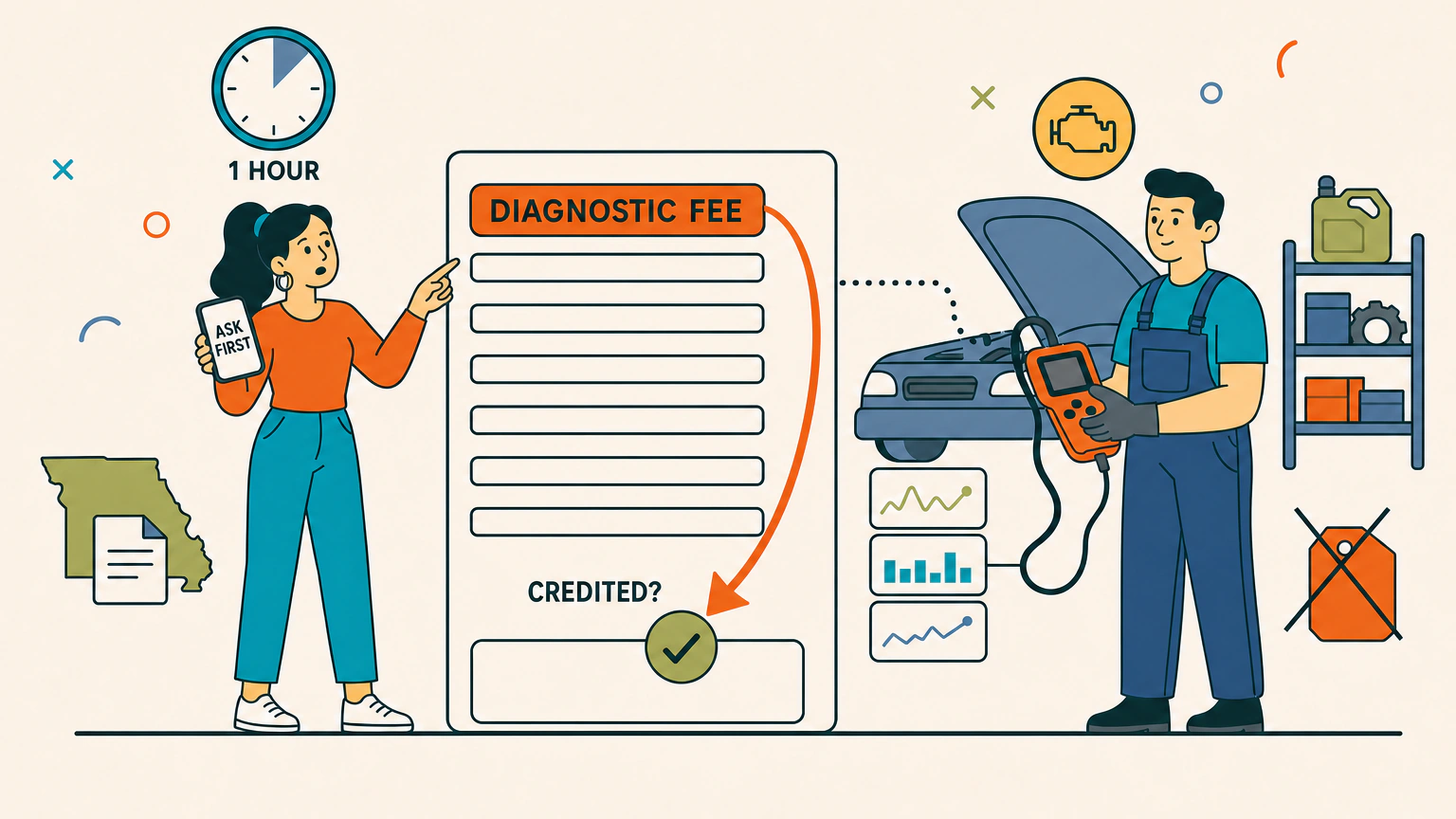
Whether the shop had to warn you about the fee, and whether it can bill that same hour twice, is a state question. New Jersey requires advance agreement and forbids the double bill. In California, no charges may accrue until you authorize the work. In Georgia, the state's own Attorney General says no law requires the shop to mention the fee at all.
On this page
- What a car diagnostic test costs in 2026
- What you are actually paying for (and what the free scan leaves out)
- Does the diagnostic fee come off the repair bill?
- What your state says about diagnostic fees
- When you should not pay a diagnostic fee
- What the fee is protecting you from
- Choosing a shop that diagnoses instead of guessing
- Frequently asked questions
What a car diagnostic test costs in 2026
The scan tool isn't the expense. The technician's hour is.
The one-hour rule of thumb
Shops commonly bill a standard diagnosis as one hour of posted labor. That single habit explains most of the spread: the same test costs $85 in one town and $185 in another because the hour changed, not the work. Ranges like these are what shops charge around the country, not a quote for your car. Find out what an hour is worth where you live: what shops in your state charge per hour, and the going rates for auto repair shops in your city.
What each type of shop charges
Where you take the car changes both the price and what the hour buys.
| Where you go | Typical fee | What it usually includes | Usually credited toward the repair? | Best for |
|---|---|---|---|---|
| Auto parts store (free code scan) | $0 | Stored codes and a possible-causes list | Not applicable | Deciding whether to keep driving |
| Independent repair shop | 1 hour of posted rate, commonly $80-$150 | Codes, live data, pinpoint testing, a written finding | Usually, if you repair there | Most check engine lights |
| Franchise or chain service center | $50-$150 | Similar scope; depth varies by store | Often; varies by promotion | Convenience; tire and brake work |
| Dealership service department | About $100 typical, $50-$500 by brand | Factory scan tool, brand procedures, recall lookup by VIN | Sometimes; waived on warranty or recall work | Brand electronics, driver assistance, open campaigns |
| Mobile mechanic | Call-out fee plus diagnostic time | On-site code read and basic testing | Varies by operator | A car that will not start |
RepairPal's estimator lists check engine light diagnosis at $122-$233, in labor.
Why an A/C, ABS or intermittent diagnosis costs more
Some faults never show up as a code. An A/C complaint needs a performance test with gauges, which is why A/C repair shops quote that separately. ABS, airbag and tire-pressure codes live in their own modules, and reading them takes a tool with compatible coverage. Then there's the fault that refuses to happen while the car sits on the lift. Catching an intermittent in the act is what auto electrical specialists do for a living. A second authorized hour is normal here, and it isn't padding.
What you are actually paying for (and what the free scan leaves out)
A trouble code is a symptom, not a diagnosis
A trouble code records that the computer detected a fault, and it tells you which system or circuit was involved. That's the whole of it. It is not proof that any part failed.
Take P0420. It reports catalyst-system efficiency below threshold, and it can also be set by an exhaust leak, a misfire, a failing oxygen sensor or a fuel-mixture problem. Buy the part the code seems to name, untested, and you've paid for a guess.
What a real diagnosis includes
The hour buys codes, freeze-frame data, live sensor data and a pinpoint test out of the maker's own procedure, written up as a finding you can hold. Here's how to tell you got one: an estimate with a part number on it and no test behind it isn't a diagnosis. It's a shopping list.
| Tier | What the technician does | What you get on paper | Typical time | Typical cost |
|---|---|---|---|---|
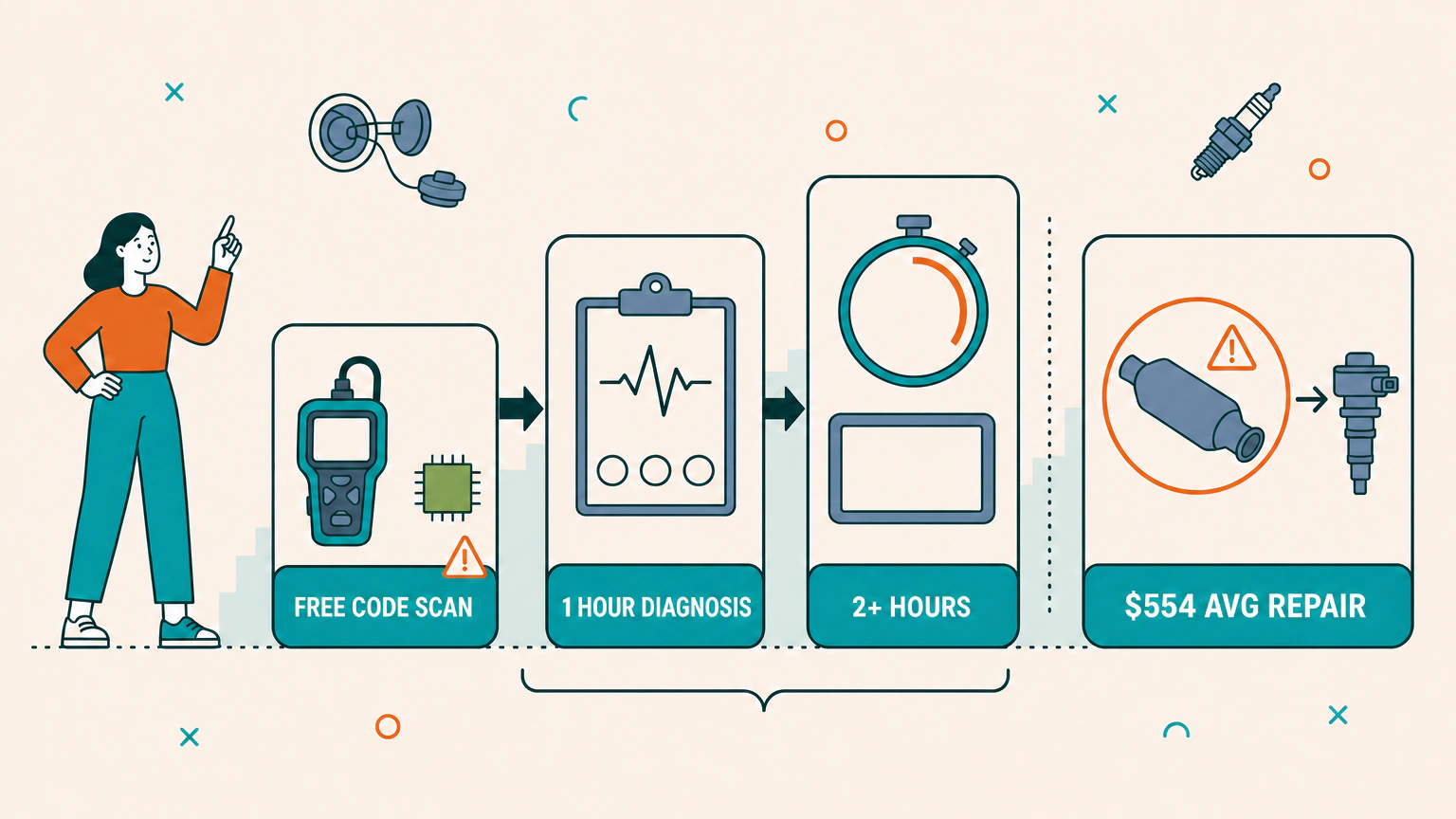
| Code scan | Plugs in a generic reader | Code numbers and a generic description | 5-15 minutes | Free at many parts retailers |
| Standard diagnosis | Codes, freeze-frame and live data, then a pinpoint test | A finding naming the part and the test that proved it | About 1 hour | One hour of the shop's rate |
| Extended or intermittent diagnosis | Data logging, circuit testing, oscilloscope work, road testing | A log or waveform of the fault as it happens | 2+ hours, sometimes across visits | Each extra hour, authorized separately |
The free parts-store scan: good first step, wrong place to stop
Plenty of auto parts retailers read stored codes at no charge, and that's a real help when the only question is whether to keep driving.
Know what it can't do. Module coverage varies by retailer and vehicle, nothing analyzes live data, and nobody tests the circuit. If the counter refuses to clear your codes, that's a favor: clearing them wipes the emissions monitors your inspection depends on.
Where to Get It Diagnosed
Pick what your car is doing and where you live to see what each option costs, what it actually tests, and what your state requires the shop to tell you first.
Pick the closest match. If more than one applies, pick the one that worries you most.
Sets the rule on whether the shop has to tell you the fee before it starts.
A covered fault or an open recall usually means the manufacturer pays for the diagnosis, not you.
5 options for a steady check engine light in California
-
Independent repair shop
Best fit
Typical fee
About 1 hour of the shop's posted rate - commonly $80-$150
Typical time
About 1 hour
What you get
Codes, freeze-frame and live data, a pinpoint test from the manufacturer's procedure, and a written finding.
Credited toward the repair?
Usually credited if you approve the repair here - confirm before you authorize
-
Auto parts store (free code scan)
Workable
Typical fee
Free
Typical time
5-15 min
What you get
Stored trouble codes and a printed possible-causes list. Module coverage varies by retailer and vehicle; no live-data analysis or component testing.
Credited toward the repair?
Not applicable
-
Franchise or chain service center
Workable
Typical fee
$50-$150
Typical time
About 1 hour
What you get
Similar scope to an independent shop; depth varies by store and by the systems that store specializes in.
Credited toward the repair?
Often credited, sometimes promotion-dependent
-
Dealership service department
Workable
Typical fee
About $100 typical; $50-$500 depending on brand and complexity
Typical time
1 hour or more
What you get
Factory scan tool, brand-specific test procedures, and a technical-service-bulletin and recall lookup by VIN.
Credited toward the repair?
Sometimes credited; commonly waived outright when the fault turns out to be warranty or recall work
-
Mobile mechanic
Workable
Typical fee
Call-out fee plus diagnostic time
Typical time
Varies
What you get
On-site code read and basic testing. Limited for anything needing a lift, a scope or a long road test.
Credited toward the repair?
Varies by operator - ask
RepairPal's published estimate for check engine light diagnosis and testing is $122-$233 before taxes and fees.
Three levels of diagnosis
The repair waiting behind the light averages $554CarMD 2026 Vehicle Health Index. An hour of testing is the cheaper half of that bill.
State rules verified against the statute or regulation itself in nine states, August 2026. Fee ranges are typical US figures, not a quote for your vehicle. This is general consumer information, not legal advice.
Does the diagnostic fee come off the repair bill?
Charge, charge-and-credit, waive: the three shop policies
Charge-and-credit is the common one. The fee goes on the estimate, you owe it either way, and it comes off the repair total if you have the work done there. Think of it as prepaid labor rather than a deposit. Take the car somewhere else and you keep the finding; the shop keeps the money.
When the fee is genuinely waived
A real waiver takes the charge off, and it happens for reasons somebody can name out loud. An active factory warranty or safety recall covers the fault. A service contract covers the diagnostic charge. Or the shop agrees this one is a comeback on its own repair. Ask about coverage before the technician starts, not when the invoice prints.
Five questions to ask before you hand over the keys
You don't have to be smooth about this. Read them off your phone at the counter.
- "What is the diagnostic fee, and is that a flat charge or an hourly rate?"
- "If I have you do the repair, does the fee come off the bill?"
- "How many hours are you authorized to spend before you call me back?"
- "Will I get the test result in writing, not just the code number?"
- "Could this be covered by warranty or an open recall, and will you check by VIN before you bill me?"
Pro tip: cap the authorization in writing. Approve one hour of diagnostic time and make the shop call you before it bills more. If the work order has no line for that, write the cap on it yourself, sign it, and photograph your copy before you walk out. A verbal promise to credit the fee is not an authorization.
Six signs the "diagnosis" was not one
Red flag: you may have paid for a guess.
- The estimate names a part but never names a test.
- Nobody mentioned the fee until the work was finished, which breaks the rule in several states.
- The shop quotes a repair off a code you read at a parts store.
- You're told the fee isn't creditable "as a policy," and no policy appears anywhere on the estimate.
- The plan is to "start with the cheap part and see," which is the parts cannon.
- The shop won't put its finding in writing.
Say yes to the repair and the next argument is over the final number, so it's worth knowing how far past the estimate your state lets a shop go.
What your state says about diagnostic fees
The two rules that actually vary
Two questions do all the work here. Must the shop tell you about the fee before it starts? And if you approve the repair, can it bill that same time again? Seven of the nine states we read answer the first. Exactly one answers the second.
States where the shop has to tell you first
California is blunt: "No work shall be done and no charges shall accrue before authorization to proceed is obtained from the customer." No work, and no charges. In effect that covers the diagnostic hour. Minnesota gets there by a longer route: a shop can charge for a diagnosis only if it tells you there will be one, tells you how it is figured, tells you it sits on top of the repair price, and gets your authorization first.
Florida hangs everything on the written estimate. Where the repair will exceed $150, that estimate has to reach you, diagnostic work included, before any diagnostic work happens, unless you waive it as the statute allows. North Carolina runs the same structure at $350, subject to written and partial waivers, including after-hours drop-offs. Virginia is narrower: a shop may charge an estimate fee only if it disclosed that when you asked, in writing or on a sign at the entrance. Massachusetts wants the amount of any estimate or diagnosis charge stated, and posting it counts.
New Jersey, the one state that bans the double bill
If you live anywhere else, this is the rule you'll wish you had. New Jersey's regulation says two things in a row: "Such diagnostic charge must be agreed to in advance by the customer. No cost of diagnosis which would have been incurred in accomplishing the repair shall be billed twice if the customer elects to have the dealer make the repair."
Agreed in advance, and never billed twice. Among the states we read, only New Jersey wrote down that second sentence.
States where no law requires disclosure: Georgia and New York
Then the other end. Georgia's Attorney General puts it plainly: "There is no Georgia law that requires businesses to disclose diagnostic fees before providing auto repair estimates." A Georgia shop follows its own policy and nothing more, so asking at the counter is the only protection you get. New York's rule doesn't go much further: a shop "may charge a reasonable fee for making an estimate."
One caution before you look up your state. Repair rules change, and this is general consumer information, not legal advice. If a specific bill is worth fighting over, your attorney general's consumer protection division or a lawyer licensed in your state is the call to make.
| State | Must the shop disclose the fee before it starts? | Must it credit the fee if you approve the repair? | Source |
|---|---|---|---|
| California | In effect yes: no work and no charges before you authorize | Not addressed | Cal. Bus. & Prof. Code § 9884.9(a) |
| Florida | Yes over $150: written estimate, including diagnostic work, before any diagnostic work, unless waived as the statute allows | Not addressed | Fla. Stat. § 559.905(1) |
| Georgia | No: the Attorney General states no Georgia law requires it | Not addressed | Georgia AG, Consumer Ed |
| Massachusetts | Yes: must state the amount of any estimate or diagnosis charge; posting counts | Not addressed | 940 CMR 5.05(4)(c) |
| Minnesota | Yes: must state the charge, how it is figured and that it is extra, and get authorization first | Not addressed; must reassemble and return the car if you decline | Minn. Stat. § 325F.58 |
| New Jersey | Yes: "agreed to in advance by the customer" | Yes: the same diagnostic time may not be "billed twice" | N.J.A.C. 13:45A-26C.2 |
| New York | Not specifically: a "reasonable fee for making an estimate" is allowed | Not addressed | 15 NYCRR § 82.5(a) |
| North Carolina | Yes over $350: written estimate, including diagnostic cost, before any diagnostic work, subject to written and statutory partial waivers | Not addressed | N.C. Gen. Stat. § 20-354.3 |
| Virginia | Yes if you asked: only if disclosed then, in writing or on an entrance sign | Not addressed | Va. Code § 59.1-207.3 |
These nine states were checked against the statute or regulation itself. The other forty-one are not listed because we have not verified them to a primary source, not because no rule exists. For every state not listed, ask about the diagnostic charge and request a written estimate before work starts. To check your own state, search "[your state] motor vehicle repair act" and "[your state] attorney general auto repair."
How to find your own state's rule in five minutes
Run those two searches and look for three things: a repair act, a bureau of automotive repair or whatever your state calls its regulator, and a consumer-protection rule aimed at repair shops. While you're there, find out where complaints go, the attorney general or the shop regulator. You want that address before you need it.
When you should not pay a diagnostic fee
Warranty, recall and campaign work
Covered defect or open recall, and the manufacturer normally pays the dealer for the diagnostic time. It should never reach your invoice. So ask, in writing, for a VIN check against open safety recalls before you authorize the work. And check first whether going to a different mechanic voids your warranty.
Comebacks on the shop's own repair
Same symptom, same car, after that shop already fixed it. Before you pay to diagnose it twice, check whether the original repair warranty covers another diagnosis. Ask for the original work order too.
When you were sold a guess
An invoice that lists one replaced part after another with no test between them is parts-swapping, and you paid for it. Escalate in order: the shop manager first, estimate and invoice in hand. Then your state attorney general's consumer protection division, or the licensing board if your state has one. Then small claims.
What the fee is protecting you from
The average check engine light now costs $554 to fix
Here's the number behind the fee. CarMD's tally for 2025 put the average cost of dealing with a check engine light at a record $554, up 33% in a year. Labor drove most of that, rising 51% against 23% for parts. The average vehicle on US roads is now 12.8 years old.
The $172 job and the $1,511 job
The cheapest common fix and the most expensive are nine to one apart, and a code alone won't tell you which end you're on.
| Repair | Average cost |
|---|---|
| Catalytic converter | $1,511 |
| Oxygen (O₂) sensor | $287 |
| Ignition coil and spark plug(s) | $480 |
| Mass air flow (MAF) sensor replacement | $346 |
| Ignition coil | $256 |
| EVAP canister purge control valve | $172 |
| Fuel injector(s) | $572 |
| ABS wheel speed sensor | $314 |
| Thermostat | $324 |
| Spark plug(s) | $299 |
CarMD 2026 Vehicle Health Index, April 22, 2026, from more than 39 million US vehicles.
And the two ends are connected. A misfire or a failing oxygen sensor, left unresolved, can eventually damage a catalytic converter. That is the argument for paying the hour: it can help stop a $256 ignition coil from becoming a $1,511 converter, which is what engine repair specialists test for.
Driving on the light is not free either
The meter runs while you make up your mind. A failing oxygen sensor can cost you up to 40% of your fuel economy, and you pay that at the pump.
Safety first: a flashing check engine light means stop driving as soon as it is safe to do so. A flashing light is a severe misfire pushing unburned fuel into the exhaust, and that is the fastest way to destroy a catalytic converter.
Choosing a shop that diagnoses instead of guessing
Ask for the worksheet, not the code
A shop that wants an hour of your money should be willing to show its work: the code, the live data, the test it ran and what that test said. Ask before you book. The good ones answer without flinching.
The credential that matters for diagnosis specifically
Finding a fault and replacing a part are different skills, and the harder one carries its own advanced certification. Ask for it by name, and read up on the certification that covers diagnosis specifically before you choose between two quotes.
Compare the posted rate before you book
The fee is one hour of the posted rate, so the rate is the thing to compare. Preferred Mechanic publishes an hourly rate and fair-price range on its city pages, so you're looking at what auto repair shops in your city charge rather than somebody else's market. The Best of Preferred Mechanic awards flag the highest scorers, and the site says those rankings come out of machine analysis of public sources rather than paid placement.
Frequently asked questions
Do I have to pay a diagnostic fee if I don't get the repair done?
Usually, yes, if you authorized the fee. You bought a technician's time and what that time found, and both have value whether or not you go ahead. In Minnesota, a shop that charged for the estimate has to give your car back reassembled once you pay.
Is the diagnostic fee applied to the repair?
Usually, at shops running the charge-and-credit model. Treat it as prepaid labor rather than a refundable deposit, and get the answer before you authorize anything. In New Jersey the credit isn't a courtesy at all: the regulation forbids billing the same diagnostic time twice.
What is the average diagnostic fee for a car?
About $100 to $150 nationally, and most commonly that's one hour of the shop's posted labor rate. RepairPal's national estimator lists check engine light diagnosis and testing at $122 to $233 in labor. Dealers typically run around $100, though the spread by brand is $50 to $500.
Is a diagnostic fee covered by warranty?
If the fault turns out to be a covered defect or an open recall, the manufacturer normally pays the dealer for the diagnostic time and it shouldn't reach your bill. If it isn't covered, you pay. So ask for a VIN recall check before anyone starts, and ask for that answer in writing.
How long does a car diagnostic test take?
A code scan takes 5 to 15 minutes. A standard diagnosis takes about an hour. An intermittent fault is the one that stretches: several hours, sometimes across more than one visit, because the technician has to reproduce a condition your car only shows when it feels like it.
How accurate is a car diagnostic test?
The code is accurate about what the computer measured. It is not a verdict on what failed. P0420 reports catalyst-system efficiency below threshold, and it can also be set by an exhaust leak, a misfire or a bad oxygen sensor. The accuracy you're paying for comes from the testing that happens after the code.
Can I get a free check engine light diagnostic?
Many auto parts retailers scan stored codes free, and that is a legitimate first step. Just know what you're getting: a code read rather than a diagnosis. Module coverage varies by retailer and vehicle, with no live-data analysis and nobody testing the circuit.
Why do mechanics charge for a diagnostic when the computer does the work?
Because the computer only retrieves codes and data. Everything after that is a technician running the maker's pinpoint tests to figure out which of the several faults that can set your code actually did. That's the part you're buying, and it keeps you from spending $1,511 on a converter to fix a $256 coil.