

On this page
- The short answer, and the one sentence that actually matters
- What federal law actually says (in two sentences and one quote)
- Your car has up to four warranties, and they don't follow the same rules
- The four places the protection genuinely stops
- What a dealer has to prove before it can refuse your claim
- The service record that defeats a denial
- Aftermarket parts, fluids and specs — where the real risk lives
- If the dealer says no anyway: your escalation ladder
- Choosing a shop that keeps your warranty clean
- Frequently asked questions
- The sources behind this
The short answer, and the one sentence that actually matters
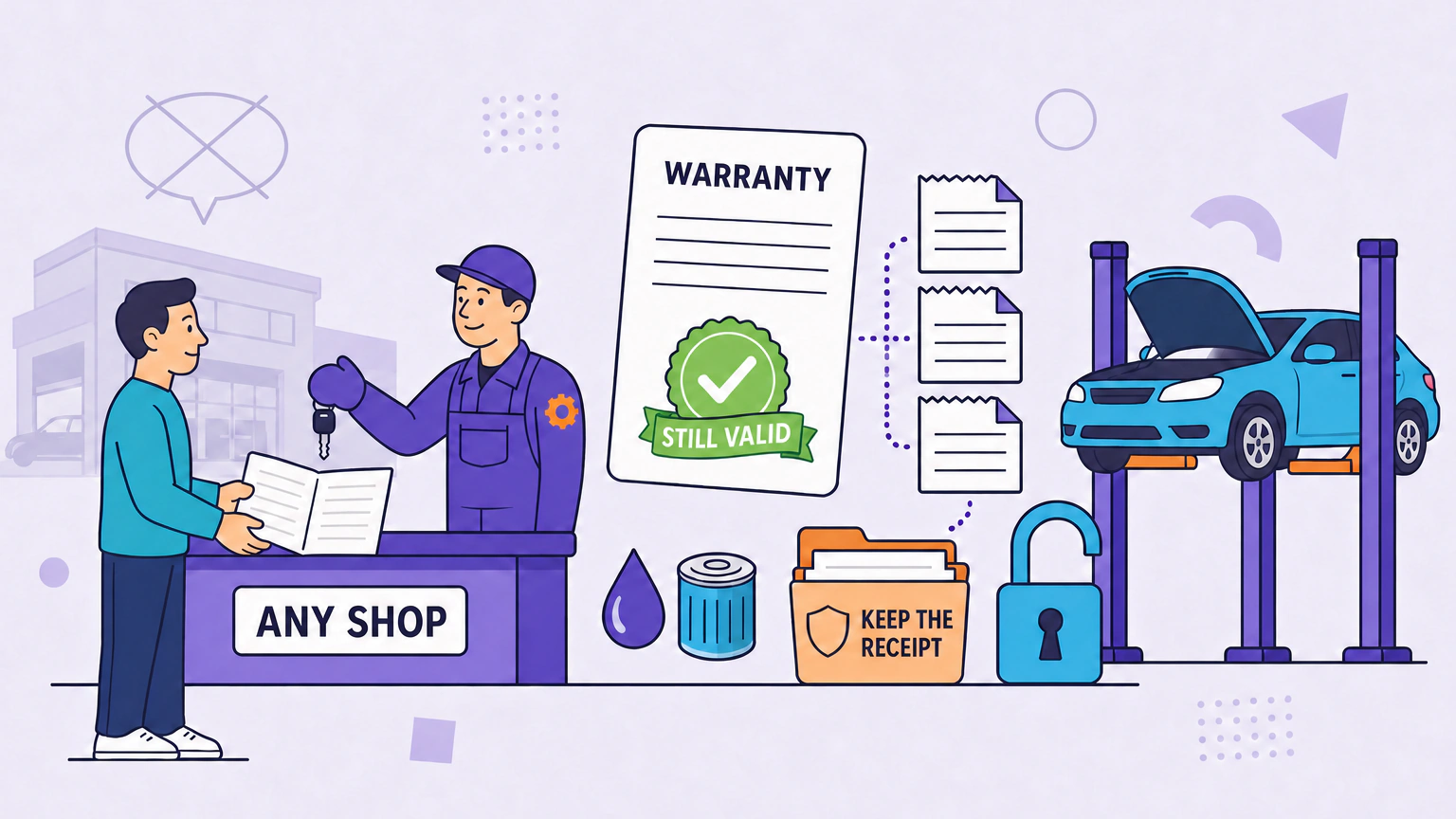
No. Getting your car serviced somewhere other than the dealer does not void your warranty. Book the cheaper oil change. Take the brakes, the tires and the scheduled maintenance to the shop down the street, and your factory coverage is exactly what it was this morning. The Magnuson-Moss Warranty Act makes it illegal for a manufacturer to hang your warranty on using its dealers or its branded parts, unless it hands you that part or that service free of charge. The Federal Trade Commission enforces it: in October 2022 it finalized orders against Harley-Davidson, MWE Investments and Weber over terms claiming coverage would be void if customers used independent repairers, and required Harley-Davidson and MWE to add language similar to "Taking your product to be serviced by a repair shop that is not affiliated with or an authorized dealer of [Company] will not void this warranty."
What a dealer can still do is refuse coverage for damage it can prove the outside work or part caused. Unrelated coverage stays in force. Causation, not location.
At a service counter, "void" and "denied" get used as though they were one word. They aren't, and the gap between them is where your money sits. One is a claim about your whole warranty. The other is about coverage for particular damage, and the manufacturer carries the burden of proving causation.
Voiding a warranty and denying a claim are two different things
Voiding a warranty means cancelling it. No manufacturer gets to do that because you picked a different shop.
Denying a claim means refusing coverage for particular damage. That one is genuinely on the table, in narrow circumstances.
The FTC explains it with a belt. Somebody replaces the belt improperly, the bad work damages the engine, and the manufacturer can refuse to pay for the engine. Even then, "the warranty would still be in effect for other parts of your car."
What federal law actually says (in two sentences and one quote)
A manufacturer can't require you to use its dealers or its branded parts to keep your warranty alive. Under the FTC's own regulation, it can't even tell you that you must.
The tie-in ban — 15 U.S.C. § 2302(c)
No warrantor "may condition his written or implied warranty of such product on the consumer's using, in connection with such product, any article or service (other than article or service provided without charge under the terms of the warranty) which is identified by brand, trade, or corporate name."
Translated for the service drive: a carmaker can insist on its own oil filter only if it hands you that filter for free. That's why a car sold with free scheduled maintenance can legitimately route you to a dealer. The FTC can waive the ban, but only through a proceeding published in the Federal Register for comment.
The FTC's rule on "use only authorized dealer" language — 16 C.F.R. § 700.10
Making the statement is prohibited, not just acting on it. The rule bars conditioning a warranty's continued validity on using only authorized service or authorized parts for non-warranty work, and it prints the banned wording as its own example: "This warranty is void if service is performed by anyone other than an authorized 'ABC' dealer and all replacement parts must be genuine 'ABC' parts."
Read that, then read your own warranty booklet.
What the manufacturer keeps is narrow. It may deny liability "where the warrantor can demonstrate that the defect or damage was so caused." One word does all the work there, and the word is "caused."
It is enforced — the 2022 right-to-repair orders
On October 27, 2022 the FTC approved final orders against Harley-Davidson, MWE Investments and Weber-Stephen Products. No more telling customers their warranties are void for using third-party service or parts. Corrective warranty language added. Existing customers notified. Break the orders again and the penalty runs up to $53,088 per violation.
Look at who those companies are. Harley-Davidson builds motorcycles, Weber builds grills, and not one of the three is a carmaker. What the FTC has done to carmakers is write to them. On April 10, 2018 its staff sent warning letters to six major companies selling automobiles, cellular devices and video gaming systems over this language, and said it would recheck their websites after 30 days. The FTC never named the six, and we aren't going to guess at them.
Pro tip: the one sentence to say at the counter. "I'd like the denial and the reason in writing, please, and can you tell me what evidence shows the outside service caused this failure?" Say it politely, then stop talking. It moves the conversation off policy and onto proof, which is where federal law puts the burden.
Your car has up to four warranties, and they don't follow the same rules
Almost everybody talks about "your warranty" as one document with one rule. It isn't. A three-year-old car carries up to four coverage categories at once, and they disagree about who may touch it.
| Warranty | Typical coverage window | Routine maintenance — who may do it | The covered repair — who must do it | What governs it |
|---|---|---|---|---|
| Factory warranty (bumper-to-bumper / powertrain) | Set by the manufacturer; check your booklet | Anyone, including you | Usually an authorized dealer; check the booklet's emergency-repair procedure | 15 U.S.C. § 2302(c); 16 C.F.R. § 700.10 |
| Federal emissions, Performance Warranty | 2 years / 24,000 miles; 8 years / 80,000 miles for specified major components | Anyone | A manufacturer-authorized facility, per EPA | Clean Air Act; EPA guidance |
| Federal emissions, Design and Defect Warranty | Same terms, the longer one covering catalytic converters, the ECU and the OBD device | Anyone | A manufacturer-authorized facility, per EPA | Clean Air Act; EPA guidance |
| Vehicle service contract ("extended warranty") | Whatever the contract says | Anyone, unless the contract says otherwise | Often a facility the contract approves, after prior authorization | The contract, plus state regulation |
| The repair shop's own warranty | Set by the shop; may be time- and mileage-limited | n/a | The shop that did the work | The shop's written terms |
A safety recall is not a warranty at all. It runs on its own law.
The factory warranty (bumper-to-bumper and powertrain)
Maintenance goes wherever you want it to go. A dealer, an independent shop, a quick-lube chain, your own driveway. Compare prices among oil change shops in your area and keep the difference.
Covered repairs are the other half, and there the booklet does the talking. Manufacturers normally route paid work through authorized dealers, with limited emergency-repair exceptions.
The federal emissions warranties (2 years/24,000 miles, and 8 years/80,000 miles)
The Clean Air Act hands you two more, and almost nobody knows they own them. The Performance Warranty covers repairs you need because your vehicle failed an emissions test. The Design and Defect Warranty covers emissions parts that fail from defects in materials or workmanship.
Both run the first 2 years or 24,000 miles. Both stretch to 8 years or 80,000 miles for what the EPA calls specified major emission control components, which "only include the catalytic converters, the electronic emissions control unit or computer (ECU), and the onboard emissions diagnostic (OBD) device or computer."
The vehicle service contract you bought at the finance desk
What the finance office sold you is a contract, not a manufacturer's warranty. The tie-in ban is a weak tool against a contract.
Take California. It licenses these providers through its Department of Insurance and requires almost all contracts to be guaranteed by a backup insurer named on the contract. The obligor can require you to approve a tear-down inspection before it decides. Once it accepts, it issues your shop a claim authorization number. Going ahead without prior authorization can lead to a denied claim.
Your state will do some of it differently, through a different agency.
Your independent shop's own warranty on the work it did
The fourth coverage category is the one people forget they may have at all. If a shop offers its own warranty, the written terms may cover parts and labor for a set time or mileage, including a repair that shop got wrong. Ask for the terms in writing before you authorize work.
The four places the protection genuinely stops
Four limits, and two of them normally send you back to a dealership.
1. The covered repair itself goes to the dealer
If the manufacturer is paying, follow its warranty-service procedure. You can take a warrantable failure to an independent shop, but reimbursement depends on the booklet's emergency-repair terms.
2. Reimbursement under the emissions warranties goes to an authorized facility
The EPA does not hedge: "If you plan to have the manufacturer pay for a repair under either of the emissions warranties, you must take the vehicle to a facility authorized by the vehicle manufacturer for repair."
An unauthorized shop, it adds, "is not obligated to advise you of parts that are covered under warranty." Nobody has to tell you. That's how drivers end up paying for catalytic converters still inside 8 years and 80,000 miles.
3. Safety recall work goes through the dealer network
A recall is not warranty coverage. Federal safety law makes the manufacturer "remedy the defect or noncompliance without charge when the vehicle or equipment is presented for remedy," through its franchised dealers. The free remedy "does not apply if the motor vehicle or replacement equipment was bought by the first purchaser more than 15 calendar years" before notice. Check your VIN at NHTSA's free recall lookup, nhtsa.gov/recalls, before you book.
4. Your service contract's own terms
If your contract names an approved facility, or demands authorization before a wrench turns, those terms may govern the claim under applicable state law. The factory-warranty tie-in ban does not override the service contract's process. Use the contract's process, or argue later with the invoice already paid.
What a dealer has to prove before it can refuse your claim
A denial is not an announcement a service advisor gets to make. It's a position the manufacturer has to hold up. The FTC states the standard twice. It "must be able to demonstrate" that the outside work rather than some other defect caused the damage. It "must show that the aftermarket or recycled part caused the need for repairs before denying warranty coverage."
What a Dealer Has to Prove
Warranty coverage is not one rule. It is a chain of five steps, and the federal law behind it is the Magnuson-Moss Warranty Act, enacted 1975 (15 U.S.C. § 2301 et seq.). Scroll to move through the steps, or jump straight to one.
Four coverage categories, one car
Factory warranty
Bumper-to-bumper and powertrain. Check your booklet for the term.
Federal emissions warranties
2 years / 24,000 miles. 8 years / 80,000 miles for the catalytic converters, the ECU and the OBD device.
Service contract
The 'extended warranty' you bought. A contract, not a manufacturer's warranty.
Shop's own warranty
If offered, its written terms cover the shop's work.
Different coverage layers. Different rules about who may touch your car.
The tie-in is the illegal part
"Service here or your warranty is void"
15 U.S.C. § 2302(c)
A manufacturer cannot condition your warranty on using its dealers or its branded parts — unless it provides them free under the warranty.
16 C.F.R. § 700.10 — even saying it is prohibited.
FTC, 2022: Harley-Davidson and MWE ordered to add 'will not void this warranty.' Current maximum: $53,088 per violation.
The one door left open: proof
still covered.
A dealer may refuse coverage for damage — and only if it can show the outside work or part caused that damage. Unrelated warranty coverage stays in effect.
"The warranty would still be in effect for other parts of your car."
Where the protection actually stops
Warranty repair Usually an authorized dealer; check the booklet's emergency-repair procedure.
Safety recall Remedied without charge through the dealer network. The free-remedy rule need not apply if the first purchaser bought it more than 15 years before the notice.
Emissions reimbursement "you must take the vehicle to a facility authorized by the vehicle manufacturer for repair."
Service contract Some contracts limit the repair facility or require pre-approval; follow yours.
What defeats a denial
Date
Odometer
Fluid specification
Part number
Shop name and address
The dealer has to prove causation. This is the document that makes that hard.
Then pick a shop that prints all five.
Federal rules, current as of the verification date on this article. Not legal advice — read your own warranty and service contract.
What "caused" means in practice
You put in oil that meets the manufacturer's specification. The engine fails 20,000 miles later from a known defect. The oil change is irrelevant, and a denial has nothing to stand on.
Somebody fits the wrong belt badly and the engine is damaged. The manufacturer may refuse coverage for damage caused by that installation. Unrelated coverage remains.
You have the car tuned for performance and the powertrain later fails. Expect a causation dispute. The manufacturer still must support a denial.
The service record that defeats a denial
Read that burden of proof backwards and it turns into a specification for your paperwork. Pin down the date, the mileage, the fluid specification and the part number, and "the outside work caused this" gets hard to say out loud.
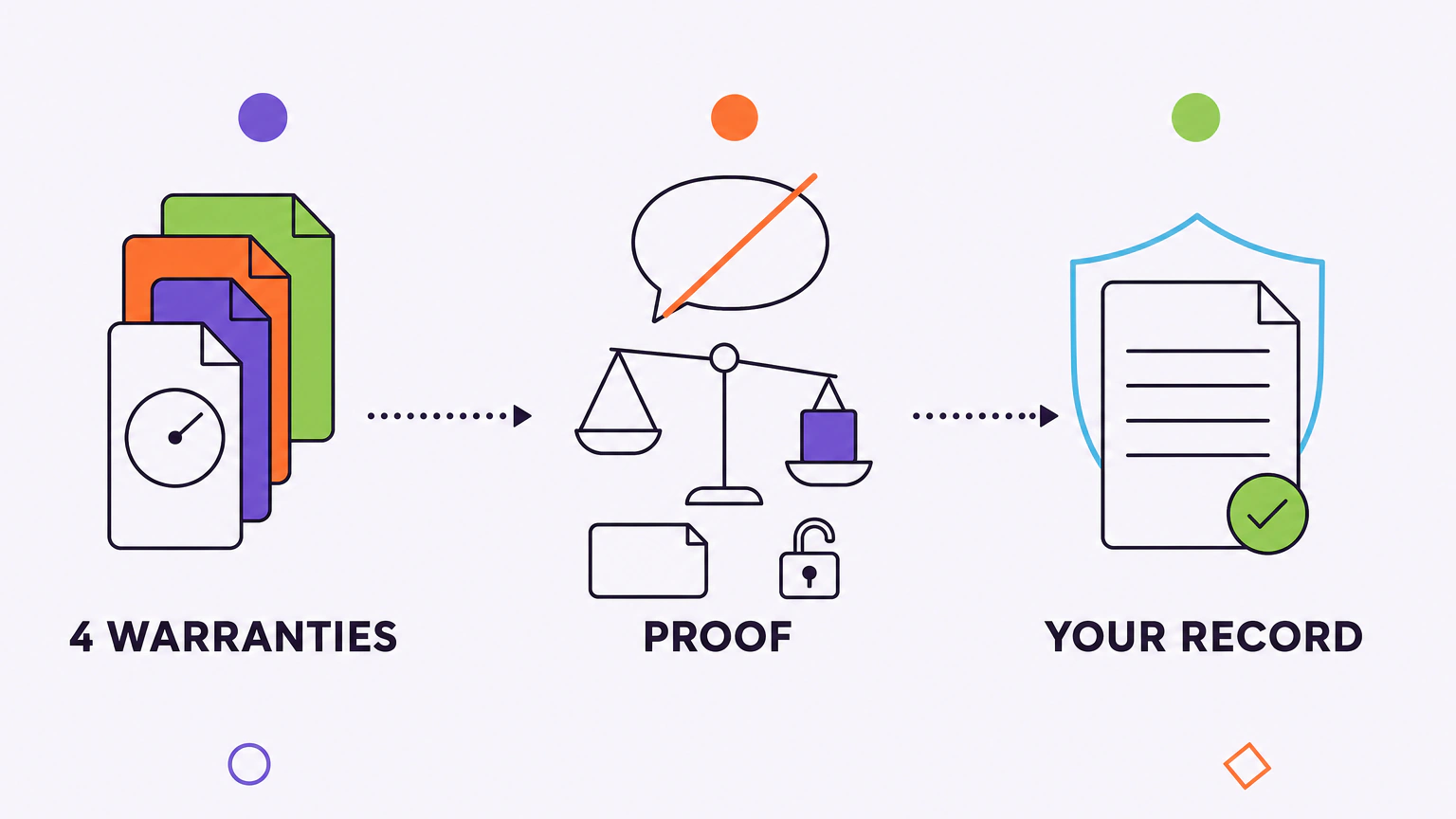
Build the file as you go:
- Date of service and the odometer reading, every visit.
- The shop's legal name, address and phone number. A handwritten total on a blank slip is not a record.
- Every fluid by specification, not brand: the oil grade and the manufacturer standard it meets, printed in your owner's manual.
- Part numbers for every part installed, filters included.
- Which scheduled-maintenance interval the visit satisfies, such as "30,000-mile service."
- A labor description specific enough that a stranger reading it in three years knows what was done.
- Photographs of the invoice, taken the day you get it, in one folder.
- Ask for the old part back if you want it. State law may give you that right.
- A one-line log: date, mileage, what was done, where.
Invoice photos on your phone beat a stuffed glovebox, and either beats your memory. If you'd rather keep the whole schedule under one roof, shops that handle factory scheduled maintenance track the intervals for you.
Ask for these five lines on every invoice
Short enough to say while the advisor is still typing. Date. Odometer reading. The exact fluid or part specification from the owner's manual. The part number installed. The shop's name and address.
Aftermarket parts, fluids and specs — where the real risk lives
Using an aftermarket part does not itself void coverage. The risk is a defective, improperly installed or out-of-spec part or fluid that causes damage.
Oil is where this bites. "Meets or exceeds" on a bottle is a general claim. Your owner's manual names the specific standard your engine needs. Ask for the specification on the invoice rather than the brand, because a specification is checkable years later. Filters, coolant and transmission fluid work the same way.
Red flag: five things a service advisor should not say to you.
- "If you don't service here, your warranty is void." Saying it is the violation, not just acting on it.
- "You have to use genuine [brand] parts to keep coverage." Only if the manufacturer supplies them free.
- "We can't honor this because you went somewhere else." A denial needs proof that the outside work caused this failure.
- "Your whole warranty is gone." No. Even a valid causation-based denial leaves unrelated coverage in force.
- "There's nothing in writing, that's just policy." Then ask for the denial and its reason in writing.
The FTC asks drivers told a warranty is void for using an independent shop or third-party part to report it at ReportFraud.ftc.gov.
If the dealer says no anyway: your escalation ladder
One caveat before you climb. We're not your lawyer and this isn't legal advice, and warranty booklets and service contracts differ line by line, so read yours before you argue with anybody.
All of this is federal law aimed at the manufacturer, and it usually surfaces years after the service. A fight with the shop over the bill is a different animal, and it depends instead on your state's rules on repair estimates and authorization. Work the rungs in order.
- The service manager. Ask for the denial and its stated reason in writing, and don't leave without it.
- The manufacturer's customer assistance line or zone representative. A different decision-maker from the dealership. Bring the written denial and your service log.
- The FTC, at ReportFraud.ftc.gov. Its own alert asks for exactly these reports. Bring both documents.
- Your state attorney general's consumer protection office. For a service contract, go instead to the state agency that regulates it and any backup insurer named on the contract. Bring both documents.
- Small claims, or a Magnuson-Moss action. Federal law says a consumer who finally prevails may recover costs and expenses "including attorneys' fees based on actual time expended." Bring everything, plus every invoice.
Choosing a shop that keeps your warranty clean
Three questions, all of them askable before you hand over a key.
Does the shop print specifications and part numbers on the invoice? Ask before the first visit, not after a denial. Start with auto repair shops near you and compare the paperwork.
Are its technicians certified for the system in question? Check the technician's credentials for the system being worked on, especially for engine, transmission and emissions work.
Will it put its workmanship warranty in writing, in months and miles? Price is the next question, and what an independent shop should charge per hour sets your benchmark for quotes from independent mechanic shops.
We list dealerships and independents side by side, with no stake in which you pick. Preferred Mechanic says its rating methodology scores businesses on 150 proprietary data points from public reviews and discussion, published as the Best of Preferred Mechanic awards. That's our claim about our own method. The invoice test is yours.
Frequently asked questions
Does getting an oil change somewhere other than the dealer void my warranty?
No, and the FTC lists what you can take anywhere: oil changes, tire rotations, belt replacement, fluid checks and flushes, new brake pads, inspections. An independent mechanic, a retail chain, or you. Keep the invoice, and make sure it names the oil specification from your owner's manual.
Is my car warranty void if it wasn't serviced by the dealer?
No. Who performed the service does not void coverage, and federal law makes it illegal for a manufacturer to claim otherwise. What causes real trouble is something different: a service that was skipped, or one you cannot prove ever happened three years later.
Does missing or being late on an oil change void my warranty?
Not automatically. This is the genuine risk though, and it's a separate question from where the work was done. Follow the schedule in your owner's manual and keep records with dates and odometer readings. A manufacturer that can show a failure came from missed maintenance can deny that claim.
Will aftermarket parts void my car warranty?
No. Using an aftermarket or recycled part does not void your warranty. Before denying coverage, the manufacturer or dealer must show the part caused the need for the repair. A valid denial reaches the damage caused by that part, while unrelated coverage remains in force.
Can an independent mechanic do actual warranty repair work?
They can perform the repair. Whether the manufacturer pays is a separate question, answered in your warranty booklet. Warranty work normally goes through authorized dealers, while some booklets allow reimbursement for defined emergency repairs elsewhere. Read that section before you need it.
What should I do if the dealership won't honor my warranty?
Get the denial and its stated reason in writing first. Everything after that runs on that document. Escalate to the manufacturer rather than the dealership. Report it to the FTC at ReportFraud.ftc.gov and file with your state attorney general. Under federal law a consumer who prevails may recover costs and attorneys' fees.
Is an extended warranty different from the factory warranty on this?
Yes, and it's the exception that matters. A vehicle service contract is a contract, not a manufacturer's warranty, so the federal tie-in ban does not govern it. It can require prior authorization before work starts, and its own terms can decide where the repair happens.
Do I have to service a leased car at the dealership?
No. The federal warranty protection works the same way on a leased car. The lease is a separate contract with its own maintenance obligations, and end-of-lease inspections look at maintenance history, so read the maintenance clause and keep the same records.
The sources behind this
The primary sources:
- 15 U.S.C. § 2302(c) and § 2310(d), 16 C.F.R. § 700.10, 49 U.S.C. § 30120 (Cornell Legal Information Institute).
- FTC final orders, October 27, 2022, and FTC staff warning letters, April 10, 2018.
- FTC consumer alerts, July 7, 2022, and "Auto Warranties, Routine Maintenance, and Repairs: Is Using the Dealer a Must?" (GovInfo GOVPUB-FT-PURL-gpo18134).
- EPA, "Frequent Questions related to Transportation, Air Pollution, and Climate Change."
- California Department of Insurance, "Guide to Automobile Service Contracts, Extended Warranties and Other Repair Agreements," revised February 18, 2025.
Your own warranty booklet and your service contract govern your car. Go find them tonight and read the maintenance section.