

On this page
A 12-volt battery that reads 12 volts is mostly flat
Probes on the posts, meter on, and the screen says 12.1. It's a 12-volt battery, so 12.1 sounds like a pass.
It isn't.
OPTIMA Batteries lays out the arithmetic. Each of the six cells inside a 12-volt battery should read about 2.1 volts when it's full. Six times 2.1 is 12.6, and that's where a healthy battery rests. OPTIMA is blunt about the other end: a meter reading "12.00" volts means the battery is "significantly discharged." East Penn Manufacturing, which builds Deka batteries in Pennsylvania, puts 12.0 volts at a quarter charged on its own chart.
So the headline number is the easy part. The useful work is in the four readings that fool people: a half-charged battery that still starts the car, an AGM that looks full at three-quarters, a number flattered by the drive home, and a pickup that cuts its own charging voltage to save gas.
What the number means with the engine off
A resting reading means one taken with the engine off, after the battery has sat still. Battery University puts the minimum wait at four hours. Do that, then read your number against what the battery maker publishes. East Penn's chart gives standard batteries and AGM batteries, the sealed type, separate columns.
| Charge | Standard (flooded) battery | AGM battery | What to do |
|---|---|---|---|
| 100% | 12.6 volts | 12.8 volts | Nothing to charge |
| 75% | 12.4 volts | 12.6 volts | Top it up before cold weather |
| 50% | 12.2 volts | 12.3 volts | Charge it now |
| 25% | 12.0 volts | 12.0 volts | Charge it now, then test again |
| 0% | 11.8 volts | 11.8 volts | Charge it, then see if it holds |
Engine off, after the battery has rested. The voltages are East Penn's. Battery Council International's version for a standard battery at about 80°F reads 12.65, 12.45, 12.24, 12.06 and 11.89 volts, the same ladder with more decimals.
Why 12.2 volts isn't a healthy battery
Some online charts call anything from 12.2 to 12.6 volts a healthy resting battery. East Penn's chart says 12.2 volts is half charged.
OPTIMA goes further. Once any lead-acid battery sits below 12.4 volts, AGM included, sulfation starts, and sulfation "diminishes both capacity and lifespan."
Those charts sound right because the car keeps starting. OPTIMA also says batteries start cars "even if their voltage level is well below 12.4 volts." So a half-charged battery feels perfectly fine in September. The engine turns over, the radio comes on, nothing warns you. The first hard frost is when it stops being fine.
We'd charge anything under 12.4 volts before the cold arrives, and we wouldn't wait for a slow crank to prove the point. A slow crank is the thing you're trying to avoid.
The type of battery changes the answer too.
AGM batteries sit higher, so the same number means less
AGM stands for absorbent glass mat. The acid sits in fiberglass matting instead of sloshing around loose, and the case is sealed. It also reads a little higher than a standard battery at the same state of charge.
East Penn gives AGM its own column. Full is 12.8 volts. 12.6 is three-quarters. 12.3 is half. So the 12.6 that means "full" on a standard battery means "three-quarters" on an AGM, with a top-up due.
The exact line moves by battery. OPTIMA, which makes only AGM batteries, puts its REDTOP line at about 12.6 to 12.8 volts when full, and its deep-cycle YELLOWTOP line at about 13.0 to 13.2.
The label on the case says AGM if it is one. If you can't identify the battery, stop and use the handbook before you interpret the number.
Testing it yourself with a multimeter
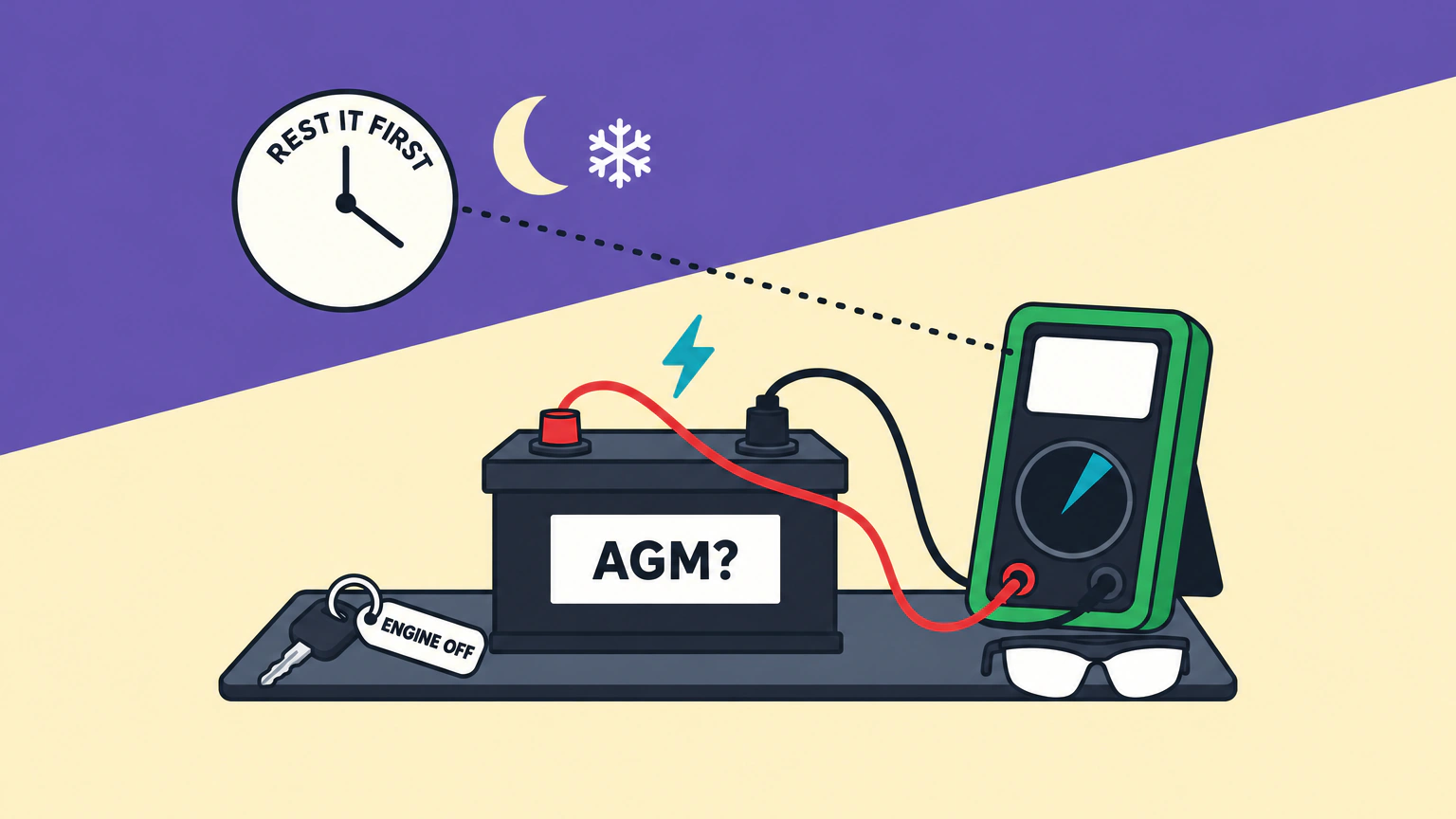
This takes five minutes and a meter that costs about as much as lunch. Two steps decide whether the number is worth anything: letting the car sit, and reading the label. Skip either one and you're looking at a number that means something else.
- Look before you touch it. A swollen, cracked or leaking case, or a rotten-egg smell, means don't test or charge it.
- Put on safety glasses and keep sparks and flames away, because every battery gives off explosive hydrogen gas.
- Let the car sit with the engine off for at least four hours. Overnight is better.
- Set the meter to DC volts, on the 20-volt range if it has ranges.
- Touch the red probe to the positive post and the black probe to the negative post.
- Write the reading down to two decimals, and check the battery's label for the letters AGM before you look the number up.
Why a battery reads great right after a drive
A battery that's just been driven or charged holds a little extra charge sitting on the plate surfaces. That's surface charge, and it pushes the meter above the battery's real state. Battery University calls the result "a false voltage-based SoC reading." AutoZone puts it in driveway terms: test right after use and you're reading the charge your car just put in.
The fix is free. Switch the headlights on for a few minutes with the engine off, or let the car sit a few hours, then read again. Technicians do the same before any serious test. How full a battery is and how healthy it is are different measurements, and surface charge blurs the first.
This matters most if you test after your commute. That number flatters the battery. A low reading taken right then is worse news than it looks.
Cold mornings pull the reading down, and the starting power down further
Cold does two things to a battery, and they're very different sizes.
It lowers the voltage the battery shows. Heat raises the reading and cold drops it, Battery University says. It also takes the fight out of the battery. AAA's Automotive Research Center puts the loss at about 35 percent of a battery's strength at 32°F, and about 60 percent at 0°F. Meanwhile the engine can need up to twice the current to turn over.
So the meter moves a little and the cranking power moves a lot. That's why a battery reading 12.2 in October is a no-start candidate in January.
Test near room temperature when you can. Treat a cold-morning reading as the battery's worst day rather than its average.
If the resting number looks fine, the next question is whether the car is keeping it that way.
Engine running: is the alternator keeping up?
Charge the battery first. AutoZone warns that a battery which can't hold a charge puts "an incredible strain" on an alternator that was never built to recharge a flat one.
Then start the engine, switch the lights, blower and radio off, and read at the same two posts.
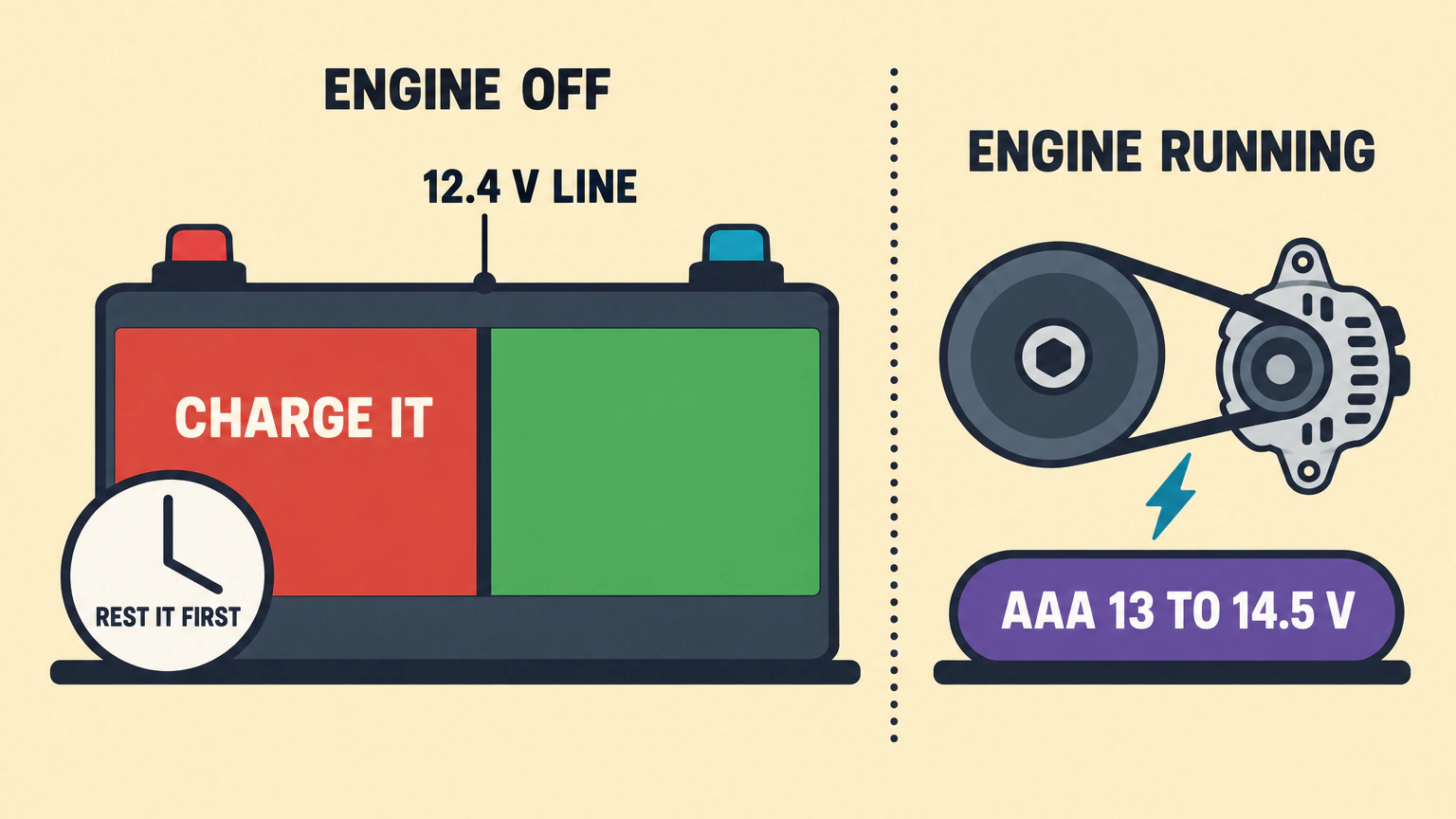
AAA's rule is short. 13 to 14.5 volts means the alternator is charging the battery properly. Any other reading, AAA says, means it's over- or under-charging. Hold onto that. A newer kind of car complicates it.
| Engine running, lights off | What it can mean | What to do |
|---|---|---|
| Under 13 volts | Below AAA's range, but it can be normal on a smart-charging vehicle | Compare it with the maker's target. GM specifies 12.6 to 13.1 volts in fuel economy mode on certain trucks and SUVs |
| 13 to 14.5 volts | Inside AAA's range; one reading alone doesn't prove the system is healthy | Compare it with the maker's target if you have symptoms or the reading keeps moving |
| Over 14.5 volts | Above AAA's range, but a smart-charging system can legitimately run higher | Compare it with the maker's target. If the reading is outside that target, have the charging system tested |
AAA supplies the 13 to 14.5 reference. GM and Clore show why the vehicle maker's target controls on computer-managed systems.
Why some newer cars read under 13 volts on purpose
Plenty of cars now let a computer set the charging voltage, minute by minute.
GM's own bulletin for its full-size trucks and SUVs spells it out. From the 2005 model year, its light-duty pickups and utilities cut the generator's target to 12.6 to 13.1 volts in "Fuel Economy Mode," which makes the dash voltmeter swing between 12 and 14 volts. GM tells its technicians that the fluctuation "is normal system operation and NO repairs should be attempted." An FCA US service case describes the same 12-to-14-volt swing on its own regulated charging. Gears, a repair-trade magazine, says technicians diagnose this mode as a failed charging system, install new parts, and find the car behaves exactly as before.
On those GM trucks, the bulletin says turning on the headlights raises the target to 13.9 to 14.5 volts. Other vehicles can use different strategies, so check the handbook before treating that as a test.
If your reading falls outside the maker's target, get the charging system tested. Our guide to what a charging-system diagnosis costs has the numbers. A shop can compare voltage at the alternator and battery, then check the charging circuit for damaged cables or poor connections.
And when a guide treats a moving gauge as proof of a fault, it's describing an older car.
When the reading runs too high
Above AAA's 14.5 volts isn't automatically a fault either.
MOTOR magazine describes GM's Battery Sulfation Mode. When battery voltage sits under 13.2 volts for 45 minutes, the system targets 13.9 to 15.5 volts for five minutes. GM's bulletin uses the same top figure for its charge mode, 13.9 to 15.5 volts, depending on the battery's charge and its estimated temperature. So read it again after a few more minutes of running.
Clore Automotive, which makes the testers and chargers shops buy, goes further. On a car whose charging is module-controlled, it says, an output of 13.0 volts can be perfectly normal in one situation while 16.0 volts is normal on the same vehicle in another. The old "if output is between X and Y, it is OK" rule is over.
Which is why one high number is a reason to look rather than a verdict. If the reading stays outside your car maker's target, take it to an independent shop and have the charging system checked. East Penn is blunt about the stakes: "Never overcharge batteries. Excessive charging will shorten battery life." It also warns that charging an AGM battery above 15.4 volts, "even one time," may greatly shorten its life.
Put in the number your meter showed and tell us how you took it. We'll tell you what it means.
This interpreter is for a confirmed conventional 12-volt lead-acid starter battery. If the label or handbook doesn't confirm that, stop here and use the maker's instructions.
Set the meter to DC volts, on the 20-volt range if it has one. Red probe on the positive post, black on the negative.
What that voltage says
Engine off and rested, under 12.4 volts means charge it.
With the engine running, AAA's 13 to 14.5 volt range is a useful reference, but the maker's target controls.
Half to three-quarters charged
On East Penn's chart for a standard battery, 12.2 volts is 50 percent and 12.4 is 75 percent. Yours is in that stretch.
Charge it now, with a battery charger rather than a drive. OPTIMA says sulfation starts below 12.4 volts and can cut both capacity and battery life.
Your reading: 12.20 volts
A meter reading tells you charge, not strength. A load test tells you that.
What a voltage reading can't tell you
A voltage reading tells you how full a battery is. It doesn't tell you how strong it is.
OPTIMA says measuring battery voltage "isn't the definitive assessment of a battery's health." East Penn calls a load test "the best way to determine if the battery is delivering adequate electrical performance."
A battery can read 12.6 volts at rest and still have weak internal conductance. Put it under load and the voltage can collapse.
The cranking check you can do with a helper
Leave the meter on the posts, have someone turn the key, and watch for the lowest number.
NAPA's line is 9.6 volts. Stay above it, NAPA says, and "you have sufficient cranking power." East Penn uses that same 9.6 volts as the pass mark on a proper load test at 70°F or warmer, and the line falls as the battery gets colder, down to 8.5 volts at 0°F.
Two things to be clear about, because this is where people talk themselves into a new battery.
Those temperature figures belong to a controlled load test, the kind that pulls half the battery's cold-cranking-amp rating for a measured 15 seconds. Turning your key isn't that test. A dipped crank reading is a reason to get a real load test, never a verdict on its own.
And a low crank number has several suspects. Clore's carbon-pile tester manual lists them: a failing battery, bad battery or starter connections, a failing starter motor, or a battery too small for the car. A dragging starter pulls more current than it should and deepens the dip all by itself.
If it never cranks, there's nothing to measure. Start with a car that won't crank at all, which goes by the sound instead.
Charge it before anyone tests it
None of the top search results mentions this step, and it's the one that saves batteries.
East Penn: "You can't load test a discharged battery. If the voltage is below 12.4, be sure to completely charge it before continuing." The handheld units most parts counters use are conductance testers, and East Penn says those are "ineffective on a discharged battery."
So a battery that's simply flat can be handed a bad verdict by a free test. It runs the other way too. A borderline battery passes as good with a note to recharge it, then fails once it's been charged properly and retested.
Charge it first. Then get it tested, and ask for one more thing East Penn recommends. If a tester says to replace a battery that was tested in the car, the test gets repeated with the cables off and the posts cleaned.
That's what a proper car battery service near you covers: charge, then test, then a verdict worth acting on.
What to do with the number
Two moves cover almost every low reading. Put a charger on it, then find out whether it holds. Neither one needs a shop, and both tell you more than another look at the meter. And there's one battery you never charge at all.
Compare a surprising running reading with the maker's target before you call it a fault.
Under 12.4 volts, use a charger, not a drive around the block
A lap of the neighborhood won't do it. OPTIMA explains why: the energy used to start the car "may not be replaced by the alternator, simply by idling the car in the driveway for a few minutes," and most alternators "were designed to maintain batteries, not recharge deeply-discharged batteries."
So use a charger, and expect it to take a while. East Penn's chart gives the scale, starting from half charge at 80°F. About three hours on a 10-amp charger. About 15 hours on a 2-amp maintainer. The time depends on the battery's age, temperature and capacity, and on the charger's efficiency.
One rule if yours is an AGM. Use a charger with an AGM setting, because East Penn warns that a typical shop charger going above 15.4 volts can damage one.
Read it again in two days, and again in a week
A charge is also a test. AAA's version: once it's charged, disconnect the battery and let it sit two days, then read it. Under 12.6 volts and "it is struggling to hold a charge."
OPTIMA stretches the window. Check again in another week to ten days, it says, to be sure nothing in the car is quietly discharging the battery. Modern cars draw some current with the key out, and OPTIMA says that can flatten a parked battery in a few weeks.
Two outcomes, two destinations. If it won't hold a charge on its own, the battery is the problem, and what a new battery should cost is the next thing to find out. If it holds fine on its own but keeps going flat in the car, you're hunting a drain, and that's work for auto electrical specialists.
Never charge or jump a frozen battery
East Penn writes this one in capitals, and it's earned. "Never attempt to charge a frozen battery. Allow it to warm up to room temperature before placing on charge." Don't jump-start one either. The risk is an explosion.
OPTIMA names who's exposed: "the more deeply a battery is discharged, the more vulnerable it is to freezing." So the half-charged battery from earlier, the one that still starts the car in September, is the one that can freeze solid in a hard snap.
If you're stuck and the battery might be frozen, connect nothing to it. Call roadside assistance instead.
One last thing, beyond frozen batteries. A battery that's swollen, cracked, leaking or smelling of rotten eggs isn't a driveway job, so leave the testing and charging to someone with the gear for it. Every battery gives off explosive hydrogen gas, which is the whole reason the safety glasses come first.
Frequently asked questions
My battery reads 12.2 volts. Is that bad?
It's half charged. On East Penn's chart, 12.2 volts is 50 percent for a standard battery, and on an AGM it lands between a quarter and half. OPTIMA says sulfation begins once a battery drops below 12.4 volts and can reduce capacity and battery life over time. It may well start the car today. Charge it anyway.
How many volts does a car battery need to start a car?
There's no single resting or cranking number that guarantees a start. OPTIMA says batteries routinely start cars well below 12.4 volts, which is exactly why a resting reading makes a poor pass mark. A low cranking reading can point to the battery, the connections, the starter or the battery's size. It calls for a starting-system test, not a battery verdict.
What should my battery voltage be while driving?
AAA's guide gives 13 to 14.5 volts with the engine running and the accessories off. Some newer cars sit lower or higher on purpose, so compare the reading with the maker's target. GM's bulletin says its full-size trucks swing between 12 and 14 volts in fuel-saving mode and calls that normal operation.
Why does my battery voltage drop to 12 while I'm driving?
On some computer-controlled charging systems, that can be normal. GM's bulletin says its full-size trucks and SUVs cut the generator's target to 12.6 to 13.1 volts in fuel-saving mode. The gauge then swings between 12 and 14 volts, and GM calls that normal. An FCA US service case describes the same swing. Check the handbook or maker's target before calling it a fault.
Why does my new car battery only read 12.4 volts?
It may have sat in storage without enough charging. East Penn tells sellers to test stored batteries every four to six months and recharge them if needed, then adds: "Always test and charge if necessary before installation." A new battery can arrive partly discharged. 12.4 volts is about 75 percent on a standard battery, so charge it, and check the date code on the case.
Does cold weather lower car battery voltage?
Yes, a little. Battery University says heat raises a battery's voltage while cold drops it. The bigger loss is strength rather than the reading. AAA's research center puts a battery about 35 percent down at 32°F and about 60 percent down at 0°F, while the engine may need twice the current to start. The meter shifts slightly. The power shifts a lot.
What setting should my multimeter be on for a car battery?
DC volts. AutoZone says to choose the 20-volt option if your meter has ranges. Red probe on the positive post, black probe on the negative post. Write the reading down to two decimals, because the gap between 12.4 and 12.39 changes the answer you get.