

On this page
- The short answer
- Why one site says $150 and another says $450
- What a car battery costs in 2026, by where you buy it
- When "free installation" is not available to you
- Reading the receipt: core charge, state battery fee, tax and labor
- What a "60-month warranty" is actually worth
- Is it actually the battery?
- How long a battery should last, and when to replace it early
- Your ten minutes at the counter: what to ask before you pay
- Frequently asked questions
The short answer
You turned the key, the engine groaned, and now you're standing next to the hood working out where to spend money you had no plans to spend today. Retail prices run from about $79 for some flooded batteries to $450 or more for some AGM batteries. Eligible installation may be free, and paid shop labor goes on top of the part. RepairPal's shop estimator lists $423 to $460 for the same job, of which $59 to $86 is labor and $364 to $374 is parts. Same repair, different door.
Free installation is real. It's also conditional, and you want the conditions before you drive anywhere: where the battery sits, whether that store runs the service near you, what your car is, and whether whoever fits it can register the new battery to the charging system.
The number on the shelf tag is not the number on the receipt. Your price can include the battery, labor, a refundable core deposit, a state fee and tax. Of those charges, only the deposit comes back.
And if the car won't start where it's parked, you don't have to move it first. A mobile installer or roadside assistance can bring the battery to you, which saves you a tow.
Why one site says $150 and another says $450
Neither page is lying to you. They're pricing different doors. RepairPal separates parts and labor the way a shop does. Retail guides price a battery off the shelf and may throw the fitting in free if your car qualifies. Compare out-the-door totals, never part prices.
What each number actually includes
RepairPal's estimator puts the average battery replacement at $423 to $460. Labor is $59 to $86 of that. Parts are $364 to $374. Retail runs on its own arithmetic, where both the price and the installation policy depend on which battery and which retailer.
Look at where the gap actually opens. It's the parts line, not the labor line. That's also the line you control, because you're the one choosing the battery.
Which one applies to you
Four questions sort you into one channel or the other. How electrically complicated is your car? Where does the battery physically sit? Does it have stop-start? And can the person selling it to you perform any registration your car requires? Those answers decide whether a retailer can handle the job or whether you need a shop.
What a car battery costs in 2026, by where you buy it
Seven kinds of place will sell you a battery this afternoon. They do not add up the same way.
| Where you buy it | Typical battery price | Installation | What can disqualify you | Warranty handled by | Best for |
|---|---|---|---|---|---|
| Warehouse club (Costco, Sam's) | $90–$180 | Varies: Sam's installs eligible purchases free | Hard access or special electrical requirements at Sam's | Membership desk | Members who confirm service locally |
| Parts chain (AutoZone, O'Reilly, Advance) | $90–$450+ | Often free with purchase | Vehicle and location restrictions; complex access | Store | Eligible retail installs |
| Big-box auto care (Walmart) | $80–$190 | Free on theirs, $15 on yours | No Auto Care Center | Store | Cheapest quick fit |
| An independent shop | $120–$300 | $40–$75, at what shops charge per hour | Rarely anything | Shop and brand | Trunk and start-stop cars |
| Dealership service | $250–$500 installed | $50–$100 labor | Rarely anything | Dealer | Cars needing coding |
| Mobile or roadside installer | $150–$350 with call-out | Included | Van cannot reach it | Installer's supplier | A car stuck where it is |
| Battery specialist (Batteries Plus, Interstate) | $185–$400 | Varies by location and difficulty at Batteries Plus | Complex installs | Store | Odd sizes and AGM |
Those are researched ranges, and they move with the vehicle, the battery type, the region and whatever promotion is running, so the only number that settles anything is an out-the-door quote before you authorize work. Two chains publish figures you can hold them to. Walmart fits its own batteries free and charges $15 to fit one you bring in. Batteries Plus publishes $185 to $200 for a typical flooded battery, up to $300 for a large one, and $185 to $399 for AGM. AutoZone, O'Reilly and Advance all publish free installation for eligible vehicles. Costco's battery page says nothing at all about installation, so ask your own warehouse before you buy.
Warehouse clubs split on this: Sam's installs eligible purchases free, and Costco's battery page doesn't commit either way. Parts chains often bundle the installation in, with rules about your vehicle and your location. Walmart Auto Care publishes a price for fitting a battery you bought somewhere else. Shops and dealerships are where awkward access and real diagnosis live. Mobile installers exist for the car that isn't going anywhere.
The cheapest total is not always the cheapest battery
Say the club battery is $110 and the parts-chain battery is $150. The club won't fit it, so a shop does: 0.4 hour at $130, or $52 of labor. Club total $162. Chain total $150. In that scenario the cheaper battery finishes higher, and it's the fitting, not the shelf tag, that decided it.
When "free installation" is not available to you
A free install is a genuine offer, not bait. It comes with common restrictions, and you'd much rather find out which one applies to you at your kitchen table than at a counter with the car outside.
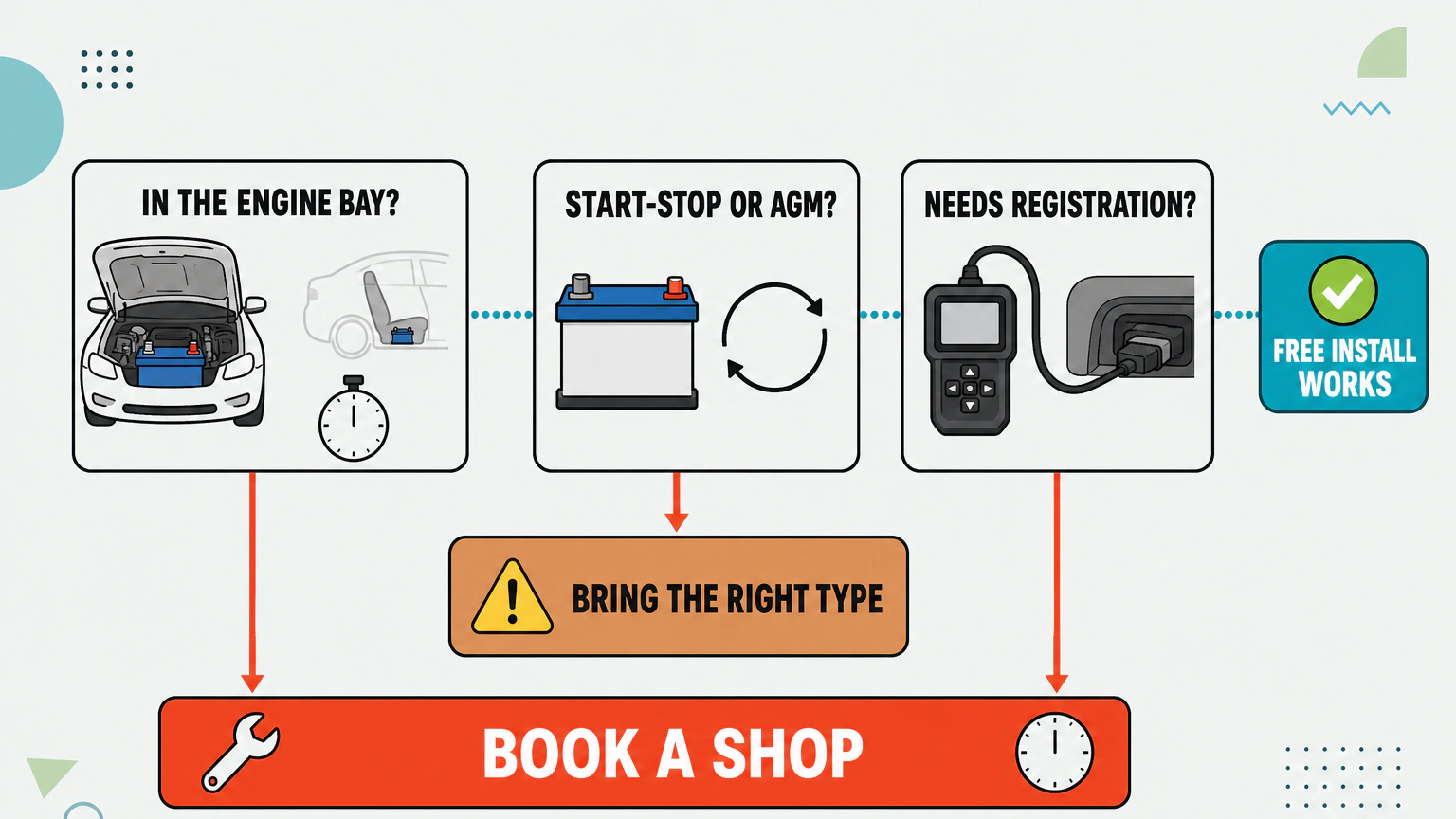
- Is the battery in the engine bay, reachable without pulling a seat, trim panel or wheel-well liner? - No: book a shop or dealer, plan on labor. - Yes: question 2.
- Does the car have stop-start, or does the manual specify AGM or EFB? - Yes: retail can still fit it, as long as you buy the right type, then question 3. - No: question 3.
- Does the maker require the battery registered to the charging system? - Yes: use somebody who can register it, which means a properly equipped parts store, a shop or a dealer. - No: call ahead and check the retailer will take your car.
Where your battery physically sits
Open the hood and look. If the battery is right there and reachable without taking anything apart, you're the easy customer, which is exactly why some retailers fit eligible purchases free. Under a seat, in the trunk or behind a wheel-well liner, and now somebody is pulling trim to get at it. Retailers may decline hard-to-access or technically complex installations, and they're within their rights to.
Start-stop cars need AGM or EFB, and the swap is not optional
Every time your car cuts the engine at a light, it's making a decision about the battery. A stop-start car manages its battery rather than merely charging it, and it reads state of charge to decide whether the engine may shut off at all. That constant cycling destroys a conventional flooded battery. Which is why these cars leave the factory with absorbent glass mat (AGM) or enhanced flooded (EFB) types.
Battery maker VARTA states the rule plainly: a start-stop battery "can only be replaced with a battery of the same type," and fitting "a normal battery instead of an AGM or EFB results in rapid deterioration of the battery, and a breakdown is inevitable." You can go up from EFB to AGM. You cannot go down from AGM. A battery can be the right group size, fit the tray, and still be the wrong chemistry.
Registration and relearn, the step that turns a $0 install into a shop visit
Registering a battery tells the car it has a new one. The step updates the battery-management system after replacement so the car can manage that battery correctly, and it needs a compatible diagnostic device to do it. A properly equipped parts store can. So can independent shops and dealers.
Some newer European models, BMW, MINI, Audi and Volkswagen among them, require it. Skipping a registration your car requires can prevent correct charging and shorten battery life, which means paying for the next battery sooner than you should have. A shop may bill the step as labor. Advance advertises free registration with eligible purchases and installations, so ask.
If the counter can't help your car, that's exactly what a vetted car battery service near you is for.
Reading the receipt: core charge, state battery fee, tax and labor
Some of what you pay for a battery is neither parts nor labor. Two lines on the invoice can be a state battery fee and a refundable core deposit, and the deposit is yours to reclaim.
| Line item | Typical amount | Who sets it | Refundable? | What to check |
|---|---|---|---|---|
| Battery (part) | $79–$450+ in opened retail guides | Retailer | No | Group size, CCA, AGM or EFB if required |
| Installation labor | $0–$80, from what shops charge per hour | Retailer or shop | No | Confirm it is waived before work |
| Core deposit | Set by retailer; subject to state law | Retailer, subject to state law | Yes, on returning the old battery | Separately stated in California; refund inside 45 days there |
| State battery fee | $2 in California | State statute | No | Separately stated, once per battery |
| Sales tax | State and local rate | State and locality | No | California generally applies it to the deposit |
| Registration or relearn | Varies; sometimes free with eligible purchase | Provider | No | Only where the car manages the battery |
The core charge is a deposit, not a fee
A core is your old battery. The US EPA regulates spent lead-acid batteries under recycling rules rather than as ordinary trash, so it isn't something you leave in a bin behind the garage. Hand it over at the counter, or follow the return instructions on the receipt, and the deposit comes back to you.
Pro tip: if you didn't bring the old battery, you paid a deposit. In California the dealer must refund it if you return a used battery of the same type and size within 45 days with the receipt. So put the old battery in the trunk and the receipt on the dash before you forget. Everywhere else, find the line labeled core, deposit or battery fee and ask how long you have to come back.
State battery fees
California charges a separately stated $2 battery fee on each covered replacement lead-acid battery, and its tax agency requires the deposit itemized too. Every other state writes its own rules and sets its own amount. California is the one we followed all the way down to the statute, so take it as one state's regime and go find out what your own does.
What California requires on the invoice. Health and Safety Code § 25215.25 sets the fee at $2, stated separately on the invoice. Section 25215.2 requires a separately stated refundable deposit when the buyer brings no used battery, a refund on one of the same type and size returned within 45 days with the receipt, and acceptance of six used batteries a day free. Dealers must post: "This dealer is required by law to charge a nonrefundable $2 California battery fee and a refundable deposit for each lead-acid battery purchased. A credit of the same amount as the refundable deposit will be issued if a used lead-acid battery is returned at the time of purchase or up to 45 days later along with this dealer's receipt." Outside California, your receipt and your state's agency are where the local rules and the local amount live.
What you should never see on the invoice
Red flag: six lines that do not belong on a battery invoice.
- A disposal or "hazmat" fee for the old battery you just handed over. California bars charging you to take one.
- In California, a core deposit still sitting on the total when you walked in with the old battery.
- In California, a bundled "fees and shop supplies" line where the battery fee and deposit belong itemized.
- A premium AGM sold into a car that doesn't require one, pitched to you as "longer life."
- A battery replaced without a charging-system test after a no-start. That's how you end up paying twice.
- "Your warranty is 60 months," with nobody mentioning how many of those months are free.
What a "60-month warranty" is actually worth
Read the number on the case again, because it isn't promising what you think. A "60-month" MT battery is not free for 60 months. Replacement is free for part of that run and discounted for the rest, which are two very different things when the battery dies. This is Interstate Batteries' current US warranty, automotive "MT" line, for batteries bought July 15, 2026 or later.
| Months since purchase | What the warranty gives you | What you still pay |
|---|---|---|
| 1–24 | A free replacement battery | Any applicable taxes and legislated fees; labor or installation may apply |
| 25–36 | 45% off suggested retail | 55% of retail, plus any applicable installation and tax |
| 37–48 | 25% off suggested retail | 75% of retail, plus any applicable installation and tax |
| 49–60 | 10% off suggested retail | 90% of retail, plus any applicable installation and tax |
| After 60 | Nothing | The full price |
So run it at month 50. Your battery fails, the replacement's suggested retail that day is $180, and your warranty is worth $18. You pay $162, plus any applicable tax and fitting charge.
Three clauses surprise people. The discount comes off Interstate's suggested retail the day you return the battery, not off what you paid, and the document says as much: that price "will not be the same price you paid." The replacement inherits whatever coverage is left, and no fresh warranty starts. And the coverage excludes "installation, towing, electrical system tests, charging a battery, rental vehicles, labor," which is how a free replacement can still carry labor or installation charges.
Other lines run differently. "MTP" gives 30 months free with discounts out to 72. "MTZ" gives 48 months free and no discounts after. Check your own warranty card, and keep the receipt, because it's the thing that fixes your purchase date.
The clauses that shorten your coverage
Here's the part that catches people who use their trucks to earn a living. The same document cuts free replacement to one year if the battery goes into a vehicle used commercially, a truck over one ton, or a diesel other than a passenger car or personal-use pickup. On an MTZ battery the limit is two years. Run a work truck and your 60-month battery is a 12-month battery.
Is it actually the battery?
The worst outcome here isn't an expensive battery. It's the right price for the wrong part. A battery that dies again three weeks after replacement needs a starting-and-charging-system diagnosis, because the repeat failure by itself doesn't identify one cause.
- Cranks slowly every cold morning, better after a long drive. The battery may be weak, but charging and connections also need checking.
- Starts after a jump, flat again in a day, headlights dim at idle. The alternator or charging circuit may be involved.
- Fine all week, dead after a weekend standing. A parasitic drain is possible, but the battery and connections still need testing.
Get a charging-system test before you buy anything. If it points at the alternator or a drain, that's work for auto electrical specialists, not for a shiny new battery.
One thing before you do any of this yourself: batteries hold sulfuric acid and can vent explosive gas, so follow the owner's manual, wear eye protection, and walk away from any battery that's cracked, swollen or leaking. That last one isn't a job. It's a hazard.
Free testing versus a real charging-system diagnosis
Search "free car battery testing near me" and you'll find plenty of it. Take it. A basic counter test can identify a weak battery and may check the starting and charging system while it's at it.
What it may not settle is the harder stuff. Intermittent drains, diode faults and connection problems can require deeper diagnosis with a multimeter, ammeter or oscilloscope, and that's what a diagnostic test costs. Pay for it when the car has already eaten one battery, or when the free test passes and the thing still won't start.
How long a battery should last, and when to replace it early
AAA puts typical battery life at three to five years, with reduced life in hotter climates, and recommends a test at three years and annually after that. Two thirds of Americans have never had a battery tested before a no-start. Cars ten years and older are twice as likely to be stranded.
Cold can expose a battery that is already marginal. The AAA Automotive Research Center reports a battery loses about 35% of its strength at 32°F and about 60% at 0°F, while a cold engine demands more current. That's the trap: the morning the battery is weakest is the morning your car asks it for the most. Suppose a planned replacement costs $150. The emergency version of the same job may add a call-out and lost time, and we'd rather you bought this one on your own schedule than on a tow truck's.
Why yours only lasted two years
Heat is a major battery killer, and nobody gets to opt out of their own climate. The rest of the list you can do something about: short trips that do not replace the energy used for starting, weeks standing unused, undercharging and corroded terminals. On a stop-start car, add a replacement whose required registration was skipped. That last one is somebody else's mistake, billed to you.
Your ten minutes at the counter: what to ask before you pay
Ask these out loud, in this order. Anywhere worth buying from answers all eight without hesitation.
- What's the out-the-door total, with labor, deposit, state fee and tax?
- Is installation included, and can you get at my battery?
- Is this the type my car requires, flooded, EFB or AGM, and which group size and CCA?
- Does my car need the battery registered, and do you do that here?
- Will you test the charging system too, so I know the alternator is fine?
- What's the free-replacement period, and what comes after it: free, prorated, nothing?
- Is the deposit refunded today, since I'm leaving the old battery with you?
- Will the receipt itemize the deposit and the state fee?
A no on question 2 isn't a dead end. It means your car belongs somewhere else, which is one phone call: a vetted car battery service near you treats those cars as routine work.
Frequently asked questions
How much does it cost to replace a car battery in 2026?
The part itself runs from about $79 for some flooded batteries to $450 or more for some AGM batteries in published retail guides, before anyone charges you labor. A shop estimate sits higher: RepairPal says $423 to $460 for the job. If your car qualifies for a retailer's free fitting, the battery price is close to the whole price.
Are car batteries cheaper at Walmart, Costco or AutoZone?
On the part alone the warehouse club is usually cheapest, roughly $90 to $180. Installation is where it evens out: Sam's installs eligible purchases free, and Walmart and the parts chains also include eligible fitting. Compare out-the-door totals, because a $40 saving vanishes the moment you hand someone $50 for fitting.
What is a core charge on a battery, and do I get it back?
You get it back. A core charge is a refundable deposit rather than a fee, and handing over the old battery is what reclaims it. In California the retailer must state it separately and refund it on a used battery of the same type and size returned within 45 days.
Does a new car battery need to be programmed or coded to the car?
Some cars, yes. Where the charging system actively manages the battery, registration may be required: it updates the battery-management system after replacement so the car can manage the new battery correctly. Skipping required registration can prevent correct charging and shorten battery life, so ask before you buy rather than after.
Why did my car battery only last two years?
Heat is a major culprit. Then short trips that never fully recharge the battery, weeks standing unused, a charging system that undercharges, and, on a start-stop car, a replacement whose required registration was skipped. AAA puts typical life at three to five years, so yours was cut short by something worth finding.
Do I need an AGM battery, or can I save money with a regular one?
If your manual or the battery in the car specifies AGM, the cheaper flooded one saves you nothing. Battery maker VARTA states that a start-stop battery can only be replaced with the same type, and that a normal battery deteriorates rapidly, with a breakdown inevitable. You'd be buying the next battery early.
Do I need a new battery or an alternator?
Symptoms give you a lead, not a verdict. A car that starts after a jump and goes flat again within a day, with headlights dimming at idle, can point to the alternator or charging circuit. Slow cold cranking can point to a weak battery. Neither diagnosis is certain from symptoms alone, so get the charging system tested before you spend.
How long does a car battery last?
Three to five years typically, with reduced life in hotter climates, according to AAA. It recommends testing the battery once it reaches three years of age and annually after that. Worth doing, because two thirds of Americans have never tested one before a no-start.
When the counter turns your car away, you want a shop that treats it as ordinary Tuesday work. Preferred Mechanic scores the shops it lists with a published rating methodology that reads more than six million opinions across review portals and forums, then names the top scorers each year in the Best of Preferred Mechanic awards. Start there, with the old battery already in the trunk.