

On this page
The short answer
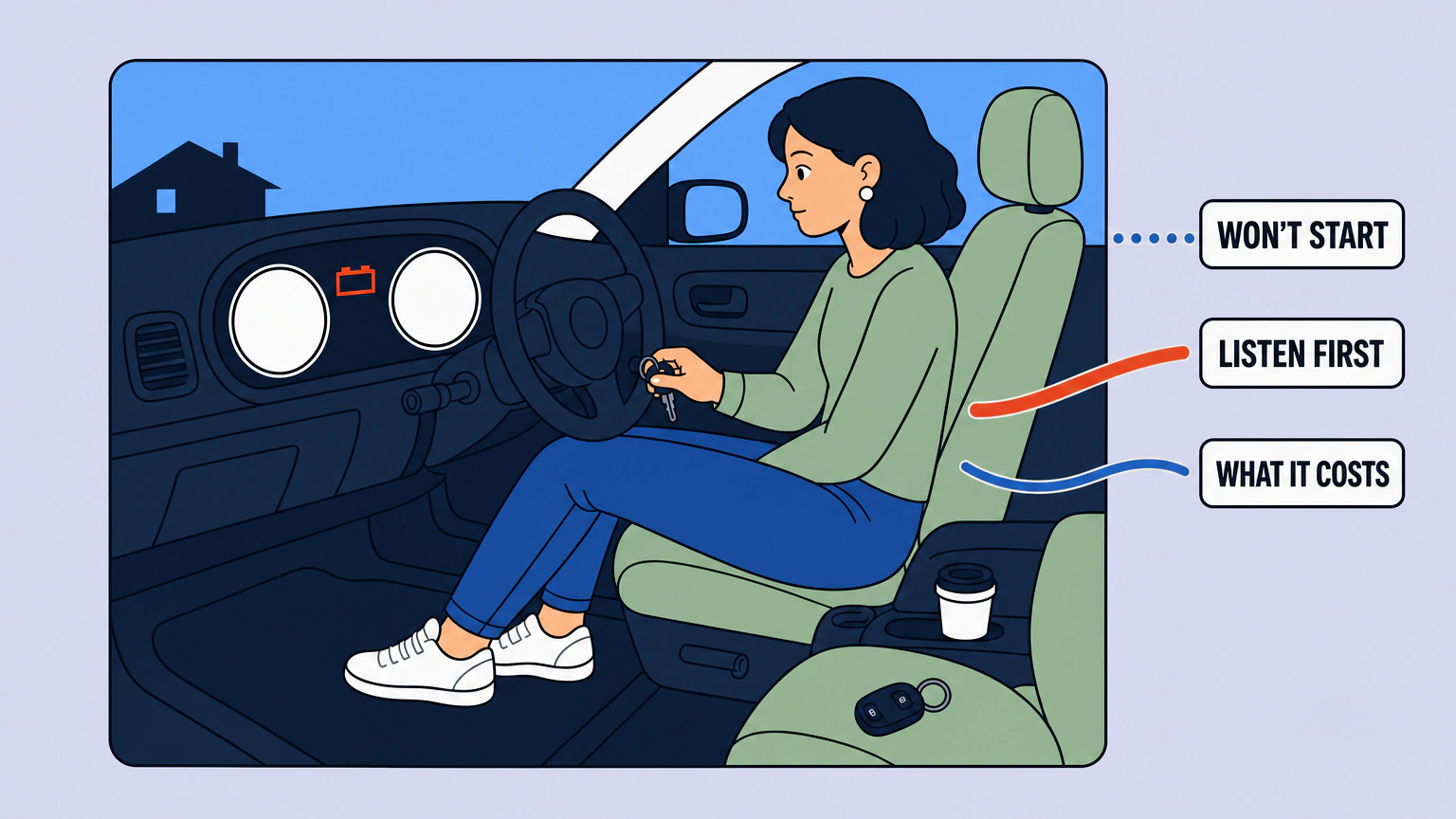
Your car won't start, and the clue that matters most is already behind you. It's the noise the car made when you turned the key.
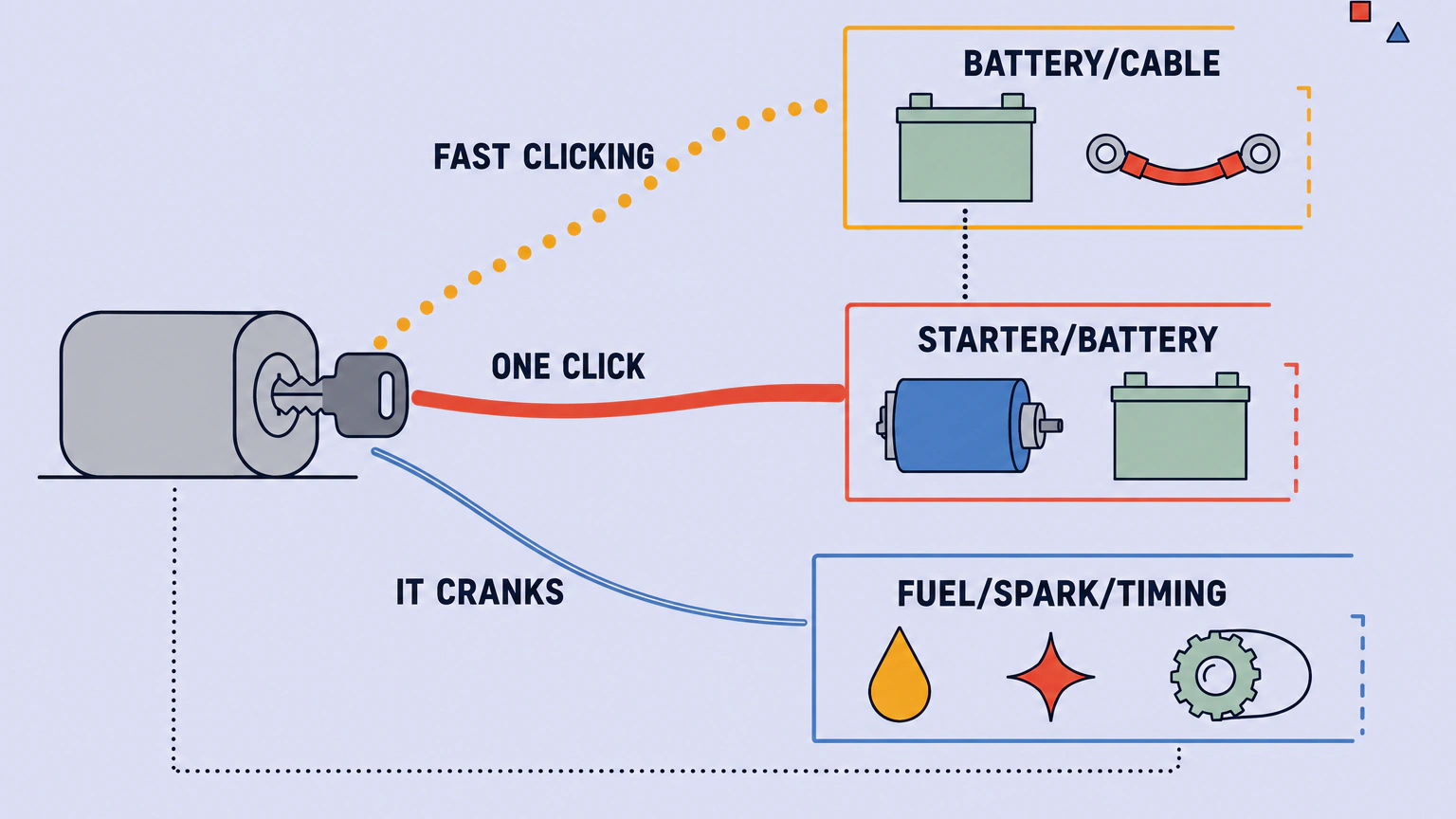
Fast clicking usually points to a weak battery or a poor connection. One loud click puts the starter high on the list, but a weak battery can sound similar. An engine that spins over and over without catching can be missing fuel, spark, timing or a sensor signal. Those branches carry very different bills, from a terminal clean to a starter at $350 to $1,100.
Sort the problem into one of those three branches before you call anyone. The first checks happen from the driver's seat. Looking at the battery means opening the hood, and anything beyond a simple check may need tools or a shop.
Five checks before you call anyone
A good mechanic on the phone asks a handful of questions before saying a word about money. That isn't stalling. Some no-starts end right there, at a question, and the answers are free.
Start this list from the driver's seat. It may fix a simple interlock problem, or it gives the next person a sharper description than "it won't start."
- Shift into neutral and try again. Then put it back in park and try once more. Automatic cars have a neutral safety switch that blocks the starter unless the shifter is properly in park or neutral. AAA says a car that starts in neutral but not in park may have a faulty switch.
- Wiggle the steering wheel side to side while you turn the key. The steering lock is an anti-theft feature, and when it grabs, it jams the ignition too. Gentle pressure left and right frees it. Force breaks keys.
- Switch the headlights on and have someone watch them while you turn the key. A hard sag moves the battery or its connections up the list. Bright, steady lights and no cranking make the starter circuit more likely, but they don't prove the battery is healthy.
- Check the owner's manual for the dead-fob starting method. Some cars start with the fob held near the button, while others use a marked slot or another backup location.
- Look at the gas gauge, then look again with the key turned to on. Running out of gas is an easy mistake, as AAA says, and it gets easier when the gauge itself is lying to you.
What the sound tells you
Everything starts three ways here. Clicking points first to the starting circuit. Total silence can come from power, a switch or an interlock. An engine that turns over and never fires needs fuel, spark, compression, timing and security checks.
Start with what you heard.
| What you hear and see | Causes to check first | What to check next | Can it be fixed where the car sits | Who to call |
|---|---|---|---|---|
| Nothing at all, dashboard dark | Battery, terminal, cable or main power fault | Check whether the headlights work, then inspect the battery and cables without touching a swollen or leaking case. | Often, yes | Car battery service |
| Nothing at all, dashboard lights up normally | Starter, ignition switch, or a car that thinks it isn't in park | Try starting in neutral. Watch the dash lights as you turn the key. | Rarely | Auto electrical specialists |
| One loud click, dash lights stay bright | Starter, solenoid, battery or cable fault | A proper jump that changes nothing moves the starter up the list, but it doesn't fully rule out the battery or its connections. | Usually needs a shop | Auto electrical specialists |
| Fast clicking, lights dim as you turn the key | Weak battery or poor battery connection | Headlights sag hard at the moment you turn the key. | Often, after testing | Car battery service |
| Engine turns over but never catches | Fuel, spark, timing, compression, sensor or security fault | Gas gauge first. Then key to on, and listen for the pump hum at the back. | Depends on the fault | An independent shop |
| Dash says it can't find the key | Dead fob battery, damaged key or immobilizer fault | Use the backup method in the owner's manual. | Sometimes; check the manual first | Roadside assistance, then a locksmith or dealer |
Silence, and the dashboard stays dark
No lights. No click. Nothing moves when you turn the key, and the dome light was already dead when you opened the door. That last detail is worth having, because it puts the fault between the battery and everything else.
The battery itself or the connection at its posts belongs first on the list. Look for green, blue or white crust and a visibly loose clamp. Either can block the current the starter needs.
A battery can also look fine and still fail under load. Starting an engine pulls 400 to 2,000 amps depending on its size, AAA says. A radio and dashboard need far less, so working accessories don't prove the battery can crank the engine.
Silence, but the dashboard lights up normally
Dash lights need much less current than the starter, so they don't prove the battery is healthy. AAA says, "If you hear a single click or nothing at all while the dashboard lights still come on, the starter is likely the issue."
Try neutral too. Starting there but not in park may point to the neutral safety switch. A loose or sticking key and dash lights that flicker as you turn it can also put the ignition switch on the list.
Then there's the key itself. If the cluster says it can't find the key, start with the backup method in the owner's manual. A dead coin cell may be all that's wrong. A damaged transponder or smart key may need an automotive locksmith or a dealer, and roadside assistance can handle the tow.
One loud click
One clunk, then silence, with the dash lights holding steady puts the starter or solenoid high on the list, but a weak battery or poor connection can sound similar.
Les Schwab puts the next step in one sentence: "When you hear a single click when you try to start, and jump-starting the vehicle doesn't fix the issue, it's likely the starter." A proper jump that changes nothing strengthens that diagnosis without proving it.
Then stop turning the key. AAA warns that repeatedly forcing a struggling starter puts extra stress on the ignition switch and the starter relay, and that all that cranking wears the flywheel the starter grabs. That's how one repair quietly turns into three.
Fast clicking
Fast clicking usually points to low voltage in the battery circuit. The battery may be weak, or a loose or corroded connection may be choking the current. Firestone describes the resulting chatter this way: the starter "rapidly turns on and off without spinning the engine and produces a clicking noise."
Watch your headlights while you turn the key. A hard sag supports a low-voltage problem, but it is still only a clue.
A weak battery often warns you first with slow cranking or dim lights. A battery-shaped warning light can also point to the charging system, so don't treat that icon as a battery diagnosis. If the battery circuit is now clicking, car battery service near you can test it. The installed price lives in our battery guide: what a replacement battery actually costs.
It cranks and cranks but never catches
The engine turns over, strongly and evenly, and never fires. Now the list shifts to fuel, spark, timing, compression, a sensor signal or the security system.
Two clues cost nothing. Start with the gas gauge, honestly, because running out of gas is an easy mistake and a faulty gauge makes it easier. Then turn the key to on without cranking and listen at the back of the car. Many pumps make a brief hum as they prime. Silence makes the pump circuit worth testing, but it doesn't prove the pump has failed.
Now look at the security or key symbol on the cluster. If it's flashing, check the owner's manual before you keep cranking. Immobilizers can block the starter, fuel or ignition in different ways.
This branch usually needs shop diagnosis. A scan tool may help alongside fuel, spark, timing and compression checks. An independent shop is a sensible call, and here's what a diagnosis should cost. If the trouble started right after you filled the tank, say so on the phone.
What Your Car Is Telling You
Answer two questions about what just happened and we'll narrow it down.
Headlight behavior adds one clue. Switch them on, then turn the key while someone watches them.
These two answers conflict: a cranking engine has power even if the lights dim. Check what the lights did before and during cranking, then choose the closest answer.
Possibilities to check first
Flat or dead battery
A weak battery or poor connection may power the dash without supplying enough current to crank the engine.
What to check nextWatch the headlights while you turn the key. A hard sag moves the battery and its connections up the list; confirm with a battery-circuit test. A rested battery reads about 12.6 volts, per AAA. If the case looks swollen or bulging, do not jump it, per AAA.Where it can be fixedUsually right where the car sits.What it runsSee what a replacement costsWho to callCar battery serviceLoose or corroded battery terminal
The battery may be fine while a loose or corroded connection blocks starting current.
What to check nextLook for corrosion or a visibly loose clamp. Either is a clue; testing confirms whether the connection is blocking current.Where it can be fixedOften, if the terminal is safely accessible.What it runsThe cost depends on whether cleaning is enough or a cable or terminal needs replacement.Who to callCar battery serviceThe alternator
The alternator charges the electrical system while the engine runs. A failed charging system can leave the battery flat again.
What to check nextIf it dies again after a jump, arrange a charging-system test; the symptom points toward charging trouble but is not conclusive. A healthy charging system reads about 13 to 14.5 volts with the engine running, per AAA.Where it can be fixedSometimes, but plan on the shop.What it runs$500 to $2,500 to replace an alternator, per AAA; confirm what the quote includes.Who to callAuto electrical specialists
This narrows it down. It doesn't replace someone putting a meter on it.
The sound narrows the first checks
- Fast clickingBattery or connection
- One clickStarter, battery or cable
- It cranksFuel, spark, timing or sensor
The jump start is a test, not just a fix
Most people jump a car hoping it catches, and then drive off relieved. That throws away the best free diagnostic of the evening.
You need a second car or a jump pack and a few minutes of attention afterward. What the car does next can narrow the tests, but it doesn't name one failed part by itself.
It starts and keeps running
The battery or its connections are now the first suspects, with a catch.
Don't drive straight home and park without a test. AAA says to go directly to a repair shop or parts store after a successful jump. Short, slow driving may not recharge the battery, and a test tells you whether the battery or charging system needs attention.
If testing confirms loose or corroded clamps, have them cleaned and tightened safely. The cost depends on whether you do it yourself or call for service.
It starts, then dies within a few minutes
That strongly points to a charging-system fault. The battery had enough help to start the engine, then the car lost the power needed to keep running.
AAA says a car that stalls within ten to fifteen minutes of a jump may have an alternator that can no longer run the electrical system or recharge the battery. Confirm it with a charging-system test.
A healthy battery rests at about 12.6 volts with the engine off. A working alternator holds 13 to 14.5 volts while the engine runs.
This reading changes your destination. A new battery won't fix a failed alternator and will go flat again, which is why we'd send you to auto electrical specialists rather than a parts counter.
A jump does nothing at all
Nothing changes with the cables connected correctly and a running car at the other end. That moves the starter, ignition switch, cables and ground connections up the list, but it doesn't fully rule out the battery.
One safety rule outranks the diagnosis. If the battery case looks swollen or bulged, leave it alone. AAA is explicit that you shouldn't jump-start a swollen battery, "as it may burst and release battery acid." Call roadside assistance and let someone with the right kit handle it.
The same goes if you smell rotten eggs, or if the car is sitting on a shoulder with traffic going past. The information isn't worth it.
What each repair actually costs
Once you have a likely fault, price is the next useful clue. The ranges below show why two no-start calls can end with very different bills.
We aren't selling you the repair. We run a directory of repair shops, so we can put the arithmetic in the open.
| Repair | Typical US range | What moves the number | Where the range comes from |
|---|---|---|---|
| Battery | Priced in our battery guide, not here: what a replacement battery actually costs | Group size, cold cranking amps rating, where you buy it | Our own battery guide |
| Starter | $350 to $1,100 | Where the starter sits, labor hours, part grade | AAA |
| Alternator | $500 to $2,500, parts included | Make and model, part grade, labor hours | AAA |
| Fuel pump | Get a vehicle-specific quote | Make and model, fuel system type, access, original or aftermarket part | AAA's current page gives conflicting ranges |
| Key, fob or transponder | Fob $50 to $100, transponder key about $200, smart key $200 to $500 | Key type, dealer programming, the tow to the dealership | AAA |
One note on that starter range. AAA's own page prints two figures for the same job: $350 to $1,100 as the average, and $400 to $1,200 with labor at its network's rates. We've used the first.
How to read the range
A wide range reflects differences in vehicle access, labor and part choice.
AAA contrasts an accessible Honda Accord starter with some Toyota and Lexus V8 starters that require intake-manifold removal. Ask which part is being quoted and how much access the job requires.
So when a shop quotes the top of a range, the useful question isn't "why so much." It's "how many hours, and which part."
Why the same job costs twice as much across town
Labor time and the shop's hourly rate are two important parts of a repair estimate; parts, supplies, fees and tax can matter too.
The estimate starts with labor time for your exact car, but shops can use different guides and judgment. The hourly rate moves too. AAA reports that shops inside its own approved network charge $150 to $300 an hour, and that's one network's spread, not the national floor and ceiling.
That difference can help explain why honest quotes vary. We've pulled apart what shops charge per hour separately.
Fixed where it sits, or towed
By now you have a suspect. The next question decides your evening: can this be sorted where the car is parked, or does the car have to travel?
Access matters, but so do the technician's equipment and the rules where the car is parked. A battery or exposed connection is often curbside work. A buried starter or fuel-tank repair usually means a shop.
What roadside and a mobile mechanic can do at the curb
More than most people expect. A jump start, terminal service, fuel delivery and often a battery swap can happen at the car. Where AAA Mobile Battery Service is available, members can get the battery, starting and charging systems tested and buy an on-site replacement if the battery fails.
A mobile mechanic may handle more than roadside assistance, including some alternator or ignition work. Confirm the vehicle and repair before booking.
Roadside crews usually tow buried-starter and fuel-tank jobs. A mobile mechanic may take on some of them, but confirm the exact repair before the truck comes. If roadside can't fix your branch, roadside assistance means a tow.
When the tow is the cheaper decision
Repeated call-outs can add up when the underlying fault has not been tested.
A failed charging system may let the car die again after a jump, and a failed starter may not respond to one. If the first proper attempt changes nothing or the car dies again, move to diagnosis instead of assuming another jump will solve it.
If a proper jump changes nothing, or the car dies again within fifteen minutes, stop paying for attempts and arrange a diagnosis. Choose the shop before the truck arrives, then ask whether your destination changes the covered mileage or bill. Here's what a tow should cost.
Cold weather is not the villain you think it is
Every January the folk wisdom says the cold killed the battery. It's half true, and the wrong half.
Cold cuts the power a battery can deliver and makes the engine harder to turn. A tired battery may start a warm engine in October, then fail in January when the job gets harder. That's why "it started fine last week" proves very little.
What actually wears a battery out is time, heat and vibration, in AAA's own summary. Heat drives the chemistry that makes electricity, and it speeds up the decay at the same time. Under a hood, temperatures can pass 200 degrees Fahrenheit. Its life data follows that logic: a battery may last five years or longer in cooler northern climates, and about three years in hot southern ones. The Sunbelt is where batteries die young. Winter just collects them.
Two practical things follow. Cold cranking amps, the rating printed on the label, is measured at zero degrees Fahrenheit, so it describes the morning you're actually worried about. And once a battery passes its third year, AAA says to have it tested. Its fall checklist repeats that advice.
If your car won't start in the cold and the battery tests good, the clamps, starter and charging system are reasonable next checks, but other faults remain possible.
The scale is worth knowing. AAA took over 27 million roadside calls across the United States in 2024. Roughly 13 million needed a tow and about 7 million involved the battery, together about 74% of everything it was called out for. A test takes a few minutes, and it's the cheapest way to stay out of that number.
Stop and get help if you see any of this
Four things end the do-it-yourself part of the evening.
Red flag: stop cranking and call someone.
A swollen or bulging battery case. AAA is explicit that you shouldn't jump-start it, "as it may burst and release battery acid." Call roadside assistance and let them deal with it.
A rotten egg smell around the hood. An overheated or failing battery can release hydrogen sulfide, a toxic and flammable gas with that smell. Shut the car off if you can do so safely, step away, and call for help.
Smoke, or a burning smell, the moment you turn the key. Stop and get out of the car. AAA lists smoke from the engine among the signs of a starter failing badly.
A strong smell of gasoline after several attempts. Stop cranking. The engine may be flooded or fuel may be leaking, and the safe next step is to get out and call for help.
We can tell you what these sounds usually mean, but we're not the ones standing next to your car. Anything smoking, venting or smelling of fuel is a call, not a project.
Frequently asked questions
Is it bad to keep trying to start a car that won't start?
Yes, once repeated attempts change nothing. AAA warns that forcing a struggling starter stresses the ignition switch and starter relay, wears the flywheel and drains the battery. Stop instead of counting on a fixed number of tries, because owner-manual limits differ by vehicle.
Can you jump start a car with a bad starter?
Usually not. A jump feeds the battery, while the starter sits farther down the circuit. Les Schwab says a single click plus a jump that changes nothing points toward the starter. Bright dash lights add another clue, but only a test confirms the fault.
My car won't start but the radio works. What does that mean?
It means you have some power, not that you have a healthy battery. A radio and lit dashboard need far less current than the starter. Starting the engine pulls 400 to 2,000 amps, AAA says, depending on engine size. Headlight behavior adds a clue, but a battery and charging-system test settles it.
I just put in a new battery and it still won't start. Why?
Start with the installation and the fault that prompted the replacement. A loose or corroded clamp can block current. A failed charging system can leave the new battery flat, and a starter, switch, cable or interlock fault can keep the engine from cranking even when the battery is good.
The car starts and then dies right away. What is going on?
If it dies within ten to fifteen minutes of a jump, AAA says the alternator may no longer be running the electrical system or recharging the battery. If it dies immediately, fuel, ignition and security faults stay on the list. A shop that can test the starting and charging systems is the right destination.
How much does it cost to fix a car that won't start?
The fixes covered here run from a terminal clean to an alternator at about $2,500, which is why the sound matters. AAA puts a starter at $350 to $1,100 and an alternator at $500 to $2,500 with parts. Its current fuel-pump page gives conflicting ranges, so get a vehicle-specific quote. Battery prices sit in our battery guide.
Do I need a tow, or can someone fix this where the car is parked?
It depends on the branch you landed in. Battery problems, loose or corroded clamps, an empty tank and many dead fobs can be curbside work. A buried starter, fuel-tank repair and most spark or timing faults usually need a shop. If a proper jump changes nothing, stop paying for attempts and arrange the tow or diagnosis.