

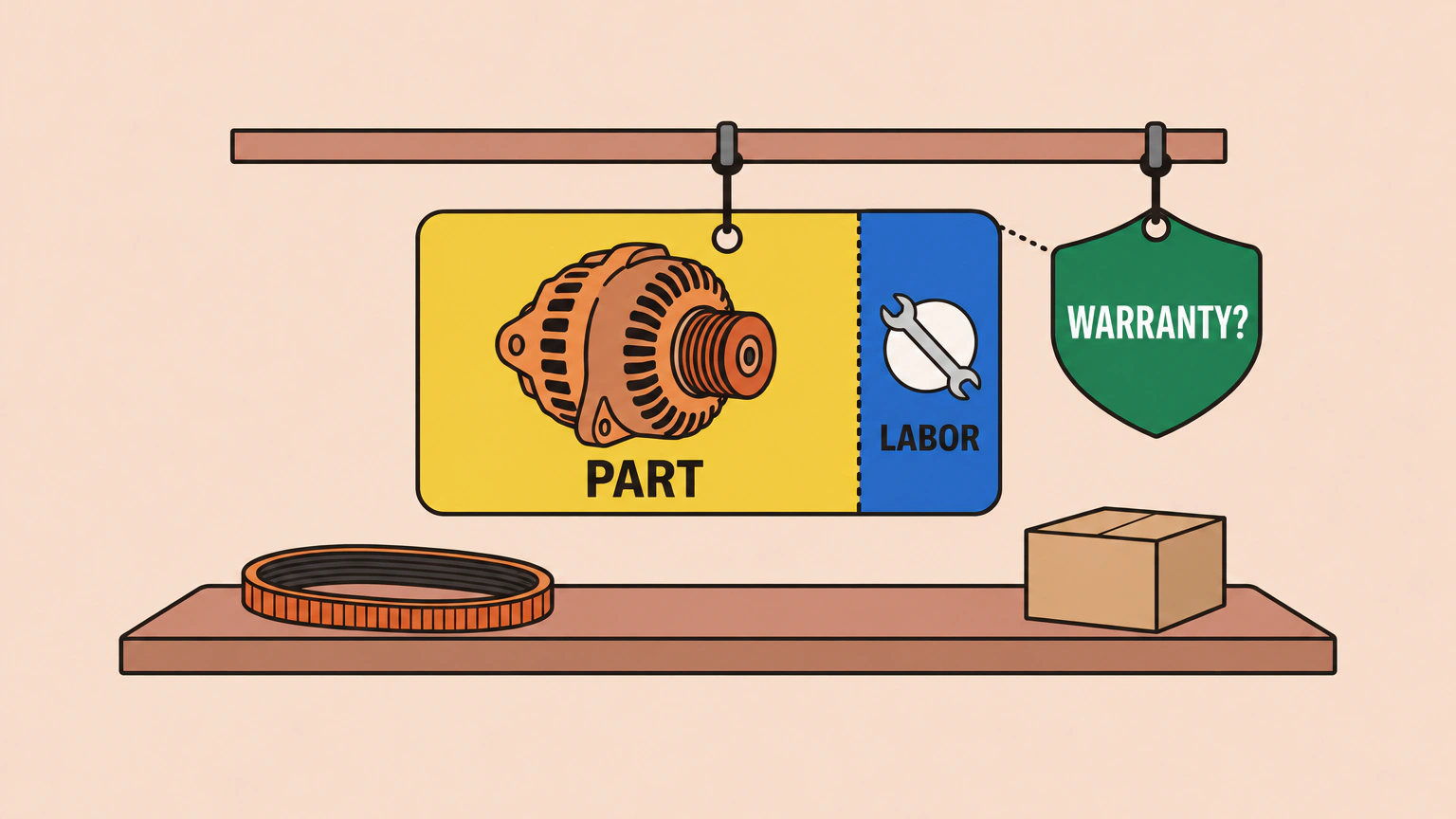
RepairPal's estimates put an alternator replacement at $527 to $1,439 across nine popular models, and the part, not the labor, is most of that bill on every one of them. If a covered defect caused the alternator to fail while your car is still inside its basic bumper-to-bumper warranty, the carmaker should pay. The longer powertrain warranty doesn't list the alternator at any of the six carmakers we checked.
On this page
What an alternator replacement costs
Start with the broad number. RepairPal's national estimate runs $809 to $1,088 for the whole job, with labor at $196 to $288 and parts at $613 to $800. That's before taxes and fees, and it isn't adjusted for where you live.
Other published ranges run wider. AAA says anywhere from $500 to $2,500. Car Talk's best estimate is $600 to $1,500. Carfax puts the job at $800 to $1,500 and says about 85% of that is the alternator itself. Nobody here is wrong. They're pricing different cars, different parts and different shops, so a national range only gets you so far. Your own model's estimate is a better yardstick, and RepairPal splits each one into labor and parts.
What RepairPal estimates for nine popular models
| Model | Total estimate | Labor | Parts |
|---|---|---|---|
| Toyota Corolla | $527 to $814 | $113 to $166 | $414 to $648 |
| Toyota Camry | $566 to $876 | $165 to $241 | $402 to $635 |
| Chevrolet Silverado 1500 | $600 to $877 | $176 to $258 | $424 to $619 |
| Nissan Altima | $694 to $893 | $101 to $148 | $594 to $745 |
| Honda Accord | $720 to $1,071 | $155 to $227 | $565 to $844 |
| Honda Odyssey | $723 to $1,225 | $229 to $336 | $494 to $889 |
| Honda Civic | $770 to $1,220 | $207 to $303 | $563 to $917 |
| Ford F-150 | $831 to $1,025 | $159 to $233 | $672 to $792 |
| Honda CR-V | $1,093 to $1,439 | $176 to $258 | $917 to $1,181 |
RepairPal's averages across model years, before taxes and fees. A single year can differ, and RepairPal's 2016 Camry estimate is $657 to $846.
On all nine cars, the parts estimate is at least twice the labor estimate. On the Altima it's more than five times. By RepairPal's split, the part is roughly 70% to 84% of the bill, a little under Carfax's figure. Labor runs from $101 to $148 on an Altima to $229 to $336 on an Odyssey.
So your alternator replacement cost has two levers. One is where the alternator sits, which sets the labor. The other is which alternator goes in, which sets the parts line.
Why labor runs higher on some cars
The labor cost to replace an alternator is the hours the job takes times the shop's hourly rate, and the hours depend on where the alternator lives. On cars where it's easy to reach, the belt comes off, several bolts come out and the old unit lifts free.
Other cars bury it. RepairPal says that in some cases "suspension components, drive axles, cooling fans and even bumpers must be removed." ConsumerAffairs says some alternators can be replaced in an hour, while others take a whole day. For the other half of that math, see what mechanics charge per hour.
The belt has to come off anyway, so RepairPal calls the job "a good time to replace that belt if it's worn." Car Talk agrees that the added cost "is minor compared to the overall job."
The part is most of the bill, so choose it on purpose
The FTC sorts replacement parts into three kinds. New parts are usually built to the original specs, by the carmaker or by an independent company. Remanufactured, rebuilt and reconditioned "generally mean the same thing," in the FTC's words: a part restored to sound working condition. Salvage parts come off another car as they are.
Here's where the online alternator price throws people. On 1A Auto's Toyota Camry alternator page, new aftermarket units list at $179.95 to $214.95, while RepairPal's parts estimate for a Camry job runs $402 to $635. That gap pays for some mix of the part's brand, the shop's markup and a warranty it has to stand behind. We've laid out why a shop's part price is higher in a separate guide.
New, remanufactured or used
| Kind of part | What it means | What a warranty on it can look like |
|---|---|---|
| New, from the carmaker | Made new to the carmaker's own specification. | Honda covers parts its dealers sell for 1 year, or for the rest of the new-car warranty if that runs longer. |
| New aftermarket | Made new by an independent company. The FTC notes that prices and quality vary. | Set by the parts maker. Ask whether it pays for labor if the part fails. |
| Remanufactured or rebuilt | Taken apart and restored to sound working condition. The FTC reserves "remanufactured" for parts rebuilt at a factory. | Honda covers a remanufactured alternator its dealer installs for 3 years or 36,000 miles. The FTC says many such warranties cover the part but not the labor to install it. |
| Used or salvage | Pulled from another car and sold without being rebuilt. | The FTC says the reliability of salvage parts "is seldom guaranteed." |
Our call: on a car you'll keep for years, we'd pay for a carmaker part or a name-brand remanufactured unit with a written warranty. The bargain box is a gamble on the one part that keeps everything else powered.
The core charge is a deposit, not a fee
GM lists alternators among the parts that carry a core charge, which it says "is used as a deposit on the portion of the part that can be reused to encourage its return." Send the old part back and the charge is refunded.
The conditions are strict. GM pays the full refund "only if the core passes inspection and is as complete as the product provided, missing no parts," and the old unit goes back in the box the new one came in. The return "must be received within 6 months" of the purchase. A part a dealer installed goes back to that same dealer.
If a core charge shows up on your invoice, ask whether it's been credited. Bought the part yourself? Then the deposit is yours to chase, and our guide to bringing your own parts covers that route.
What the invoice has to say about a rebuilt alternator
Almost nobody tells you this. The FTC has guides for the rebuilt car parts business, and they name "alternators and generators" outright. Under them, it's "unfair or deceptive" to sell a rebuilt part without disclosing, "clearly and conspicuously," that it isn't new, and that includes "on invoices." The word "remanufactured" is meant only for a part rebuilt "at a factory generally engaged in the rebuilding of such products." The guides are the FTC's view of what's deceptive. They don't hand you rights of your own, but the FTC can take action when a business ignores them.
California writes it into state law. Its repair law says "If any used, rebuilt, or reconditioned parts are supplied, the invoice shall clearly state that fact," with parts and labor listed separately. California also lets you ask for your replaced parts back when the work order is written. One exception is a part the shop must return "under a warranty arrangement," which it has to offer to show you instead. The FTC's advice works in any state: "Ask for all replaced parts. State law may require this."
Will your warranty pay for it?
Probably, if the car is young enough. Each carmaker's basic warranty covers factory parts that fail from a defect, apart from a list of exclusions. None of the six carmakers we checked puts the alternator on that list. None of their powertrain lists includes it either. Car Talk says the same thing from the other side: "The alternator is not considered part of the powertrain."
That's the surprise for Hyundai and Kia owners. Their famous 10-year powertrain warranty doesn't help with an alternator at all. The 5-year basic warranty does. Your booklet is in the glove box, or on the carmaker's owner site by model year. You also don't need dealer servicing to keep this coverage, and our guide to servicing your car somewhere else explains the federal rule.
Who covers the alternator, by carmaker
| Carmaker | Basic warranty, which covers the alternator | Powertrain warranty, which doesn't list it | Worth knowing |
|---|---|---|---|
| Toyota | 3 years or 36,000 miles | 5 years or 60,000 miles | The engine list names the water pump, the fuel pump and the engine computer, and no part of the charging system. |
| Honda | 3 years or 36,000 miles | 5 years or 60,000 miles | A remanufactured alternator a Honda dealer installs carries its own 3 years or 36,000 miles. |
| Nissan | 3 years or 36,000 miles | 5 years or 60,000 miles | Basic coverage takes in every Nissan-supplied part that no separate warranty covers. |
| Ford | 3 years or 36,000 miles | 5 years or 60,000 miles | Ford calls its basic warranty Bumper to Bumper. Its powertrain list includes the engine thermostat but not the alternator. |
| Hyundai | 5 years or 60,000 miles | 10 years or 100,000 miles, original owner only | Later owners get powertrain coverage for 5 years or 60,000 miles, the same as basic. |
| Kia | 5 years or 60,000 miles | 10 years or 100,000 miles, original owner only | Later owners get 5 years or 60,000 miles. |
Terms from each carmaker's 2026 US warranty booklet (Toyota's is the 2026 Corolla guide), except Kia's 2025 manual. Coverage ends at whichever limit you reach first.
Prices here are published estimates, and your quote depends on your car, your area and the part. Your own warranty booklet decides what your carmaker covers, so check it before you pay.
Just outside the warranty? Ask anyway
A warranty that ran out last month doesn't always mean you pay. Car Talk's advice: if the alternator fails within a few months or about 10,000 miles of the basic warranty's end, ask the carmaker to cover it at a dealer "as a goodwill gesture." Its own 2016 Subaru Forester was just past the time limit, the dealer quoted almost exactly $1,000, and Subaru paid.
Subaru already knew about an alternator issue on that model and year. So check for a recall or a service bulletin first, using the recall check in our symptoms guide. Extended service contracts vary, and Car Talk says to look closely at yours.
Honda's booklet gives you a reason to keep every receipt. A remanufactured alternator a Honda dealer installs carries its own 3 years or 36,000 miles, and Honda won't honor a claim without proof of the purchase date and where the part went in.
Before you say yes to the quote
If nobody has tested the charging system yet, make sure it's really the alternator first. A belt, a cable or a tired battery can pass for a dead alternator. Once you're sure, settle these things on paper before the work starts. If anything looks off, get a second quote from an auto electrical specialist.
Before you approve an alternator quote
- The charging system and the battery were both tested, and you've seen the results.
- The estimate says which alternator you're getting: new from the carmaker, new aftermarket, or remanufactured.
- The new unit's output rating matches the old one, or beats it if you've added power-hungry accessories.
- Labor is a separate line, so you can see the hours you're paying for.
- The drive belt has been checked, and a new one, if you want it, is its own line.
- Any core charge is listed, and you know whether you'll get it back.
- The part's warranty and the shop's labor warranty are both in writing.
- The battery gets fully charged, or replaced if it fails its test, before the new alternator goes in.
If the new alternator quits next year, those two written warranties decide who pays for the part and who pays to fit it again. Here's what a repair warranty has to cover.
Dealer or independent shop?
Under warranty, the answer is easy. Car Talk says "definitely use your dealer," because that's where the carmaker pays. Out of warranty, it suggests a trusted independent shop or a chain you've had good luck with. Its estimate is that avoiding the dealer "will likely save you about 10% to 30%."
Price isn't the only thing to compare, though. A dealer's remanufactured part can carry a longer warranty, as Honda's 3 years or 36,000 miles shows. Get a number from an independent mechanic or a local repair shop, and put the warranties side by side. We've also covered what to do if the bill comes in higher than the estimate.
Your next move: get the quote in writing, with the part type and its warranty named. Then get a second quote from a specialist before you sign anything.
Alternator replacement questions people ask
Is an alternator covered under the powertrain warranty?
No, not at the six carmakers we checked. Toyota, Honda, Nissan, Ford, Hyundai and Kia all leave it off their powertrain lists. Their basic warranties cover defects for 3 years or 36,000 miles at the first four, and 5 years or 60,000 miles at Hyundai and Kia. Car Talk puts it plainly: the alternator "is not considered part of the powertrain."
Is a remanufactured alternator as good as a new one?
A good one can be. The FTC reserves "remanufactured" for parts rebuilt at a factory that does that kind of work. Honda backs a remanufactured alternator its dealers install for 3 years or 36,000 miles. What matters is who rebuilt it and what the warranty says in writing.
How long does it take to replace an alternator?
Some alternators can be replaced in an hour, while others take a whole day. ConsumerAffairs says access is what makes the difference. RepairPal's labor estimates show the same spread, from $101 to $148 on an Altima to $229 to $336 on an Odyssey.
Should I replace the battery when I replace the alternator?
Only if it fails a test. A battery that ran flat because the alternator quit may recover on a charger, or it may be finished. Either way, it should be fully charged before the new alternator goes in. One alternator box, quoted by OPTIMA, warns that the alternator "isn't designed to charge a dead battery" and that skipping the charge "may Void Your Warranty." A battery shop can test it, and if it needs replacing, here's what a new battery costs.
Can an alternator be repaired instead of replaced?
Rarely, at an ordinary shop. Car Talk says "It is not practical for any shop to repair an alternator." Specialist rebuilders do it in volume, and that's where remanufactured units come from.
Should I keep my old alternator?
Usually not, because it's worth its core deposit. GM, for one, refunds that deposit only when the old unit comes back complete, in the new part's box, within six months. If you'd just like to see it, say so when you sign the work order. California requires a shop to hand back replaced parts you asked for then, or to show you any it must return under a warranty arrangement.
Do hybrids and electric cars have an alternator?
Electric cars don't, and many hybrids don't either. Car Talk says many hybrids and plug-in hybrids, and all EVs, use "a solid-state device called a DC-to-DC converter" instead. That part can fall under the longer hybrid warranty. Ford, for example, lists the DC/DC converter among the hybrid and electric components it covers for 8 years or 100,000 miles.