

On this page
- The short answer: some shops yes, many no, and here is the catch
- How shops price parts, and why percentage is not dollar savings
- The four costs that come back the other way
- Side by side: what each option actually buys you
- Can a shop legally refuse? And can it charge you more for the labor?
- When bringing your own part actually makes sense
- The move most readers should make first
- How to find a shop that will install your part
- Frequently asked questions
The short answer: some shops yes, many no, and here is the catch
You've found the part online for a lot less than the shop wants, and you want to know whether you can walk in with it. Some shops will fit it. Many won't. The ones that will may write your part out of their labor warranty, right there on the repair order. So the useful answer to "can I bring my own parts to a mechanic" isn't permission. It's arithmetic. And the arithmetic isn't the markup percentage: a smaller percentage on a costly part can still be the bigger gap in dollars. Your saving is usually smaller than the price difference you saw online.
This is a pricing and warranty question wearing a legal costume.
What most shops will actually tell you
Call around and you'll get different answers. Vehicle Service Pros, a trade publication for shop owners, describes three policies a well-run shop picks from: refuse every customer-supplied part, take them with written conditions (an inspection fee, a signed waiver, a labor warranty that plainly excludes your part), or decide case by case against written criteria. "We don't do that" is a policy, not a verdict on you. The shop two miles down the road may have picked differently.
The one number that decides it for you
Subtract your purchase price from the shop's quoted part price. That gap is the whole reason you're asking. It's also a gross figure: the fees and risks come back the other way.
Whole-job totals won't show the parts line, but they do set the scale. Here's what auto repair shops near you charge across a few common categories.
| Category | National average | Typical range | Sample |
|---|---|---|---|
| Brakes: repair and services | $152 | $132 to $303 | 777 cost profiles |
| Auto electrical | $158 | $137 to $231 | 893 cost profiles |
| Auto repair shops | $483 | $389 to $683 | 865 cost profiles |
| Mechanic shops | $578 | $420 to $735 | 743 cost profiles |
Those are Preferred Mechanic's own cost profiles adding up, not a market survey, and the panel moves with where you are, so check the category page for your own area. It won't tell you how much of a bill was parts.
How shops price parts, and why percentage is not dollar savings
There is no one markup. Shops run a matrix: a fat percentage on the cheap stuff, a thinner one as the part gets expensive. What lands on your invoice depends on both numbers.
The parts matrix: why a $4 part can carry a higher markup percentage
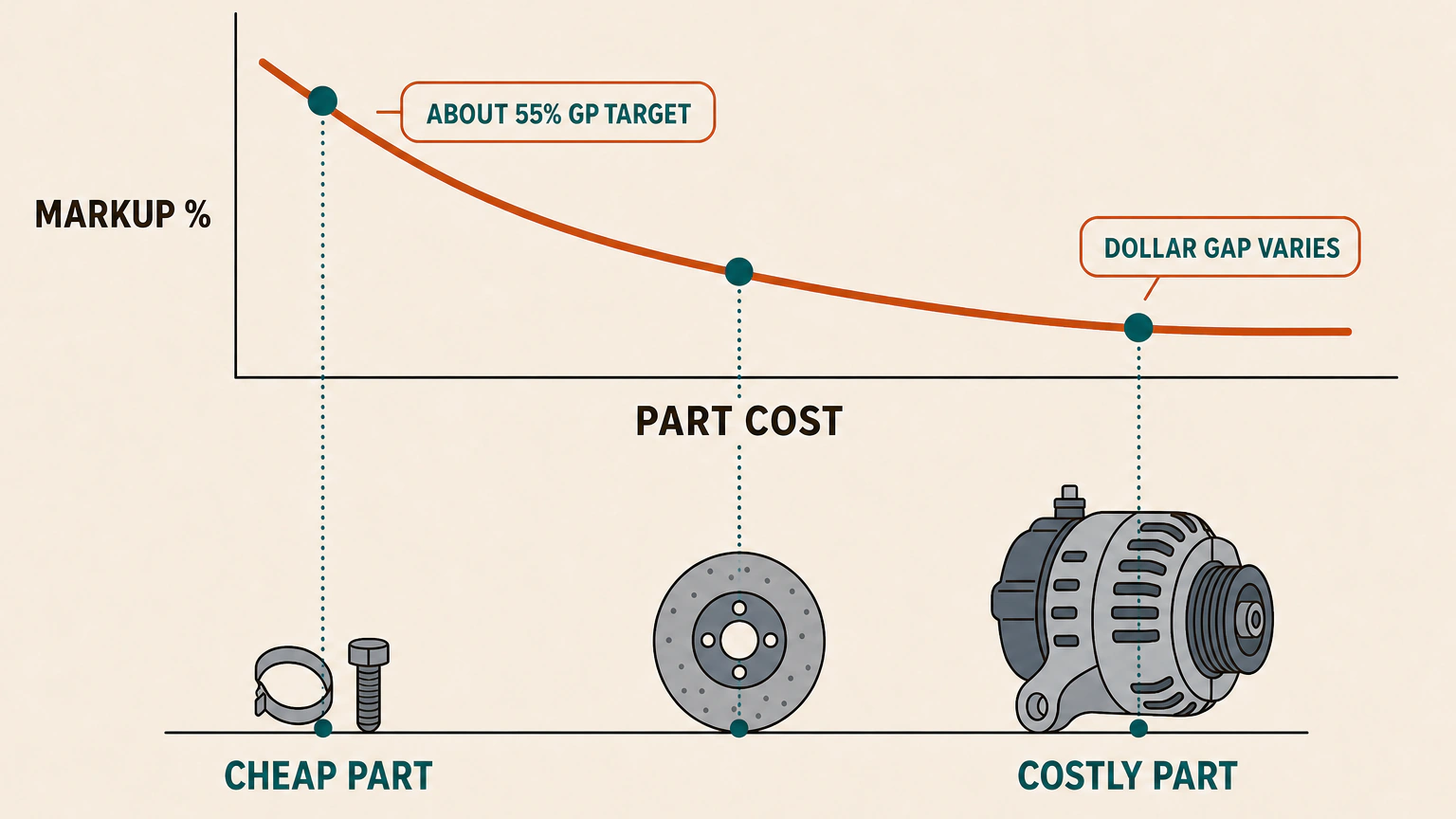
Kaizen CPAs and Advisors, which does the books for repair shops, tells them to aim for about a 55 percent gross profit margin on parts and to build a pricing matrix to get there. At the bottom of that matrix, a part costing the shop between a penny and five dollars "might have a 300% - 400% markup." From there the percentage slides down as the dollar cost climbs.
What that markup is actually paying for
The margin buys work you never see. Somebody sourced the part, took delivery, chased the supplier, sent back the wrong one, and will file the claim when it fails. Vehicle Service Pros puts it to shop owners bluntly: strip out the parts margin and what's left is a labor-only job carrying all the exposure.
Where that leaves your particular part
Percentages are not savings. A huge percentage on a part that costs a few dollars is still a few dollars. A modest percentage on something expensive can be the wider gap. Price your own part both ways.
| What the part costs the shop | Typical markup-percentage direction | What the source supports |
|---|---|---|
| A few dollars or less | Highest band, cited at 300 to 400 percent | A high percentage on a small dollar base |
| Mid-priced parts | Percentage slides down as cost rises* | Compare the shop's quoted price with your purchase price |
| Big-ticket parts | Lower percentage than cheap parts* | Lower percentage does not necessarily mean fewer dollars |
*Rows two and three are directional: the source describes a sliding scale and publishes a percentage only for the cheapest band.
The four costs that come back the other way
Four of these can settle the question on their own. The fifth is a handful of small charges that quietly eat the gap.
You take responsibility for the part warranty, and labor may be excluded
Buy the part and you own its warranty, whatever it turns out to be worth. The FTC is blunt about it: on remanufactured, rebuilt and reconditioned parts, "many manufacturers offer a warranty covering replacement parts, but not the labor to install them." A free replacement part is not a free repair. Vehicle Service Pros describes parts sold with "a warranty that only applies to the original purchaser buying direct from the seller," so you may be filing the claim yourself.
You may lose the shop's labor warranty on that repair
This is the one that costs real money. Know what a shop's own repair warranty normally covers before you trade it away. When a part fails inside a shop's written parts-and-labor warranty, the shop handles the replacement. When it excludes the part you supplied, you pay that labor twice. Our rate guide puts the US average near $132 an hour, with nearly half of the shops surveyed between $120 and $159, so a two-hour reinstall runs about $264 before you buy the part again. Look up what shops in your state charge per hour and do that multiplication on your own job. And don't assume a warranty is owed: California's Bureau of Automotive Repair has told repair dealers there plainly that shops are not required to provide one.
Check how the nationwide network warranty treats supplied parts
If a shop sells you on its nationwide warranty, ask how it reads. NAPA AutoCare's "Peace of Mind" limited repair warranty covers 24 months or 24,000 miles, stretching to 36 months or 36,000 miles on qualifying EasyPay repairs, and then it shouts the exclusion in capitals: "SPECIFICALLY EXCLUDED ARE ANY REPAIRS INVOLVING USED OR SALVAGED PARTS, CUSTOMER SUPPLIED PARTS." AAA's Approved Auto Repair terms run 24 months or 24,000 miles unless the shop states otherwise in writing, warn that other restrictions may apply, and say nothing about customer-supplied parts either way. Silence isn't a yes. Ask.
Wrong part, missing hardware, and the car already on the lift
Year, make and model is not enough. Mid-year running changes, VIN-specific variations and trim-level differences mean the box on your porch can be the wrong box, and hardware kits, gaskets and clips are often sold separately. Vehicle Service Pros describes the routine version: a supplied remanufactured caliper whose bleeder screw threads turn out to be damaged once the brakes are open, so the job stops with the car apart. Somebody pays for that time. Settle who before you book.
Cores, hardware and sales tax: the three small ones that add up
Buy the part yourself and the core deposit becomes your errand: keep the old unit and the receipt, and get it back inside the seller's window. See how core charges work on a battery, and ask auto electrical specialists how core returns work on starters and alternators. The tax base shifts too. California's tax agency says tax generally doesn't apply to itemized repair labor, and that where the retail value of the parts a shop furnishes exceeds ten percent of the total charge, the shop is the retailer and tax is due on their fair retail selling price. Sales tax is written state by state.
Side by side: what each option actually buys you
Part price against part price is the wrong comparison. What matters is everything attached to each one.
| What you get | Shop supplies the part | You supply the part |
|---|---|---|
| Price you pay for the part | Shop's quoted part price | Your purchase price |
| Who handles a covered part claim | The shop, under its written terms | You, under the seller's terms |
| Who warrants the labor on that repair | The shop's written terms | Depends on the shop's written terms |
| Who pays reinstall labor after a covered failure | The shop if its warranty covers it | You if the shop excludes it |
| Nationwide network warranty (NAPA / AAA Approved) | May qualify under the program's terms | NAPA excludes supplied parts; AAA terms may vary in writing |
| Who handles a wrong-fitment part | The shop under its terms | You handle the return; labor or inspection charges depend on the shop |
| Who returns the core and chases the deposit | The shop | You, inside the seller's window |
| What sales tax is charged on | The shop's parts price, where taxed | Your purchase price, where taxed |
Red flag: the warranty on the box may already be void. Vehicle Service Pros describes the terms shops keep running into: a retail warranty written to run to the original purchaser, buying direct from the seller. Read the warranty text before you pay, not after it fails. Keep the receipt. Check whether the seller requires the buyer to be the installer. A claim you can't document is a claim you don't have.
Can a shop legally refuse? And can it charge you more for the labor?
Yes, and yes. Vehicle Service Pros describes shops that turn away every customer-supplied part, and shops that take yours at a different number, with an inspection fee attached. It also says courts have found shops carry a professional obligation to refuse parts they knew or should have known were unsafe. A no can be the professional call rather than a sales tactic.
What state repair law actually governs (and what it doesn't)
State repair law is mostly about what happens after a shop takes your job: estimates, authorization, disclosure, invoices. We read California's and Washington's consumer guidance, and neither puts a shop under a duty to accept the work at all. That's two states, not fifty. On the money side, your state's rules on estimates and authorization are the ones worth knowing.
What your invoice must show, and how to use it
Here's the lever most readers don't know they hold. California's Bureau of Automotive Repair tells consumers the estimate must show the estimated price for parts and labor excluding sales tax, and the final invoice must list every part supplied, flagging the used, reconditioned and rebuilt ones, with the total cost for parts and labor. Washington's Attorney General goes further. There the invoice must list and describe all parts, indicate whether they were rebuilt, used or aftermarket body parts, and show the price per part, the total for all parts and the total for all labor. Those are the two states we read, so search your own attorney general or repair regulator for "auto repair" to find the local version. Then use it: ask for the parts line itemized before you go shopping.
Aftermarket parts and your factory warranty: a two-sentence answer
Federal warranty law generally bars a warrantor from conditioning a written or implied warranty on your using an article or service identified by brand, trade or corporate name, so an aftermarket part does not by itself void a factory warranty. What a manufacturer can still deny, and on what grounds, is whether aftermarket parts can void your factory warranty.
When bringing your own part actually makes sense
Five situations flip the answer. Each carries the condition that keeps it safe:
- A discontinued or hard-to-source part you already tracked down. Send the part number ahead and let the shop confirm the application.
- A restoration or an older vehicle the shop's suppliers can't serve. Agree up front that the labor is billable even if the part doesn't fit.
- A part you bought by mistake and cannot return. Get it inspected before the car goes up, not on the lift.
- A brand you deliberately chose that the shop can't source. Get the labor-warranty answer in writing before you book.
- A part with a lifetime warranty you already own. Check that the warranty survives a replacement you didn't install, and keep the receipt.
The move most readers should make first
You want a smaller bill, not a project. So before you order anything, ask the shop to quote the part cheaper. That question can move the number without costing you the written warranty.
Ask for the part quoted three ways
The FTC sorts parts into three grades. New parts are made to the original manufacturer's specifications. Remanufactured, rebuilt and reconditioned "generally mean the same thing: parts have been restored to a sound working condition." Salvage parts come used off another vehicle, and their "reliability is seldom guaranteed." A shop willing to quote a remanufactured alternator beside a new one may drop the part price while leaving its written warranty where it is.
Six questions to ask before you buy anything
Ask these on the phone, before any money leaves your account:
- "Will you install a part I supply, and does that change your labor rate for this job?"
- "If you supply the part instead, can you quote it new and remanufactured, so I can see both?"
- "If I bring the part, is there any warranty on your labor, and can I have that in writing on the repair order?"
- "Does this repair still qualify for your nationwide warranty if I supply the part?"
- "Is there a hardware kit, gasket or core involved that isn't in the box I'd be buying?"
- "If the part turns out to be the wrong fitment once the car is apart, what do you charge me for the time?"
How to find a shop that will install your part
One phone call settles this faster than any web form. The wording matters.
Pro tip: the one sentence that gets a straight answer on the phone.
"I have the part already, do you install customer-supplied parts, and if you do, what changes about the labor rate and the warranty?" All three at once, in one breath. That keeps the call from ending at a flat no, and it tells you in about fifteen seconds whether the shop is worth the drive.
The answer changes with the job. A cabin filter is not a caliper, and brake repair shops may refuse a part they cannot verify. On brakes, steering, suspension and airbags, we'd take that refusal as good news: the judgment is what you're paying for.
A fair written condition reads like this. The shop inspects your part, charges a stated inspection fee, says plainly whether its labor warranty applies, and quotes the hourly charge if the part turns out wrong. Nothing decided while the car is in pieces. Then search by the work you need: auto repair shops near you for general jobs, an independent mechanic shop when a dealership has said no, and the brake or electrical categories for those repairs. The Best of Preferred Mechanic awards explain how those shops are scored.
Frequently asked questions
Can I bring my own parts to a dealership?
Sometimes. Dealership service departments may refuse customer-supplied parts outright, or take them with written conditions, and there's no telling which until you ask. If yours says no, an independent mechanic shop is the next call: Vehicle Service Pros describes accept-with-conditions policies among independent shops.
Can I bring my own parts to a body shop?
Policies vary, so ask before the car is booked in. Ask three things: how a part you supply changes the estimate, what it does to the claim, and whether the shop's written warranty still covers the labor. Get those answers on the repair order.
How much do mechanics mark up parts?
There's no single number, because the percentage moves with what the part costs the shop. Kaizen, a CPA firm advising repair shops, describes a matrix: parts costing a few dollars may carry a 300 to 400 percent markup, and the percentage slides down as the price rises. It tells shops to aim for about a 55 percent gross profit margin on parts.
Will the shop still warranty the labor if I supply the part?
Maybe not. AAA notes that some shops charge a higher labor rate on customer-supplied-parts jobs, and that the rate may or may not include a labor warranty. Get the answer written on the repair order before work starts. A yes at the counter is worth nothing when the part fails.
Can a shop legally refuse to install a part I bought?
As far as we could tell, yes. California's and Washington's consumer guidance creates no duty to accept the job, and those are the two states we read, so check your own. Vehicle Service Pros also says shops may face a professional obligation to decline parts they believe are unsafe, though it identifies no court or case.
Is it actually cheaper to buy your own car parts?
Sometimes, and the only way to know is to do the subtraction. Take the shop's quoted part price minus your purchase price, then take back out the core return, the sales tax, extra fees, fitment risk and any labor warranty you're giving up. A lower markup percentage on an expensive part does not necessarily mean a smaller dollar saving.
What's a core charge, and do I still pay it if I buy the part myself?
A core charge is a refundable deposit on the old part, which the rebuilder needs back. You pay it either way. The difference is the legwork: buy the part yourself and you return the old unit with your receipt inside the seller's window, then chase the refund.
We're not lawyers, and repair law changes at every state line. If your repair turns into a real dispute, your state consumer protection office or auto repair regulator is who to call.