


On this page
- The short answer
- How long is a repair guaranteed? The five tiers you will actually meet
- Parts and labor run on two different clocks
- What these warranties do not cover
- What to do when the same problem comes back
- What your invoice has to say
- Pick the warranty before you pick the shop
- Frequently asked questions
The short answer
The same noise is back three weeks after you paid to make it stop, and you want one thing settled: does the shop owe you a free fix? Start with the uncomfortable part. No federal law sets a standard warranty term for mechanic work. The Federal Trade Commission says it plainly: "There is no 'standard warranty' on repairs," and it tells you to go check your own state's warranty rights. What fills that gap is whatever the shop wrote down. A common benchmark is 12 months or 12,000 miles. The national networks go past it: 24 months or 24,000 miles at NAPA AutoCare and AAA Approved shops, 36 months or 36,000 miles at TechNet shops. Get it in writing and you have clear evidence of what was promised, on terms that may be enforceable under the warranty, contract and state law.
So no, mechanics are not subject to a federal standard repair-warranty term. Plenty of them write a warranty anyway, and both what your state requires and what any given shop offers will vary. Ask for the term in months and miles before you authorize the work. Two numbers, on the repair order, in ink.
None of that is the same question as whether servicing elsewhere can void your factory coverage, which covers the vehicle rather than the repair.
What "no standard warranty" actually means
It means the fine print is where the deal actually lives. The FTC's own warning names the levers: warranties "may be subject to limitations, including time, mileage, deductibles, businesses authorized to perform warranty work or special procedures required to obtain reimbursement." Written terms set those levers, within whatever the law allows. Two shops can hand you very different terms on the same repair.
Why a written warranty is worth more than a promise
Paper beats memory. The Magnuson-Moss Warranty Act carries a labeling rule: when a written warranty on a part sold with the repair meets the Act's definition of a consumer-product written warranty, it must be conspicuously designated a "full (statement of duration) warranty" or a "limited warranty" (15 U.S.C. § 2303). That rule doesn't reach every piece of paper a shop hands you, though. A promise about the repair service itself may be a service contract under the Act instead.
So don't hunt for the magic word. Look for three things on the paperwork: a duration, a mileage limit, and the shop's name. A verbal promise can be harder to prove.
How long is a repair guaranteed? The five tiers you will actually meet
You land on one of five rungs, and which one depends on what was repaired, who repaired it, and which network, if any, the shop belongs to. Most of these terms come straight from the programs' own warranty documents. Two don't. The independent-shop benchmark is Motor1's reporting, and the Gold term is whatever the participating shop publishes for itself.
| Program or shop type | Term (months / miles) | Parts and labor? | Honored where | Notable exclusions | Who to call for a claim |
|---|---|---|---|---|---|
| TechNet Professional | 36 / 36,000 | Yes | 15,000+ North American locations | Wear and tear; misuse; accident | Warranty Administrator, (866) 588-0728 |
| NAPA AutoCare Peace of Mind | 24 / 24,000 | Yes | Any participating NAPA AutoCare shop | Internal engine; internal transmission repairs or components; body, paint, glass | Original shop if less than 25 miles and reasonably able, else (800) 452-NAPA |
| NAPA paid by EasyPay card, or a Gold-certified shop | 36 / 36,000 for qualifying EasyPay repairs; Gold terms as participating shops publish | Yes | EasyPay at participating NAPA shops; Gold under the shop's published terms | EasyPay excludes commercial use; check the Gold terms | As published in the applicable terms |
| AAA Approved Auto Repair facility | 24 / 24,000 | Yes | The AAR facility | "Unless otherwise noted"; its terms govern | The facility; AAA dispute resolution |
| AAMCO Total Car Care | 12 / 12,000 | On covered assemblies | Participating AAMCO centers | Abuse, accident, alterations; consequential damages | The AAMCO center |
| AAMCO remanufactured automatic transmission | 12 / 12,000, 36 / 50,000 or 36 / 100,000 by option | Yes | Participating AAMCO centers | As above; check the selected option's terms | The AAMCO center |
| Wrench / YourMechanic (mobile) | 12 / 12,000; 90 days / 3,000 on oil changes | On services performed | Wrench service area | Non-transferable; no consequential damages; no clock restart | Wrench |
| Unaffiliated independent shop | Typically 12 / 12,000, set by the shop | Varies, ask | That shop only | Whatever the invoice says | The shop owner |
| Dealer service department (part-level) | Ford/Motorcraft 24 months, unlimited miles; Toyota 12 months, unlimited miles; Mopar 24 months, unlimited miles, or the greater remaining 3-year/36,000-mile basic coverage | Ford covers eligible dealer labor; Toyota labor only if dealer-sold and installed | Any authorized dealer of that brand | Coverage and exclusions vary by brand and installation | Any authorized dealer |
Programs revise these terms. What governs your own repair is your invoice, the program's own terms, and whatever your state's law requires.
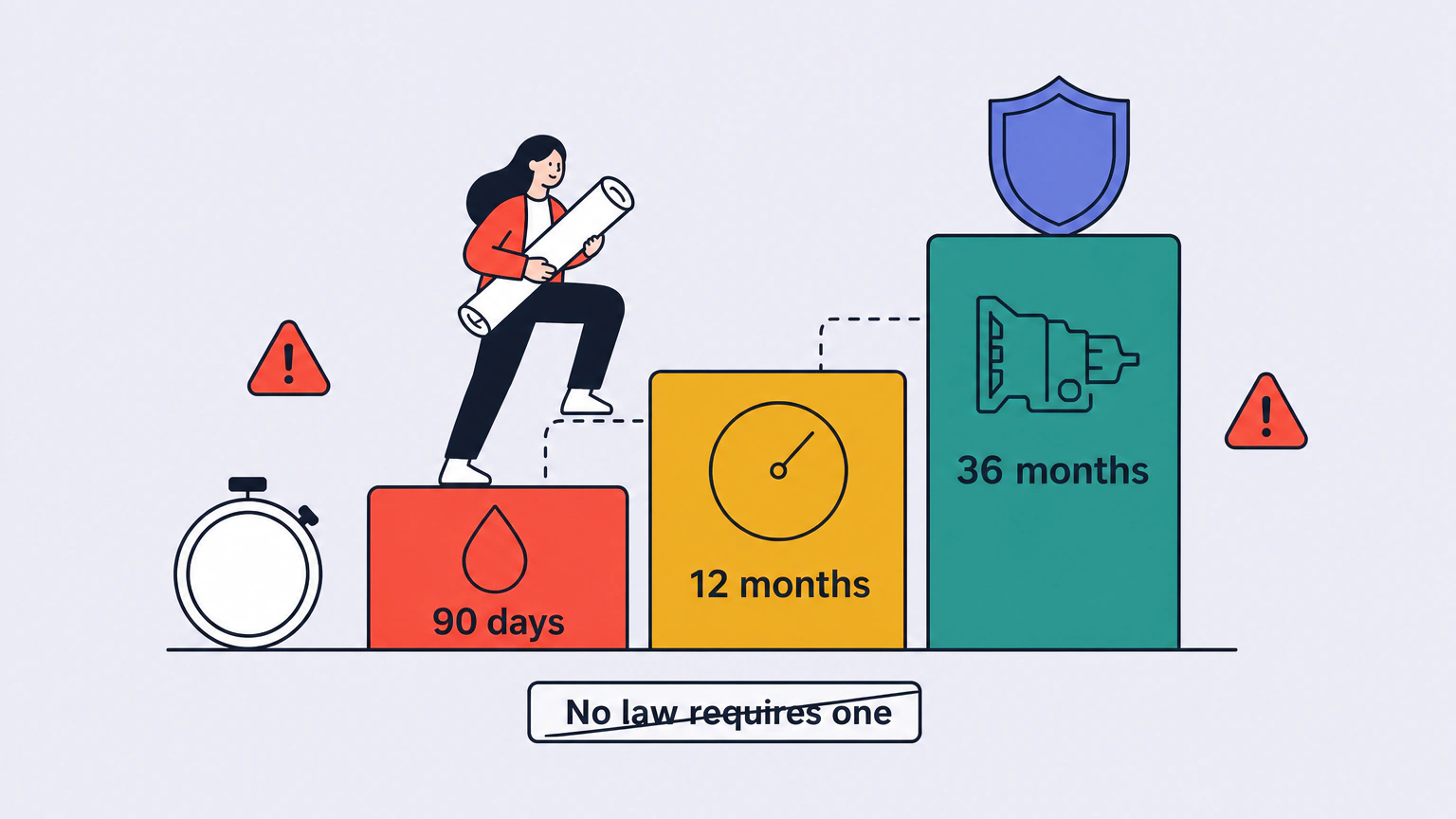
90 days: oil changes and some transmission sub-jobs
Not everything gets a year. Wrench warrants an oil change for 90 days or 3,000 miles, and AAMCO puts 90-day terms on minor transmission services, electronic components, manual transmissions and pre-owned transmissions. Some fluid and transmission work carries a shorter clock than the headline number on the wall, so ask which clock your job is on before you drive off.
12 months / 12,000 miles: the industry floor
Wrench's limited warranty runs 12 months or 12,000 miles, counted from the date and the odometer reading on the day of service. AAMCO's Total Car Care warranty covers parts and labor for the same stretch. Motor1 reports that 12 months or 12,000 miles is typical, and that no warranty at all is a major red flag.
We'd walk from a shop that offers nothing. An independent sets its own term, so call two or three independent mechanic shops and ask before you book anything.
24 months / 24,000 miles: NAPA AutoCare and AAA Approved
Join a network and the clock doubles. NAPA AutoCare's Peace of Mind warranty covers the repairs on its list for 24 months or 24,000 miles, measured again from the date and odometer on the original repair order. AAA's Approved Auto Repair standards say the same thing in AAA's own words: "Repairs, including parts and labor, are covered by a warranty of 24 months or 24,000 miles whichever comes first."
36 months / 36,000 miles: TechNet and the extensions
TechNet Professional's nationwide warranty runs 36 months or 36,000 miles across North America, honored at 15,000+ locations. Three years, and it travels with you. NAPA shops that publish the full Peace of Mind terms state that coverage extends to 36 months or 36,000 miles when qualifying repairs are paid with the NAPA AutoCare EasyPay card. Gold-certified shops advertise 36/36.
Longer terms on major assemblies
A rebuilt transmission is its own transaction, and it gets its own paperwork. AAMCO lists 36 months/50,000 miles and 36 months/100,000 miles options on remanufactured or custom-rebuilt automatics. Major assembly jobs can also fall outside a network warranty, so ask about the warranty on the assembly itself, separately, and get that one in writing too.
Parts and labor run on two different clocks
Here's the split that catches people. A shop warranty can cover the repair and the parts the shop supplied. The part's manufacturer can cover that same part separately, under a warranty of its own. Those two clocks may start on the same afternoon and stop on different days, and which one is still running affects whether your comeback is covered.
The shop warrants the work; the manufacturer warrants the part
Wrench spells the principle out in its own terms: where a part carries a manufacturer warranty longer than the shop's period, the longer one applies to that part, and the shop's term applies to the work.
Picture a 14-month-old alternator. The manufacturer could still be covering the part. Whether anybody covers the labor to put the new one in comes down to the applicable terms, which is why the answer to "is this free?" so often arrives as "half of it."
What the OEM part warranties actually run
Three brands, three different answers. Eligible Ford and Motorcraft parts sold since October 1, 2013 carry 24 months with unlimited miles, and Ford's published dealer terms cover parts and eligible labor. Toyota Genuine Parts installed by a dealer are covered for 12 months regardless of mileage, or the remaining new-vehicle warranty, whichever is greater, with labor only where the dealer both sold and installed the part. Mopar runs for 24 months with unlimited miles, or the greater remaining 3-year/36,000-mile basic coverage. So the brand, and who installed the part, are what set your coverage.
"The part's free, the labor isn't": how to avoid the split bill
One question at the counter, and you want the answer written on the invoice: "If this part fails inside its own manufacturer warranty, does your warranty cover the labor to install the replacement?"
Ask it out loud. The answer is the difference between a free comeback and a second labor bill, and "lifetime" stamped on a part is not a promise about labor. When you compare brake shops, compare the labor terms as well as any "lifetime" part coverage.
What these warranties do not cover
Exclusions can turn into a disagreement later, at the point where you have no leverage left. Request them and read them before you authorize the work.
| Exclusion | What it means in practice | Which programs it appears in |
|---|---|---|
| Internal engine work and engine replacement | Not a network claim | NAPA |
| Internal transmission repairs or components | The internal transmission work is outside the network warranty | NAPA |
| Body, paint, molding and glass | Collision and cosmetic work | NAPA, TechNet |
| Normal wear and tear | Ordinary wear is not a covered defect where excluded | NAPA, TechNet |
| Abnormal use, misuse, neglect, accident, alteration | Track use, ignored warning lights, modifications | TechNet, NAPA, AAMCO |
| Commercial use of a passenger vehicle | Commercial use may be excluded or disqualify an extension | NAPA EasyPay extension, AAMCO, Wrench |
| Missed required maintenance during the term | Coverage can depend on necessary maintenance | NAPA, TechNet, Wrench |
| Customer-supplied parts | Supplied parts or related work may be excluded | NAPA, TechNet, Wrench; ask the shop |
| Consequential damages | Incidental or consequential losses may be excluded | NAPA, TechNet, AAMCO, Wrench |
| Cap at the original repair's cost | The warrantor's obligation may be capped | NAPA, TechNet, Wrench |
| Non-transferability on resale | The next owner has no claim under a non-transferable term | NAPA, TechNet, Wrench; some AAMCO terms |
The repairs that fall outside network coverage
NAPA's covered-systems list is long, and it stops somewhere. Internal engine repairs, engine assembly replacement, internal transmission repairs or components, and body, paint, molding and glass work all sit outside it. TechNet's list works the same way, covering systems rather than body or glass.
Which is exactly why you ask transmission repair specialists for the warranty on the rebuilt unit itself.
Conditions that quietly void coverage
Several of these programs require reasonable and necessary maintenance during the term. Several exclude some combination of abnormal use, misuse, neglect, accident, alteration or normal wear. NAPA, TechNet and Wrench each cap what they owe at the original covered repair's cost. AAMCO and Wrench exclude commercial use, as does NAPA's EasyPay extension.
Then there are the two you can trip over yourself. Supplying your own parts, and letting a second shop work on the car without authorization, can each defeat coverage under specified program terms.
It probably does not transfer, and a warranty repair does not restart the clock
NAPA's coverage belongs to the original purchaser. Not to whoever buys the car from you halfway through the term. A buyer inherits nothing.
Wrench's is non-transferable too, and Wrench states that remedial work does not restart the period, so a second comeback runs on whatever time is left from the first repair order. The clock doesn't reset because the shop touched the car again.
What to do when the same problem comes back
Work these in order, and don't improvise. Skipping step three can cost you coverage under program terms.
- Dig out the original repair order. The date and the odometer reading on it are where your clock started.
- Photograph or record the symptom while you still have it. Video of the noise beats your description of the noise.
- Call the original shop first and say the words: "this is a warranty return on invoice #___." Going elsewhere first can cost you the coverage.
- If you cannot reasonably return to the original shop, including because it has closed, call the program administrator before authorizing anything.
- Get the warranty visit written up on its own repair order, even at no charge, and keep it.
- If the same fault returns a third time, put the history in a dated letter, set a deadline, then escalate.
Where you are allowed to take it
Under NAPA's terms, if you are less than 25 miles from the original shop, that's where you go, repair order in hand, as long as you're reasonably able to get there. If you can't, call the administrator at (800) 452-NAPA before any work begins. Published hours are 8:00 a.m. to 8:00 p.m. ET on weekdays. An inoperable vehicle may qualify for towing and rental benefits under the terms, so raise that on the same call.
TechNet puts it as a reasonableness test. Return to the original facility if you reasonably can. Otherwise call the National Warranty Administrator at (866) 588-0728 before work begins. Either route, producing the repair order is a condition, so don't leave the house without it.
The remedy is the shop's choice, not yours
You may want your money back. The terms may not care what you want. NAPA's and Wrench's give the applicable facility or warrantor a menu of options that includes re-performing the work, replacing a part, or refunding covered charges, all subject to their cost caps.
So when you ask "can I get a refund from a mechanic," the honest answer is sometimes, and the applicable terms control which of those you get.
California's extra clock
If you're in California, read this twice. The California provision in the NAPA warranty extends the period by the whole days the vehicle is delivered for warranty repairs. Days in the shop don't count against you. Under the same provision, the warranty does not expire while a covered defect exists.
And if repairs do not remedy the defect after a reasonable number of attempts, the terms provide for replacement parts or a refund, less a charge for use, with a 60-day administrator-notice condition attached. That notice is a condition, not a courtesy. Put the date on a calendar the day you start the claim.
If the shop refuses
Escalate in this order, and keep every scrap of paper.
- A dated written demand. Name the invoice number, the symptom, every visit and a deadline.
- Your state Attorney General or local consumer protection agency. Once you've been to the owner, this is the FTC's own next step.
- The state repair regulator, where one exists. California's Bureau of Automotive Repair is one example. Learn your state's rules on estimates and authorization before you call.
- AAA's dispute process, if the shop is an AAA Approved Auto Repair facility. AAA investigates, the business accepts its decision, and you stay free to seek recourse elsewhere.
- Small claims court. You don't need an attorney, and the FTC says so.
- A credit card dispute, where its conditions apply, if you paid by card.
Red flag: four answers that should end the conversation
- "We stand behind our work," with nothing in writing.
- A warranty on parts only, with labor billed again on the comeback.
- Refusal to print the term on the invoice.
- Blaming the parts supplier and sending you to the manufacturer.
What your invoice has to say
Federal law sets no standard minimum repair-warranty term. What some states regulate instead is the paperwork: where a warranty exists, the invoice has to say so. State law may impose other repair duties as well.
Three states where the paperwork rules are written down
- California. All work by an automotive repair dealer, "including all warranty work," must be recorded on an invoice, with service work and parts listed and priced separately (Bus. & Prof. Code § 9884.8, per the Bureau of Automotive Repair's Write It Right).
- Wisconsin. Where an invoice item carries a warranty from the shop or manufacturer, the invoice must carry "a statement or notation indicating that fact" (ATCP 132.08(8)).
- Florida. The Motor Vehicle Repair Act requires "a statement indicating what, if anything, is guaranteed in connection with the repair work and the time and mileage period for which the guarantee is effective" (Fla. Stat. § 559.911(5)).
These are examples, not a complete list, and they don't all do the same job. California does not require a repair dealer to offer a warranty at all. These Wisconsin and Florida provisions require honoring or disclosing a warranty when one exists, rather than setting a minimum offered term. To find your own state's rule, search your attorney general's site for "auto repair" or look for a state motor vehicle repair board. The FTC's advice is the same: check with your Attorney General or local consumer protection agency.
Pick the warranty before you pick the shop
You can compare warranty terms the way you compare prices, and it costs you one phone call. A participating network program can also make specified coverage available away from the original facility, on terms that may run longer than a local shop's. Coverage you can use when you're nowhere near the shop that did the work is worth asking about before you hand over the keys.
Six questions to ask before you authorize
None of these is rude. A shop that resents being asked has told you something.
- "How long is the warranty on this repair, in months and miles?"
- "Does it cover labor as well as the part?"
- "Is the shop part of a nationwide program, NAPA AutoCare, TechNet or AAA Approved, or is the warranty good only here?"
- "If it fails while I'm out of state, who do I call?"
- "Is the warranty written on the invoice, or do I get a separate document?"
- "Does the part carry its own manufacturer's warranty, and is it longer than yours?"
Ask them out loud, and check the technician's credentials before you book.
How to find shops that carry a network warranty
Participating shops may display their NAPA AutoCare, TechNet or AAA Approved affiliation, but don't count on spotting a sign. Start with the auto repair shops in your area and ask about the program before you ask about the price. A written, network-backed warranty is one honest signal to judge a shop on. The Best of Preferred Mechanic awards weigh a separate set: reviews, verifiable business information, licenses or accreditations, and complaint history.
Frequently asked questions
Do mechanics have to warranty their work by law?
Not under federal law. No federal rule sets a standard repair-warranty term, and the Federal Trade Commission states there is no standard warranty on repairs. What your own state requires varies. That's why the paperwork matters: written terms are evidence of what was promised, and they may be enforceable subject to their conditions and applicable law.
How long do mechanics warranty their work?
Commonly 12 months or 12,000 miles, whichever comes first. The networks go longer: NAPA AutoCare and AAA Approved shops run 24 months or 24,000 miles, TechNet shops 36 months or 36,000 miles. At the other end, an oil change or a minor transmission service can be covered for as little as 90 days.
Does a repair warranty cover parts, labor, or both?
The major network warranties cover both, which is most of the reason to prefer one. A part can also carry its own manufacturer warranty on top: Ford and Motorcraft parts run 24 months with unlimited miles, Toyota Genuine Parts 12 months. Where the part's own warranty is longer, that longer one applies to the part.
What if the same problem comes back after the repair?
Take the original repair order back to the shop that did the work and use the words "warranty return." Under NAPA's program you go back there if you are less than 25 miles away and reasonably able to. If you can't, call the administrator before you authorize work anywhere else.
Can I take my car to a different shop and still be covered?
Sometimes, inside a nationwide program, and often only after you've contacted the administrator. Another participating or authorized facility may be permitted. Go elsewhere without following the notice and authorization terms and you can jeopardize the coverage, because the original shop or warrantor never gets its chance to inspect or remedy the failure.
Can I get a refund from a mechanic instead of another repair?
Sometimes. The applicable warranty controls who chooses the remedy, and it may not be you. NAPA's and Wrench's terms include options to re-do covered work, replace a part, or refund covered charges, subject to their cost caps. Ask for the refund by all means. Just don't assume it's yours to pick.
Does a warranty repair restart the clock?
Not at Wrench, which says so expressly: its clock runs from the original service date and odometer reading, and remedial work does not restart it. NAPA and TechNet carry a California provision that runs the other way, extending their periods by the whole days a vehicle is delivered for warranty repairs.
Is a repair warranty transferable if I sell the car?
NAPA, TechNet and Wrench limit their published coverage to the original purchaser, and some AAMCO terms are non-transferable too. Check the warranty on your own repair before you assume anything. If you're the one selling, show the invoice as evidence of recent work, but don't promise the buyer coverage you can't hand over.
We're not your lawyer, and this is general information rather than advice on your own repair. Terms change, so the ones that count are on your invoice, in the applicable program's own document, and in your state law. If a shop won't honor what it wrote, the FTC points you to your state Attorney General or local consumer protection agency.