

On this page
- Start here: is it a rejection or a failure?
- The four things a failed report can actually be saying
- Before you spend a dollar: check the federal emissions warranty
- Who is allowed to fix it, and why it decides whether your money counts
- What the repairs actually cost
- Retests, waivers and extensions, state by state
- One thing never to do
- How to choose the shop that fixes it
- Frequently asked questions
- Where these rules come from
Start here: is it a rejection or a failure?
You're holding a piece of paper that says your car didn't pass, your registration renewal is riding on it, and somebody at the counter is already using the word "converter." Before any of that, read the top line of the report.
Rejection and failure are two different words, and they cost two different amounts. A rejection means your car's own self-tests hadn't finished running. It happens constantly after a battery change or a code reset, and nothing is necessarily wrong with the car. You drive the pattern the state asks for, you come back, and usually you're done. If the monitors still won't set after that, then it's time to pay somebody to look.
If the paper really does say failure, check the car's age and mileage before you authorize a dollar of work. On a 1995-or-later light-duty vehicle, federal law puts specified major emission-control components, the catalytic converter and the emissions-control module among them, under an 8-year/80,000-mile manufacturer warranty. That can move the bill off you and onto the carmaker.
What a "rejection from testing" means
Federal rules say a 1996-or-newer car is rejected from testing, not failed, when a scan of its onboard diagnostic (OBD) system turns up a "not ready" code. States are allowed to be gentler than that. They can hold off on rejecting 1996 to 2000 cars until three or more monitors read not ready, and 2001-and-later cars until two or more.
Nothing is necessarily broken. The Nevada DMV puts it in one sentence: "A 'Rejected' test is not the same as a 'Failed' test. It just means the vehicle is not ready to be tested."
Why your car came back "not ready"
Readiness monitors are the self-tests your car's computer runs on each emissions system, and they have to finish before the station's equipment will accept a result. Missouri's program lists the usual reasons they come back "Not Completed." The battery was replaced or disconnected. A shop cleared the stored trouble codes. The computer has a power or grounding fault. The engine never got hot enough for the test to run. A software update reset everything.
Look at that list again, because one item on it isn't bad luck. Wiping the codes wipes the monitors along with them. The favor somebody did you last week is very often the reason you're standing at this counter today.
What to do about a rejection
Drive it.
That really is the cure most of the time. The pattern each monitor needs is called a drive cycle, and the name is worth learning, because it's what you'll be typing into a search bar tonight. Missouri tells drivers to expect four to seven days of mixed city and highway driving. Nevada says up to a week of varied driving on 1996-and-newer cars.
Missouri also gives you room to do it. A driver who failed only on readiness can go up to 30 days past registration expiration while the monitors set, and Missouri says to keep the report in the car so you can show it to an officer. Start the driving now rather than in the last few days. The $5 per month late fee is what waiting buys you.
What you can't do is buy your way past a rejection. Virginia grants no waiver for a "rejection from testing" at all, so there it has to be cured, never waived.
The four things a failed report can actually be saying
Four different results can print as a fail, and they aren't variations on one problem. Three of them can mean repairs. One of them usually just means driving. Find out which line on your paper is marked before anybody opens the hood.
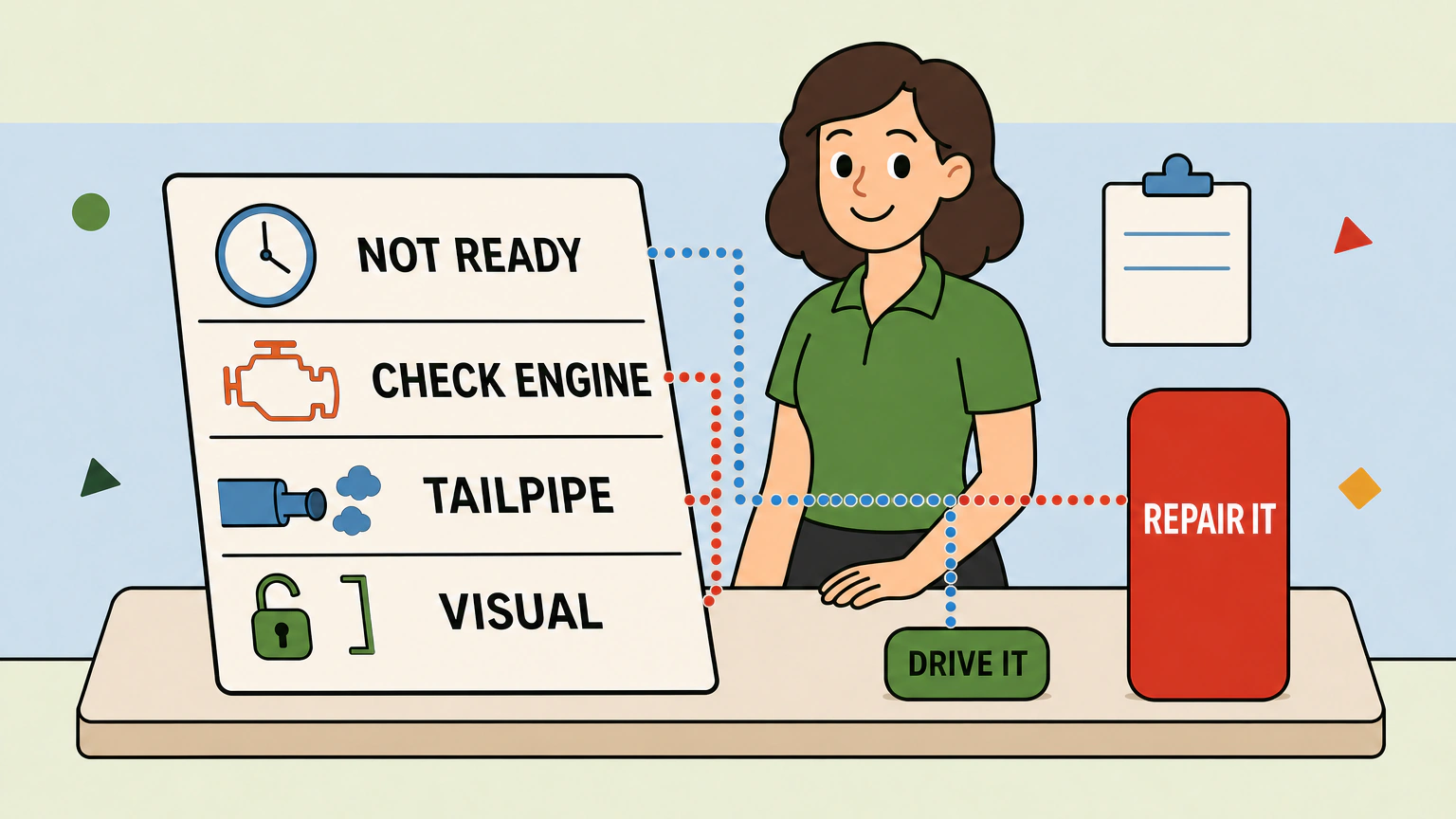
| What the report says | What it actually means | Typical cure | Waiver eligible? |
|---|---|---|---|
| Rejection / not ready | Self-tests unfinished, nothing proven broken | Drive a full drive cycle, then return | No. Virginia excludes any "rejection from testing" |
| Check engine light (MIL) on | The lamp alone fails the car in an OBD program | Diagnose and fix the stored trouble codes | Illinois excludes costs where the car failed for a MIL failure |
| Tailpipe gases over the limit | Measured emissions exceed the standard | Fuel, ignition or converter repair | Nevada allows it for carbon monoxide or hydrocarbon failures on 1968 to 1995 light-duty vehicles |
| Visual or functional failure | Equipment missing, disconnected or incorrect for the certified configuration | Restore compliant equipment | No in Virginia, which excludes visual and visible-smoke failures |
The check engine light is on (an OBD/MIL failure)
The malfunction indicator lamp, MIL on your report, is the check engine light on your dashboard. Learn the initials, because that's the word the counter will use. In an OBD program a lit lamp fails the car on its own, whatever the tailpipe would have measured.
Now find the Diagnostic Trouble Codes section of the report, and don't assume it's the whole story. Virginia warns that only five codes print in the Remarks section even when the computer is holding more, and every one of them has to be resolved before the car passes. That's work for auto electrical and diagnostic specialists.
The tailpipe numbers are over the limit
This is mostly an older-car problem, in the programs that still put a probe in the pipe instead of reading the computer. Nevada draws its line by model year: carbon monoxide and hydrocarbon levels decide waivers on 1968 to 1995 light-duty vehicles, and the check engine lamp decides them on 1996 and newer. Virginia measures hydrocarbons, carbon monoxide and sometimes nitric oxide. It names two usual suspects, a faulty oxygen sensor and a broken converter.
The visual or functional check failed
Somebody looked, and something was missing, unplugged or wrong. Emissions equipment gone, disconnected, or replaced with a part that isn't approved for the vehicle's certified configuration.
This is a bad category to land in, because the money rules are at their harshest. Virginia keeps visual-inspection and visible-smoke failures out of its waivers entirely. Nevada makes you repair a smoking vehicle with no cost limit at all.
The station could not complete the test
Not every dead end is a failure. The same federal rule rejects a car when the exhaust system is missing or leaking, and when the vehicle is simply unsafe to test. Leaks and missing pipe are a job for muffler and exhaust shops.
The third dead end is quieter. The diagnostic connector under your dash won't talk to the station's equipment, and until it does, nobody can read the car at all. Illinois wants both the MIL and the OBD data link connector working, and it excludes repair costs from waiver eligibility where the connector doesn't communicate. So in Illinois, money you spend while that connector is dead can leave you holding receipts that never count.
Before you spend a dollar: check the federal emissions warranty
What is covered, and for how long
There are two clocks, and both of them are federal.
On a 1995-or-later light-duty car or truck, emission-related parts generally carry 2 years or 24,000 miles, whichever comes first. The specified major emission-control components carry 8 years or 80,000 miles, again whichever runs out first. That second list is longer now than the three parts the statute originally named, because the current federal regulation adds to it, so the list that governs your car is the one printed in your own warranty booklet. Georgia's program lays out both periods and notes that many manufacturers cover more than the federal floor.
Check the odometer before you check the price.
The performance warranty, in plain English
There's a second warranty inside the same law, and almost nobody mentions it.
It turns on three things. You maintained the car the way the manufacturer told you to. It failed to conform to the emission standards during the warranty period. And that failure made you "bear any penalty or other sanction (including the denial of the right to use such vehicle)." Where all three are true, the manufacturer "shall remedy such nonconformity under such warranty with the cost thereof to be borne by the manufacturer."
That last clause is the whole point. Being blocked from renewing your registration is the sanction. The EPA titled its own consumer fact sheet, in so many words, "If Your Car Just Failed An Emissions Test... You May Be Entitled To Free Repairs."
How to use it, and what to keep if they say no
Call the manufacturer or an authorized dealer. Bring the inspection report as your evidence of the failure, and bring your maintenance records too, because the first thing anybody asks is whether you kept up the schedule. The EPA points out that the law doesn't require you to fail every test before coverage applies.
Pro tip: get the denial in writing.
A verbal "you're out of warranty" is worth nothing to you afterwards. The federal waiver rules require that available warranty coverage be used before any repair spending counts, and where the owner is still inside the emissions warranty's age and mileage window, they want a written denial of warranty coverage from the manufacturer or an authorized dealer. Ask for it in the room, while somebody is still standing in front of you. The EPA's fact sheet also tells you to ask who made the decision and who you appeal to.
None of this is your bumper-to-bumper factory warranty, which runs on its own rules about where you're allowed to have the car serviced. Different statute, different fight: how your factory warranty actually works.
Who is allowed to fix it, and why it decides whether your money counts
The credential that matters is not ASE
The certificate framed on the wall is probably ASE, and for this particular job it's the wrong certificate.
Several states count your repair money toward a waiver only when a specifically licensed person did the work. Virginia wants a Certified Emissions Repair Technician (CRT) at a Certified Emissions Repair Facility (CRF). Nevada wants a 2G Licensed Authorized Station. California runs its repair assistance through STAR test-and-repair stations. Missouri will let anybody turn the wrench, then counts the labor only if a Missouri Recognized Repair Technician did it.
ASE is a real credential and a good one to see. It's also voluntary, and it isn't what the waiver rules are asking about.
The mistake that costs the most money
Here it is, in Virginia's own capital letters. Pay somebody who isn't a CRT for emissions repairs, fail the reinspection, and that money "CANNOT be applied towards an emissions inspection waiver." Nevada says the same thing its own way: a vehicle not repaired at an authorized 2G station "will not be eligible for a waiver, regardless of the cost incurred."
That's the trap. The work got done, you have the receipt, and the receipt counts for nothing. Ask about the license before you hand over the keys, not after the car is on the lift. For the bill itself, we've covered your state's rules on estimates and authorization.
Paperwork you must not lose
Two pieces of paper go in the glovebox and stay there. The Vehicle Emissions Inspection Report, and the repair form issued with it. That form has a different name in every state: Emissions Repair Data Form in Virginia, Emissions Repair Form in Georgia, Repair Data Form in Illinois, a repair data sheet in Missouri. Same job, four names.
Then watch the dates, because every one of these rules has a clock on it. Illinois wants receipts that identify the car by VIN and are dated no more than 30 days before the test eligibility date. Washoe County in Nevada counts parts you bought yourself only if you bought them within 14 days of the initial test. And the federal rule puts qualifying repairs inside 60 days of the test date.
What the repairs actually cost
Diagnosis first
Pay for the diagnosis before you pay for parts. Georgia's program tells drivers to expect $60 to $100 for a diagnostic analysis, and Missouri won't consider a cost-based waiver at all unless a pre-repair inspection came first.
That first hour is its own negotiation, including whether the shop credits it back against the repair: what a diagnostic test should cost.
The cheap end and the expensive end
Nobody can price your repair off a report. What we can show you is where the two ends of the range sit.
| What failed | Typical cost | Source of the figure |
|---|---|---|
| Diagnosis | $60 to $100 | Georgia's Clean Air Force |
| Loose or failed gas cap | Cheapest thing to check first; no figure asserted | Federal evaporative test procedure |
| Oxygen sensor | Just under $200 | Firestone, citing Edmunds.com estimates |
| Exhaust and muffler work | $114 to $248 typical, $145 average | This platform's own muffler and exhaust shops panel, 754 cost profiles |
| Sensors and electrical faults | $137 to $231 typical, $158 average | This platform's own auto electrical and diagnostic specialists panel, 893 cost profiles |
| Major engine work | $1,597 to $2,575, $1,854 average | This platform's own engine repair specialists panel, 896 cost profiles |
The bottom three rows are our own aggregates across the sample sizes shown, not market statistics, and they price the repair rather than the test. Our own emissions-testing category publishes no price panel at all. We looked. So treat whatever a testing station quotes you as a local question with a local answer.
Why a converter is the number everyone fears
You already know the word. So does everybody else in the waiting room, and they all quote a different number for it.
We went looking for a national price on a catalytic converter and couldn't find one we were willing to print, so we haven't printed one. What we can pass on is what Firestone tells its own customers: ignore a faulty oxygen sensor and it "could lead to catalytic converter issues and a repair bill of more than $1,000."
Now put the two halves together. The converter is also one of the parts that may still be sitting inside that 8-year/80,000-mile federal warranty. Check the coverage before you accept the quote, in that order. If the car is out of coverage, an engine repair specialist is the shop you want.
Retests, waivers and extensions, state by state
The free retest is usually short, and the clock has already started
Free retests are measured in days rather than weeks, and they usually belong to the station that failed you rather than to any station you like.
Virginia gives you 14 calendar days at the original station. Georgia gives 30 calendar days. Missouri gives 20 business days. The clock is already running, so the first job is finding out which station your retest is tied to: emissions testing and smog check stations near you.
What a waiver is, and what it is not
A waiver is not a pass. It's the state accepting that you spent enough money trying.
The federal rules only open that door after the car fails a retest performed after all the qualifying repairs, and those repairs have to fall within 60 days of the test date. The repairs have to be appropriate to the cause of the failure. Somebody reads the receipts. Tampering repairs never qualify, and their cost doesn't count toward the minimum either. And the waiver you finally get is good for one test cycle, so next cycle you start over.
Why the dollar figure is different in every state
Because the federal floor moves, and every state builds its own number on top of it.
The enhanced-program minimum is "at least $450 in repairs," and that $450 is adjusted every January by the change in the Consumer Price Index against 1989. Basic programs may use the lower tier instead: $75 for pre-1981 vehicles and $200 for 1981-and-newer. Each program then publishes the threshold that applies to it. That's why the figures we could confirm run from $200 in Washoe County to $1,176 in Georgia and Illinois.
| Jurisdiction | Free retest | Waiver threshold | Who must do the repairs | Source |
|---|---|---|---|---|
| Georgia | One free retest at the original station, within 30 calendar days | $1,176 in emissions-related repairs for 2026 registration, updated annually by CPI | Any technician, but the repair technician must complete the Emissions Repair Form | Georgia's Clean Air Force |
| Virginia | One free retest at the original station, within 14 calendar days | The amount printed on your own inspection report ($1,090 on or after January 5, 2026) | Certified Emissions Repair Technician at a Certified Emissions Repair Facility; money paid to anyone else does not count | Virginia DEQ |
| Illinois | None found | $1,176, excluding tampering-related repairs, after at least two failed tests | A recognized repair technician; receipts dated no more than 30 days before the test eligibility date | Illinois Air Team |
| Missouri | One free retest at the same station if repairs are done within 20 business days | None found | Anyone may repair the car, but labor counts toward a cost-based waiver only if a Missouri Recognized Repair Technician did it | Missouri Gateway VIP |
| Nevada, Clark County | None found | $450 | 2G Licensed Authorized Station only | Nevada DMV |
| Nevada, Washoe County | None found | $200 | 2G Licensed Authorized Station or the registered owner, with owner-purchased parts bought within 14 days of the initial test | Nevada DMV |
| California | Not applicable, see note | Repair assistance rather than a cost waiver: up to $1,450 (1996 and newer) or $1,100 (1976 to 1995), household income at or below 225% of the federal poverty level | STAR test-and-repair station | California BAR |
Seven jurisdictions, each one read on the program's own site. Where a cell says something couldn't be verified, that's a gap in what the program publishes rather than a zero, and we'd rather show you the gap than fill it with a plausible number. Your own program may run differently on coverage, exemptions, waivers and assistance, so go and find it: your state's name plus "vehicle emissions inspection program," and then the .gov site or the named program operator, not somebody's blog.
Then trust the amount printed on your own inspection report over any figure in print, ours included. That isn't us being modest. Georgia's own site currently shows two different amounts on one page: $1,176 for 2026 registration in its guidance, and $1,146 for 2025 registration inside its FAQ. When the program that wrote the rule is carrying two numbers at once, the paper in your hand is the one to go by.
If you cannot afford the repair
Say the number is more than you have. That's an ordinary sentence at an inspection station, and two of the states we read have money set aside for exactly that.
California's Consumer Assistance Program pays up to $1,450 toward emissions repairs on 1996-and-newer vehicles, or $1,100 on 1976 to 1995 vehicles. You have to be the registered owner, your gross household income has to be at or below 225% of the federal poverty level, and there's a co-payment at a STAR test-and-repair station. Nevada's Smog Free Clark County voucher pays up to $975 on 1968 to 1999 vehicles, also subject to income restrictions.
If your state has nothing like that, ask for time instead of money. The federal rules allow a time extension for economic hardship, and some states will extend the registration itself. Georgia sends drivers to their county tag office for a possible 30-day extension that can't be renewed.
One thing never to do
Do not let anyone "clear the codes" to get you through
Somebody will offer. It's usually meant kindly, and it's still the worst thing that can happen to your week.
Red flag: "we'll just clear the codes and you'll sail through."
It sounds like a favor. It's the one offer in this whole process that reliably makes things worse:
- Clearing the codes resets every readiness monitor to "not ready," so the car comes back rejected instead of passed.
- The fault that lit the lamp is untouched, so the lamp can come straight back.
- You've spent part of your free-retest window on a test that produced no result.
What to say: "Please diagnose and repair the fault, and give me an itemized receipt dated today."
Do not let anyone remove or disable emissions equipment
The other offer comes with a wink. It's about making the equipment stop reporting rather than making the car run right.
Federal law makes it unlawful for anybody to knowingly remove or render inoperative an emissions control device once the car has been sold. It's equally unlawful to make, sell or install a part whose "principal effect" is to bypass or defeat one. Tampering repairs count toward a waiver in none of the programs we read, and Nevada makes you repair a tampered vehicle with no cost limit.
So the shortcut is more expensive than the repair. Recognize the offer, and say no to it.
How to choose the shop that fixes it
The five questions to ask before you authorize work
You don't need to understand any of this to ask five good questions. Read them off your phone at the counter if you like, before you sign anything:
- "Is this shop certified by the state's emissions program, and will my receipt count toward a waiver?"
- "My car is under 8 years old and under 80,000 miles; have you checked whether the catalytic converter or the emissions computer is still under the federal emissions warranty?"
- "Which specific code on my report are you fixing, and how will you confirm it is fixed before I pay for a retest?"
- "Will you fill out the emissions repair form, and can I have itemized receipts dated today?"
- "How many miles do I need to drive before the monitors are ready to retest?"
A shop that answers all five without flinching is the shop you want. A shop that gets impatient at question one has already told you something useful.
Where to find a qualified shop
Start with the right category rather than the nearest sign: emissions testing and smog check stations near you for the test itself, muffler and exhaust shops for leaks and missing pipe, and auto electrical and diagnostic specialists for sensors and a connector that won't talk. If you want to know how we score a shop before you trust a listing, that's published with the Best of Preferred Mechanic awards.
Frequently asked questions
Can I still drive my car if it failed the emissions test?
The failed test by itself doesn't decide that. Your registration status and your state's rules do, and they vary. Missouri, for example, gives a driver who failed only on readiness monitors up to 30 days past expiration, and tells that driver to keep the test report in the car to show law enforcement. Check what your own program allows before you assume you're covered.
How many times can you fail an emissions test?
There's no federal strike count. What limits you is money and the calendar. Free retests come with state deadlines, and the ones we confirmed are 14 calendar days in Virginia, 20 business days in Missouri and 30 calendar days in Georgia. Under the federal rule, a waiver only opens up after you fail a retest that followed all the qualifying repairs. So you fail until you fix it, or until you qualify for a waiver.
Can I register my car if it failed emissions?
Not on the failure alone, in a program that makes emissions compliance a registration condition. You get there with a passing certificate, a waiver, an extension or another program-specific exemption. The waiver route generally means a failed retest after qualifying repairs, plus the minimum spend your state sets. An extension only buys time: Georgia sends drivers to county tag offices for a possible 30-day registration extension that can't be renewed.
How long do I have to drive before the readiness monitors reset?
There's no single mileage answer, because each monitor needs its own drive cycle: a particular mix of cold starts, steady cruising and stop-and-go that lets the computer finish that self-test. Missouri's guidance is four to seven days of mixed city and highway driving. Nevada tells owners of 1996-and-newer cars to drive under varying conditions for up to a week. Plan on a week of ordinary driving.
Is a catalytic converter covered under warranty?
On a 1995-or-later light-duty vehicle, yes: 8 years or 80,000 miles, whichever comes first. Federal law names the catalytic converter explicitly as a "specified major emission control component," alongside the electronic emissions control unit and the onboard diagnostic device. Many manufacturers cover more than that floor, so read your own warranty booklet before you accept a quote.
Will a loose gas cap fail an emissions test?
Yes, in programs that run an evaporative-system pressure check. The federal procedure has the inspector confirm the cap is properly tightened, pressurize the system, watch for pressure decay, then loosen the cap to confirm the tank had been pressurized. It's the cheapest thing to rule out, and the Nevada DMV names it among the most common causes of a check engine light that appears out of nowhere.
Does clearing the check engine light help me pass?
No, and it makes the next test worse. Clearing the light resets the readiness monitors, which gets the car rejected rather than passed, and the fault that lit the lamp is still there. You've also thrown away the stored trouble codes a technician would have used to find it. Fix the cause, drive the drive cycle, then retest.
Where these rules come from
Every rule on this page came out of the federal regulation itself or the state program's own site rather than out of somebody else's guide, and where a program publishes nothing, we've said so instead of guessing. The EPA's directory of state and local inspection and maintenance programs lists 28 states plus the District of Columbia, though a listed state may test only particular areas or particular vehicles.
So the paper in your hand outranks all of it. Read the top line, work out whether you're driving or repairing, and go do that today while the retest window is still open. How we score the shops in our directories is published with the Best of Preferred Mechanic awards.