


Last verified: August 17, 2026. Every statute quoted below was read from the state's own official code site on that date.
On this page
- The short answer, and the one thing that decides your bill
- Three mandatory no-deductible rules, and why they are not the same
- Two statutory paths to optional no-deductible glass coverage
- What a windshield actually costs in 2026
- ADAS calibration: the line item that decides the bill
- Will filing a glass claim raise your premium?
- Choosing the shop: what your insurer can and cannot require
- Red flag: "we'll cover your deductible"
- Before you book: eight questions for the glass shop
- Frequently asked questions
- Find a shop
The short answer, and the one thing that decides your bill
Comprehensive coverage pays for glass broken by road debris, storms, vandalism or animals. Collision pays when the glass broke in a crash. What changes your bill is the deductible, and that depends on your state and on what you elected when you bought the policy.
Which coverage actually pays: comprehensive vs collision
A rock chip, flying gravel, hail or a fallen branch is a comprehensive loss. The Insurance Information Institute puts it plainly: comprehensive "will also pay to repair your windshield if it is cracked or shattered," and is "usually sold with a separate deductible, although some insurers may offer the glass portion of the coverage without a deductible." Hit a pole or another car and the glass rides along with the rest of the repair, which is work for collision centers. A liability-only policy does not cover damage to your own glass, and comprehensive itself is optional unless a lender or lessor requires it.
Repair vs replacement, and why a chip is often free
Some insurers waive the deductible on a repair, the injection of clear resin into a chip, even where they would apply it to a full replacement. Whether your damage qualifies is the technician's call. It turns on the size and depth of the break, how close it sits to the edge, whether it lies in the driver's line of sight, and how long it has been open to dirt and moisture. Have it looked at quickly, and by a shop that does chip work, because auto glass repair shops save damage that replacement quotes treat as beyond repair.
The "glass-only claim" idea, and why it matters
Kentucky's statute turns on a claim being for motor vehicle glass only, and the phrase is worth borrowing wherever you live. Glass broken on its own is handled differently from the same glass replaced inside a collision repair: different coverage, different paperwork, sometimes a different shop network. If your windshield broke in a crash, the collision rules are the ones that matter to you.
Three mandatory no-deductible rules, and why they are not the same
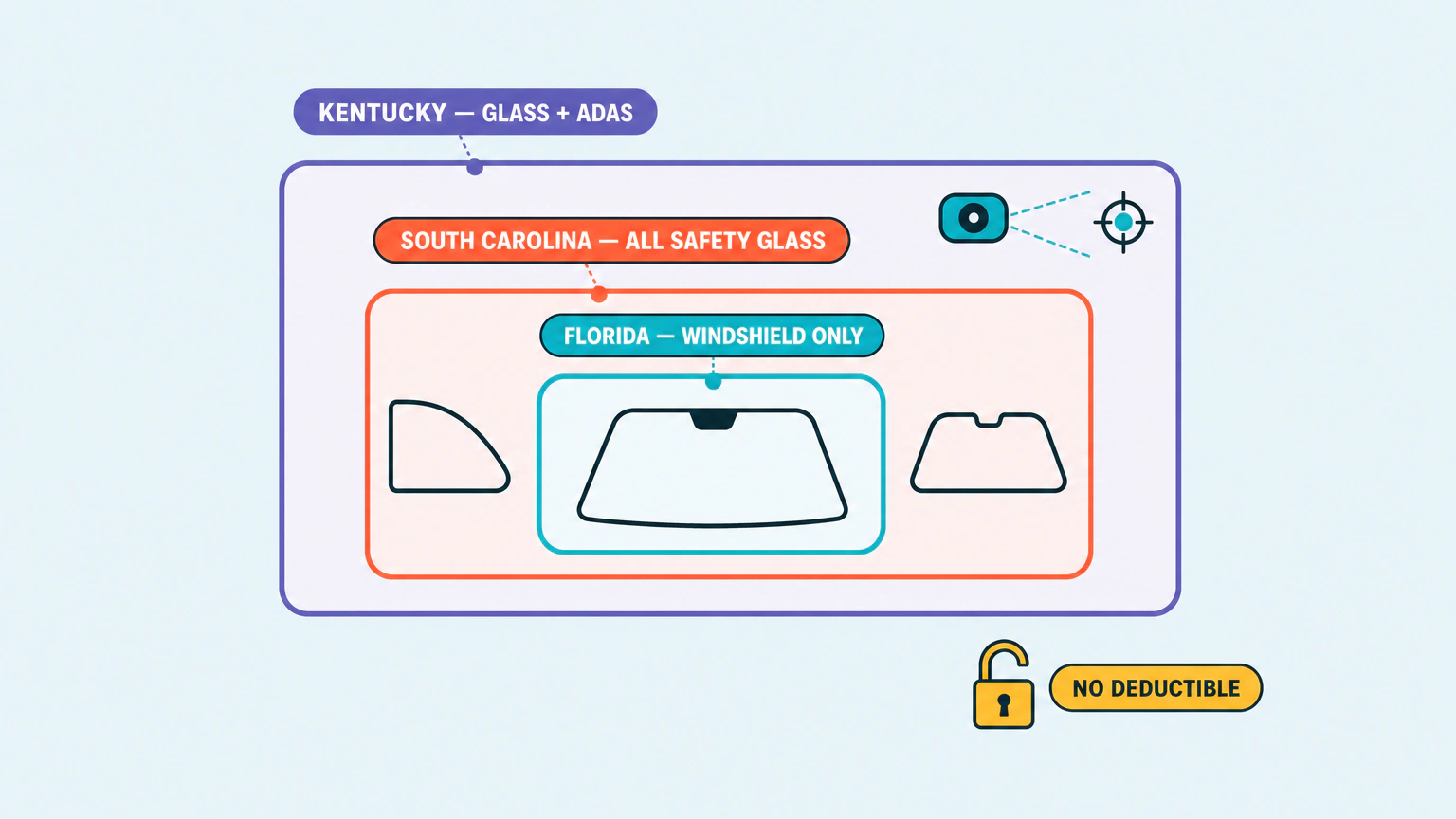
The three mandatory no-deductible rules discussed here do not share one law. One statute covers the windshield, one covers all automobile safety glass, and one covers the glass plus the electronics that ride on it.
| State | What the law does | Which glass | Calibration | Authority |
|---|---|---|---|---|
| Florida | Deductible cannot apply to a comprehensive glass claim | Windshield only | Not addressed | Fla. Stat. § 627.7288 |
| South Carolina | Deductible does not apply | All automobile safety glass | Not addressed | S.C. Code Ann. § 38-77-280(B) |
| Kentucky | Complete coverage without any deductible or minimum, on glass-only claims | Windshield, doors, windows, plus lights and the non-glass parts of the job | Yes, included by definition | KRS 304.20-060, as amended by 2024 Ky. Acts ch. 27 (SB 29) |
| Arizona | Insurer must make no-deductible coverage available at the insured's option | Windshield, doors, windows, and lights | Not addressed | Ariz. Rev. Stat. § 20-264 |
| New York | Insurers may sell window glass coverage with no deductible | Window glass | Not addressed | N.Y. Ins. Law § 3411(k) |
| Other states | Rules and optional glass endorsements vary | Policy-specific | Policy-specific | Check your declarations page and your state department of insurance |
Retrieved August 17, 2026: Florida from the 2025 Florida Statutes, South Carolina from a code current through the 2025 session, Arizona from the current displayed text of § 20-264, New York from the Senate's published text of § 3411, and Kentucky from the current codified text of KRS 304.20-060. State law is not the whole answer: other jurisdictions and policies may offer separate full-glass terms, so check your declarations page and state insurance department.
Florida: the windshield, and only the windshield
Fla. Stat. § 627.7288 says the deductible provisions of a comprehensive or combined additional coverage policy "shall not be applicable to damage to the windshield of any motor vehicle covered under such policy." Read the noun carefully. A shattered door glass, a broken back glass or a cracked sunroof is not a windshield, so the statute does not waive a deductible on those claims; the policy controls.
South Carolina: all automobile safety glass
S.C. Code Ann. § 38-77-280(B) is one sentence and it's broader: "Any automobile physical damage insurance coverage deductible or policy deductible does not apply to automobile safety glass." A South Carolina driver with a smashed side window is covered by the same waiver that covers her windshield, which is exactly where the Florida rule stops.
Kentucky: the glass, and since April 2024, the calibration
Kentucky's 2024 Senate Bill 29 rewrote KRS 304.20-060 to add calibration to the statutory definition of a glass-only claim. It defines the repair or replacement of damaged motor vehicle glass to include calibrating or recalibrating an advanced driver assistance system when an incident requires the damaged glass to be replaced. And it requires complete coverage without regard to any deductible or minimum amount when the claim is for motor vehicle glass only. The camera work is not an extra to be argued over: the statute puts it inside the glass claim. The act took effect April 2, 2024 and applies to policies issued or renewed from that date.
Two statutory paths to optional no-deductible glass coverage
Arizona: a waiver you have to elect
Ariz. Rev. Stat. § 20-264 waives nothing by itself. It requires an insurer writing comprehensive coverage to "provide at the option of the insured complete coverage for the repair or replacement of all damaged safety equipment without regard to any deductible," and defines safety equipment as the glass in the windshield, doors and windows plus the material used in the lights. That's an option you elect. Check your declarations page for it, and if it's not there, ask what it costs to add.
New York: a permission, not a promise
N.Y. Ins. Law § 3411(k) sets a standard $200 physical damage deductible and bars insurers from selling one below $50 for fire, theft or comprehensive coverage and $100 for collision, "except that window glass coverage may be sold without a deductible." That exception is addressed to the insurer, not to you. It permits a zero-deductible glass product. Nothing in it makes a carrier waive a deductible you agreed to.
In other states: how to find your own answer in ten minutes
For states not covered in the table, here is the procedure instead of a guess. Read your declarations page and look for a separate glass or "full glass" deductible line under comprehensive. Then search your state department of insurance website for "glass" or "safety glass," which is the authority on your state's rule, not a blog. Finally, ask the shop what it normally bills your carrier in your state, because glass shops file these claims daily.
Pro tip: read your declarations page first. For many drivers the answer is already there, printed as a separate glass or full-glass deductible line under comprehensive coverage. A five-minute call to your agent settles what no article can, because coverage turns on the policy you actually bought.
What a windshield actually costs in 2026
The typical job
Most windshield replacements aren't the frightening number you've heard about. PreferredMechanic's own provider cost profiles put the national average at $223, with most jobs between $187 and $404, and chip repair far below that. Those are our own aggregate of quoted work: a reality check before you call windshield replacement shops near you, not a quote.
| Job | Typical price | Source |
|---|---|---|
| Rock-chip repair | $130 national average, $84 to $162 typical range | PreferredMechanic auto glass cost profiles (866 profiles), retrieved August 17, 2026 |
| Windshield replacement, most vehicles | $223 national average, $187 to $404 typical range | PreferredMechanic windshield cost profiles (702 profiles), retrieved August 17, 2026 |
| Windshield replacement, full observed spread | $142 to $909 | Same dataset |
| ADAS component transfer plus calibration, on a windshield replacement | $360.00 average | AAA, Cost of ADAS Repairs, December 2023 |
| Average total estimate for that ADAS windshield job | $1,439.78 | AAA, same study |
The PreferredMechanic figures are this platform's own aggregate of provider cost profiles, not a market survey, and they adapt to location. The AAA figures are estimates prepared on three 2023 model-year vehicles in two labor markets. The two are complementary rather than comparable: one describes what shops commonly quote, the other what one specific job costs.
Why a late-model car is a different number entirely
AAA priced this in December 2023 on a 2023 Ford F-150, Nissan Rogue and Toyota Camry. Transferring the ADAS components to the replacement windshield and performing the necessary calibration averaged $360.00, or 25.4% of an average total repair estimate of $1,439.78. That is why an ADAS-equipped windshield can produce a much higher quote than glass alone.
When paying cash beats filing
Run three questions before you call the claims line. What is your comprehensive deductible, and is the quoted job at or below it? If it is, filing buys you nothing. Does your state bar the deductible on glass, which makes the claim free to you? And would the claim show on your record either way, which is a question for your agent rather than for the shop that wants the work?
ADAS calibration: the line item that decides the bill
Why new glass moves a camera
On many late-model vehicles, the forward camera for lane keeping, automatic emergency braking and traffic-sign recognition is mounted to the windshield itself, behind the mirror. Take the glass out and the camera's aim is no longer a known quantity, even when the new bracket looks identical. The system has to be re-aimed and confirmed, or it's guessing about where your lane is.
Static, dynamic, and who is allowed to do it
Static calibration happens in the shop against printed targets, and it needs floor space, controlled lighting and level ground. Dynamic calibration happens on a road drive at set speeds on clearly marked roads. Plenty of cars need both. Some glass shops calibrate in-house, some sublet it, some send you to the dealership, which is why the labor line surprises people: it's scan-tool work billed much like what a diagnostic actually costs. Ask which route your shop takes before you book.
What Kentucky now forces a shop to disclose, and why it is a good checklist anywhere
Kentucky's 2024 act makes a glass shop tell the customer, before the work is contracted, whether the vehicle has an advanced driver assistance system, whether calibration is required to make that system operable and to meet the manufacturer's specifications, and whether the shop can perform that calibration to those specifications. If it cannot, it must say the vehicle should go to the manufacturer's certified dealership or another qualified specialist. Afterward it must provide notice whether the ADAS is in working order. That is why the checklist works as a script anywhere.
Will filing a glass claim raise your premium?
Nobody can honestly promise you it won't. A glass claim from non-collision damage is generally a comprehensive claim, and the Insurance Information Institute notes that some insurers offer the glass portion of comprehensive without a deductible at all. But rating practice is set carrier by carrier and state by state, and none of the five statutes says a word about premiums. So do the one thing that produces an answer specific to you: ask your agent whether a comprehensive glass claim is rated in your state and on your policy. Ask before you file, and get the answer in writing.
Choosing the shop: what your insurer can and cannot require
Networks, referrals and your right to choose
Some carriers route glass claims through a network administrator that offers to schedule the job for you, often with a shop already chosen. The convenience is real, and so is your say. Kentucky's 2024 law states outright that an insured shall not be required to use a particular motor vehicle glass repair shop, while still allowing insurers to run a network. Elsewhere your policy language and your state's steering rules govern, which is the ground covered in our guide to choosing your own body shop after an accident. Ask what your carrier will pay at the shop you want before you commit.
OEM, dealer and aftermarket glass
Original-equipment glass is made to the automaker's specification, dealer-branded glass carries the automaker's name, and aftermarket glass is made by another manufacturer to its own tolerances. On a car with a windshield camera the difference matters: optical distortion, tint bands, acoustic layers and the exact bracket the camera clips into all bear on whether the system calibrates and stays calibrated. If your estimate doesn't say which glass it includes, ask, and ask whether the shop has calibrated that model with that glass before.
Red flag: "we'll cover your deductible"
Red flag: an offer to pay, waive or forgive your deductible. In Minnesota that's illegal for the shop: Minn. Stat. § 325F.783 bars anyone selling retail auto glass paid for by an insurer from waiving, forgiving or paying any part of the deductible, and from offering rebates, gifts, prizes, coupons or referral fees as an inducement. Kentucky's 2024 glass act carries a similar anti-inducement prohibition for directing or making a glass claim. A law like that regulates the shop's conduct. It gives you no coverage. Read the offer as a pricing signal rather than a gift, and ask for the itemized out-the-door price instead.
Before you book: eight questions for the glass shop
Ask these on the phone, before you agree to anything, and write down the answers.
- Does my car have a camera or sensor mounted to the windshield? Give the year, make, model and trim, because it varies within a model line.
- Does the replacement require a calibration to meet the manufacturer's specifications? Ask for a yes or a no, not "usually."
- Do you perform the calibration here, sublet it, or send me to the dealership? Each route carries a different price and timeline.
- Is the calibration static, dynamic, or both, and how long will the car be with you? A dynamic calibration needs suitable roads and weather, which can delay the job.
- Is the glass OEM, dealer-branded or aftermarket, and does it carry the correct camera bracket? Get the brand written on the estimate.
- What is the safe drive-away time after the adhesive is applied? That figure comes from the adhesive manufacturer, so follow it before driving.
- Will you give me the calibration result in writing? A pass you cannot show is a pass you cannot prove later.
- What is the total out-the-door price, including calibration, moldings, disposal and shop fees, and what does my insurer pay directly? While you are asking, how to check a technician's certifications takes two minutes.
Frequently asked questions
These questions were reconstructed from FAQ schema published on ranking carrier pages, from question-form search autocomplete stems, and from the headings competing pages answer. They are not retrieved people-also-ask results.
Does insurance cover windshield replacement without a deductible?
Sometimes. Comprehensive coverage pays for a covered replacement, but you owe any applicable deductible unless state law bars one or your policy has zero-deductible glass coverage. Florida, South Carolina and Kentucky have mandatory rules for the claims their statutes cover. Arizona requires insurers to offer an option, New York permits one, and other state and policy terms vary.
Which states have free windshield replacement?
None are truly free. The mandatory rules discussed here remove the deductible in Florida for the windshield only, South Carolina for all automobile safety glass, and Kentucky for glass-only claims, including required ADAS calibration. You still need applicable physical-damage coverage, and the insurer still has to accept the damage as covered.
Does filing a windshield claim raise my insurance premium?
It might, and no general rule settles it. A glass claim is a comprehensive claim rather than an at-fault claim, and carriers rate them differently by company and by state. Ask your agent whether a comprehensive glass claim is rated where you live, before you file, and get the answer in writing.
Does comprehensive cover a rock chip, or only a full crack?
Both. Comprehensive covers glass damage from road debris, storms, vandalism and animals, whether it's a small chip or a spreading crack. Some insurers waive the deductible on a resin repair even when they would apply it to a replacement.
How much does windshield calibration cost, and does insurance pay for it?
AAA measured an average of $360.00 to transfer ADAS components and calibrate the camera on new glass in December 2023, within an average total estimate of $1,439.78 on three 2023 models. Ask whether the estimate for a covered replacement includes it; Kentucky's statute expressly puts required calibration inside the no-deductible glass-only claim.
Do I have to use the glass shop my insurance company names?
Not necessarily. Carriers may route glass claims through network administrators and recommend a shop, but Kentucky's 2024 law says an insured cannot be required to use a particular glass shop. Elsewhere your policy and your state's steering rules govern. Ask what your carrier will pay at the shop you choose.
Can I pass a state inspection with a cracked windshield?
Sometimes, and it's a state rule rather than an insurance rule. States that run safety inspections set their own limits on cracks and chips, particularly in the driver's line of sight, and those limits differ. Check your state's vehicle inspection page or ask the inspection station before you book the repair.
Find a shop
You know what to ask now. Take the eight questions to two or three windshield replacement shops near you, compare out-the-door numbers rather than headline prices, and see the Best of Preferred Mechanic awards for how we score the shops we recommend.
Please note: this is general information about insurance coverage, not legal or insurance advice. Coverage turns on the policy you actually bought, so read your declarations page and confirm with your insurer or agent before you file. Windshield bonding and ADAS calibration can be safety-critical, so follow the vehicle and adhesive manufacturers' procedures and ask for written confirmation of any calibration performed.