

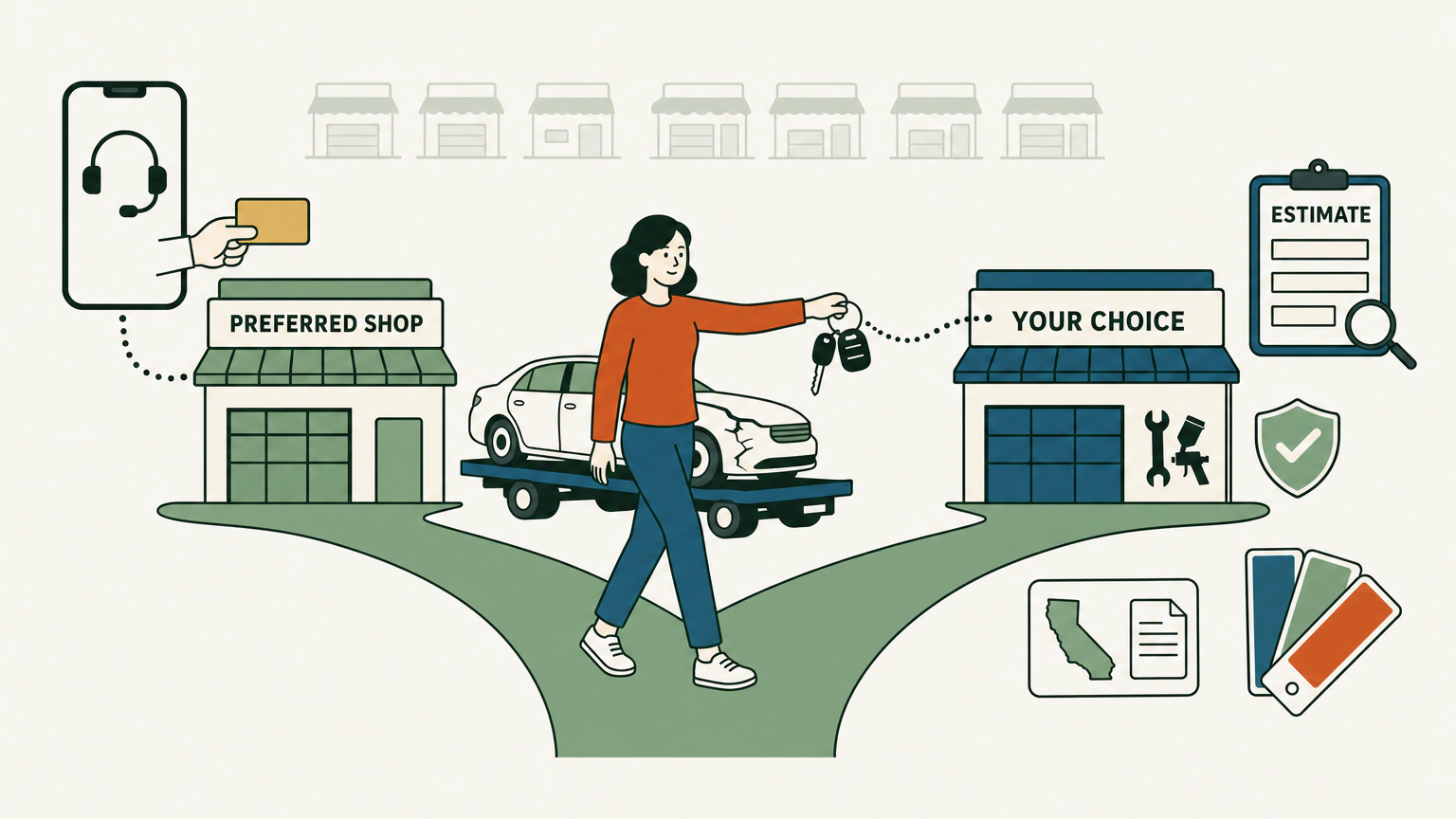
Two questions hide inside that one. Who gets to pick the shop is a matter of state law and of what kind of claim you filed. Who pays when your shop's number lands higher than the insurer's is a separate fight, with separate rules.
On this page
- The short answer, and the one word that changes it
- What your state actually requires (10 jurisdictions verified)
- Why the adjuster wants you at that shop
- The real fight is the estimate, not the shop
- Parts: the second place your choice quietly disappears
- How to pick a shop you'd choose even if the insurer loved it
- What the claim looks like from here
- If your insurer still won't move
- Frequently asked questions
The short answer, and the one word that changes it
Two documents are doing two different jobs here. Your policy, plus the law that applies to your claim, sets what the insurer has to pay toward repairing or settling the loss. That payment obligation doesn't decide who does the work. Shop choice is its own question, answered state by state.
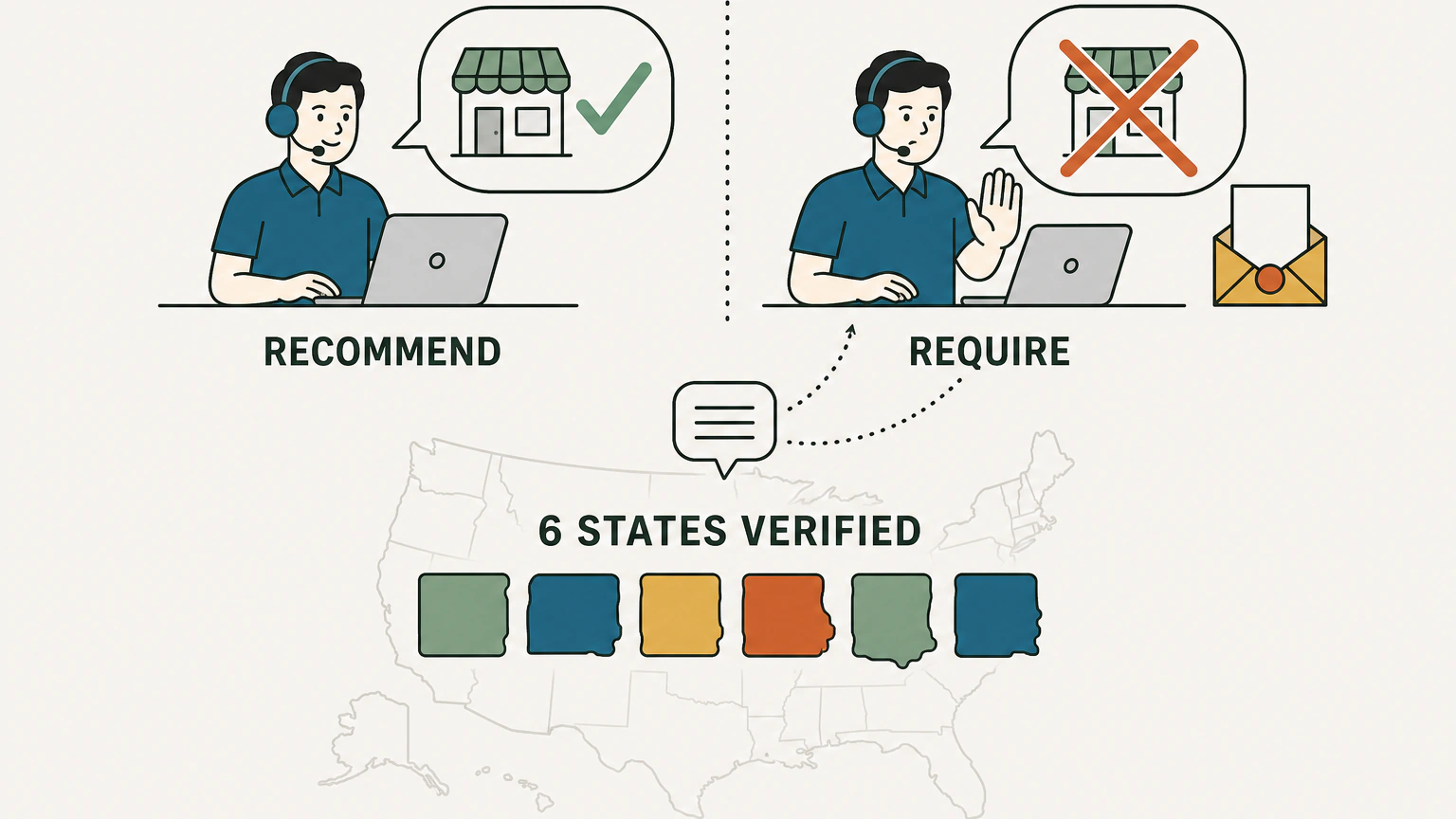
"Recommend" is legal. "Require" usually isn't.
In the six states that protect your choice, an adjuster may recommend a shop, within whatever limits that state puts on the recommending. What the adjuster may not do is make that shop a condition of getting your covered repairs paid for. Florida and Ohio work the other way around. Neither of their cited rules bans a required shop, and the duties land on the insurer once it chooses to repair the car and picks the shop itself.
What "steering" actually means
Steering is the trade's word for improper pressure toward one shop or away from another. It isn't a single legal test, though. Each state's rule names the conduct it prohibits in its own language, so the label alone wins you nothing. What the rules do name is concrete: tying your coverage to a shop on the list, sending you an unreasonable distance, or carrying on working you after you've already chosen. So skip the label when you complain. Describe what the adjuster did, and cite the rule that names it.
There is no federal law here
Insurance rules are written state by state, by legislatures and by agencies, and they don't share a structure. We went looking for a federal right to choose your own repair shop and came up empty. Of the ten jurisdictions we read, six protect your choice in the claim types their rules cover. Three write duties about repairs and estimates without banning a required shop outright. And on Massachusetts we can tell you exactly what the parts rule says, while the shop-choice question is one we couldn't confirm, so we don't claim it.
What your state actually requires (10 jurisdictions verified)
Find your state first. Then read across to the column that matches the argument you're having: who picks the shop, what you're owed in writing, and who decides what goes on the car. Every cell came from the statute or the regulation itself.
| State | Require a specific shop? | Notice you're owed | Dictate parts? | Primary source |
|---|---|---|---|---|
| California | No | Before an unrequested recommendation; an accepted oral recommendation triggers a separate written notice within five calendar days | This rule doesn't say | Cal. Ins. Code § 758.5 |
| New York | No, for an insured's collision or comprehensive loss | No recommendation unless the insured asks, plus a 12-point-type disclosure on the estimate. Glass-only claims excepted | This rule doesn't say | N.Y. Ins. Law § 2610 |
| Oregon | No, as a condition of an insured's recovery under a motor vehicle liability policy | A spoken notice before any recommendation | A separate section governs it | ORS § 746.280 |
| Texas | No, first or third party | No tying coverage to a preferred-list shop, no referral fees, no unreasonable travel | May not limit coverage by specifying the "brand, type, kind, age, vendor, supplier, or condition" | Tex. Ins. Code §§ 1952.301-.304 |
| Minnesota | No. Requiring a shop, or any "intimidation, coercion, threat, incentive, or inducement," is unfair | A scripted advisory at claim report, then it must stop influencing you | No, window glass excepted | Minn. Stat. § 72A.201 subd. 6 |
| New Jersey | No, for insured collision or comprehensive claims, if the facility is licensed | Written notice that body shops must be licensed | This rule doesn't say | N.J.A.C. § 11:3-10.3 |
| Florida | No flat ban stated in the cited section; if the insurer elects to repair and specifically requires a shop, it must restore pre-loss performance and appearance at no extra cost beyond the policy | The estimate behind the settlement, and 72 hours before storage payments stop | "At least equivalent in kind and quality... in fit, appearance, and performance" | Fla. Stat. § 626.9743 |
| Ohio | No flat ban stated in the cited rule; if the insurer elects to repair and designates a shop, it must restore pre-loss condition within a reasonable time and at no extra cost beyond the policy | It pays the difference against your higher estimate, or names a shop that will match its number | Must comply with R.C. § 1345.81 | Ohio Admin. Code § 3901-1-54(H) |
| Washington | No flat ban, but no arbitrary denial of your estimate and no ignoring your shop | Full reasons for paying less, a warning you may owe the difference, a shop list on request | This rule doesn't say | WAC § 284-30-390 |
| Massachusetts | Its rules answer a different question | This rule doesn't say | Opposite: rebuilt, aftermarket or used unless safety is impaired, none can be found, new OEM costs least, or under 20,000 miles | 211 CMR § 133.04 |
That leaves forty states and the District of Columbia we haven't read, and we'd rather leave a cell honest than guess at it. If yours is one of them, the NAIC directory is the fastest route to your regulator and its complaint process. What it won't tell you is that your state adopted any particular unfair-claims model, so don't assume yours did. Search your own regulator's current rules for "steering" and "repair facility."
Your state's rules, and what to say next
Ten state records checked line by line against cited law; other states and DC are labeled not verified. Pick yours.
- Recommendation rules vary by state.
- Requiring a specific shop is prohibited for the cited claim contexts in six of the ten state records reviewed here: California, New York, Oregon, Texas, Minnesota and New Jersey.
The cited Florida and Ohio provisions do not state a flat ban; they impose restoration duties if an insurer elects to repair and specifically requires or designates a shop.
Select the law you want to review. If you are unsure which state's law governs the claim, ask that state's regulator.
Your insurer may not require a shop, may only recommend one if you asked or after telling you in writing that you can choose, and may not pay you less because you chose your own.
2 rules for California, The adjuster recommended a shop
No requiring; recommendations require a request or written notice
No insurer shall require that an automobile be repaired at a specific automotive repair dealer. It may only suggest or recommend one if you expressly ask for a referral, or after you have been informed in writing of your right to select the shop. Once you have chosen, it may not suggest a different one.
Cal. Ins. Code § 758.5(a)-(c)
Say this:
"I've selected my shop. Please note that in the file and do not suggest a different one."
The notice it owes you, word for word
If the recommendation was made orally and you accepted it, the insurer must mail or provide a separate freestanding document within five calendar days, in no less than 10-point type, beginning
"WE ARE PROHIBITED BY LAW FROM REQUIRING THAT REPAIRS BE DONE AT A SPECIFIC AUTOMOTIVE REPAIR DEALER."
Cal. Ins. Code § 758.5(b)(3)
Cal. Ins. Code § 758.5 — verified 2026-08-03.
The cited rules were checked on August 3, 2026; unverified fields are labeled. Rules change - check your state's department of insurance before you rely on this.
Six states where the law says the choice is yours
Two of the six don't just protect your choice. They write your adjuster's script for him, which means you can read it straight back to him. Oregon's has to be spoken before any recommendation, in these words: "OREGON LAW PROHIBITS US FROM REQUIRING YOU TO GET REPAIRS TO YOUR VEHICLE AT A PARTICULAR MOTOR VEHICLE REPAIR SHOP. YOU HAVE THE RIGHT TO SELECT THE MOTOR VEHICLE REPAIR SHOP OF YOUR CHOICE." Minnesota's runs at the moment you report the claim: "You have the legal right to choose a repair shop to fix your vehicle. Your policy will cover the reasonable costs of repairing your vehicle to its pre-accident condition no matter where you have repairs made. Have you selected a repair shop or would you like a referral?" If you live in either state and never heard those sentences, write down that you never heard them.
Two states where the rule is conditional, not a ban
Florida and Ohio don't ban steering outright. Their rules bite only after the insurer chooses to repair your car and picks the shop: from then on it has to return the vehicle to its condition immediately before the loss, at no cost to you beyond the policy.
Read that twice, because it cuts both ways. Neither rule hands the insurer permission to pick your shop, either. They say what it owes you if it does. So if an adjuster tells you the car is going to their shop, get that decision and that promise in writing, the day it's made.
Two more rules worth knowing even though they aren't about shop choice
Washington skips the shop question and regulates the estimate fight instead: no arbitrary denial of your shop's number, a duty to actually talk to your shop, full disclosure when the insurer decides to pay less. Massachusetts points the opposite way from Minnesota on parts. Neither rule cares who holds the wrenches. Both of them bite the moment money moves.
If your state isn't in the table
You still have two things wherever you live. The NAIC directory will name your regulator and its complaint route. Your own policy spells out the coverage terms the insurer has to work inside. So read the policy, find the regulator, and then put one question to your adjuster in writing: "Are you requiring me to use this shop, and under what policy provision?" Whatever comes back either ends the argument or becomes page one of your complaint file.
One honest caveat: we're explaining how these state rules read, not advising you on your own claim. We're not your lawyer, and your policy language and the facts of your crash are what control the outcome. If your state's rule differs from what we've written, tell us and we'll fix it.
Why the adjuster wants you at that shop
Network shops are often good shops, and a shop doesn't get worse because an insurer likes it. But "preferred" describes an arrangement, and once you know the arrangement you can judge this shop instead of the label on it.
What a DRP is, in plain terms
A direct repair program (DRP) is an agreement between an insurer and the shops that sign up for it. Insurers publish the terms, and they run to what you'd expect: agreed repair pricing, parts procedures, cycle-time tracking, inspection rights, all of it attached to the cars the insurer sends over. So "preferred" means the shop joined. It is not a finding that your repair will come out better.
What it genuinely buys you
Speed, mostly. Estimates and supplements can move straight between the shop and the insurer instead of through you, and that keeps a claim moving. Programs vary in what else they add: direct payment, priority service, a repair guarantee. One thing doesn't vary. You authorize the repairs on your own car, and the insurer decides what it covers.
What it can cost you
The same contract can set agreed pricing, parts procedures and cycle-time measures, and you weren't at the table for any of it. Texas legislated against one version of that risk: a network contract there may not reduce your coverage. In that state, at least, the deal between insurer and shop can't shrink what your policy owes you.
Four sentences that should make you slow down
Red flag: four lines you may hear, and what the rules actually say.
- "If you use your own shop, we can't guarantee the work." Two different promises are hiding in that sentence. Ask for the shop's own written warranty, because that's the one that fixes a bad panel gap. And in Texas, telling you the repair won't be covered unless you use a preferred-list shop is prohibited outright.
- "That shop isn't on our list, so this will take longer." Slow isn't automatically illegal. Refusing to deal with the shop you chose is another matter: in Washington, failing to make a good-faith effort to communicate with it is itself an unfair practice.
- "We'll only pay our rate. Anything above is on you." Half true at best. Depending on where you live, the insurer may owe the difference, or may owe you a documented explanation of why it doesn't.
- "Bring it to our drive-in center first, it's only 40 miles." Texas, Ohio and Washington all prohibit making you travel an unreasonable distance. Ask what unreasonable means where you live before you spend a Saturday finding out.
The real fight is the estimate, not the shop
Keep two bodies of law apart in your head, because the people on the phone won't. What a shop may bill you above its own written estimate is repair-act law, and that fight has its own rules: your state's rules on repair estimates and authorization. Insurance law answers a different question: what your insurer must pay toward that estimate.
What your insurer owes: pre-loss condition, not the cheapest quote
Two states put the standard into words worth memorizing. Oregon bars an insurer from limiting the cost of the repairs needed to bring the car back to pre-loss condition "relative to safety, function and appearance." Florida writes it as the vehicle's "physical condition as to performance and appearance immediately prior to the loss." Neither one says anything about the cheapest quote in the file. Pre-loss condition is the standard, and it's the phrase to use out loud.
When your shop's number is higher than the adjuster's
Three rules do the heavy lifting here, and they're worth knowing by heart.
Washington first. An insurer there can't deny your estimate solely because your shop's hourly rate is higher, when that rate doesn't raise the overall cost of the repair. The rate and the total are two different arguments, and only one of them is about your money. Washington also makes the insurer document its reasons in full whenever it pays less than your shop asked for.
California blocks the other maneuver. Your insurer may not discount what your chosen shop reasonably costs down to what its own shop would have charged.
Ohio is the bluntest of the three. Produce a higher written estimate and the insurer either pays the difference or names a shop that will do the job for its number. There is no third door where it simply shrugs.
Now the blunt half, which you should hear from us rather than from an adjuster: Washington also requires that you be told you may owe the difference. These rules force the insurer to explain itself and to argue honestly. They don't promise that every dollar of your shop's estimate lands on the insurer's side of the table.
Your shop's estimate came in higher. Four moves, in order.
- Get both estimates itemized in writing. Then ask, in writing, which line items are actually disputed, so the argument shrinks to those.
- Have your shop send the manufacturer's published procedure for that operation. That document argues better than either of you can.
- Quote the rule that applies where you live, by name and section, in writing.
- If you're still short, ask whether your policy has an appraisal provision, and file with your state department of insurance. The complaint is free. Appraisal is not: you pay your own appraiser and part of the umpire's fee.
Labor rate is the usual sticking point
Body-shop door rates get surveyed separately from mechanical rates, and they come out as four numbers rather than one: body, refinish, frame and mechanical. Before you argue about yours, find out whether it's even out of line: what shops in your state charge per hour. Then work out which fight you're actually in, because a dispute about the rate and a dispute about the hours look identical on an invoice and are won in completely different ways.
Supplements: why the first estimate is never the last
A first estimate is written from the outside of a car that was damaged on the inside. That isn't a knock on the adjuster. It's what an estimate is before anything comes apart.
By late 2025, over a third of insurer-network estimates carried calibration work, up from about a quarter the year before, according to CCC's industry data. Fewer than half of those calibrations were on the initial estimate. The rest arrived as supplements. So a low opening number may be pointing at damage or calibration work nobody has found yet, rather than at a cheaper repair.
Parts: the second place your choice quietly disappears
The four words on your estimate, decoded
| What it says on the estimate | What it actually is | When it's reasonable | What to ask |
|---|---|---|---|
| OEM / original equipment | New, from the manufacturer's supply chain | Structural, safety and sensor-adjacent parts | "Does the procedure require OEM here?" |
| Aftermarket | New, from an independent manufacturer | Non-structural cosmetic panels | "Is it certified, and will you warranty the fit?" |
| Recycled / LKQ / used | An original part off a donor vehicle | Discontinued and cosmetic parts | "What year and mileage was the donor car?" |
| Remanufactured / rebuilt | A used part restored to specification | Mechanical assemblies | "Who rebuilt it, and what warranty comes with it?" |
State law can override every one of those four defaults, and it does so in opposite directions depending on where you live.
What your state says about non-OEM parts
Whether your insurer has to pay for OEM parts comes down to your state and to the part. Texas adds a rule that's easy to miss and worth having: an insurer there can't stop your shop from telling you where a part came from and what was charged for it. That's the whole trick. An argument you can't win becomes a document request you can.
Where a cheap part becomes an expensive problem
Bumper covers, brackets, mirror housings and glass are sensor real estate now. Radar sits behind the fascia. Cameras look out through the windshield. A misaligned sensor bracket can affect an ADAS system, which is why the cheap part and the calibration behind it belong in the same conversation. Look for windshield replacement and repair shops that document calibration, and ask for that document by name.
How to pick a shop you'd choose even if the insurer loved it
Rights get you through the door of a shop you picked. They say nothing about whether it's any good. That part is on you, and it shows up later, in the panel gaps.
Credentials that mean something on collision work
Ask about Gold Class. It's I-CAR's collision-side recognition, and its published standards call for trained role representatives in four areas, estimator, refinish, structural and non-structural technician, each at ProLevel 2 or above, renewed annually with training that keeps running. The six-credit annual rule people quote applies to role representatives once they reach ProLevel 3, and to non-role representatives. On the technician side, ASE's B-series and L4 ADAS credentials are the ones to ask for: how to check a technician's credentials before you book.
Reading reviews for a body shop is different
A five-star average built on a friendly front desk tells you nothing about panel gaps. Read for this trade's vocabulary instead: supplement, delay, "had to go back," paint match, calibration, rental days. Those words are where collision work goes wrong.
Our own ratings, for the record, run on 150 proprietary data points drawn from more than 6 million analyzed opinions, and the methodology we publish lists the broad factors rather than all 150 points. An insurer's preferred list is a different animal. It reflects a network program, and some of those program criteria are public too.
Nine questions before you hand over the keys
Ask these before you sign an authorization, at any shop, including one you found among collision centers in your area.
- Are your technicians certified for my make, and can I see the certificate?
- Will you follow the manufacturer's published procedure, and give me a copy of it?
- Which parts on this estimate are OEM, and which aren't?
- Do you calibrate ADAS in-house or sublet it, and who documents it?
- What is your written workmanship warranty, and how long does it run?
- Who talks to the insurer about supplements, you or me?
- What's your realistic keys-to-keys estimate, and what would push it out?
- Will you photograph the damage before and during teardown?
- Do you charge storage if the claim stalls, and starting from what day?
What the claim looks like from here
A collision claim, stage by stage.
- Claim report and tow. You report the claim and decide where the car goes. Ask when storage charges begin before the truck pulls away.
- Initial estimate. The adjuster may look at the car or at photographs of it. This is where you tell the insurer which shop you selected.
- Teardown and supplements. Panels come off and the shop finds damage or calibration work that nothing on the outside showed. More than half the calibrations CCC counted arrived this way rather than on the initial estimate.
- Repair and calibration. CCC measured average keys-to-keys times of 13 days with no calibration, 15.5 with one, and past 17 once several are involved.
- Pickup. Inspect the repair before you take the keys, and keep every piece of paper.
The first 48 hours
Storage charges may begin the moment the car lands, depending on the facility and the law where you are (what a tow and storage should cost). So ask. Then photograph everything before the car moves again. If the adjuster names a shop, write down whether you accepted it, and which shop you actually chose. In Florida, an insurer owes you 72 hours' notice before it stops paying authorized storage.
Teardown, supplement, approval
This is where the days can disappear. The shop takes the damaged area apart, finds what the photos couldn't show, and writes a supplement for the insurer. Whether parts or labor then wait on approval depends on the program, the policy and the procedure everyone agreed to. A reinspection can add time. So can reconciling two versions of the same estimate. Ask one question at drop-off: who chases the approvals, and how often?
At pickup: the ten-minute inspection
Take the car outside. Shop lighting flatters paint and daylight doesn't. Walk the repaired side from several angles, then compare the panel gaps against the side nobody touched. Open every door and the trunk. Start it up and read the dash for warning lights. Then ask for the calibration report, the parts invoices and the repair order while you're standing there. If the color is off, that's a refinish problem, and automotive painting shops are the specialists.
If your insurer still won't move
The appraisal clause in your own policy
Your auto policy may contain an appraisal provision for disputes over the amount of a loss. The Texas Department of Insurance lays out the mechanics: each side hires an appraiser, the two appraisers pick an umpire, and the umpire's decision binds. You pay your own appraiser plus half the umpire.
Two limits matter before you reach for it. Appraisal settles the amount, not whether the loss is covered. And Texas's own wording is that your policy "may include" one, so go read yours before you count on it.
Complaining to your state department of insurance
This is the cheap rung. A complaint to your state department of insurance is free and generally needs no lawyer. The process varies from state to state, and where the matter falls inside the department's authority, the department forwards your complaint and the insurer has to respond. Give them the claim number, both estimates, the dates, the names and the rule you believe was broken. A complaint that quotes a regulation reads differently from one that expresses frustration.
When it stops being a claims problem
An attorney earns their keep when there are injuries, when liability is genuinely disputed, or when a claim is denied outright. A plain argument about repair dollars usually isn't any of those. Start with the complaint, which costs nothing, and remember that appraisal can cost you.
Frequently asked questions
Can an insurance company force you to use their body shop?
Not in California, New York, Oregon, Texas, Minnesota or New Jersey. Requiring a specific shop is prohibited in all six, for the claim types those rules cover. Florida and Ohio are built differently. Their cited rules don't state a flat ban. They say that once the insurer chooses to repair the car and requires or designates the shop, it owes you that car back in pre-loss condition at no cost beyond your policy.
What are your car insurance repair rights?
They vary by state, by claim type and by policy, which is the answer nobody wants. In the states we read, the protections cluster around three things: choosing the shop, getting an estimate or a written disclosure, and getting real reasons when the insurer pays less than your shop asked. Check the rule for your own state before you assume all three are yours.
Is insurance steering illegal?
It depends what the adjuster actually did. In the six states we read that protect shop choice, requiring a specific shop is prohibited for the claim types those rules cover. Recommending one is where they split. New York bars a collision or comprehensive insurer from suggesting a shop to its insured unless the insured asks. California allows it after a request or a written notice. Oregon wants that spoken notice first.
Do I need to get three estimates?
None of the ten state rules we read requires three estimates. Start with one itemized estimate from the shop you chose, and check what your policy asks of you. A second estimate can still earn its keep: Ohio's regulation expects that a claimant may obtain a higher one, and it makes the insurer answer that estimate rather than ignore it.
Does insurance have to pay for OEM parts?
It depends on your state and on the part. Texas bars an insurer from limiting coverage by specifying a part's brand, type, kind, age, vendor, supplier or condition. Minnesota bars requiring non-original-equipment parts, window glass excepted. Massachusetts runs the other way, directing like-kind rebuilt, aftermarket or used parts unless an exception applies. Florida requires equivalence in fit, appearance and performance.
Does the insurance company pay me or the body shop?
Either one. The insurer may pay you or pay the repair facility directly. If the check comes to you and there's a loan on the car, it may name your lienholder too, which means both endorsements before anyone can deposit it. Ask which method and which payees before the work starts.
Why do insurance companies want you to use their body shops?
Because the terms are settled in advance. A direct repair program agreement can fix contracted labor rates, agreed parts sourcing and cycle-time targets long before your car arrives. Some programs also rank their shops on program performance, so the order isn't random, but joining a network is not an independent quality rating. Texas law says explicitly that such a contract may not reduce your coverage.
What is a supplement, and why did my repair get more expensive after it started?
A supplement is an addition to the original estimate, covering damage or operations identified after that estimate was written. That's why the number moved. It happens often enough to be measured: CCC's data puts 51.5% of ADAS calibrations on a supplement rather than on the first estimate.
Six of the states we read protect shop choice in the claim types their rules cover. Everywhere else the answer lives in your policy and in your state's current rules, not in a flat national yes. Either way your leverage is the same, and it's paper: written estimates, written answers, dated notes.
So go pick the shop. Start with collision centers in your area, or with auto body repair shops if this never becomes a claim at all. Our Best of Preferred Mechanic awards page walks through the 150-point evaluation and the broad factors behind it, without publishing every proprietary data point.