

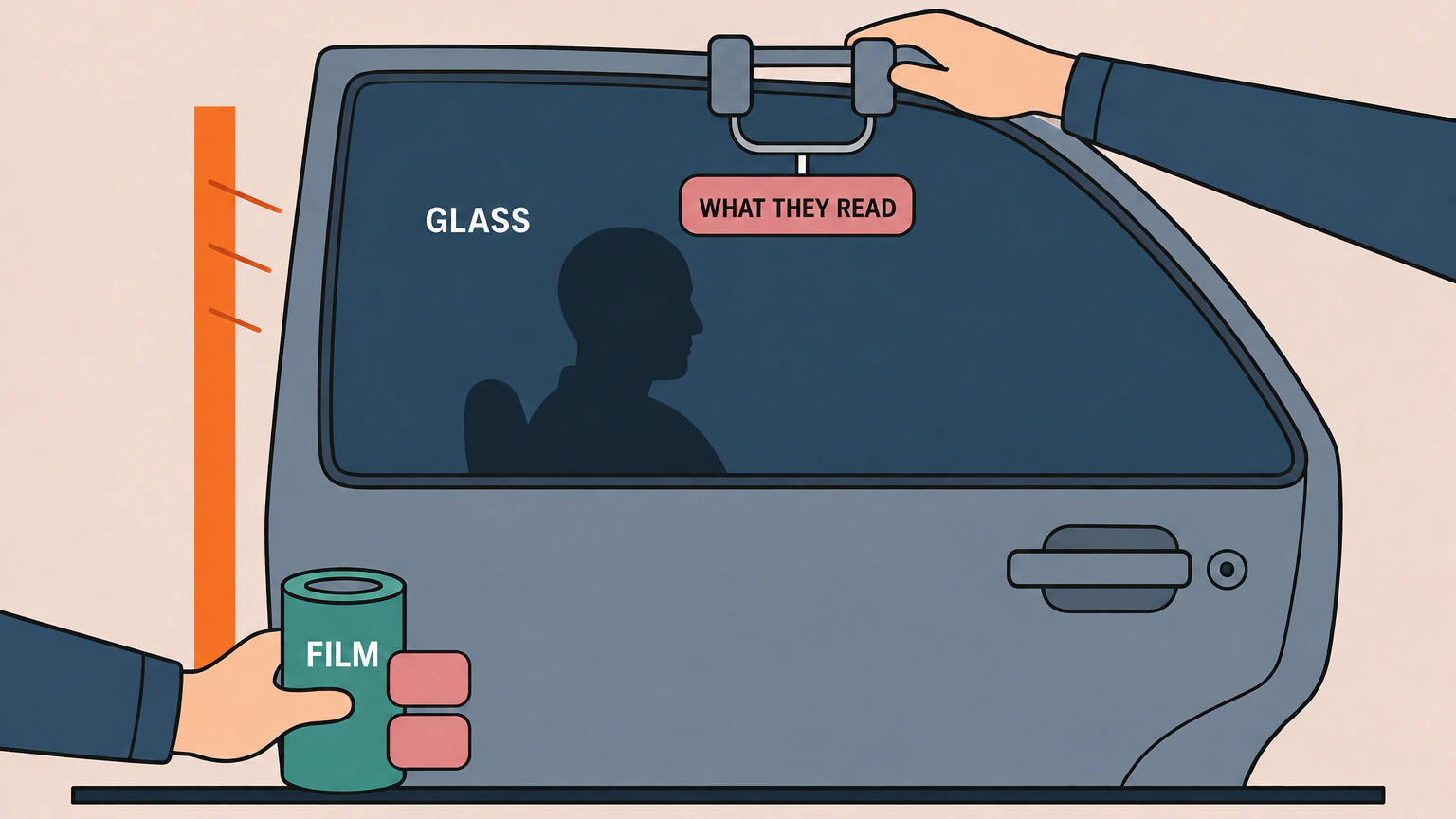
Here's the number to check first, and it isn't the one on the box. The finished-window limit is measured through the glass with the film on it. A 35 percent film over factory glass usually meters darker than 35. Find your state below, then ask your installer to meter the finished window in front of you and to hand over whatever label or certificate your state requires.
On this page
- The finished-window number is measured through the glass
- What 13 state statutes actually say
- Your state is not in the table? Find your own number in about five minutes
- Who gets the ticket, and what your installer is on the hook for
- Medical exemptions, and the paperwork that has to be in the car
- What tinting costs, and how to book it once
- Frequently asked questions
The finished-window number is measured through the glass
Two numbers follow a tint job around. One is the film's rating, printed on the box and quoted at the counter. The other is what a meter reads once that film is stuck to your glass. The second one is what an officer can measure at a traffic stop. We read thirteen state codes, and most of them say so in their own words.
What VLT means, in one sentence
VLT stands for visible light transmission, the share of visible light that gets through. Lower number, darker window. A 5 percent film looks very dark. A 70 percent film is nearly clear.
Your state's code may use "light transmittance," "sunscreening device" or "glazing" as well as the word "tint." A plain-language search can still miss the rule. Arizona writes the measurement out: light transmission is the ratio of light "allowed to pass through the product or material including the glazing."
Why a 35 percent film does not give you a 35 percent window
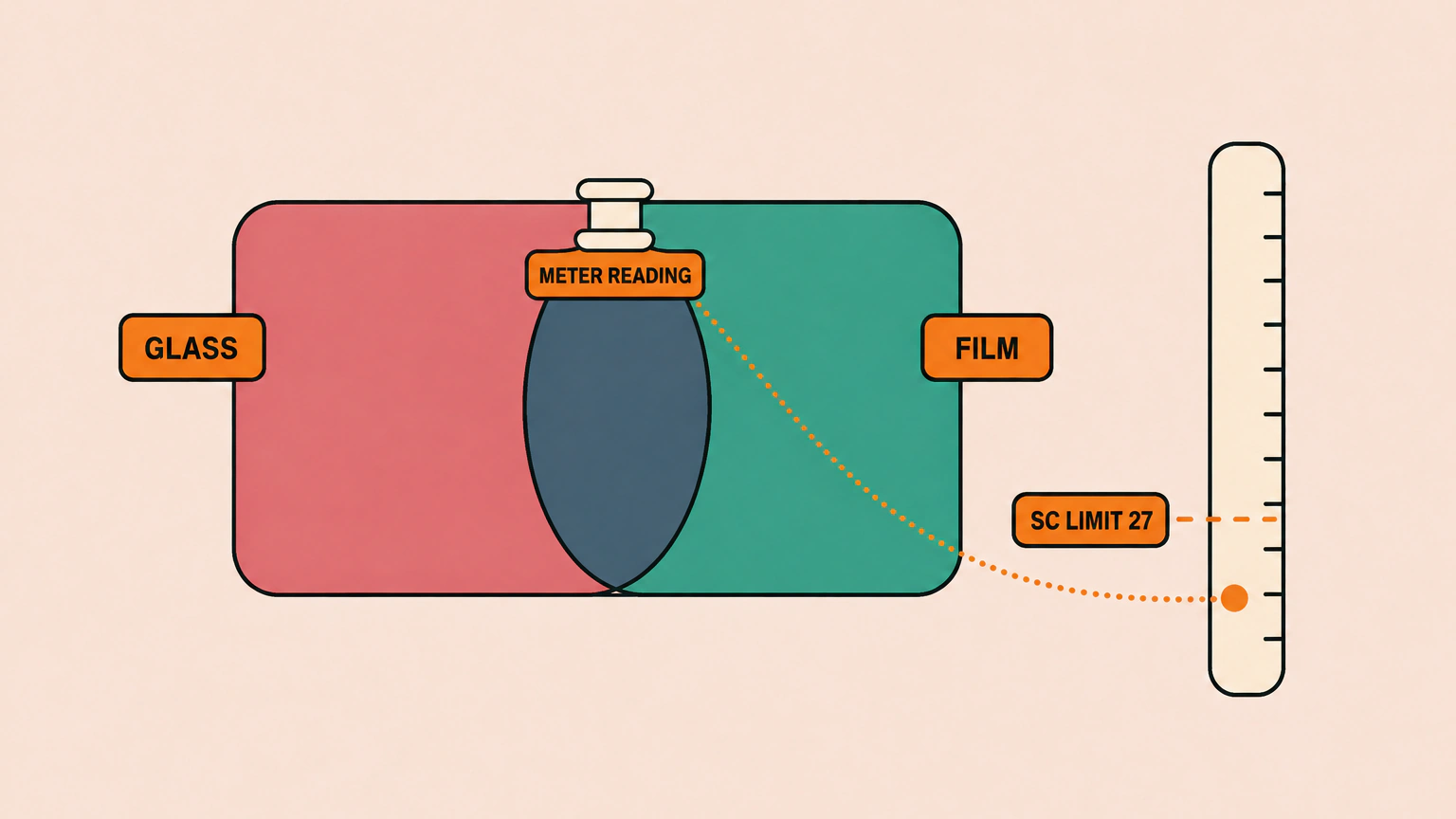
The film's rating is tested on clear reference glass, not on your car's own factory glass. Your state's figure is measured on the assembled window. Factory glass already stops some light. Film stops more. Put them together and the meter reads lower than either number on its own.
We aren't going to hand you a formula, because the states don't give one either. They name the finished-window reading. A meter gives you that number.
Oregon is the cleanest proof of the gap. ORS 815.221 sets two separate numbers for the same piece of glass: the tinting material has to transmit 50 percent or more, and the total through the window with that material applied has to be 35 percent or more. One window, two figures. A shop can hit the first and miss the second.
Factory glass changes the combined reading, and three states say so outright
The dark glass in the back of an SUV came that way from the factory. Add film, and that glass affects the combined reading. Three statutes make the combination explicit:
"the combined light transmission of the sunscreening device with the factory or manufacturer installed sunscreening material must not be less than twenty-seven percent." (S.C. Code § 56-5-5015(C))
"net film screening" means "the total sunscreening or coloring material applied to the window that includes both the material applied by the manufacturer during the safety glazing and any film sunscreening or coloring material applied after the vehicle is manufactured." (RCW 46.37.430(2)(b))
sunscreening material is authorized "when applied to and tested on the glass of such windows on the specific motor vehicle." (Fla. Stat. § 316.2953)
Texas comes at the same fact from the other end, exempting a factory-tinted or pretinted window installed by the vehicle manufacturer. South Carolina says it in one line too: with no after-factory device added to the window, the section's light transmittance rules don't apply at all. So the glass on its own is fine. The moment film goes over it, the combined reading is what governs.
What 13 state statutes actually say
We opened thirteen states' codes and read the sections: Arizona, California, Colorado, Florida, Minnesota, Missouri, Nevada, New York, Oregon, South Carolina, Texas, Virginia and Washington. The other thirty-seven we didn't read, and no figure here is a national rule. We picked these thirteen for search demand and for statute text we could open, not to fill in a map.
Front side windows, the number that gets people pulled over
Front side windows usually carry the stricter limit. Read your row across: the figure for the windows either side of you, the figure for everything behind you, and the citation so you can pull the section yourself.
| State | Front side windows | Behind the driver | Statute |
|---|---|---|---|
| Arizona | 33% plus or minus 3; reflectance 35% plus or minus 3 | No transmission figure; reflectance 35% plus or minus 3 or less, with a rear-window exception when both mirrors give a 200-foot view | A.R.S. 28-959.01 |
| California | Clear, colorless film only, 88% film and 70% finished window | Side windows behind the driver are outside the ban; the rear window is outside it with both mirrors | Veh. Code 26708 |
| Colorado | 27% | Darker only if front sides and windshield are 70% | C.R.S. 42-4-227 |
| Florida | 28% minimum and 25% maximum reflectance, each with a 3-point tolerance | Windows behind the driver have a 15% minimum, or 6% on a multipurpose vehicle, and 35% maximum reflectance, each with a 3-point tolerance; both mirrors are required if the rear window is nontransparent | Fla. Stat. 316.2953, 316.2954, 316.2955 |
| Minnesota | 50% plus or minus 3; reflectance 20% plus or minus 3 or less | 50% baseline, with vehicle-class exceptions behind the driver | Minn. Stat. 169.71 subd. 4 |
| Missouri | 35% plus or minus 3; reflectance 35% plus or minus 3 or less | No transmission figure in the statute | Mo. Rev. Stat. 307.173 |
| Nevada | 35%, with a 7 point tolerance | Exempt with an outside mirror on each side | NRS 484D.440 |
| New York | 70% | 70% on rear side windows of a car; rear window 70% unless both side mirrors | V.T.L. 375(12-a) |
| Oregon | Film 50% or higher, finished window 35% or higher, and reflectance 13% or less | Same baseline; a multipurpose passenger vehicle can go darker behind the driver with both mirrors and AS-3 glass | ORS 815.221 |
| South Carolina | 27% combined with the factory material | 27% combined for covered rear windows since 1993, with both mirrors; trucks other than pickups, buses, trailers, motor homes, multipurpose passenger vehicles and recreational vehicles are exempt behind the driver | S.C. Code 56-5-5015 |
| Texas | 25% in combination with the window; reflectance 25% or less | Side windows exempt; rear window exempt with both mirrors | Tex. Transp. Code 547.613 |
| Virginia | 50% | 35%; a pickup or multipurpose vehicle may go darker | Va. Code 46.2-1052 |
| Washington | 24% net film screening; both mirrors; one sheet only | 24% baseline, with listed vehicle-class exceptions behind the driver | RCW 46.37.430 |
Those are the thirteen states whose statutes we opened and read. Every other state has its own rule, and you can find yours in about five minutes.
This is what the statutes say, not what a meter will read on your car. If you're holding a citation, read the issuing state's own section, including any rule for vehicles registered elsewhere.
The front-side figures in this table run from New York's 70 percent down to Washington's 24. Resist the urge to rank states by those numbers alone. Texas measures its 25 percent "in combination with the vent or window." Oregon runs two figures at once. New York writes its 70 around the material itself. Same units, different objects.
Behind the driver, where the states stop agreeing
Once you're past the driver's seat, the thirteen fall into four shapes.
Some start with one figure across the car. Minnesota, Oregon and Washington do that, then carve out their own lists of vehicles. Minnesota frees the rear windows of a pickup and the windows behind a van's driver. Oregon frees multipurpose passenger vehicles. Washington's list is longer, running from motor homes to limousines.
Some set no transmission figure back there at all. Texas exempts side windows behind the operator outright, Arizona and Missouri name no figure there, and California's ban stops at the front seat.
Some go looser. Florida drops to 15 percent on windows behind the driver, or 6 percent on a multipurpose vehicle. Virginia allows 35 and lets a pickup or multipurpose vehicle go darker still.
Colorado makes it conditional, and that one catches people. The back of the car can go below 27 percent only if the front sides and the windshield are still passing 70. Several states also attach a mirror condition. Nevada and Texas condition their rear-window exemptions on both outside mirrors, and Florida requires both when material makes the rear window nontransparent. That's a safety trade, not a formality.
California's front film has to be clear
A flat 70 percent answer for California's front sides is incomplete.
Vehicle Code 26708 bans material on the windshield and side windows. Then it carves out one narrow route for the front: clear, colorless film that lets through at least 88 percent. The window with that film on it still has to meet the federal glazing standard, which the code describes as carrying a "specified minimum light transmittance of 70 percent." The paperwork matters as much as the film. Carry the installer's signed certificate with the company's and film maker's full names and street addresses. It must confirm that the windows meet those rules. If you installed it yourself, carry the maker's signed certificate. It must give the maker's full name and street address and confirm that the windows meet the rules when installed as instructed.
So a California front side window doesn't get a smoke film at 70 percent. It gets nearly clear UV film and a piece of paper. Side windows behind the driver sit outside the ban entirely. That exemption ends at the front seat.
The windshield, and the AS-1 line most drivers have never looked for
Many states confine ordinary aftermarket film to an upper windshield band, while others use different rules. The boundary usually has a name you've never used: the AS-1 line, which South Carolina's code defines as a glazing position marking set by the federal standard. Look along the top edge of your windshield for a small "AS-1" mark in the glass. The line runs across from it.
Texas puts the limit at the AS-1 line or five inches from the top, whichever sits higher. Washington uses the AS-1 portion or six inches. South Carolina is stricter than either: if the AS-1 line isn't visible, no film goes on the windshield at all. Oregon allows the top six inches, New York the uppermost six, Colorado four. Virginia allows only a replacement for the manufacturer's upper sunshield or clear film that stays compliant with the federal glazing standard. Arizona, California and Nevada skip the mark and measure instead: the bottom edge of the material must sit at least 29 inches above the driver's seat.
One thing worth knowing before you book an auto glass shop: film doesn't survive a glass swap. If you're replacing the windshield, the film leaves with the old glass, so price the reapplication into the same job.
The tolerance is in the statute, and it is not a rounding error
Several states build a measurement margin into the law.
Arizona's front-side figure is 33 percent plus or minus 3. Florida applies plus or minus 3 to every percentage in its tint sections. Minnesota's transmission figure is 50 plus or minus 3, and Missouri's is 35 plus or minus 3. Nevada names its own margin outright: 35 percent "with a tolerance of 7 percent." Virginia handles it from the enforcement side. Officers there have to use equipment that meets a state purchasing standard, and every reading gets a tolerance of minus seven percentage points. Texas does something different again. Its department can treat a window as exempt when the reading is off by no more than three percent.
That margin can decide whether a meter reading passes or fails.
Your state is not in the table? Find your own number in about five minutes
Thirteen rows, not fifty, and that's deliberate. A guessed cell in a legal table is worse than an admitted gap, so we read the sections we could open rather than copying figures from another chart. The method takes minutes. It's the one we used on all thirteen, and it works just as well on the other equipment law that varies by state.
The first trap is vocabulary: a code may file the rule under "sunscreening" or "light transmittance" as well as "tint." And a percentage isn't always in the statute. Iowa's section bans a window that's "excessively dark or reflective." Then it tells the department to write the rules that set the measurable standard. In Iowa the number lives in a rule, not the code.
- Search your state code for sunscreening, sun screening, light transmittance and tint, because the rule may use any of those terms.
- Open the section itself, not a summary of it, and read the subsection that names front side windows.
- Write down two numbers: the transmittance figure and any tolerance the statute allows.
- Check whether the sentence talks about the material or about the window with the material applied.
- Look for a separate subsection covering windows behind the driver, which is usually where the rule changes.
- Note the page's currency or amended date beside your number.
Who gets the ticket, and what your installer is on the hook for
Read the operative sentence in almost any of these statutes and you'll notice who it points at. "A person shall not operate." That's you, in the driver's seat, whoever stuck the film on and whenever they did it. Buy a used car with dark windows and the roadside citation can be yours, regardless of who installed the film. That's one more reason to put the glass on the list for a pre-purchase inspection before money changes hands.
What it costs you depends on the state. Florida calls it a noncriminal traffic infraction, punishable as a nonmoving violation. Nevada says a tint violation isn't a moving violation. Colorado grades it a class B traffic infraction. Missouri makes it a class C misdemeanor, and South Carolina a misdemeanor carrying up to $200 or thirty days.
Virginia is the outlier worth knowing about. No officer there may stop you for a tint violation at all, and evidence found after a stop like that can't be used against you. Virginia's courts may also dismiss the summons outright if you show up with proof that the film now complies. The practical first step is fixing the film, then checking whether your state lets proof of compliance help with the citation. If your state inspects vehicle equipment, an inspection station is the cheap place to find out before a trooper does.
The installer can have a legal duty too
Five examples show duties and penalties that can reach the installer, not only the driver. Texas fines a tint business up to $1,000 for skipping the label the code requires. Virginia makes a shop that installs film below the limit guilty of a Class 3 misdemeanor on a first offense. Oregon makes the installer give you a certificate stating the film's numbers. California requires a certificate signed by the installing company to be in the car. Washington requires a compliance sticker on the driver's door post.
Others reach the shop by a different route. South Carolina wants a certificate of compliance stuck in the lower right corner of every tinted window. It has to carry the film's reading and the installer's name, address and phone. A professional tinter who skips it faces a fine of at least $1,000. Minnesota makes it a misdemeanor to apply non-compliant film as part of a business. Colorado grades the installer's infraction a full class above the driver's. Arizona makes whoever sells or installs the material say plainly that putting it on a front window may be illegal in some states.
None of that cancels your citation. It does give you leverage at the counter: a shop that won't tell you the film's rating, won't meter the finished window and can't produce the document its own state requires is telling you something.
What to ask a shop before you pay
None of these six is confrontational, and a good shop answers all of them without blinking. If you'd rather have a second opinion on the glass afterward, your regular shop can meter it too.
- Ask which film they plan to use and what its rated transmittance is.
- Ask what your glass reads on a meter before any film goes on.
- Ask them to meter the finished window in front of you and tell you the number.
- Ask for the label, sticker or certificate your state requires, and check it is actually there.
- Ask what happens if you are ticketed, and get that answer written on the invoice.
- Keep the invoice and the film's rating in the glovebox with your registration.
Medical exemptions, and the paperwork that has to be in the car
Most of the states in the table have a medical route, and none is automatic.
Arizona issues an exemption on a physician's written attestation. California accepts a letter from a licensed physician and surgeon, or from a licensed optometrist, and adds a line people miss: the device can't be used during darkness. Minnesota wants a prescription or a statement that says three things: whether the condition is temporary or permanent, the lowest reading the patient needs, and an expiration date. The date can run no more than two years out. A doctor who calls the condition permanent can leave it off, and since a 2026 amendment a Minnesota optometrist can write the statement too. Missouri issues a permit through the Department of Public Safety on a physician's prescription. South Carolina takes an affidavit from a physician or optometrist, updated every two years. New York runs it through the commissioner, and only for conditions on a list the health department keeps.
In Oregon and South Carolina, the roadside rule is explicit: keep the document in the vehicle and show it when an officer asks.
What tinting costs, and how to book it once
Across 804 window-tinting cost profiles in our own listings, the displayed average range is $123 to $255. The overall average is $128, with reported prices from $92 to $510. That's our own aggregate, not a market survey, and it moves with where you are and how many windows you're doing.
The number that hurts is the one nobody quotes: paying twice. Stripping illegal film is a separate job you pay for. The rear window is the delicate one, because the defroster grid is printed on the inside of that glass, right under the film. Then you pay again for the film you should have bought first.
So book it once. Ask what your glass meters at before anything goes on, ask for the finished reading, and take the certificate. Any of the tint shops near you that does this daily should be able to meter the glass before you leave.
Frequently asked questions
Is 35 percent tint legal?
It depends on which number your state's statute names. A 35 percent reading passes on the front sides in Arizona, Colorado, Florida, Missouri, Nevada, South Carolina, Texas and Washington. It fails in New York, Minnesota and Virginia, where the floor is 50 or 70. Oregon bans a 35 percent film outright while asking for 35 through the finished window, and California allows only clear film up front.
How do police measure window tint?
With a handheld meter clipped over the assembled window, so the reading covers the film and the factory glass together. Several statutes build in a margin: Arizona, Florida, Minnesota and Missouri use plus or minus 3, and Nevada allows 7 points. Virginia goes further and requires officers to use equipment meeting a state purchasing standard, then gives every reading a tolerance of minus seven percentage points.
Can I get a ticket for tint that was already on the car when I bought it?
Yes. The operating provisions apply to the driver, even where a separate installer duty exists. A previous owner's choice can become your citation when you drive the car home. That's why the glass belongs on the list for a pre-purchase inspection, and why the fix is usually removal plus proof of compliance rather than an argument about who did it.
Does factory privacy glass count toward my state's limit?
Once you add film, the factory glass affects the finished reading in all thirteen states we read. South Carolina and Washington say it outright. Texas proves the other half: factory-tinted manufacturer glass is exempt on its own, but added film must meet the combined-window rule.
Is my out of state tint legal when I drive into another state?
Crossing a state line does not produce one universal answer. Some states exempt vehicles registered elsewhere. Texas does. Several statutes in the table also apply only to vehicles registered or required to be registered there. Any particular state pair needs its own reading of both codes, including medical-paperwork rules.
What happens if a shop installs tint that turns out to be illegal?
The shop can be on the hook and you still get the ticket. Texas fines a tint business up to $1,000 for a missing label. Virginia makes a first installer offense a Class 3 misdemeanor. Oregon, California, South Carolina and Washington all want a certificate or a sticker. None of that cancels your own citation. Keep the invoice, get the film removed, and use the state's duty as leverage on who pays.