

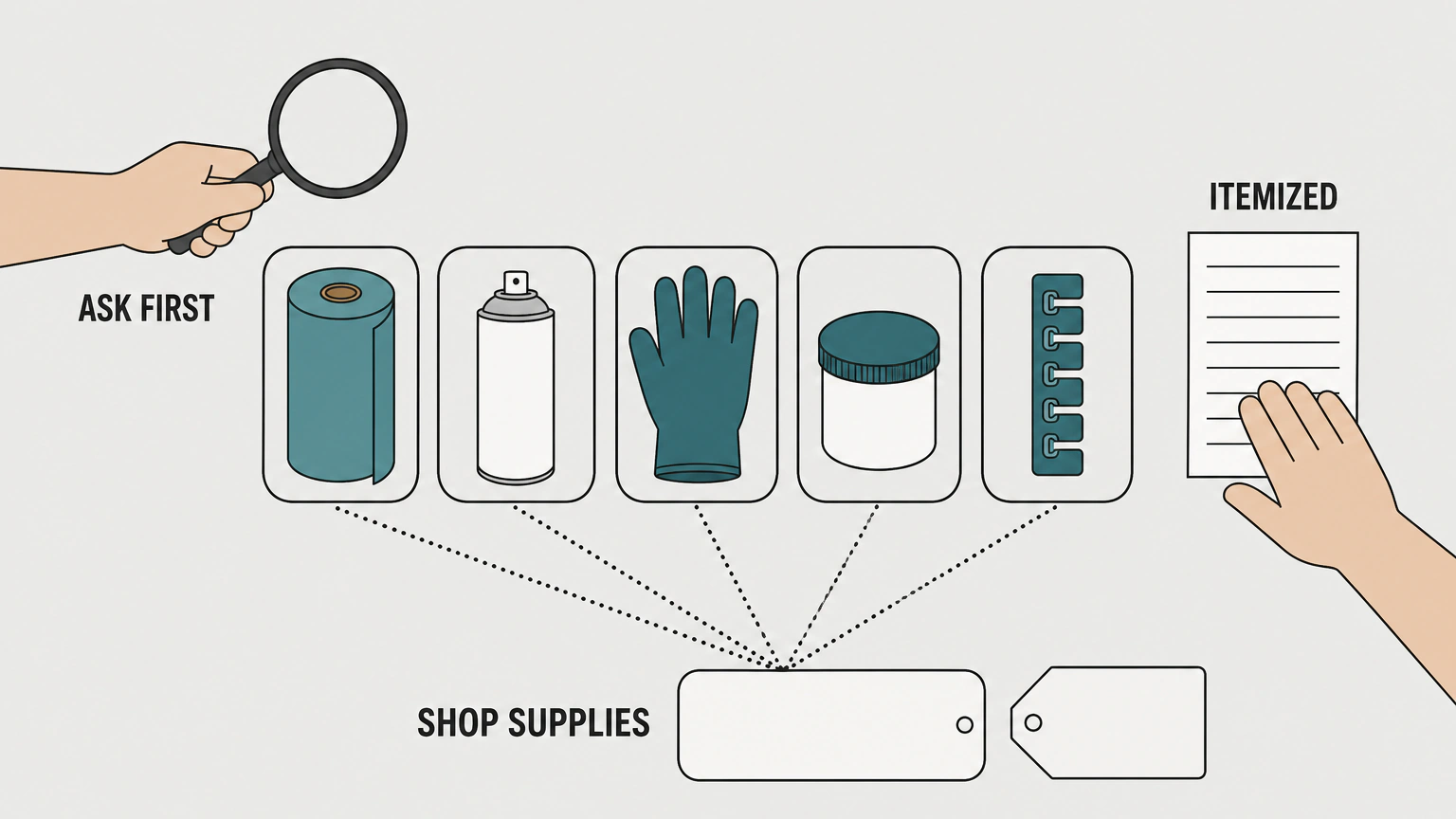
Here's what it is. Shop supplies is what a shop charges for the things it uses on your car but can't sensibly bill by the item: rags, brake cleaner, gloves, grease, clips. Shops may calculate it as a percentage of labor or of labor and parts. Whether the charge is allowed, and what the shop must tell you first, depends on state law.
States land far apart on it. In California a line labeled generically as "shop supplies" isn't allowed at all. In Florida your written estimate has to carry a sentence admitting the charge covers the shop's costs and profits.
On this page
What you are actually paying for
Think about what the shop actually did. A tech pulled your wheels, sprayed the calipers down, packed a bearing with grease and clipped a new hose into place. None of that is a part. None of it is a labor hour either. It's the stuff in between.
So shops group it. One line, one number, one phrase that tells you almost nothing.
The charge can represent a real cost. The questions are its size, its timing, and whether anyone told you.
The rags, sprays and clips it covers
Ask a shop-owner training company to list it and you get a page. ATI, which coaches repair shops on their numbers, names gasket materials, bench lubricants, chassis grease, gloves, wheel weights, sandpaper, welding rods, minor hardware like bolts and washers, wiping cloths, glass cleaner and assorted clips and fasteners. Then it stops, about a third of the way down its own list.
Car Talk's shorter version covers the same ground: solvents, cleaners, small amounts of fluid, rags, servicing the parts-cleaning machine, and getting rid of waste oil. AAA adds brake cleaner by name.
Now picture a shop billing you for one-tenth of a can of brake cleaner and two squirts of grease. The bookkeeping would cost more than the grease. That's the argument for bundling, and it's a fair one.
How shops work out the number, and why it is not simply in the labor rate
Fullbay lays out two percentage methods.
The first is a percentage of labor. The company sells shop management software and publishes advice for shop owners, and its worked example runs 8 percent: a $500 labor charge carries $40 of shop supplies. A longer job burns more consumables, so labor tracks them reasonably well.
The second is a smaller percentage of labor and parts together. Fullbay's example is 5 percent on a job totaling $800, which is also $40. It names the flaw too. A job with a costly part and little labor picks up a charge out of all proportion to the rags it used.
Fullbay adds a third rule, and ATI tells shops the same one. Set a cap, so a big repair doesn't carry a runaway number.
So why break it out at all? Car Talk's Ray Magliozzi was blunt about that. Plenty of shops just "bury that stuff in the labor rate" and quote a slightly higher hourly figure instead. Car Talk says shops may split it out because customers compare posted labor rates. That makes the supplies line partly a marketing decision, which matters when you weigh whether the labor rate underneath it is fair.
Where the law draws a line
The FTC's nationwide fee rule, the one aimed at hidden ticket and hotel fees, doesn't reach car repair. State law is the next place to look.
Five state rules show how sharply the answer can change. California flatly bans the generic line. Florida allows it and dictates the exact sentence your estimate has to carry. Pennsylvania allows it only if you heard about it first. New York and Ohio require itemized invoices, but the provisions below don't decide whether this fee is allowed.
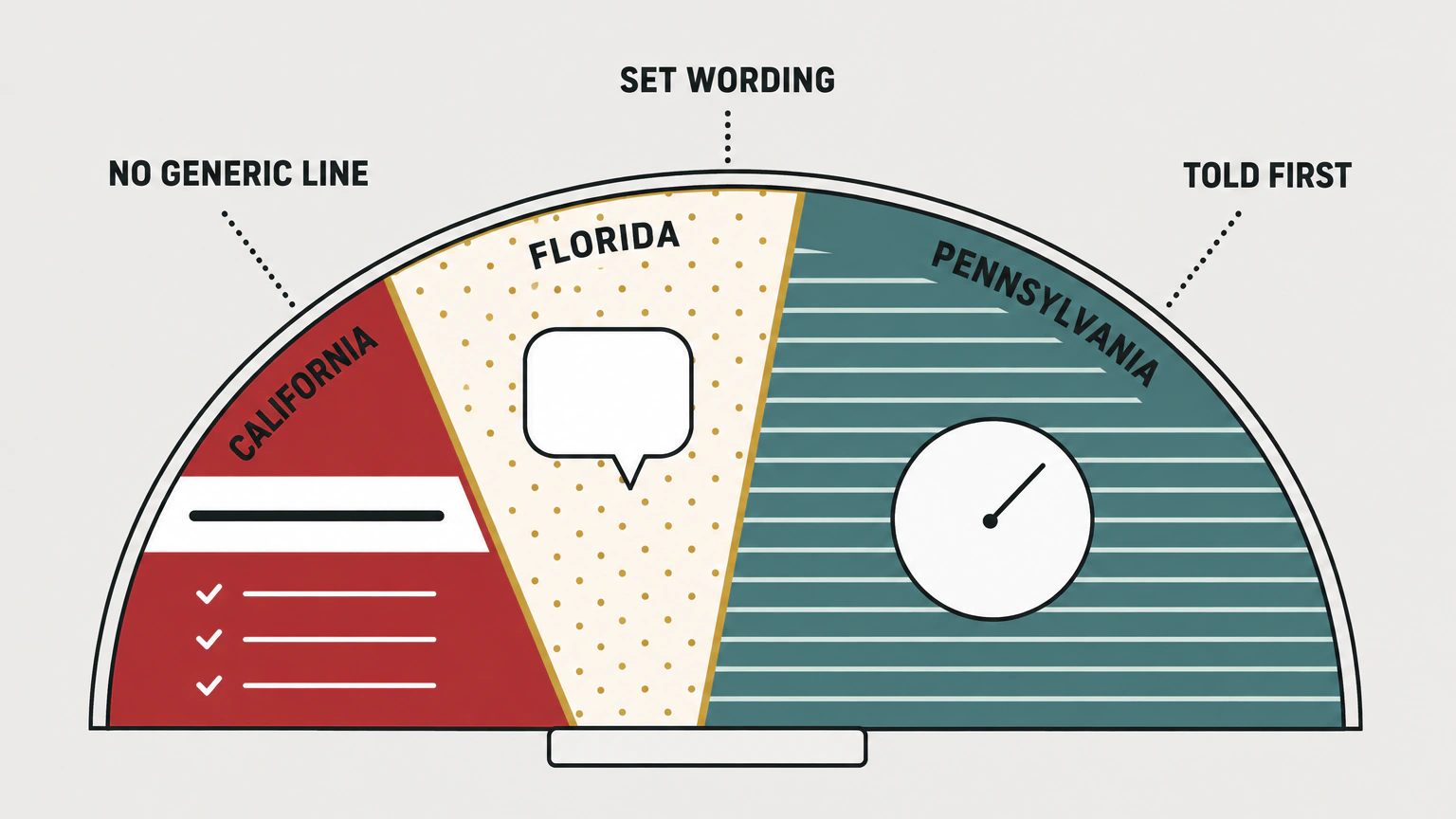
California says the generic line is not allowed
California's Bureau of Automotive Repair, the agency that registers repair shops there, puts this exact question in its own compliance guide for shops. Can the customer be charged for shop supplies? The answer is one word: "No."
The guide goes further. "Charging for items generally noted as shop supplies or miscellaneous parts is prohibited," it says. You may only be charged for supplies used on your vehicle. Their cost belongs in the estimate. Each one gets itemized on the invoice.
One charge survives that rule. Toxic waste disposal tied to your specific job is allowed, itemized separately on both the estimate and the invoice, and both documents have to carry the shop's EPA identification number.
California also bans trade shorthand. A customer, the Bureau notes, isn't likely to know that R&R means remove and replace, or that a TPS is a throttle position sensor. So those get spelled out.
Florida makes the estimate say what the charge is for
Florida went the other way, and for a reader holding a bill it might be the more useful rule.
For covered Florida repairs expected to exceed $150, the shop generally must give you a written estimate before work begins. That estimate has to include any charge for shop supplies or waste removal. If there is one, the statute dictates the sentence that goes with it: "This charge represents costs and profits to the motor vehicle repair facility for miscellaneous shop supplies or waste disposal."
Read that again. The state made the shop tell you, in writing, that part of the money is profit. Quote it back at the counter.
Above $150 Florida also requires a signed notice in capital letters, at least 12-point type, where you tick a box asking for the estimate or turning it down. You can waive the written estimate in writing, and the statute also has limited implied-waiver rules for after-hours or third-party delivery. Don't sign a waiver casually.
Pennsylvania will not let a shop charge it unless you were told first
Pennsylvania works from the invoice backward. Its rule lists what the invoice has to show: the itemized services, the parts by name or number with the price of each, the labor charge broken into hours and the rate, the total. Then it closes with the sentence that settles this question. "No other charges are permitted by this paragraph unless they are clearly and conspicuously disclosed to the customer prior to the commencement of repairs."
Clearly and conspicuously does real work there. A line you first met on the final bill wasn't disclosed before repairs began. Pennsylvania puts separate advance-disclosure duties on storage charges and on any fee for an estimate or a diagnosis.
New York and Ohio just say itemize
New York and Ohio take a narrower route. Their rules require an itemized invoice without saying whether a shop supplies fee is allowed.
New York requires the shop's invoice to carry "a list of all parts supplied and labor performed, including the cost for each such part and labor." Ohio's consumer rule makes it a deceptive practice to fail to hand you a written itemized list of the repairs, the parts or materials, their cost, and the amount charged for labor.
Those rules still give you a useful question. Where is the fee listed, and what does the invoice say it covers?
| State | What the rule means for a shop supplies line | Where it comes from |
|---|---|---|
| California | A line labeled generically as shop supplies or miscellaneous parts is not permitted. Only supplies actually used on your car may be charged, priced into the estimate and itemized on the invoice. | Bureau of Automotive Repair, Write It Right; Bus. & Prof. Code § 9884.9; 16 CCR § 3356(g) |
| Florida | Permitted, but any shop supplies or waste removal charge must be in the written estimate above $150, and the estimate must carry a set sentence calling it costs and profits for the facility. | Fla. Stat. § 559.905(1)(h) |
| Pennsylvania | Permitted only if clearly and conspicuously disclosed to you before repairs begin. | 37 Pa. Code § 301.5(8)(viii) |
| New York | This rule does not say whether a shop supplies fee is allowed. It requires the invoice to list all parts supplied and labor performed with the cost of each. | 15 NYCRR § 82.5(c) |
| Ohio | This rule does not say whether a shop supplies fee is allowed. Failing to give a written itemized list of repairs, parts or materials, their cost, and the labor charge is a deceptive practice. | Ohio Admin. Code 109:4-3-13(C)(12) |
Five states are enough to show the split, not enough to answer for every state. Your state may handle the charge through repair, estimate, invoice or general consumer protection law. To find yours, search your state attorney general or consumer protection office for "auto repair."
What a fair charge looks like on your ticket
A percentage hides how much money it is. Five percent sounds like nothing until you watch it land on a real ticket, and a repair invoice can be almost any size.
Our own cost profiles give us three real tickets to test it on. Across 697 oil change profiles our national average is $66. Across 865 general auto repair profiles it's $483. Across 837 collision profiles it's $1,826. Same percentage, wildly different money.
| Typical job | Our national average ticket | At 5 percent of the bill | At 10 percent of the bill |
|---|---|---|---|
| Oil change | $66 | $3.30 | $6.60 |
| General auto repair | $483 | $24.15 | $48.30 |
| Collision repair | $1,826 | $91.30 | $182.60 |
Fullbay calls labor-only the most common method. These columns use the whole bill so you can see how fast a percentage grows on a big ticket. The averages are our own cost profiles: 697 for oil changes, 865 for general auto repair, 837 for collision.
The oil change row catches people out. In dollars the fee is pocket change, but Fullbay lists a flat minimum as one way shops may price supplies, and a minimum can take a bigger slice of a small bill. We keep the wider numbers on what an oil change actually runs. When you compare quotes from auto repair shops in your city, ask each for the supplies percentage in the same breath as the labor rate.
Five things a fair supplies line does
- It showed up on the written estimate, before anyone touched the car, with a number or a percentage against it.
- It says how it's worked out. A percentage of labor, or of labor and parts, with the percentage itself written down somewhere you can point at.
- It stops at a cap. Shop trainers tell owners to set a ceiling on this fee. Ask what theirs is, because a big repair without one carries an open-ended charge.
- Nothing on the parts list duplicates it. If brake cleaner is billed as a part, it shouldn't also sit inside the supplies percentage.
- Waste charges are identified. California requires toxic-waste costs tied to your job to be itemized separately. Elsewhere, ask whether waste disposal or tire recycling is included in the supplies fee.
Three ways this line goes wrong
The fee itself is defensible. It can reflect a real cost, and Ray Magliozzi is right that burying it in the labor rate would be simpler and just as fair. Three uses of it deserve a closer look, and each has a question attached that gets you past the label.
Billed twice for the same can of brake cleaner
Read the parts list. If brake cleaner, shop rags or a bottle of fluid appears there by name with a price against it, and a supplies percentage is charged on top, ask whether that item was excluded from the percentage. The two lines alone don't prove double billing.
Andy's Automotive & Truck Services, a repair shop that explains its own billing on its blog, puts it plainly: "It wouldn't be appropriate to charge a customer for a can of brake clean if the job only took ~10% of the can." That's one shop's standard. If you were billed for the whole can, ask what other supplies the percentage covers.
Red flag: a consumable appears by name on the parts list, and a shop supplies percentage is charged as well. Ask one question. Was that item excluded from the percentage? One shop's own blog says it wouldn't be right to bill a whole can when the job used about a tenth of it. The answer tells you whether the two lines overlap.
A percentage on a job that used nothing
Some jobs soak up supplies. A brake job burns cleaner, a fluid service drips on everything, a rusted exhaust eats penetrating oil and gloves.
Other jobs use almost none of it. Ray Magliozzi's example is a window regulator, which needs no rags, no cleaners and no solvents, "and you still end up paying 7 percent or 8 percent of your bill for supplies." His brother's point lands too. The customer whose window motor burned nothing subsidizes the one whose brake job burned a shelf of supplies.
Interior electrical work, module programming, a sensor swap, a software update: those are the jobs to look at twice. The question is short. Which supplies did this job use?
On the invoice, never on the estimate
This is the version to compare with your estimate and your state's disclosure rules.
A charge that appeared for the first time on the final bill gives you a strong disclosure question. Florida puts the charge in its estimate rule. Pennsylvania requires advance warning for charges beyond parts and labor. In another state, start with the written estimate and ask the consumer protection office which authorization rule applies.
If a late supplies charge also pushed your total past the estimate, that's a separate issue with its own limits. It is worth knowing how far past the estimate your state lets a shop go before you decide what to argue.
What to say before you hand over the keys
All of this is easier before the work starts. Thirty seconds at the counter covers it.
Ask whether there's a shop supplies or miscellaneous charge. Ask how it's worked out, as a percentage of labor or of labor and parts. Ask whether it's capped, and at what number. Then ask for it on the written estimate with everything else.
That's four questions. A clear service writer should answer all four without a fuss. A shop that gets cagey about a $30 line has told you something about the rest of the invoice.
While you're there, ask the same questions about the diagnostic fee on the same invoice, the other charge that surprises people and the one some states make shops disclose up front.
If the shop will not take it off
One thing first: we're not your lawyer, and state repair rules change, so check your own state's rules before you file anything.
You usually have more leverage before you pay. Until then you're a customer with a question about an invoice. After, you're asking for a refund. So work in that order, cheapest step first.
The four steps
- Ask for it in writing. Which supplies, on which job, and how the number was reached. A shop that can answer can put it in writing. If it can't, you have a clearer record for your complaint.
- Document the dispute if you pay to get the car back. Note what you disputed on the copy you keep, date it, and photograph it before you leave.
- Take it to your state's consumer protection office. In California it's the Bureau of Automotive Repair, which registers repair dealers directly and takes complaints about them.
- Consider small claims court if the amount justifies it. Rules and filing fees vary by state. The estimate, invoice and your written request give you the paperwork to start.
If this was a dealership service department and the answer was a shrug, price the same work at independent mechanic shops next time. Ask each one the same four questions about its supplies policy.
We put our own screening on the record rather than asking you to take it on faith, including what we promise when you book through us. When you line up the next job, start with auto repair shops in your city and ask about the supplies line in the first phone call. Thirty seconds saves an argument at the counter.
Questions drivers ask about the shop supplies fee
Is the shop supplies fee legal?
It depends on your state and on what the shop disclosed. California prohibits a generic shop supplies or miscellaneous-parts line. Florida requires set wording on qualifying written estimates, and Pennsylvania requires advance disclosure for charges beyond parts and labor. New York and Ohio require itemized invoices. Those provisions don't decide whether this fee is allowed.
Can I refuse to pay the shop supplies fee?
You can dispute it, and your position is strongest when the fee never appeared on the written estimate. Ask the shop to show you where you agreed to it. In Pennsylvania, advance disclosure is the condition of charging it at all. If you pay to get the car back, note the dispute on your copy and keep the estimate and invoice for a complaint.
How much is a normal shop supplies fee?
The percentage and cap vary by shop. Fullbay's guidance to shop owners works the math at 8 percent of labor, so $40 on a $500 labor charge, or 5 percent of labor and parts, also $40 on an $800 job. On our own $483 average repair ticket, 5 percent comes to $24.15.
Is the fee charged on parts as well as labor?
It depends which method the shop uses. Fullbay calls a percentage of labor the most common method, on the logic that a longer job burns more consumables. It also describes a smaller percentage of labor and parts together, and warns that this gets unreasonable when a job carries a big-ticket part and little labor.
Does sales tax get added to the shop supplies fee?
Sales-tax treatment depends on your state. In New York, business operating expenses passed along on a bill for taxable services are part of the taxable receipt. The state says most repair-shop charges are taxable there, so a supplies line generally rides along with the rest.
Does the federal junk fee rule cover car repair?
No. The FTC's rule on unfair or deceptive fees covers businesses selling live-event tickets and short-term lodging. Car repair sits outside it, so the rule that changed ticket and hotel pricing does nothing for your invoice. Your leverage is your state's repair or consumer protection law, plus the written estimate.