

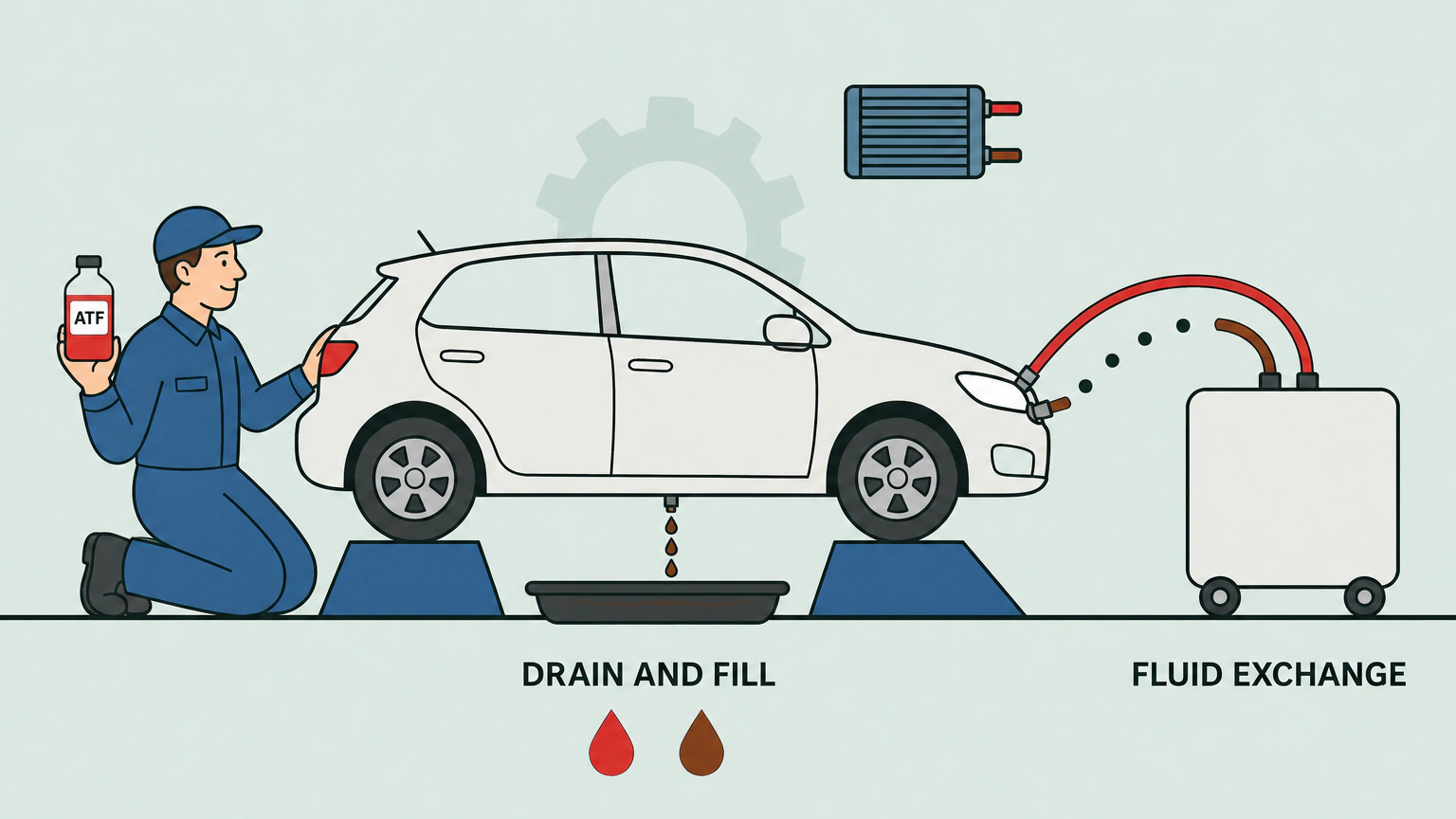
Here's the difference between a transmission flush and a fluid change, in two sentences. A fluid change drains and replaces the amount the car's procedure allows. A machine exchange circulates fresh fluid through more of the circuit, including the torque converter and cooler.
Before you pick, check your owner's manual. General Motors and American Honda warn their dealers against outside exchange machines. Mazda discourages preventive flushing unless its own procedure calls for it, and Kia limits flushing to a narrow replacement job. None of it is secret. It's just never on the menu board.
On this page
Start here: a flush and a fluid change are two different jobs
Shops use both names loosely, and some use them for the same job. Fix that first, because one is about to land on your bill.
Both services put fresh automatic transmission fluid in your car. ATF is the oil your transmission runs on. It carries the pressure that shifts the gears and keeps the parts from grinding. The two jobs split on one question: how much old fluid comes out, and what the technician touches on the way.
What happens during a fluid change
Call it a drain and fill, because that's what it is. The service follows the maker's procedure, which may use a drain plug or require the pan to come off. A pan drop can include a new gasket and a serviceable filter. Then the specified fluid goes back in at the level the procedure calls for.
A pan drop adds parts and labor, but it also exposes the pan for inspection. In one GM fluid-condition bulletin, a small amount of fine metal or friction material is normal. Large pieces or gritty debris point to internal damage.
What happens during a flush
A machine exchange connects equipment to the transmission fluid circuit. New fluid goes in as old fluid comes out. Because fluid circulates, the service can exchange fluid in the torque converter and cooler that a typical pan drain leaves behind.
Then there's the trade nobody mentions. A machine exchange does not guarantee that the pan comes off, the filter and gasket are changed, or the magnet is inspected. Ask what the quoted service includes.
Why nobody agrees on how much old fluid comes out
Ask three shops how much old fluid a drain and fill leaves behind and you'll get three answers. The pages ranking highest on this question don't agree either. Jiffy Lube says a fluid change "only drains 20% to 40% of the total ATF volume." BRAKEmax puts it at "only about 40% of the dirty fluid." Hot Shot's Secret, which sells additives, says a change "involves removing around 70% of the transmission fluid." One service, and the published figures run from a fifth to seven tenths.
They're arguing about the wrong thing. Your transmission isn't a tank you empty. It's a loop. Fluid leaves the pan, goes through the pump and valve body, fills the torque converter, runs out to a cooler and comes back. On a typical drain and fill, much of the fluid outside the pan stays behind. The exact amount comes from the service procedure and capacities for your car.
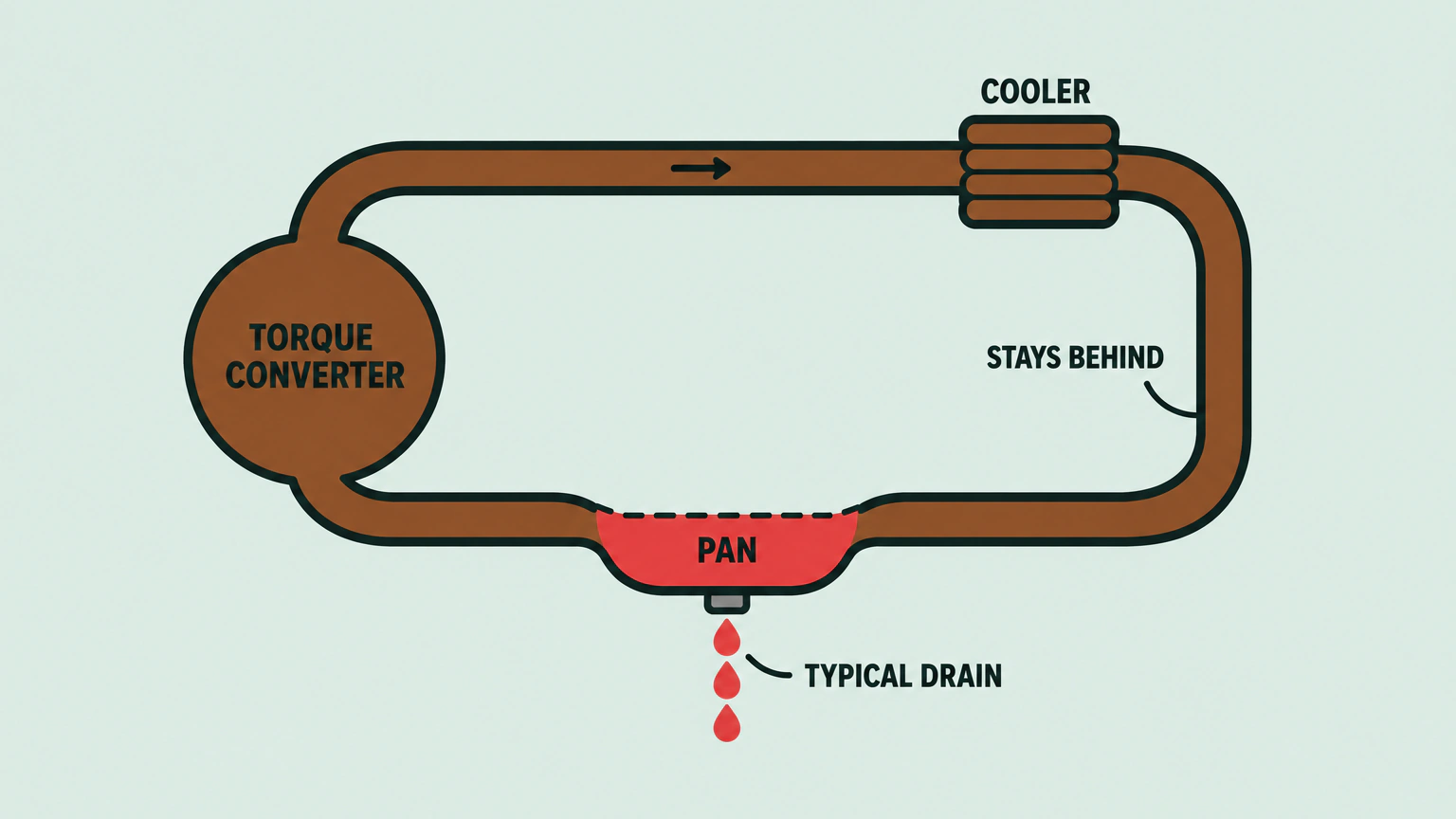
So the share you get out isn't one universal fact about the service. It depends on your car's drain procedure and refill capacity compared with the whole system. Anyone quoting one percentage for every vehicle is quoting a slogan.
| Service | What happens in the bay | What it reaches | Filter | Where it sits on the price range |
|---|---|---|---|---|
| Drain and fill, plug only | Drain plug out, gravity drain, plug back in, refill | The fluid that drains through the plug. Much of the fluid outside the pan may stay behind. | Not touched | Bottom of the range |
| Pan drop with filter | Pan comes off, fluid drains, filter and gasket replaced, pan refitted | Pan fluid, plus a look at the magnet for debris | Replaced where the maker fits a serviceable one | Middle of the range |
| Machine fluid exchange, the flush | Machine connected to the transmission circuit, old fluid exchanged as new goes in | More of the circuit, including fluid in the torque converter and cooler | Ask whether filter service is included | Top of the range |
| Inspect only, sealed unit | Technician checks for leaks and condition, nothing is drained | Nothing is replaced | Not serviced during an inspection | Inspection only |
What four carmakers tell their own dealers about flush machines
Carmakers talk to their dealers in technical service bulletins: this problem, these vehicles, do it this way. They aren't written for you and they aren't advertising, which is what makes them worth reading.
They're also public. Federal rules require manufacturers to submit certain dealer communications about vehicle defects or failures to the National Highway Traffic Safety Administration, which publishes the files it receives. We opened five manufacturer documents. GM and Honda warn against outside exchange machines, while Mazda and Kia limit when flushing belongs in the job.
| Maker | Document | Vehicles and date it covers | What it says |
|---|---|---|---|
| General Motors | Service Bulletin 04-06-01-029K | 2025 and prior GM passenger cars and trucks with gasoline engines, October 2024 | "The use of external transmission fluid exchange or flush machines is not recommended for the automatic or manual transmission." Fluid "should only be replaced by draining and refilling." |
| American Honda | Service Bulletin 23-073 | 2016 to 2020 Pilot with the 6 speed automatic, September 2023 | "The term flush refers to repeatedly draining and filling the transmission with Honda Genuine ATF-DW1. Other after market flush systems are available, but American Honda strongly recommends that you avoid using on any Honda vehicles." |
| Mazda | Service Alert SA-029-26 | A model list running 2000 to 2026, issued April 2026 | "Fluid flushing for preventive maintenance purposes is strongly discouraged, unless otherwise specified in a published procedure." Flushing is recommended if the wrong fluid was added. |
| Kia | TSB TRA 046, revision 5 | All listed models, 2005 to 2025, April 2025 | "A flush is required ONLY when a transmission is replaced, and the transmission oil cooler is transferred to the new transmission." |
| Toyota | 2025 Warranty and Maintenance Guide, Corolla | 2025 Corolla, as published | The normal chart lists the transmission fluid as inspect only. Replacement appears solely under special operating conditions such as towing or taxi style duty. |
These are documents written for technicians about specific vehicles, so a bulletin governs your car only if your car is on its list. Start with your own maintenance schedule, and a dealer can tell you which bulletins cover your VIN.
GM says drain and refill. Kia makes one replacement exception
GM's is the blunt one. Bulletin 04-06-01-029K, dated October 2024 and covering 2025 and earlier gasoline cars and trucks, tells dealers: "The use of external transmission fluid exchange or flush machines is not recommended for the automatic or manual transmission." Outside machines "may affect the operation or durability of the transmission," it goes on, and fluid "should only be replaced by draining and refilling."
GM keeps renewing that line. The October 2024 revision retained the transmission wording and added model years through 2025, along with an Important statement elsewhere in the bulletin.
One detail cuts the other way, so we'll say it out loud. A 2017 version approved one flush tool, for the transmission cooler, not the transmission. That section was dropped in 2020.
Kia's current TRA 046 adds one more condition. It says, "A flush is required ONLY when a transmission is replaced, and the transmission oil cooler is transferred to the new transmission." The capitals are Kia's.
Honda: a flush means three drain and fills
Honda doesn't ban the outcome. It redefines the word, which turns out to be more useful.
In Service Bulletin 23-073, written for 2016 to 2020 Pilots with the six-speed automatic, Honda tells its technicians: "The term flush refers to repeatedly draining and filling the transmission with Honda Genuine ATF-DW1. Other after market flush systems are available, but American Honda strongly recommends that you avoid using on any Honda vehicles." The procedure under that note is three drain and fills, 3.3 US quarts each on that model, with the car driven through its gears between them.
This isn't new. A 2016 Acura bulletin uses nearly the same sentence and calls the same three-cycle method a flush.
Look at what Honda is doing. Three drain and fills mix fresh fluid through the transmission without an outside exchange machine. Honda's flat rate for this Pilot procedure is 1.4 hours.
Mazda: flushing on a schedule is strongly discouraged
Mazda's alert is the sharpest of the four and the most recent. It lists services that sit outside Mazda's factory scheduled maintenance, and it says: "Fluid flushing for preventive maintenance purposes is strongly discouraged, unless otherwise specified in a published procedure."
Then it says something aimed at the service drive rather than at the car: "Services performed outside of Mazda's factory scheduled maintenance are not recommended. These services are unnecessary and create unneeded expenses for your customers."
Mazda does name one case where it wants a transmission flushed: someone topped the transmission up with the wrong kind of fluid. That's a repair, not maintenance.
How often your car actually needs the service
Method is one question. Timing is the other, and timing decides whether you should buy anything today.
Start with the maintenance schedule your carmaker published for your exact model and drivetrain. That chart is in your glovebox or on the maker's site, and it costs nothing to read.
Severe service, in your carmaker's own words
"Severe service" sounds like abuse. In the charts it's a short list of named conditions, narrower than most drivers assume.
Toyota's 2025 Corolla guide shows the shape of it. On the normal chart, the automatic transmission fluid line is marked I for inspect. Replacement turns up only on the special operating conditions chart, tied to two footnotes: "Perform this service if you drive while towing a trailer, using a car-top carrier, or heavy vehicle loading," and "Perform this service if you operate with extensive idling and/or low-speed driving for a long distance such as police, professional/private use like taxi or door-to-door delivery use." The chart's own instruction is to "Perform these service items only if you drive primarily under the conditions indicated."
Hold that list against your week. Mileage alone doesn't decide whether Toyota's special conditions apply. Towing or heavy loading can qualify, as can extensive idling or low-speed commercial driving. GM's 2016 Traverse schedule also lists "Change automatic transmission fluid" under severe use only.
If your driving does meet the definition, follow the maker's severe column rather than a shop menu, and ask for shops that work to the factory schedule when you book.
What lifetime fluid really means
"Filled for life" is a maintenance claim, not a promise that fluid cannot age. Read it against the schedule for your exact model and drivetrain.
A sealed unit may require a model-specific level-check procedure. Toyota's 2025 Corolla guide calls for sealed transmissions to be inspected for leaks. That's an inspection, not a fluid replacement.
Here's the test, and it takes two minutes. Find the transmission line in your own maintenance chart. If it says inspect at your mileage, an inspection is what you're due for. If it says replace, note the mileage and which column it sits in, normal or severe.
The high mileage question, and why shops get nervous
This is the one genuinely gray area, so we'll treat it that way.
At high mileage with no service history, the missing fact is the transmission's condition. Mileage alone doesn't tell you whether it needs a drain and fill, another procedure, or a repair.
Honda's bulletins pair repeated drain and fills with specific symptoms and repair procedures. GM directs technicians to the drain-and-refill procedure for the vehicle instead of an outside exchange machine. Neither source gives every high-mileage transmission one universal remedy.
At 100,000 miles with no records, check the schedule for your exact car. Ask the shop to diagnose any slipping, shudder, or leaks before you approve fluid work.
We can tell you what the carmakers put in writing, but we can't see inside your transmission. If the fluid is dark and nobody has touched it in a very long time, have a shop look at it before you decide.
What it should cost
Now the number, because a $180 service quote is often presented beside a much bigger repair figure.
What our own cost profiles show
Across our own data for transmission fluid work, the national average is $158. The typical job lands between $105 and $200, with a floor near $84 and a ceiling near $263. That comes from 944 cost profiles in our listings, and it shifts with the market you're in.
The spread isn't mystery. A plug-only drain and fill can use less labor and fewer parts than a pan drop with a filter and gasket. A machine exchange generally uses more fluid, and some transmissions require a pricier model-specific ATF.
Labor rate is another part of the quote, and it varies by zip code. If a quote looks high, check what shop labor costs where you live first. When you're ready to book, here are shops that do transmission fluid work near you.
The repair bill behind the maintenance decision
The other number is why anyone sells you the first one. Across our own listings, transmission repair averages $1,442, with most jobs between $1,133 and $2,884 and the top of the range past $3,600, from 785 cost profiles.
Side by side, the numbers explain why transmission maintenance is easy to sell. The cost gap does not prove that every service on an estimate will prevent a repair. Follow your maker's schedule instead of treating the repair figure as a forecast. Here's what a transmission repair actually runs.
How to tell if you are being sold one you do not need
The Federal Trade Commission puts the problem in two sentences worth carrying to the counter: "Follow the manufacturer's maintenance schedule in your owner's manual for your type of driving. Some repair shops create their own maintenance schedules, which call for more frequent servicing than the manufacturer's recommendations."
That isn't an accusation and we won't make one. Ask whether the shop is using its own schedule or the one your carmaker published.
Six questions to ask before you say yes
A good shop answers all six without flinching, and a few will be glad you asked.
- Which service are you quoting me, a drain and fill or a machine exchange? Listen for a straight answer, not "a transmission service."
- What does my owner's manual say for my mileage and my kind of driving? A good advisor pulls up the schedule, not the menu.
- Is my transmission sealed, and does it have a filter you can actually change? Ask the shop to identify the serviceable parts before it writes the estimate.
- What fluid are you putting in, and is it the one my carmaker specifies? Ask for the spec by name and expect it on the invoice.
- Has this transmission been serviced before, and do you have the record? Use the record to compare past work with the maker's schedule.
- If it shifts fine today, what are you expecting this to fix? A maintenance answer is fine. A vague one is your cue to wait.
Red flags on the estimate
Red flag: the recommendation rests entirely on how the fluid looks. ATF darkens with heat, and dark alone is not a diagnosis. Ask which line on your schedule calls for this at your mileage.
Red flag: the service isn't on your chart and nobody can point to the line. Ask whether the shop is using its own maintenance schedule and why it differs from the maker's.
Red flag: an additive appears as its own line item. Mazda tells dealers that transmission additives "could (under certain conditions) lead to internal damage and void the warranty." Find out what it's for, and what happens if you decline it.
Red flag: a machine exchange is quoted on a car whose maker published a bulletin against it. Have the shop check the bulletins for your VIN.
And if a flush turns up on the invoice that was never on the estimate, that's a different conversation with its own rules. Here's what to do when the bill comes back higher.
Transmission flush questions we get asked most
Can a transmission flush damage my transmission?
It may, depending on the vehicle and procedure. GM says outside exchange machines may affect transmission operation or durability. Mazda discourages preventive flushing unless one of its own procedures calls for it. Check the service information for your car before approving a machine exchange.
What happens if I never change the transmission fluid?
Fluid ages, and its properties can change. American Honda traced a shudder in some 2013 to 2016 Acura RDXs to deteriorated fluid under specific high-heat driving conditions. That case does not turn the repair average into a forecast for every skipped service. Follow the schedule for your model and investigate symptoms when they appear.
How do I know when my transmission fluid needs changing?
Your maintenance chart tells you when fluid service is due. Fluid color alone isn't a verdict. GM's diagnostic guidance also checks for burnt odor, contamination, debris, and transmission symptoms before deciding what the fluid condition means. If you notice slipping or shudder, ask for a diagnosis instead of treating a flush as the diagnosis.
Is a fluid change necessary on a sealed transmission?
Sometimes. "Sealed" does not erase the maintenance schedule for your model. Toyota's 2025 Corolla guide calls for leak inspections and lists fluid replacement only under specified operating conditions. Follow the chart and service procedure for your car.
How often should CVT fluid be changed?
Follow the chart for your specific car. CVT designs and service intervals differ. Use the fluid your maker names instead of a universal substitute because the wrong fluid can damage the transmission.
How long does a transmission fluid change take?
Honda allows 1.4 labor hours for its three-cycle Pilot procedure, including the drive cycles. Another car or procedure can take a different amount of time. Ask for the labor time on your estimate.