

On this page
- How much does it cost to replace a catalytic converter?
- Why your state can double the price of the part
- Before you pay, check whether you should be paying at all
- Factory, California-approved or federal: which part to pay for
- What the shop should hand you when it's done
- If your converter was stolen
- Frequently asked questions
- Where to get it done
How much does it cost to replace a catalytic converter?
The national numbers, and why they're so far apart
You're holding a quote with a comma in it, and somebody you know swears theirs cost a third as much. Both numbers can be honest. RepairPal's average job runs $2,283 to $2,473, and $2,055 to $2,139 of that is the part. So the part is the story. ConsumerAffairs gathered shop quotes on three cars and got averages from $933 for a 2017 Ford F-150 to $4,414 for a 2017 Honda Civic. On the Civic, the part alone was more than nine-tenths of the bill.
Your catalytic converter replacement cost comes down to three things. The car comes first, because some have two or more converters in awkward places. Then your state, which decides which parts a shop may legally fit. Then the part itself: factory, California-approved or federal. Here's how the big published estimates line up.
| Source | Installed price | What's behind it |
|---|---|---|
| RepairPal | $2,283 to $2,473 for its average job | Parts $2,055 to $2,139 and labor $228 to $334, before tax and fees |
| AAA | $1,000 to $4,000 | Parts $300 to $2,500, and labor at $160 to $200 an hour |
| ConsumerAffairs, five mechanics on three cars | $933 (2017 Ford F-150) to $4,414 (2017 Honda Civic) | The part was 93% of the Civic bill; labor was 69% of a 2019 BMW 740i's |
| Edmunds, citing RepairPal | $970 to $1,064 (Toyota RAV4) up to $3,124 to $3,241 (Chevrolet Silverado 1500) | Late-model examples, parts and labor before tax; a Toyota Prius runs $2,346 to $2,413 |
Where labor gets expensive
On RepairPal's average job, labor is the smaller line, at $228 to $334. AAA puts shop rates at $160 to $200 an hour. The exception is access. Some converters are simply hard to reach, and AAA says those cars leave you with a higher bill. ConsumerAffairs' 2019 BMW 740i came back at $1,589 in labor against a $720 part.
Then come the add-ons. AAA says oxygen sensors often fail along with the converter, adding "approximately $300 per sensor," and corroded pipes, heat shields or mounting hardware can join the list. Count the converters, too. MagnaFlow lists two for a 2011-2014 F-150 5.0L, and CARB's own application classes separate vehicles with one converter per exhaust bank (one side of a V engine) from vehicles with more. So a quote can honestly charge for two parts. Which converter your state allows is the next question.
Why your state can double the price of the part
Start with the federal floor. Since 1986, EPA has let shops fit a cheaper aftermarket converter, meaning one not made by the carmaker. The car has to be past its emissions warranty, it has to really need one, and the part has to meet EPA's rules. That's why cheap converters exist at all. Several states use stricter rules for at least some vehicles.
Where states rule out the cheaper federal converter
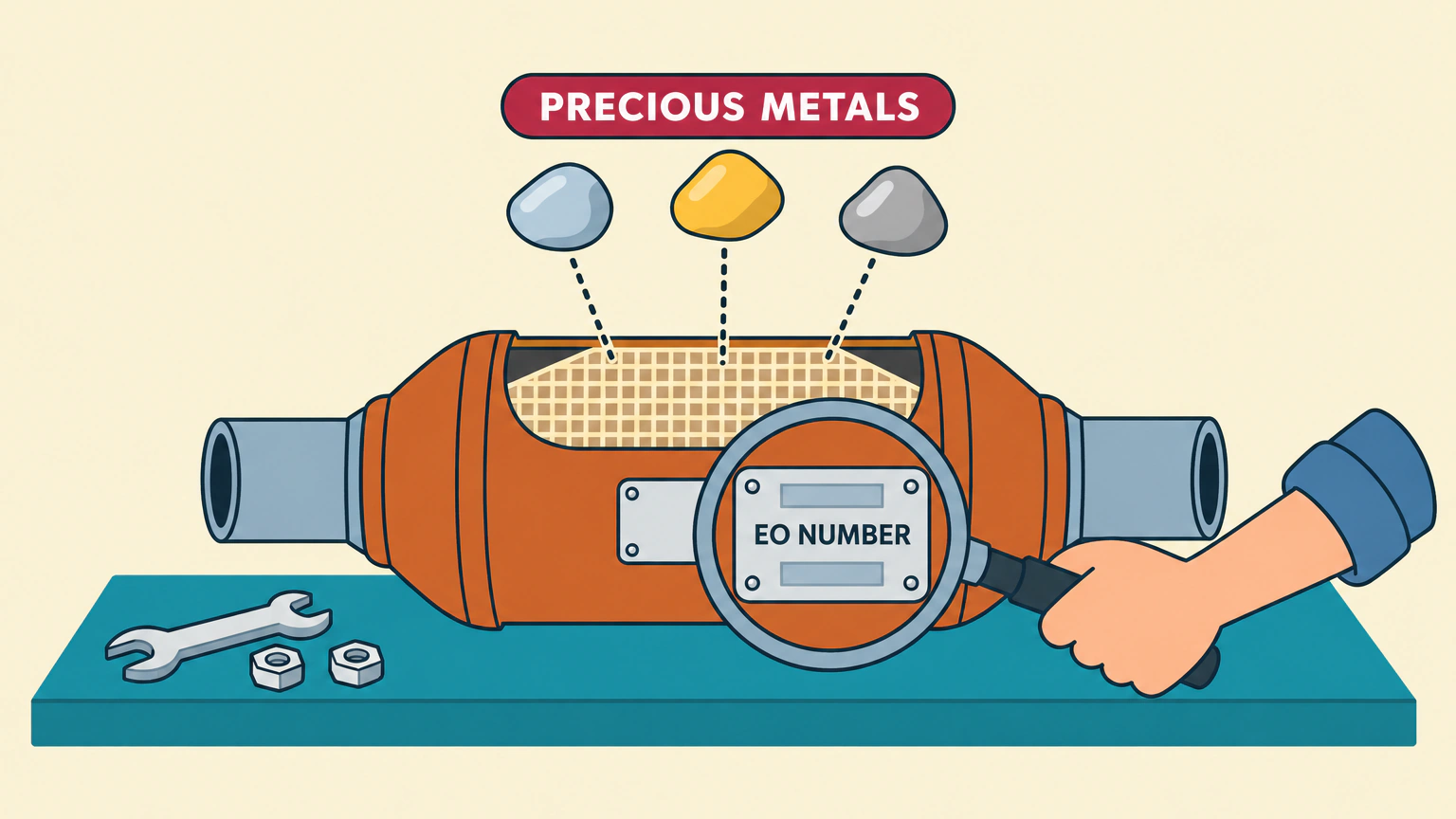
California does it by approving parts one model at a time. CARB, the state's Air Resources Board, approves each aftermarket converter by Executive Order. The order lists the cars that part may go on. The EO number is stamped on the shell. No number, no sale in California. Colorado copied California's rule for cars of any age from January 1, 2021.
New York went furthest. Its regulation makes it "unlawful to offer for sale, sell or install any federal certified after market catalytic converter" in the state unless the owner has a waiver. Maine applies the rule only to 2001-and-newer cars certified to California or EPA "50-state" standards. California, New York, Colorado and Maine ban used converters. The Ozone Transport Commission's advisory April 2025 tracker lists Washington, D.C., Delaware, Rhode Island and Vermont. It lists them as using California's aftermarket converter rule, section 2222, for some vehicles. Coverage differs, so check the state rule before buying.
| Jurisdiction | In force since | Cars it covers | What a shop may install | Used converters | The rule |
|---|---|---|---|---|---|
| California | January 1, 2009 | Every gasoline car and light truck in the state, federal-emissions cars included | A factory converter, or a new one with a CARB Executive Order number that lists your car | Banned since July 10, 2008 | 13 CCR 2222(h); Vehicle Code 27156 |
| New York | January 1, 2023 | Every gasoline car, light truck and medium-duty vehicle, any model year | Factory or CARB-approved; a federal converter only with a state waiver | Banned | 6 NYCRR 218-7.2 |
| Colorado | January 1, 2021 | Any model year, anywhere in the state | Factory or CARB-approved | Banned, certified used factory units included | AQCC Regulation 20 (5 CCR 1001-24) |
| Maine | June 1, 2018 | 2001 and newer gasoline vehicles under 14,000 lbs certified to California or EPA "50-state" standards | Factory or CARB-approved; federal-only and pre-2001 cars can still take a federal converter | Banned on every vehicle; selling one for scrap is allowed | Maine DEP catalytic converter standards |
| New Jersey | Adopted for 2027 models. Confirm current enforcement | California-certified 2027-and-newer vehicles covered by its ACC II text. Federally certified vehicles legally registered in New Jersey are excluded | Adopted text says factory under warranty and CARB-approved afterward | Adopted text applies California's used-converter ban to covered vehicles | N.J.A.C. 7:27-29A (adopted 2023) |
| Federal baseline | 1986 | A missing original, an inspection order, or a vehicle past its emissions warranty with a documented need | Factory, CARB-approved, or a new federal EPA-compliant converter where state law permits | Tested and labeled used converters where state law permits | EPA aftermarket converter policy, 51 Fed. Reg. 28114 |
Where no approved part exists for your car, New York can grant a waiver, Colorado asks you to call its health department, and Maine can allow another unit if a factory converter would cost more than 75% of the car's value.
Same car, two legal parts
MagnaFlow makes both kinds and publishes its own prices, which turns the California premium from a guess into a number. Its federal underbody converter for a 2014-2015 Civic 1.8L lists at $319. The California-approved version is $935, nearly three times as much. The short reason is durability. New Jersey's regulator tells its techs that in testing, approved units barely wear over their 5-year, 50,000-mile warranty.
Now the counterexample, because it's the useful part. For a 2006-2013 Civic's manifold converter (the one bolted right at the engine), MagnaFlow's approved version is $461 cheaper than its federal one. So compare part numbers and prices, never labels. And if a quote says "OEM Grade," ask whether that means the carmaker's part or MagnaFlow's federal line.
| Car and converter | Federal EPA version | CARB-approved version | Difference |
|---|---|---|---|
| 2014-2015 Honda Civic 1.8L, underbody converter | $319 (52452) | $935 (5571452) | $616 more |
| 2014-2015 Honda Civic 1.8L, manifold converter | $772 (52022) | $1,061 (5531022) | $289 more |
| 2010-2011 Toyota Camry 2.5L, underbody converter | $436 (24435) | $1,063 (5571435) | $627 more |
| 2011-2014 Ford F-150 5.0L, the two converters listed | $764 and $856 (52138, 52139) | $1,743 and $2,160 (5551138, 5551139) | $887 to $1,396 more per converter |
| 2006-2013 Honda Civic 1.8L, manifold converter | $1,572 (49343) | $1,111 (5531343) | $461 less |
MagnaFlow's list prices for the part alone. "OEM Grade" and "HM Grade" are MagnaFlow's names for its federal lines, not factory parts. Labor and any shop markup come on top.
Following California's new-car rules isn't the same thing
Several states adopted California's emission standards for new cars, and some guides count 15 or more "CARB states" on that basis. Those programs don't give one answer for replacement parts. Some places also use California's aftermarket converter rule, section 2222, but they cover different cars. New Jersey adopted it in 2023 for California-certified models from 2027 onward. Its air agency excludes federally certified vehicles legally registered there. A 2025 federal law voided EPA's ACC II waiver decision, so confirm current enforcement with NJDEP before buying.
Maine shows another shape. There, the rule turns on how your car was certified, and that's printed on a label under the hood. If a shop says a CARB unit is required by law, ask which state rule and type of car it covers. The state agency can confirm that before you buy.
Pro tip: read the label under your hood first. The emissions label (the VECI label) says whether your car was certified to California or "50-state" standards or to federal rules only, and it carries the engine family or test group number an approved converter has to match. In Maine, that label decides which converter you can buy. If the label is missing, a dealer can supply a replacement.
Before you pay, check whether you should be paying at all
Check the emissions warranty first
Federal law gives 1995-and-newer cars and light trucks 8 years or 80,000 miles of emissions warranty on the converter, whichever comes first. Some cars built to California rules get more. Maine's regulator puts hybrids, plug-in hybrids and partial zero emission vehicles at up to 15 years or 150,000 miles. CARB's installer checklist gives the same top end.
Inside that window, two things follow. A defective converter should be the carmaker's bill. And an aftermarket converter isn't a legal swap. Asked about a missing converter on a car still under warranty, CARB answers, "No, because the converter is still within its warranty period." Some carmakers have also stretched converter coverage past the federal term on particular models, so ask a dealer to run your VIN before you pay anyone. If you're still covered, here's how to make an emissions warranty claim.
A P0420 code points at the converter, but it doesn't prove it
P0420 is the code for "catalyst system efficiency below threshold." In plain words, the car's computer thinks the converter isn't cleaning the exhaust well enough. It doesn't say why. An exhaust leak or another engine fault can affect the converter and oxygen-sensor readings. Walker tells technicians to resolve other engine codes and exhaust leaks before testing whether the converter itself needs replacement.
CARB tells installers that "the results of a smog check inspection do not, by themselves, provide sufficient evidence that a catalyst needs to be replaced." It makes the installer document the need. Know what a proper diagnosis costs, then find a repair shop that does the testing.
Find out why the old one died
EPA says original converters are "designed to last the life of properly tuned and maintained vehicles." So a dead one usually has a cause. The usual suspects are an engine burning oil, a misfire, an engine running rich (too much fuel), or road debris that cracked the ceramic core. That matters for your wallet. CARB's warranty terms for aftermarket converters exclude "engine misfire" and "excessive oil consumption." So a new converter on an unfixed engine can die the same way, with no warranty behind it.
One case is urgent. GM's owner's manual says a flashing check engine light means a fault "that could damage the emission control system." Slow down and get it looked at. If the engine is the culprit, start with engine repair specialists.
Factory, California-approved or federal: which part to pay for
Before a shop picks for you, compare the three legal kinds of converter. They differ on price, on warranty and on where each is allowed. You'll see what the cheaper parts give up.
| Part | Price | Warranty on the part | Where it's legal |
|---|---|---|---|
| Factory (OEM) | Usually highest. AAA and Edmunds put it 40% to 70% above aftermarket | Often one year on the replacement part | Everywhere, and the required part while the carmaker's emissions warranty still covers the converter |
| CARB-approved aftermarket | Usually well above a federal unit for the same car | 5 years or 50,000 miles, including loss of efficiency and an OBD fault | Legal when correctly matched, and required where state law applies California's aftermarket converter rule, section 2222 |
| Federal EPA-compliant aftermarket | Usually the lowest tier, but not for every part number | 5 years or 50,000 miles on the shell and end pipes; 25,000 miles on emissions performance | Where state law permits it and EPA's replacement conditions are met |
What the extra money buys
New Jersey's regulator teaches this to its emissions techs. It calls a CARB-approved converter "as effective as original converter," while a federal one "can be effective when new, but often deteriorates rapidly." The same course names the trap. Drivers who buy the cheapest federal converter find it "not effective enough to comply with the OBD system," the light comes back, and they pay for a second, better repair. (OBD is the car's onboard diagnostics, the system that sets the code.) EPA says it plainly too. Aftermarket converters "are not designed to perform as well as the converter(s) originally on the vehicle," though they "usually provide acceptable performance at a lower cost."
Our take: on a car you're keeping, pay once for the approved or factory part. A federal unit makes sense mainly on an older car with little life left, in a state where it's legal. And on an old enough car, a converter quote can creep toward what the whole car is worth. At that point it's a keep-or-sell question, not a parts question.
Direct-fit or universal
A direct-fit converter bolts in where the old one was. A universal converter gets cut and welded in, so the part costs less and the labor doesn't (AAA and Edmunds both make the point). Some guides say a universal converter is never legal where California's rule applies. That's wrong. CARB approves universal models by Executive Order for listed cars. MagnaFlow's own store lists approved universal units for under $200. And New York's regulator told installers, "Universal fit AMCCs are legal." (AMCC means aftermarket converter.)
What isn't legal is forcing a part to fit. CARB says welding in pipe adaptors means the part isn't approved for that car, and the car can fail the Smog Check visual inspection. A bad weld or another exhaust leak can affect converter and oxygen-sensor operation, so repair any leak before paying for a factory unit. Muffler and exhaust shops do this work every day.
Why we'd skip a used converter
California, New York, Colorado and Maine ban used, recycled and salvaged converters outright. Colorado's ban even covers certified used factory units. Under federal rules, a used converter is allowed only if state law permits it. It also has to be tested and labeled, but it can come with no warranty. EPA says its performance and remaining life depend on how it was used before. That's a lot of unknowns for a part you're paying a shop to install. We'd pass.
People get one rule wrong. EPA calls it a violation to install an untested used converter a customer brings in, "even if the customer insists that the used converter came off his/her vehicle." Before buying the part yourself, know the wider trade-offs.
What the shop should hand you when it's done
Federal policy and state rules put most of this in writing. A shop that does converter work right will have it ready. Check each item before you pay, and keep the paperwork with the car.
- The reason for the replacement, written on the invoice: the test or diagnosis that found a legitimate need, physical damage or a missing converter.
- Your name and address, and the car's make, model year and mileage, on the same invoice.
- The warranty card for a new aftermarket converter, filled in, signed by you, with your copy in your hand.
- Check the compliance stamp. Use the CARB Executive Order number where state law requires one. Under federal policy, N means new and U means used.
- The new converter in the same spot as the old one, the same number of converters, and every oxygen sensor where it was.
- An answer about your old converter: the shop has to keep it at least 15 days after fitting an aftermarket unit, and a factory converter has scrap value.
- Any misfire, oil burning or exhaust leak found during diagnosis, fixed or written on the estimate.
Red flag: a quote far below everyone else's. Ask three things before you say yes: is the converter new, is it federal or CARB-approved, and what's the brand and part number? In California, New York and Colorado, a federal or used converter isn't legal to install. And if anyone offers to remove the converter or fit a straight pipe, walk away. EPA says its tampering rules apply for a car's entire life, warranty or not.
The time to settle the part number and the price is before the work starts. It also pays to know what a shop can add to the estimate once your car is on the lift.
If your converter was stolen
You turn the key and the engine sounds far louder than it should. Progressive lists the signs: that roar at startup, a bad smell, and an obvious hole underneath near the muffler. Its advice is to take the car to a mechanic right away and consider a tow, "because driving without the converter can be hazardous."
On coverage, Progressive says comprehensive "will typically pay to replace the stolen catalytic converter and repair any related damage from its removal." Find your comprehensive line and deductible on your declarations page before you collect quotes.
Then comes the rule that changes the bill. In California, New York, Colorado and Maine, a car still inside its emissions warranty period has to get a factory converter, even after a theft. All four regulators say so. Under EPA's policy, a missing converter is one case where a shop may fit an aftermarket unit, but state restrictions can narrow that choice. Why thieves bother is no mystery. Edmunds' scrap list puts large factory converters at up to $820 each.
Frequently asked questions
Can I drive with a bad catalytic converter?
A stored code by itself doesn't tell you whether the car is safe to drive. A rattle underneath, a rotten-egg smell or a loss of power needs prompt diagnosis: AAA lists all three as signs of converter trouble. A flashing check engine light is urgent. GM's owner's manual says it means a fault "that could damage the emission control system," so reduce speed and park if it keeps flashing.
Does insurance cover a stolen catalytic converter?
Usually, if you carry comprehensive coverage. Progressive says that part of your policy typically pays for a stolen converter and the damage from cutting it out. Find your comprehensive line and deductible on the declarations page before you collect quotes. In California, New York, Colorado and Maine, a car still inside its emissions warranty period has to get a factory converter, even after a theft.
How long is the warranty on a replacement catalytic converter?
It depends on the part. A new federal converter has to carry 5 years or 50,000 miles on the shell and end pipes and 25,000 miles on emissions performance, under EPA's rules. A CARB-approved one carries 5 years or 50,000 miles, including loss of efficiency. A factory replacement part often carries one year. CARB's terms exclude damage from misfires, oil burning and road debris, so keep the warranty card.
Do I need a CARB-compliant catalytic converter?
Yes in California, New York and Colorado, on any gasoline car or light truck. In Maine, the rule covers 2001-and-newer cars certified to California or EPA "50-state" standards. The Ozone Transport Commission's advisory April 2025 tracker lists Washington, D.C., Delaware, Rhode Island and Vermont. It lists them as using California's aftermarket converter rule, section 2222, for some vehicles. Coverage differs, so ask the state air agency before buying a federal converter.
Does New Jersey require a CARB-compliant catalytic converter?
For most repairs today, no. New Jersey adopted California's aftermarket converter rule, section 2222, for California-certified models from 2027 onward. Its air agency excludes federally certified vehicles legally registered there. A 2025 federal law voided EPA's ACC II waiver decision, so confirm current enforcement with NJDEP before buying.
Can I buy a used catalytic converter?
Not to install in California, New York, Colorado or Maine, where used, recycled and salvaged converters are banned. Under federal policy, a used converter is allowed only where state law permits and only if it has been tested and labeled with a code starting with U. It needn't carry any warranty. A shop can't install an untested one you bring in, EPA says, even if you insist it came off your own car.
Why are catalytic converters so expensive?
The metals. Converters carry platinum or palladium, and most modern ones add rhodium, according to EPA. More metal cleans better and costs more, New Jersey's regulator tells its technicians. Scrap prices show the gap. Edmunds' list of Scrap Monster averages from February 2026 puts large factory converters at up to $820 each and aftermarket converters at $20.
Where to get it done
The replacement itself is a job for muffler and exhaust shops. If you failed an inspection, the retest happens at an emissions testing station. And if the old converter died of oil burning or a misfire, see engine repair specialists before the new one goes in. Then take three things to two shops: the part number you were quoted, the paperwork checklist and a photo of your emissions label. Compare the parts they name, not just the totals. Converter rules change, and your state's air-quality agency has the final word on what goes on your car.