

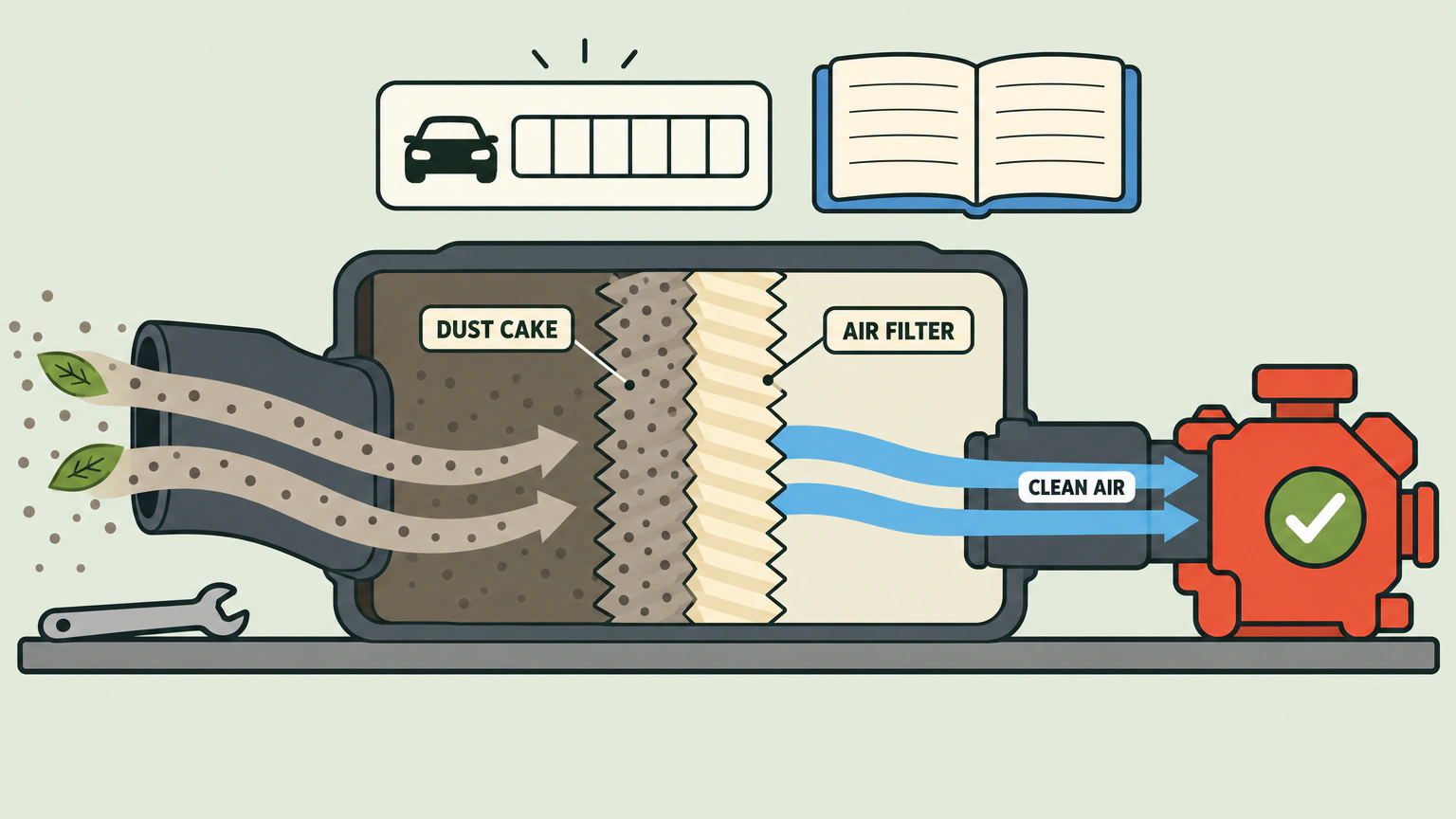
Here's the short answer on how often to change your engine air filter. Of the four carmakers' 2025 and 2026 schedules we read, Toyota says 30,000 miles or 36 months and Hyundai 24,000 miles or 36 months, whichever comes first. Dirt or dusty roads mean extra checks or earlier changes. Honda and Chevrolet let a reading on your dash decide.
A filter that looks gray at an oil change isn't proof it's done. The Energy Department's own lab says filters are built to catch more dirt as that first layer of dust builds, and that changing them early is common.
So before you say yes, get three things: your carmaker's number, the one check that matters, and a fair price.
On this page
What your carmaker actually says
Carmakers don't agree on the number, and they don't even use the same kind of rule. Toyota and Hyundai print mileage and time limits, whichever comes first. Honda and Chevrolet skip the number and let the car decide: Honda's Maintenance Minder shows a code, and Chevrolet's air filter life display counts down. For a yardstick, the Energy Department's lab puts the standard service life of a car's air filter at "about 30,000 miles" in normal driving.
What four carmakers schedule
| Carmaker and model we read | Normal driving | Dirt or dusty roads | What tells you it's due |
|---|---|---|---|
| Toyota, 2026 Corolla | Replace at 30,000 miles or 36 months, whichever comes first | Inspect every 5,000 miles or six months if you drive mainly on dirt or dusty roads | A maintenance chart in the Warranty and Maintenance Guide |
| Hyundai, 2026 Tucson | Replace every 24,000 miles or 36 months, and inspect every 8,000 miles or 12 months | Replace more often than the normal schedule | A maintenance chart in the owner's manual |
| Honda, 2025 CR-V | Replace when the Maintenance Minder shows code 2 | Replace every 15,000 miles | A code on the dash |
| Chevrolet, 2025 Equinox | Replace when the air filter life display says to | The display's timing already depends on how and where you drive | A percentage on the dash, if your car has the feature |
Each row comes from that carmaker's own schedule for that model. Other models, even from the same brand, can differ, so check the maintenance section of your own owner's manual.
Now hold those numbers against the advice on cost pages. Mobile Car Care's price guide calls every 12,000 to 15,000 miles "a good rule of thumb," though it also sends you to your manual. That's about twice as often as Toyota's 30,000 or Hyundai's 24,000, so on those cars you'd buy roughly two filters for every one the carmaker schedules. Charts and service menus split on more than filters, and we've worked through the same question about a transmission flush.
Your number lives in the maintenance section of your owner's manual, where Honda calls the part the "air cleaner element" and Hyundai the "air cleaner filter." We read four models, not forty. That's enough to prove the rules differ, and only your manual has your answer. To hand the bookkeeping to someone else, look for shops that service to the factory schedule.
Why a gray filter isn't the verdict
The filter in the technician's hand does look bad. But looks are exactly what the carmakers and the lab say not to go by on their own, and the reason is built into how a filter works.
The dust layer is part of how it works
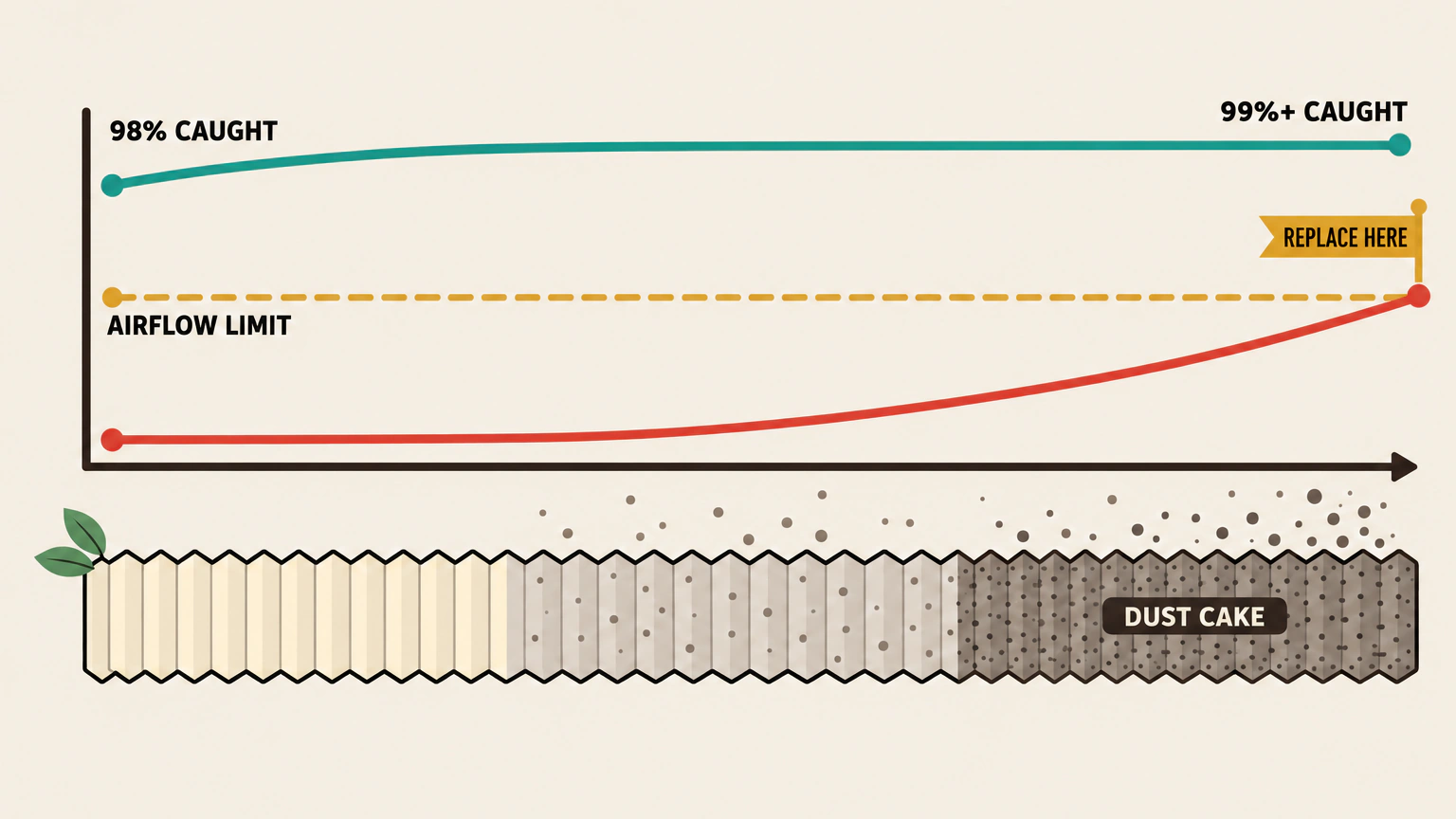
Oak Ridge National Laboratory tested clogged filters for the Energy Department. Its report says engine air filters "are designed to actually increase their efficiency by using this initial layer of dust as an added filter layer." A new filter catches about 98 percent of the dirt, the report says, and more than 99 percent by the end of its service life.
The same report explains why so many filters get changed early. Over-servicing is "very common," it says, because people don't understand how a filter reaches its best efficiency. "It is common, however, for servicing to occur when the filter appears dirty." And changing a filter before its useful life is up "can result in premature engine wear," because the fresh one starts over at its least efficient.
So the gray layer the technician shows you is, for a while, doing the filtering.
Gray is working. Torn is done.
A dirty filter can still need replacing. The end of its life is just measured another way.
What carmakers tell technicians to look for
The carmakers' own books set the inspection rules, and they don't line up. Toyota's 2026 Corolla guide says to "check for damage, excessive wear and oiliness, and replace if necessary." Chevrolet's 2025 Equinox manual says to tap and shake out loose dirt, then "Inspect the filter for damage, and replace if damaged," and never to clean it with water or compressed air. Hyundai's 2026 Tucson manual lets you clean it with compressed air for inspection, then says, "If soiled, replace the air cleaner filter."
So one carmaker replaces for damage and another for dirt. We won't pick the convenient one. Your manual decides.
Engineers go by something stricter: pressure drop, or how much harder the engine has to pull to draw air through the filter. The lab's report gives the common engineering definition. A filter's life ends when its pressure drop reaches about 2.5 kPa (10 inches of water) more than a clean filter's. Some trucks carry a restriction indicator that measures airflow restriction, and the lab tested factory units from a Chevrolet Silverado and from diesel Dodge Ram pickups.
Without a restriction test, your carmaker's interval or dash reading is the best stand-in. Damage or a failed inspection under your manual's rules is a reason to replace early.
The gas mileage pitch, and what the Energy Department found
One national quick-lube chain's service page still warns that a dirty filter can cost you up to 10 percent in gas mileage. On a modern car, the Energy Department disagrees. Its fueleconomy.gov site says replacing a clogged filter on "fuel-injected, computer-controlled gasoline engines," which covers cars from the early 1980s on, or on diesel engines "does not improve fuel economy, but it can improve acceleration."
The lab test behind that line used three fuel-injected cars: a 2003 Toyota Camry, a 2007 Buick Lucerne and a 2006 Dodge Charger. Clogged filters had "no significant effect on the fuel economy," because each engine's computer kept the air and fuel mix where it belonged. But the cars took 6 to 12 percent longer to go from 20 to 80 mph at full throttle.
Only the old carbureted car, a 1972 Pontiac, lost mileage. A new filter improved it by 2 to 6 percent over a typically clogged one, and by up to 14 percent over one so clogged the car was hard to drive.
A clogged filter costs you power when you merge, not money at the pump. That's still a reason to replace it on schedule. It just isn't the reason you were given.
When sooner really is the right call
Dust is the one condition every carmaker plans for. Honda's 2025 CR-V schedule says to replace the filter every 15,000 miles in dusty conditions. Toyota adds an inspection every 5,000 miles or six months if most of your driving is on dirt or dusty roads. Hyundai says to replace it more often on "rough, dusty, muddy, unpaved, graveled or salt-spread roads," and wherever sand or dust gets into the engine.
Damage changes the answer, too. Torn or crushed pleats, or oil soaked into the paper, means replace it now, by Toyota's own inspection standard. Never drive with the filter torn or out. Hyundai warns that driving without it "may result in excessive engine wear," and Chevrolet says dirt "can easily get into the engine." In the lab's tests, the Charger's badly clogged filter was torn out of its seat and pulled into the intake hose under hard acceleration.
If yours shows damage and you'd like a second opinion, an independent mechanic shop can take a look.
What a new engine air filter should cost
Two prices matter here: the part, and the part installed. The gap between them is where your money goes. Carfax gives the example in its engine air filter guide: a filter that costs $30 at a parts store "might be $50 or more when installed by a mechanic."
What you're paying for
| What you're paying for | Price | Where the number comes from |
|---|---|---|
| The filter itself at a parts store | $15 to $40 | Carfax's engine air filter guide |
| A shop's markup on that filter | $10 to $30 over the store price | Family Handyman |
| Extra labor when the air box is buried under parts | $25 to $50 | Family Handyman |
| What Jerry says most drivers pay at a shop | $73 to $142 | Jerry's engine air filter cost guide |
| A whole oil change, for scale | $30 to $70 conventional, $70 to $120 full synthetic | Our own planning estimates for oil change places |
Prices vary by car and region. Our oil change figures are the planning estimates on our own oil change places page, not a quote for your town.
On some cars the swap is simple. Hyundai's Tucson manual has you pull up the filter cover and pull down a lever to release it. The 2025 Equinox's 1.5-liter engine has five screws on the air box lid. Family Handyman notes that some housings sit under hoses, brackets or engine covers, or need a sensor unplugged, and that's why shops charge labor for it.
Use the filter your manual specifies or an equivalent, since Hyundai warns that non-genuine parts "may damage the air flow sensor." The warranty worry has a short answer, too. Federal law bars a carmaker from tying coverage to a branded part or service it doesn't hand you free, so doing it yourself won't void your warranty. Keep the receipt with the mileage on it.
For scale, our own planning estimates for oil change places near you put a conventional oil change at $30 to $70. At Jerry's $73 to $142, the installed filter can cost more than the oil change it rides along with, and it shares the bill with the shop supplies fee, another small line worth questioning.
What to do when the shop shows you a dirty filter
Being shown your filter isn't a red flag. Checking it is routine at quick lubes like Valvoline, which inspects it in its 18-point check with every full-service oil change, and Take 5, which says it will "check your air filters and wipers and recommend replacement if needed." Ask for a picture of your filter beside a clean one for the inspection report.
The Motorist Assurance Program, the repair industry's own inspection standard, sorts recommendations into "Required" and "Suggested." A part is required when it no longer does its job, misses a design spec or is missing. It's suggested when it's near the end of its life or due under the carmaker's schedule. And "Suggested services are always optional."
Before you say yes at the counter, run through these.
- Look at your dash first. Honda code 2 and Chevrolet's replacement messages tell you when to change the filter.
- Find the mileage of your last filter change on an old receipt or the service sticker.
- Ask to see the filter from your own car, held next to a new one.
- Check for damage and follow your manual's inspection rules. Torn or crushed pleats, oil soaked into the paper or a damaged seal mean replace it now.
- Compare the miles since the last change with your carmaker's schedule.
- Ask for the price of the filter and the price of the labor as two separate numbers.
- If it's early and passes your manual's inspection rules, say no for today. A suggested service is optional.
- Write down the part number if you'd rather buy the filter and fit it yourself.
Say yes on the spot if the filter fails your manual's inspection or you're past your carmaker's interval. Dusty driving can bring that date forward. Otherwise, "not today" is a fair answer, and your manual can settle it at home. If you'd rather bring your own filter next time, ask first. Then pick a shop that works to your carmaker's schedule, and read what we promise about the shops we list before you book.
Frequently asked questions
Does a dirty engine air filter hurt gas mileage?
Not on a modern car. The Energy Department says replacing a clogged filter on fuel-injected, computer-controlled gas engines and diesels, which covers cars from the early 1980s on, doesn't improve fuel economy, though it can improve acceleration. In its lab's tests, three such cars showed no significant mileage change with clogged filters. They took 6 to 12 percent longer to go from 20 to 80 mph. Carbureted engines are the exception.
Can I change the engine air filter myself without voiding my warranty?
Yes. Federal law bars a carmaker from making your warranty depend on a branded part or service it doesn't provide free, so doing the job yourself doesn't void coverage. We cover how far that protection goes separately. Keep the receipt and note the mileage. Use the filter your manual specifies or an equivalent, because Hyundai warns a non-genuine part may damage the air flow sensor.
Is the engine air filter the same as the cabin air filter?
No. The engine filter cleans the air your engine burns, and the cabin filter cleans the air coming out of your vents. Carmakers schedule them separately. Chevrolet's 2025 Equinox manual calls for a new cabin filter every 22,500 miles or 24 months, while the engine filter waits for its own dash message. Ask which one a quote means.
How often should I change it if I drive on dirt roads?
Sooner, and your carmaker says how much. Honda's 2025 CR-V schedule says every 15,000 miles in dusty conditions. Toyota's 2026 Corolla guide adds an inspection every 5,000 miles or six months if most of your driving is on dirt or dusty roads. Hyundai's 2026 Tucson manual says to replace it more often on rough, dusty, muddy, unpaved or graveled roads.
Can I blow out a dirty air filter with compressed air and reuse it?
Follow your own manual, because carmakers disagree. Chevrolet's 2025 Equinox manual says to tap and shake out loose dirt and never to clean the filter with water or compressed air. Hyundai's 2026 Tucson manual allows compressed air to clean it for inspection, but says to replace it if it's soiled. Neither wants it washed.
Can a clogged air filter damage my engine?
Mostly it costs you power, but there are limits. In the Energy Department's lab tests, one car's badly clogged filter was torn from its seat and pulled into the intake hose under hard acceleration. Driving with no filter at all is the real danger: Hyundai warns it "may result in excessive engine wear." Toyota and Chevrolet both say to replace a damaged filter, so do it right away.