

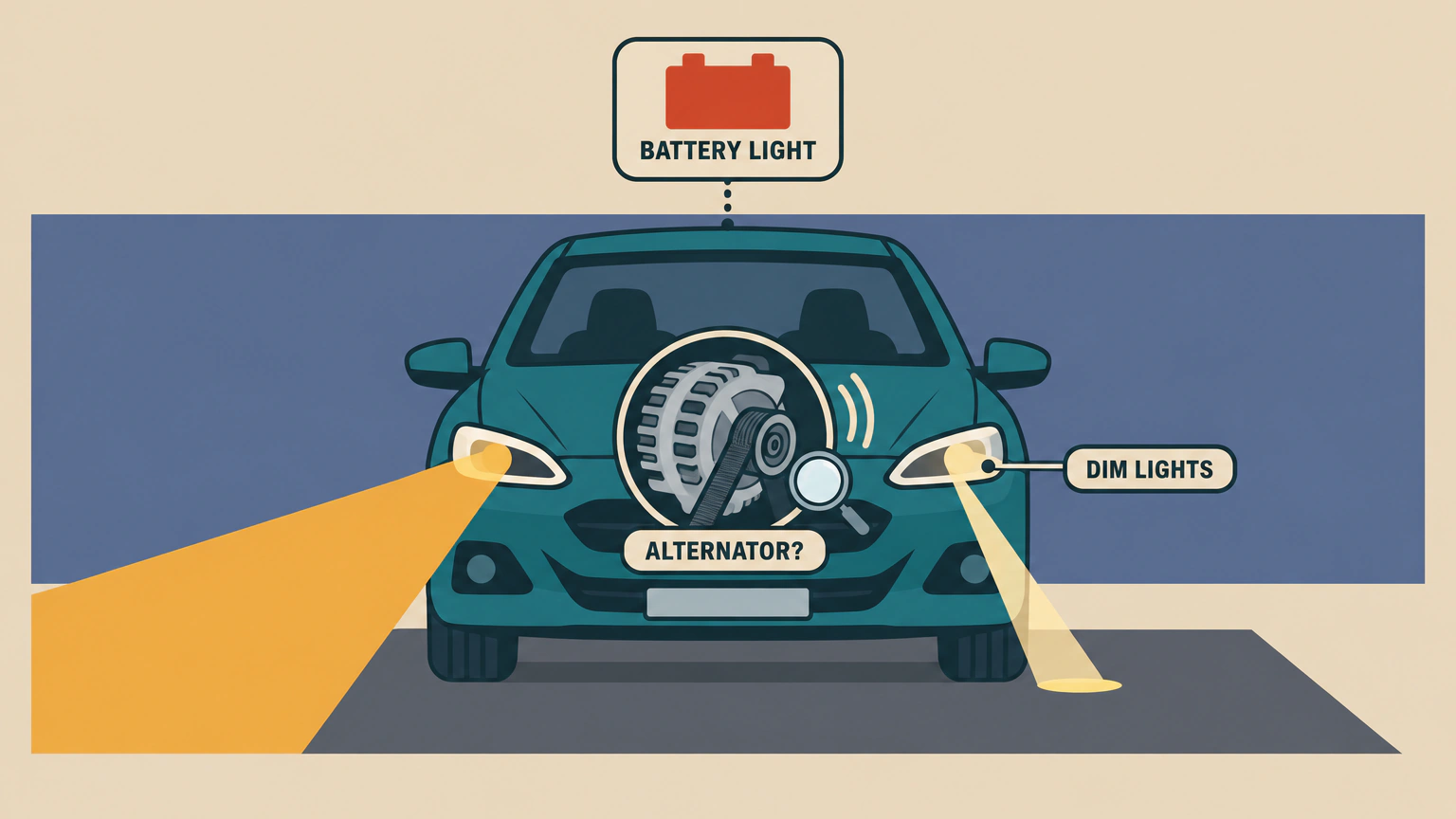
A failing alternator usually announces itself with a battery light on the dash, headlights that dim or flicker, a battery that keeps going dead, a whine from the front of the engine or a burning smell. Between them, a weak battery, a slipping belt, a loose cable or the car's own charging computer can cause every one of those signs, so have the whole charging system tested before you pay for an alternator.
On this page
- The seven signs of a bad alternator
- Is it the alternator or the battery?
- Four problems that look exactly like a bad alternator
- What a real charging system test includes
- Can you keep driving with the battery light on?
- Before you pay, check for a recall
- What it costs when it really is the alternator
- Frequently asked questions
The seven signs of a bad alternator
These bad alternator signs are all real. The alternator is a small generator, spun by a belt off the engine, that recharges the battery and powers the car once it's running. When it falters, the car lets you know. Almost every sign also has a second suspect, and that's where a wrong diagnosis starts.
| The sign | What's happening | What else causes it |
|---|---|---|
| The battery light comes on while you're driving | The car isn't being charged, or the computer thinks it isn't. If charging has stopped, the car is running on the battery. | A slipping belt, a loose cable, a blown fuse, or a lost signal between the computer and the alternator |
| Headlights dim, flicker or surge brighter | Charging voltage is sagging or jumping. Leaking diodes or a failing regulator inside the alternator do this. | A slipping belt, or a poor connection in the charging wiring |
| The battery keeps going dead | It isn't being recharged on the road, or a bad diode is draining it while the car is parked. | A worn-out battery, a drain from something left drawing power, or lots of short, slow trips with everything switched on |
| A whine, growl or grinding from the front of the engine | Worn bearings inside the alternator, or the belt rubbing the pulley. | A worn belt or tensioner, or a failing clutch in the alternator's pulley |
| A smell of burning rubber or hot wiring | The belt is slipping on a pulley, or wiring is overheating. | A loose or worn belt by itself, or a damaged cable |
| Windows, heated seats or the radio slow down or cut out | There isn't enough power to go around, so the car drops the extras first. | A weak battery, or any fault above that starves the system |
| Stalling, or a hard start | Voltage has fallen too low for the ignition, the fuel system and the computers. | A dead battery, or a starter problem |
The battery light isn't really a battery light
GM's 2025 Equinox manual is plain about it. The light comes on for a moment when you turn the key, as a bulb check, and it "should go out when the engine is started." If it stays on, or comes on while you're driving, "there may be a problem with the electrical charging system." Honda's 2020 HR-V guide says its indicator "comes on when the battery is not charging." So the light names a system, not a part.
On newer cars, a computer decides when to light it. Andrew Markel of Underhood Service, a trade magazine for mechanics, notes that if the engine computer loses its signal to the alternator, it "would turn on the battery light, but the regulator would still charge." A lit warning and a working alternator can happen together.
What the whine and the burning smell are telling you
Firestone traces a whine or growl to one of two places: the belt rubbing or riding wrong on the alternator's pulley, or worn bearings inside the alternator. A brief buzz or metallic rattle as you shut the engine off, or during a hard upshift, points at the one-way clutch in some alternator pulleys, MOTOR magazine reports. A bad diode can make noise too. (Diodes turn the alternator's output into current the battery can use.)
Your nose helps. Burning rubber usually means the belt. A hot-wire smell means an overworked alternator or a damaged cable.
Is it the alternator or the battery?
The signs of a bad alternator vs a bad battery overlap, and Firestone says as much: the two can cause some of the same symptoms. The quickest way to tell if your alternator is bad, or just the battery, is timing. The battery starts the car. The alternator keeps it going. So trouble at the key points at the battery, and trouble on the road points at charging.
A jump start sorts out a lot. If the car starts and stays running, suspect the battery. If it dies soon after the cables come off, suspect the charging system, and AAA puts "soon" at 10 to 15 minutes. Our guide to a car that won't start at all covers that test in full.
A meter helps too: AAA looks for about 12.6 volts with the engine off and 13 to 14.5 running. Learn what your meter reading means before you treat either as a verdict, because a newer car can read low on purpose. A battery that only dies overnight points elsewhere: a leaking diode, or something left drawing power.
One rule beats the rest. The battery gets tested and charged first. Isuzu's December 2024 bulletin to its truck dealers is blunt: "Never replace an alternator before testing the battery's condition."
Four problems that look exactly like a bad alternator
Nobody selling you an alternator has a reason to tell you how often bad alternator symptoms come from somewhere else. In 2008, Underhood Service wrote that "every alternator supplier we've ever talked to" agrees: "Most of the alternators that are returned under warranty have nothing whatsoever wrong with them." It blamed bad wiring connections, bad battery cables, a bad battery or a bad computer instead.
Isuzu told its truck dealers in December 2024: "Many of the alternator cores returned by dealers have been determined to have No Trouble Found after testing." Volkswagen's bulletin for most of its 2012 to 2024 models says, "Only replace the generator if the GFF Test plan fails for this component." GFF is its guided fault-finding routine, run on the dealer's scan tool. And Albin Moore, a technician writing for tool maker Clore Automotive, has seen a generator "replaced once, twice, or even three times" with the same symptoms each time.
That's one old trade article, one truck maker and one carmaker, and we couldn't find a published rate to set beside them. All of it points the same way.
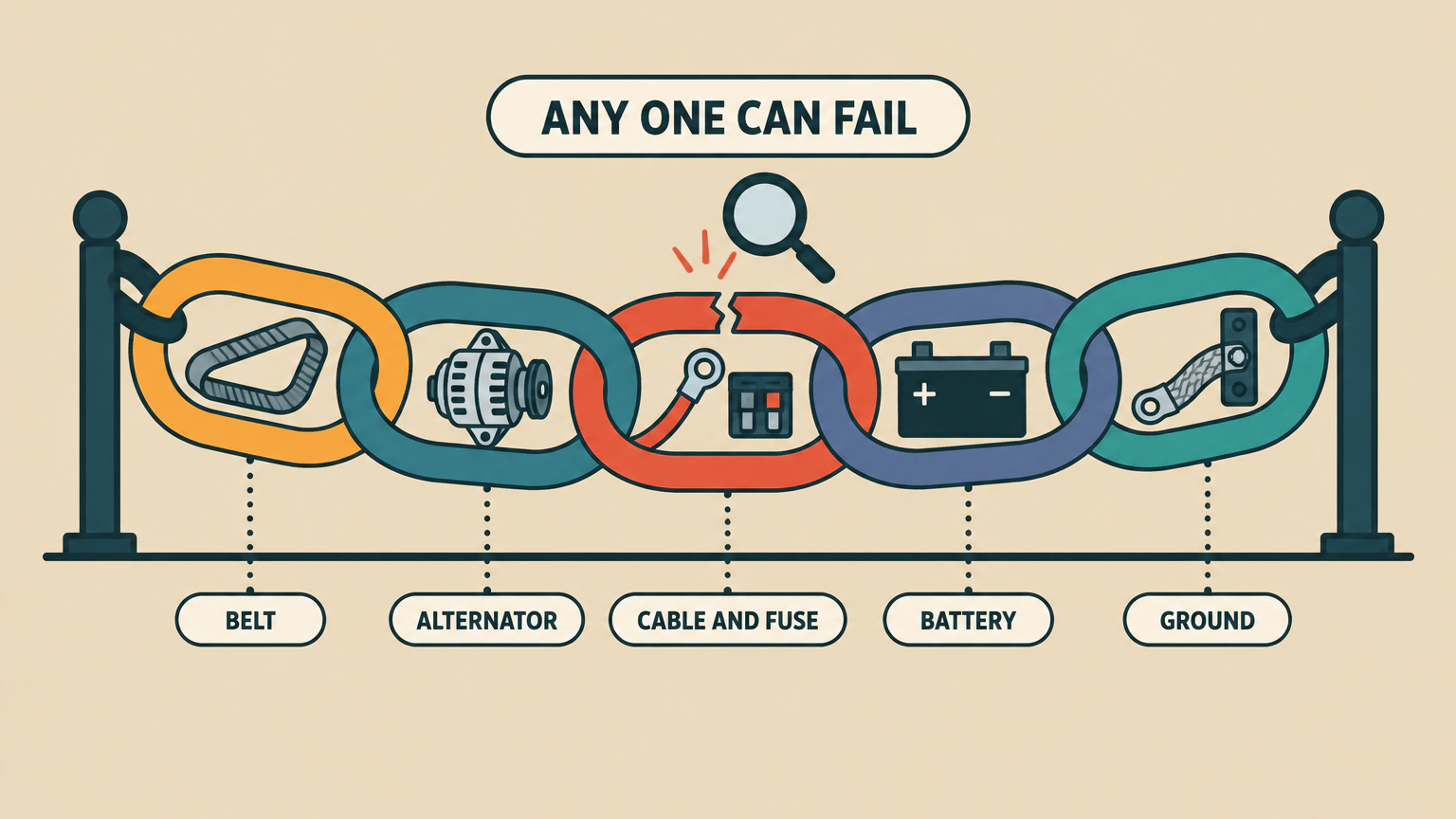
A battery that can't take a charge
DENSO, which builds alternators for carmakers, explains the chain reaction. An alternator "forced to charge a discharged battery" runs at its maximum rate for long stretches, overheats, and can burn out its diodes and windings. Its advice: "check the battery carefully and replace if necessary." A battery with a bad cell does harm too, Underhood Service notes, because the alternator overcharges the cells that are left. OPTIMA says a deeply drained battery belongs on a battery charger, "not the vehicle's charging system."
That makes a jump and a long drive hard on an alternator, and a new one bolted to a bad battery can fail the same way. BBB Industries' 2020 warranty sheet for its Remy alternators calls the warranty "void if the unit is improperly installed or damaged because of misdiagnosis of the vehicle's electrical system." Have a battery shop test the battery first. If it fails, here's what a new battery costs.
A belt, tensioner or pulley that slips
The alternator only turns when the belt turns it. DENSO says a belt that's too loose "will slip around the pulley and cause the alternator to charge irregularly or not at all," and one that's too tight wears out the bearings early. Moore's first basic check looks for slip from "a worn drive belt, pulley, or a slipping one way generator clutch."
That clutch matters. Many late-model cars use a decoupler pulley that lets the alternator freewheel when the belt suddenly slows, and Underhood Service warns that "these pulleys have a limited lifespan." One that freewheels all the time leaves "a dead-battery/no-charge condition with no obvious causes," MOTOR says, and on a high-mileage unit the most cost-effective fix is usually a new alternator.
Carmakers differ. Kia's 2016 bulletin for the 2014 to 2016 Forte cured an idle vibration with a new alternator pulley, not a new alternator. Nissan's for the 2020 and 2021 Sentra swaps the tensioner, the alternator and the belt together once the noise is traced to the alternator. DENSO recommends a new belt with every new alternator. So a belt on an alternator estimate isn't padding.
A loose cable, a bad ground or a blown fuse
Markel's verdict: "Many so-called alternator problems turn out to be nothing more than a bad connection at the alternator or a bad wiring harness." A ground is the return path, the strap or cable tying the engine and body back to the battery's negative post.
The check is called voltage drop. A tech measures across each joint with the engine running, and Underhood Service and DENSO both draw the line at 0.2 volts. Shops look at the battery cable ends, the alternator's output cable and the engine ground strap. Most charging systems also have a fuse or fusible link (a short wire built to burn through like a fuse) between the alternator and the battery. If it's open, Moore writes, "the generator will never charge."
Two recalls make the point. GM's 2019 and 2020 Silverado and Sierra had excess glue on a cable ring at the alternator, and Kia's 2023 Sportage had a terminal nut that could loosen. Both fixes target the connection, with new parts only where GM finds arcing damage. Tracing faults like these is daily work for an auto electrical specialist.
A computer that turned the charging down on purpose
On many newer cars, the engine computer runs the alternator. Markel again: "For some, it's normal to see as high as 16 volts for long periods at a time. For others, it's normal to see as low as 13 volts." Some even stop charging for a while, by design. His answer to the old driveway rule is worth quoting whole: "If only battery voltage is present at the battery on a running engine, does this mean the alternator is 'bad?' No, it does not."
Audi's 2023 bulletin for its 48-volt mild-hybrid models goes further. Expecting full voltage "any time the vehicle is running" is, Audi says, "no longer viable." And gear wired straight to the battery posts can make the battery misreport its charge, Markel adds, sometimes lighting the warning lamp. Our battery voltage guide covers GM's fuel-saving charging mode.
What a real charging system test includes
A proper alternator test is more than one voltage reading. Anyone charging you for a diagnosis should run all six checks. Take the list to an independent mechanic or a dealer and ask them to confirm each step. A shop that does the work won't mind. Here's what a diagnostic fee buys.
- The battery is tested and fully charged before anyone judges the alternator.
- The belt, the tensioner and the alternator pulley are checked for slipping, glazing and noise.
- Output is measured in amps as well as volts, with the headlights and blower on and the engine held around 2,000 rpm.
- The meter is switched to AC at the battery to catch leaking diodes.
- Voltage drop is measured across the battery cables, the alternator's output cable and the engine ground. More than 0.2 volts at any connection is a problem.
- On a computer-controlled system, a scan tool reads the stored codes and what the computer is asking the alternator to do.
What a free parts store test can and can't tell you
Take the free test. O'Reilly advertises free starter and alternator testing "on or off the vehicle," with bench-top testers for a part you've already pulled. AutoZone promises "a free, fast, and accurate alternator test." A failed result is real evidence.
The limit is in AutoZone's own words. If the reading is low or jumping around, the alternator "will need to be removed and bench tested" to learn whether "the fault is in the alternator, or the wiring circuit between the alternator and battery." A bench test judges the part by itself. If it passes, the problem is still somewhere in the car. On computer-controlled systems, Markel's line, quoted by Clore, is short: "Testing now requires a scan tool." And one more thing: the store running the free test also sells alternators.
Red flag: the pulled-cable test. If anyone offers to check your alternator by pulling a battery cable off with the engine running, say no. DENSO, which calls itself the world's largest original-equipment maker of starters and alternators, warns the diodes "can also be damaged severely if the battery is disconnected while the engine is running or during a jump start." A voltmeter answers the same question safely.
Can you keep driving with the battery light on?
For a short way, carefully. GM's Equinox manual warns, "Driving while this light is on could drain the battery." If a short distance must be driven, it says to "turn off all accessories, such as the radio and air conditioner," and then: "Find a safe place to stop the vehicle." Honda tells HR-V drivers to switch off the climate control and rear defogger "in order to reduce electricity consumption."
Push it and the battery runs down. Once its voltage falls far enough, Underhood Service says, the ignition and fuel systems can quit and the engine can stall. Firestone adds that it may not restart. Many cars cut the radio and other extras before the headlights, so losing those is a warning, not a fix.
Our call: a short hop to a shop or a safe spot, not a commute. Don't shut the engine off until you're there, because a drained battery may not crank it again.
We can't see your car from here, and a symptom list isn't a diagnosis. If it's stalling, stop driving it and get it tested.
How long the battery alone will carry you
There's a real number here. Battery maker East Penn defines reserve capacity as the minutes "a new, fully charged battery will deliver 25 amperes at 27°C (80°F)." The rating, it says, "represents the time the battery will continue to operate essential accessories if the alternator or generator of a vehicle fails."
That's your exact situation. OPTIMA's examples give the scale: 66 minutes for its small D51 battery and 140 for its large D27F. Makers list the figure as reserve capacity, or RC, beside cold cranking amps.
The catch is that those figures describe a new, full, warm battery at a steady 25-amp draw. Yours is older, it may be cold, and a failing alternator has probably been draining it for days. Treat the rating as a ceiling and expect well under it. AAA's marker after a jump is a stall within 10 to 15 minutes.
If the math doesn't work, call a tow, and check what a tow should cost first.
Before you pay, check for a recall
NHTSA's recall file holds about 140 campaigns that mention an alternator, more than 70 of them since 2010, across cars, trucks, motorcycles and motorhomes. Recall repairs are free. Run your 17-character VIN (lower left of the windshield, or your registration card) at nhtsa.gov/recalls, or search by license plate. The VIN check, not the model year, decides whether your car is covered.
Six of those campaigns show the range: two of the fixes are a cleaned connection and a tightened nut, and one is a leaking gasket. Hyundai's service campaign for the same kind of leak on some 2007 to 2009 Santa Fe models is even more direct. If the alternator still tests above 14.0 volts, dealers fix any oil leak, and the instruction reads: "Do not replace the alternator."
| Recall | Vehicles | What's wrong, and the free fix |
|---|---|---|
| 14V-634 (2014) | 2011 to 2014 Chrysler 300, Dodge Charger, Challenger and Durango, and 2012 to 2014 Jeep Grand Cherokee, with a 3.6L engine and a 160-amp alternator | The alternator "may suddenly fail" and the car can stall. Dealers replace the alternator. |
| 17V-435 (2017) | The same models with a 5.7L or 3.6L engine, electro-hydraulic power steering and a 160, 180 or 220-amp alternator | Sudden failure, with a stall or fire risk. Dealers inspect the alternator and replace it if its part number calls for it. |
| 16V-739 (2016) | 2011 to 2014 Dodge Charger Police, 2007 to 2013 Ram 3500 Cab Chassis, 2008 to 2013 Ram 4500 and 5500 Cab Chassis, and 2013 Ram 2500 and 3500, with a 220-amp alternator | Sudden failure, with a stall or fire risk. Dealers fit a revised alternator. |
| 19V-888 (2019) | 2019 and 2020 Chevrolet Silverado 1500 and GMC Sierra 1500 | Excess glue on the battery cable's ring makes a poor connection at the alternator. Dealers clean and reattach it. |
| 22V-651 (2022) | 2023 Kia Sportage | The nut on the alternator's battery terminal can loosen. Dealers inspect and tighten it. |
| 20V-705 (2020) | 2007 to 2012 Hyundai Veracruz | Oil can leak from a valve cover gasket onto the alternator and stop it charging. Dealers inspect and repair the gasket. |
If the recall comes after you've already paid
Federal rules cover this. The carmaker's recall has to include a plan to pay back owners who had the problem fixed before the recall. The window must open no later than a year before the carmaker told NHTSA, or the day NHTSA opened an engineering analysis if that came first. It must stay open until at least 10 days after the last owner letters go out.
You'll need a receipt showing the repair dealt with the recalled problem. The plan can refuse a repair the warranty would have covered free at the time, unless a dealer turned you down or the warranty repair didn't fix it. The carmaker has 60 days to act on a claim, and NHTSA won't referee disputes. The rule stops applying if the vehicle was first sold more than 10 years before the recall notice. So keep the alternator receipt.
What it costs when it really is the alternator
RepairPal's September 2026 estimate for an alternator replacement runs $809 to $1,088 before taxes and fees: labor $196 to $288, parts $613 to $800. AAA's bracket is wider, at $500 to $2,500.
If it is the alternator, DENSO's fitting rules are simple: never a unit with lower output than the car needs, and the right pulley. After the swap, the shop should charge the battery with a charger and check the output, Underhood Service says. And a part warranty isn't a labor warranty. Remy's covers the unit itself and nothing beyond it. Here's what a repair warranty has to cover.
Get the system tested, ask for all six checks and the readings, and start with an auto electrical specialist.
Frequently asked questions
How do I know if my alternator is bad or just the battery?
Watch the timing. Battery trouble usually shows when you start the car, and charging trouble shows while it's running. If a jump gets it going and it dies again within 10 to 15 minutes, AAA says, suspect the charging system. Then get both tested, battery first, because a bad battery can take an alternator down with it.
Can a bad alternator drain a battery overnight?
Yes. A leaking diode can let current run backward through the alternator with the engine off, as Firestone explains. So can anything else left drawing power. Underhood Service's rule of thumb is that the drain should usually fall below 50 milliamps within an hour of shutoff, and a shop can measure it to find the culprit.
Can a bad battery ruin a new alternator?
Yes. DENSO says an alternator forced to charge a discharged battery runs at its maximum rate for long periods, overheats and can burn out its diodes and windings. Charge or replace the battery first. It works the other way, too: Firestone says improper charging can shorten a battery's life over time.
Can you jump-start a car with a bad alternator?
Usually it'll start, and it'll keep going only until the battery gives out. AAA's marker is a stall within 10 to 15 minutes. DENSO adds a caution: diodes can be damaged during a jump start or by reversed polarity, so get each clamp on the right post. Then go straight to a test.
How long can you drive with a bad alternator?
Only as long as the battery lasts. Its reserve capacity rating is the ceiling. East Penn defines it as the minutes a new, fully charged battery keeps essential accessories running if the alternator fails, and OPTIMA's examples run 66 to 140. Expect much less. GM's manual allows "a short distance" with the accessories off.
Do parts stores test alternators for free?
Yes. O'Reilly and AutoZone both advertise free alternator testing, and O'Reilly tests on or off the car. A bench test judges the alternator by itself, so a pass means the fault is still somewhere in the car: a cable, the belt or the computer.
What causes an alternator to go bad?
Heat and constant load, mostly. A failing battery that keeps it at full output, a poor connection, a belt that's too tight and oil leaking onto it (the reason for one Hyundai recall) all shorten its life. AutoZone puts a typical one at seven to 10 years. Firestone says alternators don't have a universal replacement schedule.